Description
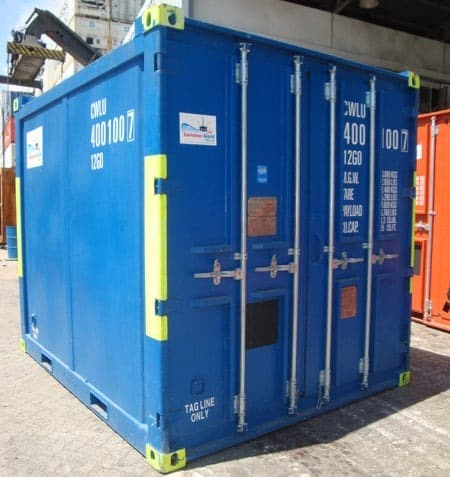
The 10ft DNV offshore container is a handling and storage unit specifically designed for offshore operations and industrial sites subject to severe conditions. Its design meets the requirements of DNV 2.7-1 and EN 12079, which govern the certification of offshore containers intended for lifting and transporting equipment to oil and gas platforms. Compact, it provides secure storage where space is limited, while withstanding intensive handling.
This container stands out for its Corten steel structure, a low-alloy steel that develops a protective oxide layer on the surface, slowing atmospheric corrosion. This property is particularly useful in marine environments, where salt air and humidity accelerate the oxidation of ordinary steels. The finish paint, generally applied in several coats, reinforces this protection. The floor is made of 28 mm marine plywood, a dense, moisture-resistant material suited to heavy loads and damp environments. The double-leaf rear doors are fitted with standard container locks, ensuring secure closure compatible with seal systems.
With external dimensions of 282 cm long, 235 cm wide and 239 cm high, this 10ft container has a compact footprint that facilitates integration on platforms, ships or restricted storage areas. Its tare weight of 1,200 kg and maximum payload of 8,960 kg allow it to carry a wide range of equipment and consumables. The 16 m³ internal volume offers substantial storage space for its size. The ISO corners, standardised to ISO 668, are positioned at all eight corners and allow lifting, securing and stacking with standard handling equipment (spreader, slings, twist-locks).
DNV 2.7-1 certification is a reference in the offshore sector. It sets out the design, manufacturing and testing requirements for containers intended to be lifted and transferred at sea. EN 12079 specifies the calculation, construction and testing requirements for offshore containers. These certifications involve load tests and periodic inspections to maintain the equipment's validity. Note that these containers must undergo regular inspections according to a defined maintenance plan, generally annual, to remain compliant.
The main use of this container is the transport and storage of equipment in offshore environments: tools, spare parts, safety equipment, samples, consumables. It can also serve as a technical room, mobile workshop or site office on isolated sites, provided the conditions of use comply with the certificate's requirements. Its robustness and watertight design make it suitable for protecting contents against water spray, sea spray and dust. However, it is not a refrigerated container or a controlled-atmosphere container: for goods sensitive to temperature or humidity, additional solutions (dehumidifiers, insulation) may be considered.
Routine maintenance consists of regularly inspecting the condition of the paint, door seals, locks and ISO corners. Deep scratches should be treated quickly to prevent corrosion. Washing with fresh water after prolonged exposure to salt is recommended. The periodic inspections required by DNV certification must be carried out by competent bodies. Replacing door seals and lubricating locking mechanisms are part of basic maintenance operations.
When buying an offshore container, several points deserve attention. The validity and traceability of DNV 2.7-1 and EN 12079 certificates should be checked, as well as test reports and maintenance history. The structural condition (deformations, corrosion, welds) must be examined, particularly at the corners and lifting points. The conformity of the marking (certification plate, identification number) is also essential. Finally, the container must be suited to the intended use: load capacity, internal dimensions, floor type, presence of specific equipment (lighting, ventilation, insulation).
In France, the transport of shipping containers is subject to road freight regulations, particularly regarding maximum authorised weights and dimensions (4.00 m height, 2.55 m width, 16.50 m length for a road train, and 44 tonnes GVW for international transport). The 10ft container, with its reduced dimensions, can be transported on a container truck or a suitable trailer. For lifting operations, the use of certified machinery and compliant slings is mandatory. Offshore containers are often handled by cranes equipped with specific spreaders. Consulting a transport professional to organise delivery in full compliance is recommended.
This 10ft DNV offshore container is offered new, with a Corten steel structure and a 28 mm marine plywood floor. It is delivered with its certificates. For any technical question or to study a specific configuration, our team is available to assist you.
To extend the service life of this offshore container, structured preventive maintenance is essential. Beyond the annual certification checks, it is advisable to set up a quarterly inspection plan adapted to the intensity of use. This plan can include a visual check of critical welds, particularly those of the ISO corners and lifting reinforcements, verification of the tightening torque of hinge and lock bolts, and examination of contact points between the floor and walls. In offshore environments, containers are frequently exposed to sea spray and saline atmospheres; rinsing with fresh water under moderate pressure, followed by natural drying, removes salt deposits that accelerate corrosion. Water retention areas, such as roof edges and hollow sections, must be inspected to avoid accumulation. If paint chips appear, localised treatment with an anti-corrosion paint suited to the marine environment is recommended. Door seals, generally made of EPDM or neoprene, must be checked for cracks, hardening or deformation; replacing them is a simple operation that preserves water and dust tightness. Lubricating locking mechanisms with seawater-resistant grease is part of routine maintenance. Finally, it is prudent to keep a maintenance log documenting each intervention, which facilitates certification audits and any resale of the container.
The regulations applicable to transporting this type of container in France should be clarified. On the road, a 10ft offshore container can be carried on a container vehicle or a flatbed trailer. The container's overall dimensions (282 x 235 x 239 cm) remain below the limits authorised for standard road transport, avoiding the need for exceptional convoys in most cases. However, the total rolling weight and load distribution must comply with the highway code and safety rules. Maritime transport of this container, when carried out as heavy cargo, falls under International Maritime Organization (IMO) requirements and may require a dangerous goods declaration if the contents justify it. For lifting, slings and accessories must comply with current standards and be suited to the maximum load. DNV-certified offshore containers are designed to be lifted with four-leg slings or dedicated spreaders; the sling angle and the presence of approved shackles are essential control points. Finally, securing on a ship or platform must be carried out according to best practice, using ISO corners and twist-locks or certified securing systems.
This 10ft container has applications in several sectors. In the oil and gas industry, it is used to transport spare parts, drilling tools, safety equipment and consumables to platforms. In the offshore wind sector, it can be used to deliver electronic components, measuring instruments or maintenance kits to offshore wind farms. Maritime service companies use it to store diving equipment, survival gear or spare parts on board support vessels. In scientific research, it can serve as a mobile laboratory or storage room for samples and sensitive equipment. In shipyards and ports, it provides secure storage for tools and handling equipment. Finally, for construction projects in coastal or island areas, it can be used as a site office, workshop or technical room, subject to compliance with usage requirements.
Compared with other container sizes, the 10ft format offers specific advantages. A standard 20ft container offers an internal volume of around 33 m³ and a higher payload, but it is bulkier and heavier, which can complicate handling on cramped sites or with limited lifting capacity. The 10ft container, with its 16 m³, is an interesting compromise between compactness and storage capacity. It can be stacked and transported more easily, and its reduced tare weight (1,200 kg) allows it to be moved with lower-capacity lifting equipment. Compared with a 40ft container, it is far more manoeuvrable and can be positioned in tight spaces. Compared with other container types, the standard dry container is not certified for offshore lifting and does not meet DNV 2.7-1 or EN 12079 requirements. The open top container, without a rigid roof, facilitates loading of out-of-gauge cargo but offers less protection against the weather. The flat rack, without side walls, is suited to heavy and bulky loads but does not protect the contents. The reefer container, finally, is designed for transporting perishable goods and incorporates a refrigeration unit, making it more complex and costly to operate. The 10ft offshore container therefore positions itself as a specialised solution for maritime environments and intensive lifting operations, where certification and robustness take priority over internal volume.
When preparing an offshore container for a mission, it is advisable to check the status of certificates and ensure the next inspection date has not passed. A container with expired certification must not be used for offshore lifting operations. It is also advisable to check that the doors work properly, that seals are present, and that there are no foreign bodies in the ISO corners. Before loading, a visual inspection of the interior reveals any traces of moisture, rust or floor degradation. For sensitive loads, adding internal lashing straps or dunnage is recommended to prevent movement during transport. Finally, closure must be secured with a seal whose number is recorded, in line with good logistics practice.
In terms of safety, using this container requires compliance with strict rules. Lifting must be carried out by qualified personnel, using accessories inspected periodically. No work should be carried out under a suspended load. Offshore containers must not be used as permanent accommodation without specific fit-out (insulation, ventilation, lighting, emergency exits). If the container is converted into a workspace, applicable health and safety rules must be followed, particularly regarding ventilation and protection against electrical hazards. The use of personal protective equipment is recommended during handling and maintenance operations.
Choosing a new 10ft offshore container provides a sound structure, with no fatigue history, and valid certificates from delivery. This simplifies administrative procedures and guarantees an optimal service life, subject to regular maintenance. For companies seeking a durable solution compliant with industry requirements, this model represents a relevant investment. Its price of €1,580.00 excl. VAT should be considered in light of its certification and robustness. For any quote request, transport or specific fit-out, our team based in Marseille is at your disposal.