Description
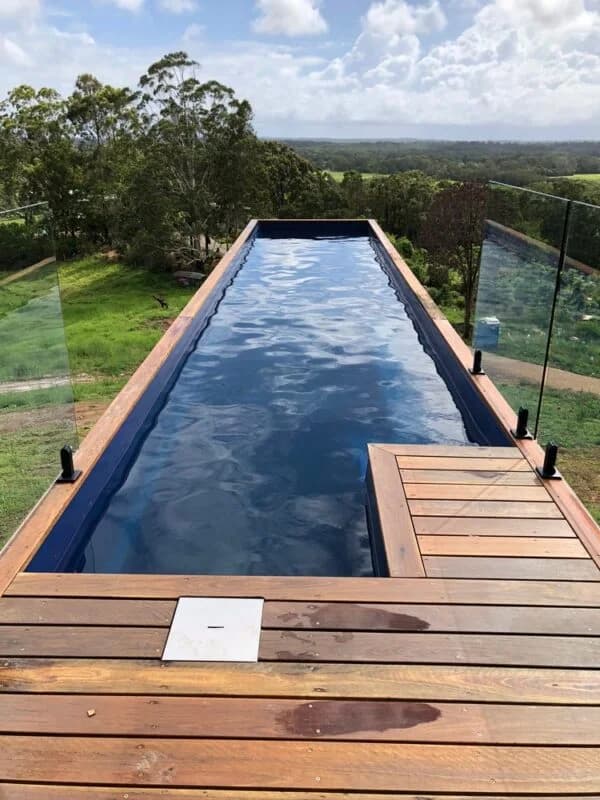
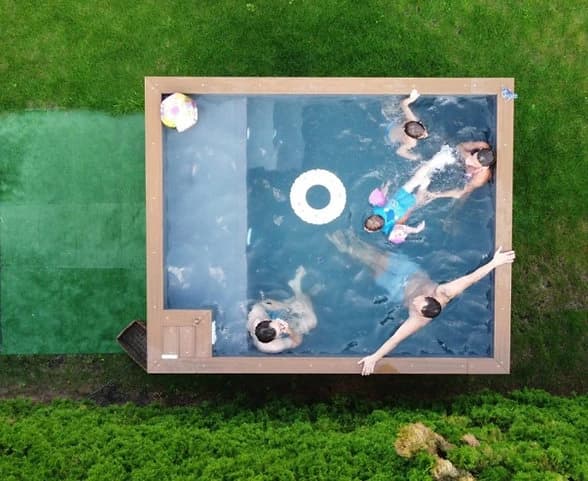
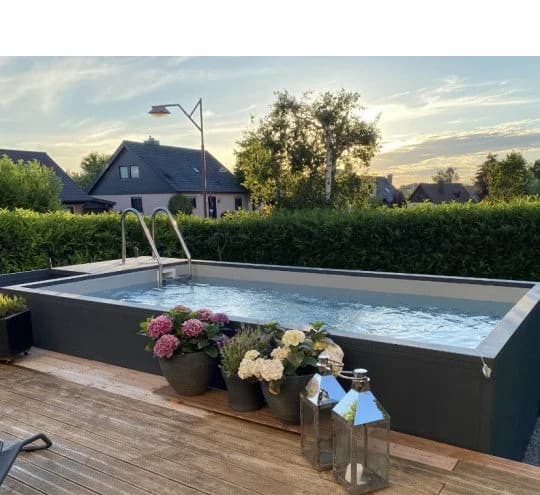
The Pool Expert stainless steel pool 3x6x1.34 m is an overflow pool designed to offer a durable and aesthetic solution. With its dimensions of 6 meters in length, 3 meters in width and 1.34 meters in depth, it defines a water surface of 18 m² and a volume of 24 m³. Its one-piece stainless steel structure ensures corrosion resistance and superior longevity compared to many traditional materials. This model stands out for its compact and refined design, with minimalist lines that fit just as well into a contemporary garden as into a more classic environment. The single depth of 1.34 m makes it a pool suitable for swimming and family games, without requiring a deep pit for diving. The integrated stairs and bench facilitate access to the water and provide an submerged rest area, an asset for people wishing to relax partially in the water. The high-quality stainless steel finish provides lasting shine and a smooth appearance, while the powerful LED lighting, dimmable in 11 colors (RGB) or white, creates a customizable ambiance. This lighting system is also energy-efficient: RGB modules consume 45 W for a flux of 1700 lm, and white modules 30 W for 2350 lm, with a diameter of 100 mm. The pool is delivered ready to be installed: the embedded parts and the technical pit are pre-plumbed and labeled, which simplifies assembly. The technical pit components are partially disassembled and protected for transport. The set includes working plans for excavation, the base plate, piping and embedded parts. Telephone support is provided, as well as on-site support: upon delivery, an employee is present to unload and place the pool in the pit, and instructions on structural work are provided. This model is manufactured in the European Union, guaranteeing compliance with quality and safety standards.
To choose your stainless steel pool well, it is essential to understand the specificities of this material. The stainless steel used in pool manufacturing is generally type 304 or 316L, with a chromium and nickel content that gives it excellent corrosion resistance, particularly in humid environments and in the presence of chlorine or salt. Unlike concrete or composite panel pools, a stainless steel pool is one-piece or assembled by welding, which limits the risk of cracks and leaks. It is also lighter than a concrete pool, which facilitates its handling and installation, especially when access to the site is constrained. The smooth surface of stainless steel limits the adhesion of algae and bacteria, thus reducing the need for chemicals and maintenance. In addition, stainless steel reflects light, which gives the water a clear and luminous hue without the need for colored liner.
The installation of a 3x6 m stainless steel pool requires careful preparation. The first step is to carry out an excavation of suitable dimensions, providing a bed of sand or compacted gravel to receive the base plate. The bottom of the excavation must be perfectly level to avoid any stress on the structure. The pool is then lowered into the pit using lifting equipment, then positioned precisely. Hydraulic and electrical connections are made according to the provided plans. The technical pit, which groups the filtration, pump and equipment, must be accessible for maintenance. It is recommended to provide a manhole or technical room in the immediate vicinity. The integrated stairs and bench are already fixed to the structure, which simplifies installation. Once in place, the pool can be backfilled gradually, taking care not to deform the walls. A leak test is essential before final filling.
Maintaining a stainless steel pool is relatively simple. The pH of the water should be checked regularly (ideally between 7.2 and 7.6) and the chlorine level (between 1 and 2 mg/L for a private pool). A shock treatment may be necessary after heavy use or a storm. Filtration must operate daily, with a filtration time adapted to the pool volume (generally 8 to 12 hours per day in summer). The prefilter baskets and the main filter must be cleaned regularly. The stainless steel surface can be cleaned with a soft cloth and a non-abrasive product; metal sponges that could scratch the surface should be avoided. Once a year, it is advisable to check the condition of the welds and seals, as well as the tightness of the embedded parts. In winter, if the pool is not used, active or passive winterization is recommended: lower the water level, add a winterizing product and cover the pool.
French regulations govern the installation and use of private pools. Any inground or semi-inground pool whose basin is likely to receive bathers must be equipped with a standardized safety device: protective barrier, alarm, cover or shelter. These devices must comply with standards NF P90-306, NF P90-307, NF P90-308 or NF P90-309. In addition, a prior declaration of works at the town hall is necessary for any pool whose basin surface exceeds 10 m². If the pool is equipped with a heating system or lighting, particular attention must be paid to electrical standards (NF C 15-100) and grounding. Connection to the water and sanitation network must comply with local rules. Finally, it is important to check local urban planning rules (PLU) concerning location, setback distances and fences.
When purchasing a stainless steel pool, several points of vigilance deserve your attention. Check the quality of the steel: 316L stainless steel is recommended for corrosive environments (seaside, saltwater pool). Check the thickness of the walls and the quality of the welds, which must be continuous and without porosity. Ensure that the filtration system is sized according to the water volume (24 m³) and the desired turnover rate. The pump must be adapted to the pressure loss of the circuit. The LED lighting system must be compatible with installation in a humid environment (IP68 protection rating for underwater projectors). Ask for the conformity certificates of the electrical components. Finally, find out about the delivery and installation conditions: the presence of an employee for unloading and setting up is an asset, but you must verify that access to the site allows the passage of a truck and lifting equipment.
This stainless steel pool model finds its place in many projects: primary residence, second home, gîte, hotel, campsite, or even wellness area. Its modular design and EU manufacturing make it a reliable solution for professionals and individuals alike. Thanks to its constant depth of 1.34 m, it is suitable for occasional swimmers and families with children, under supervision. The integrated stairs and bench offer relaxation areas. The overflow, optional or integrated depending on the configuration, adds an aesthetic dimension and a mirror effect.
In summary, the Pool Expert stainless steel pool 3x6x1.34 m combines robustness, design and ease of installation. Its volume of 24 m³ and its surface of 18 m² make it a generous pool for private use. The factory preparation of connections and the supply of excavation plans reduce the risk of error on site. Dimmable LED lighting brings a touch of comfort and customization. To guarantee a long service life, regular maintenance and compliance with safety standards are essential. Before finalizing your purchase, validate the technical aspects with a professional and ensure that your land and your budget allow for a proper installation.
Let us now delve deeper into aspects related to water treatment and pool chemistry, because a 24 m³ stainless steel pool reacts like any pool to balanced water. The pH must be maintained between 7.2 and 7.6: below, the water becomes aggressive for stainless steel and can attack the protective passive layer; above, chlorine loses its effectiveness and calcium deposits can form on the walls. The free chlorine level must remain between 1 and 2 mg/L, with combined chlorine less than 0.5 mg/L to avoid irritation and odors. Total alkalinity (TAC) must be between 80 and 120 mg/L to stabilize the pH, and calcium hardness (TH) between 10 and 20 °f to limit scaling. For a stainless steel pool, the use of salt is possible provided that the steel is grade 316L and the salt concentration does not exceed 5 g/L; otherwise, classic chlorine or active oxygen treatment is preferable. Salt electrolyzers generate chloramines and by-products that can accelerate corrosion of unprotected metal parts, including embedded parts and screws. It is therefore recommended to regularly rinse the stainless steel parts with fresh water and check for pitting corrosion.
Filtration is the heart of the system. For a volume of 24 m³, a pump with a flow rate of 6 to 8 m³/h is generally suitable, with a sand filter of 400 to 500 mm diameter or a large-surface cartridge filter. The daily filtration time must be at least equal to half the water temperature in degrees Celsius: for example, 14 hours if the water is at 28 °C. In summer, it is common to filter 10 to 12 hours per day, divided into two cycles to avoid stagnation. Cleaning the filter must be done by backwashing when the pressure gauge increases by 0.3 to 0.5 bar compared to the initial pressure. The pump prefilter baskets must be emptied weekly during peak season. A hydraulic or electric cleaning robot can complete the maintenance to remove debris at the bottom of the pool.
Winterizing a stainless steel pool differs slightly from winterizing a concrete pool. Stainless steel fears stagnant water loaded with chlorides, especially if the pool is left empty or partially filled without treatment. Passive winterization consists of lowering the water level below the skimmers (if present), adding a specific stainless steel winterizing product, placing floats to absorb frost and covering the pool with an opaque cover. Active winterization keeps filtration running at reduced speed and chemical treatment at low dose. In both cases, it is not advisable to completely drain the pool, because the structure could undergo mechanical stress due to ground pressure and thermal expansion. If a dry period is necessary, the walls must be supported and a professional consulted.
Let us now address the regulations relating to the transport and handling of the pool, because this type of pool is delivered in one piece or in several modules depending on the configuration. In France, exceptional transport is governed by the Highway Code and the decree of May 4, 2006 relating to exceptional transport of goods. A stainless steel pool 6 m long and 3 m wide often exceeds the dimensions allowed for a standard vehicle (2.55 m width, 16.5 m length, 4 m height). It is therefore necessary to obtain a traffic authorization from the prefecture, with a defined route and, depending on the size, an escort by a pilot vehicle. The weight of a stainless steel pool of this volume can reach several hundred kilograms, or even more than a ton depending on the steel thickness and equipment. Transport must be carried out on a flatbed truck or in a suitable container, with straps and wedges to prevent any movement. Upon delivery, unloading requires a crane or forklift with sufficient capacity. Access to the site must be checked in advance: street width, presence of overhead lines, slope, ground bearing capacity.
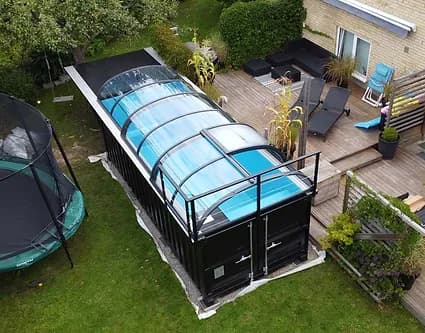
The term "pool container" deserves an explanation, because it can be confusing. It sometimes refers to a pool installed in a modified shipping container, but here it refers to a product category grouping pools designed to be transported compactly, often in a container or on a special trailer. The Pool Expert stainless steel pool 3x6x1.34 m can be shipped in a 20-foot container or on a flatbed depending on options. The standard 20-foot shipping container has internal dimensions of approximately 5.90 m long, 2.35 m wide and 2.39 m high, which is too short to contain a 6 m pool in one piece. The pool is therefore generally transported on a flatbed or in an open top or flat rack container, which allow loading from the top or side. These special containers are designed for out-of-gauge loads and are commonly used in sea and road transport.
Let us now compare this 3x6 m pool with other sizes and types available on the market. A 3x5 m pool offers a surface of 15 m² and a volume of 20 m³ for a depth of 1.34 m; it is more compact and suitable for small gardens, but limits movement in the water. A 3x7 m pool offers 21 m² and 28 m³, ideal for swimmers, but requires more space. The 3x6 m model represents a good compromise between swimming comfort and footprint. In terms of depth, a 1.34 m pool is considered a shallow pool, suitable for swimming and children, but it does not allow diving. For diving, a minimum depth of 1.80 m to 2.50 m would be required depending on safety standards. If you want a greater depth, there are models with sloped bottom or diving pit, but they are more expensive and require deeper excavation.
As for pool types, stainless steel stands out from concrete, polyester and composite panel. A concrete pool is very resistant and customizable, but its construction is long, expensive and generates waste. A polyester pool is prefabricated, light and quick to install, but it is susceptible to impacts and can discolor over time. A composite panel pool is modular and economical, but it requires a liner that must be replaced periodically. The stainless steel pool, meanwhile, offers excellent durability, impact resistance and ease of maintenance, with a higher initial cost but reduced operating cost. It is also recyclable at the end of its life, making it an ecological choice.
For tourism professionals, a 3x6 m stainless steel pool can equip a gîte, a campsite or a hotel. It offers a high-end image and low maintenance. In the health and wellness sector, it can be used for light balneotherapy sessions, thanks to its constant depth and easy access. For local authorities, it can be installed in a park or leisure center, subject to compliance with accessibility standards (ramp, water entry seat). Finally, for individuals, it adds value to the property and provides a private relaxation space.
It is important to note that the installation of a stainless steel pool may require a prior soil study, especially if the land is sloping or composed of fill. Unstable soil can cause differential settlement and damage the structure. A geotechnical engineering firm can perform bearing capacity tests and recommend suitable foundations, such as a reinforced concrete slab or strip footings. The cost of these studies varies, but it is preferable to include them in the overall budget.
In terms of warranty, stainless steel pools generally benefit from a ten-year warranty on the structure and a two-year warranty on equipment, in accordance with the Construction and Housing Code. It is advisable to check the exact conditions with the manufacturer or dealer, as they may vary. Wear parts such as seals, pump bearings and LED bulbs are not covered beyond their normal service life.
To summarize, the Pool Expert stainless steel pool 3x6x1.34 m is a technical product intended for informed buyers. Its price of €12,500 reflects the quality of the materials and the factory preparation. Before committing, compare offers, request detailed quotes including delivery, installation and additional equipment (heating, cover, robot). Find out about manufacturing and delivery times, which can vary depending on the factory load. Plan a budget for earthworks, which can represent a significant part of the total cost. Finally, ensure that your project complies with local urban planning rules and that you have the necessary authorizations.