Description
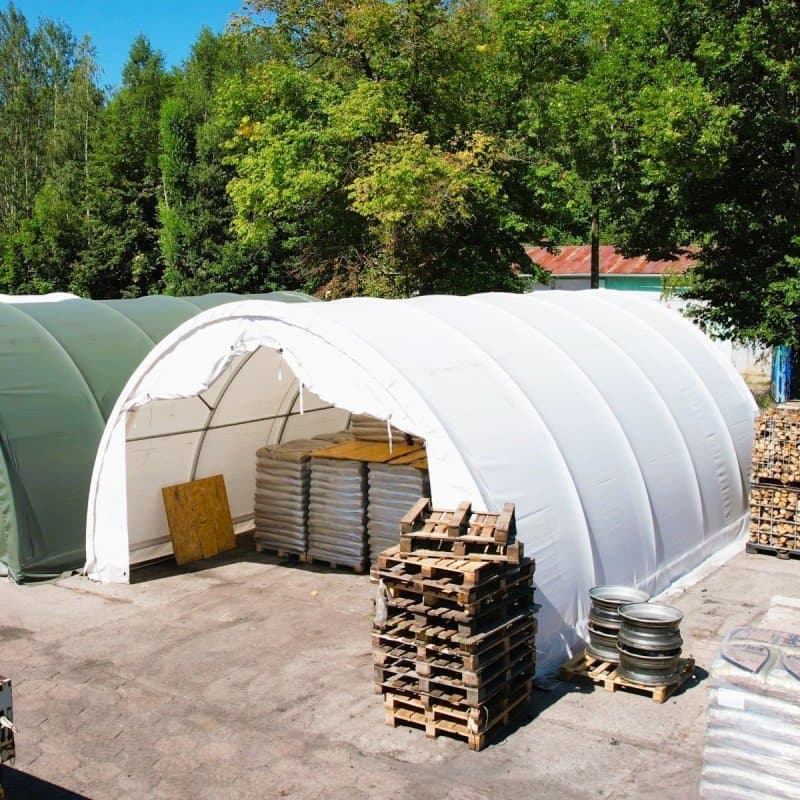
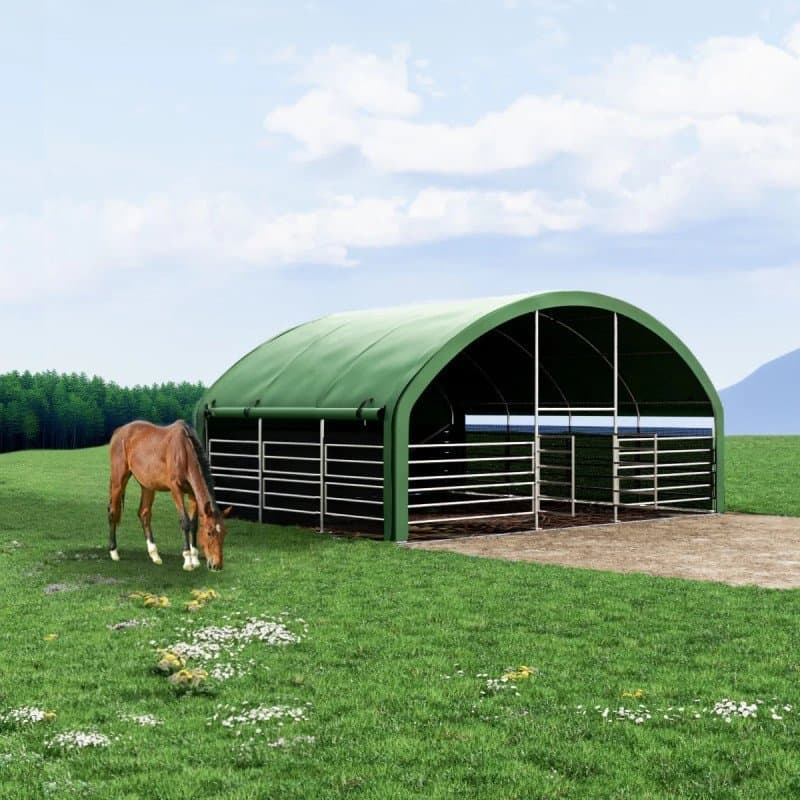
The agricultural tunnel we offer here is an arched shelter 6 meters wide by 15 meters long, designed to meet storage, animal shelter or crop protection needs. Its structure is based on galvanized steel profiles and its cover is a 900 g/m² PVC tarpaulin. This type of construction is commonly used in agriculture and industry for its ability to effectively protect against bad weather while remaining mobile and modular.
Let's start with the dimensional characteristics. The overall width is 6.10 meters and the length is 15 meters, offering a floor area of approximately 91.5 m². The height at the highest point is 3.60 meters, allowing people to stand and move around and to store large volumes. The door opening measures 4.30 m wide by 3.20 m high, making it easy to pass agricultural machinery, small tractors, trailers or pallets. Two entrance doors are provided, one at each end, allowing through-access and better natural ventilation. The arches are spaced 1.50 meters apart, ensuring good rigidity of the whole. The tubes forming the arches have a diameter of 70 x 42 mm with a thickness of 1.50 mm, and the purlins have a diameter of 40 mm with a thickness of 1.2 mm. The allowable snow load is 0.28 kPa and the maximum wind speed supported is 80 km/h. These values are indicative and depend on installation and anchoring conditions.
The 900 g/m² PVC tarpaulin is a technical fabric commonly used for this type of structure. It is generally treated against UV and mold, but the exact treatments should be verified with the manufacturer. This thickness provides good tear resistance and some opacity, protecting crops or equipment from direct radiation. The green or white color can influence the interior temperature: white reflects more light and limits overheating in summer, while green blends into the environment and may be preferred for aesthetic or regulatory reasons. The hot-dip galvanized steel structure resists corrosion and requires little maintenance. Galvanization protects the metal against rust, but deep scratches can expose the steel; it is therefore advisable to touch up damaged areas with a suitable anti-rust paint.
Installing this agricultural tunnel requires relatively flat, stabilized ground. Ground anchoring is essential to withstand winds: depending on the soil type, stakes, earth screws, concrete blocks or foundations will be used. It is important to follow the manufacturer's anchoring recommendations, as the stated wind resistance (80 km/h) assumes correct assembly and suitable anchoring. Similarly, the snow load of 0.28 kPa corresponds to a layer of fresh snow of about 2 to 3 cm; in case of heavy snowfall, it is prudent to clear accumulated snow from the cover to avoid any risk of collapse. This point is essential in regions with snowy winters.
This type of shelter has many uses. In agriculture, it can serve as a sheepfold, cowshed, poultry house, fodder shed or equipment storage. Its wide span without a central post allows easy maneuvering. It can also be used as an unheated greenhouse to protect sensitive crops, or as a covered work area for harvest preparation. In industry, it provides temporary storage space for pallets, materials or machines. Local authorities may see it as a solution for sheltering events, markets or seasonal activities. Finally, some individuals use it as a garage for a vehicle, boat or camper, or as an outdoor workshop.
Compared to a permanent building, this tunnel has several advantages. It is faster to install, does not require a building permit in most cases (subject to verification with the town hall), and can be dismantled and moved as needed. Its acquisition cost is generally lower than that of a traditional construction. However, it also has limitations: its lifespan is shorter than a masonry construction, the PVC cover must be replaced every 5 to 10 years depending on exposure and maintenance, and the structure can be damaged by violent winds or exceptional snow accumulation. It is therefore important to carefully assess local climatic constraints before choosing this type of shelter.
Routine maintenance consists of regularly checking the tension of the cover, tightening fasteners, cleaning the canvas with a gentle water jet and neutral soap, and inspecting the galvanized tubes for any signs of rust. In case of a tear, a repair with a PVC patch and suitable glue can extend the life of the cover. It is also recommended to partially or fully remove the cover in case of a storm warning to limit wind exposure. In winter, monitor snow accumulation and remove it if necessary.
From a regulatory standpoint, installing an agricultural tunnel may be subject to urban planning rules. In France, garden sheds or greenhouses under 20 m² may be exempt from building permits, but beyond that, a prior declaration or permit may be required depending on surface area, height and location. It is imperative to inquire with the town planning department before any installation. In addition, if the tunnel is used to house animals, health and animal welfare standards may apply. For professional use, the rules relating to livestock or storage buildings should be checked.
Transport and handling of this tunnel are generally done on a pallet or in dismantled packages. Weight and dimensions may vary depending on options, but assembly requires at least two people and simple tools (wrenches, screwdriver, ladder). Assembly instructions are normally provided. It is advisable to assemble the structure in calm weather and not to leave the cover unfastened in case of wind.
In summary, this 6 x 15 m agricultural tunnel is a versatile, economical and mobile solution for many storage or shelter needs. Its generous dimensions, galvanized structure and thick cover make it suitable for both professional and private use. However, climatic conditions, regulatory constraints and anchoring requirements should be carefully assessed before purchase. Regular maintenance will extend its lifespan and ensure its reliability.
Let us now take a closer look at the practical aspects of long-term care and maintenance. The PVC cover, although robust, is the part most exposed to external aggression. Ultraviolet rays, temperature variations, wind and friction against the structure eventually degrade the material. To maximize its lifespan, regular cleaning is recommended, at least twice a year, with a non-abrasive product. Organic soiling (moss, lichen, bird droppings) should be removed quickly as it can retain moisture and promote mold growth. A specific anti-mold treatment for PVC covers can be applied preventively. In case of a small tear, immediate repair with a patch and PVC glue prevents the tear from enlarging under wind. For larger tears, it may be necessary to replace a section of the cover, or even the entire cover if wear is widespread. Complete replacement of the cover is a common operation after several years of use; it is advisable to contact the manufacturer to check the availability of spare parts.
The metal structure also requires special attention. Galvanized steel is protected by a layer of zinc that sacrifices itself in case of scratches. If this layer is breached (by impact, friction or a loose fastener), corrosion can set in. It is therefore prudent to regularly check the condition of welds, bolts and junctions, and to touch up rusted areas with a zinc-rich paint. Bolts should be tightened periodically, as vibrations from wind can loosen them. A visual inspection after each major wind event is a good habit. Finally, moving parts such as doors (if equipped with hinges) should be lubricated once or twice a year.
Assembly and disassembly of this tunnel can be done by people with basic DIY skills, provided they follow the instructions carefully. It is essential to start by preparing the ground: leveling, marking axes, and possibly pouring concrete footings at anchor points. The arches are generally assembled on the ground, then raised and connected to each other by the purlins. The cover is then unrolled over the structure and secured with straps, tensioners or fixing profiles. This step is delicate because the canvas must not be torn and must be properly tensioned to avoid flapping in the wind. Complete assembly can take one to two days depending on experience and number of people. Disassembly is faster but requires the same precautions.
Let us now compare this 6 x 15 m tunnel with other dimensions and types of shelters commonly available on the market. Agricultural tunnels come in several widths: 3 m, 4 m, 5 m, 6 m, 8 m, 10 m and more. The 6 m width is a good compromise: it offers sufficient interior space for movement and storage without requiring too heavy a structure or complex foundations. Lengths also vary: 10 m, 15 m, 20 m, 30 m. The 15 m length provides about 90 m², which corresponds to a common need for small livestock or equipment storage. For larger needs, a longer tunnel can be chosen, but the structure's strength over a longer span must be verified. Indeed, the longer the tunnel, the greater the wind and snow loads, and the more the anchoring must be reinforced.
There are also tunnels with thicker profiles, offering better resistance to snow and wind. For example, some models support snow loads of 1.5 kPa or more, making them suitable for mountainous regions. The tunnel described here, with a snow load of 0.28 kPa, is more intended for areas with moderate snowfall. Similarly, the maximum wind speed of 80 km/h corresponds to a fairly strong wind (level 9 on the Beaufort scale), but not a hurricane. In coastal or exposed regions, a more robust structure or reinforced anchoring may be necessary.
Another point of comparison concerns the type of cover. The 900 g/m² PVC tarpaulin is thick and durable, but there are lighter covers (e.g., 600 g/m²) or heavier ones (1200 g/m²). The heavier the cover, the more resistant it is, but also more expensive and harder to handle. PVC is a synthetic material that can be recycled, but local recycling channels should be checked. Some tunnels use thinner agricultural plastic films, cheaper but with a shorter lifespan. Others use high-density polyethylene fabrics, lighter and less expensive, but less tear-resistant. The choice will depend on the intended use and budget.
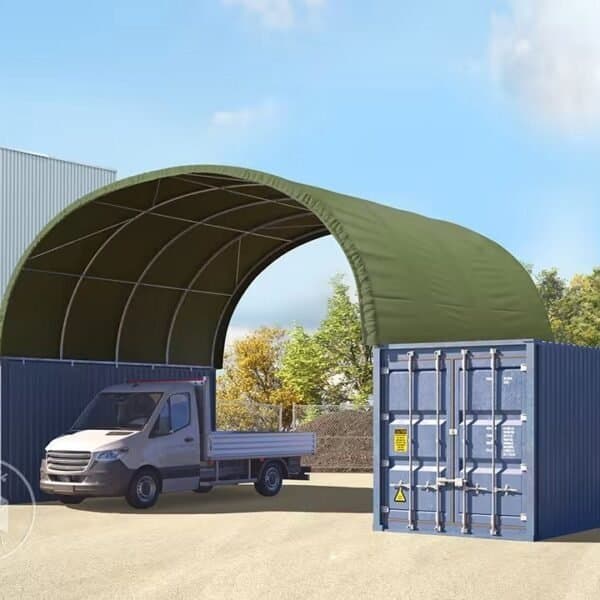
Finally, a distinction must be made between agricultural tunnels and converted shipping containers. A shipping container offers a rigid Corten steel structure, superior weather resistance and a very long lifespan. It can be fitted out as an office, workshop, secure storage room, etc. However, its acquisition and transport cost is higher, and it is less mobile than a tunnel. The agricultural tunnel is lighter, faster to install and cheaper, but less secure and with a shorter lifespan. The choice between these two solutions will depend on priorities: security, budget, mobility, durability.
Let us now address more specific sectoral use cases. In the livestock sector, this tunnel can serve as shelter for cattle, sheep, goats or poultry. For cattle, a straw litter and sufficient ventilation to avoid ammonia accumulation must be provided. The two opposite doors promote natural air circulation. For poultry, protection against predators is needed by adding perimeter fencing and ensuring the cover is not pierced. In the market gardening sector, the tunnel can be used as a greenhouse to extend the growing season, but note that the 900 g/m² PVC cover is less translucent than a standard greenhouse film, which can limit photosynthesis. It should therefore be used more for low-light crops or for storage. In the construction sector, it can serve as a material shed, prefabrication workshop or rest area for teams. In the events sector, it can be quickly assembled to shelter a marquee, stand or refreshment bar. For green waste storage or composting, it provides protection from rain and allows humidity control.
Regarding French regulations, several cases must be distinguished. If the tunnel is installed on agricultural land and used for agricultural activities, it may be considered an agricultural building and subject to prior declaration or building permit depending on its surface area. The thresholds are generally 20 m² for a prior declaration and 40 m² for a building permit, but these thresholds can vary depending on the municipality and zone (e.g., protected area). If the tunnel is installed on buildable land for non-agricultural use, the same rules apply. It is therefore essential to consult the local urban plan (PLU) of the municipality. In addition, if the tunnel is located in a protected natural or agricultural area, specific authorizations may be required. Finally, if the tunnel is used to store chemicals or hazardous materials, specific regulations apply (ICPE).
For transport, this tunnel is generally delivered as a kit, on a pallet or in packages. The total weight may vary depending on options, but it is advisable to provide a utility vehicle or truck to collect it. Delivery can be made by carrier. It is important to check the condition of packages upon receipt and report any damage to the carrier. On-site assembly requires temporary storage space for the parts.
In conclusion, this 6 x 15 m agricultural tunnel is a versatile product suitable for many uses. It combines a galvanized steel structure, a thick PVC cover and generous dimensions. Its price of 4800 euros positions it as an economical alternative to traditional buildings. However, local constraints (wind, snow, urban planning) should be carefully assessed and regular maintenance should be planned to ensure its longevity. Whether you are a farmer, craftsman, industrialist or individual, this tunnel can meet your storage or shelter needs, provided you follow the assembly and anchoring rules.