Description
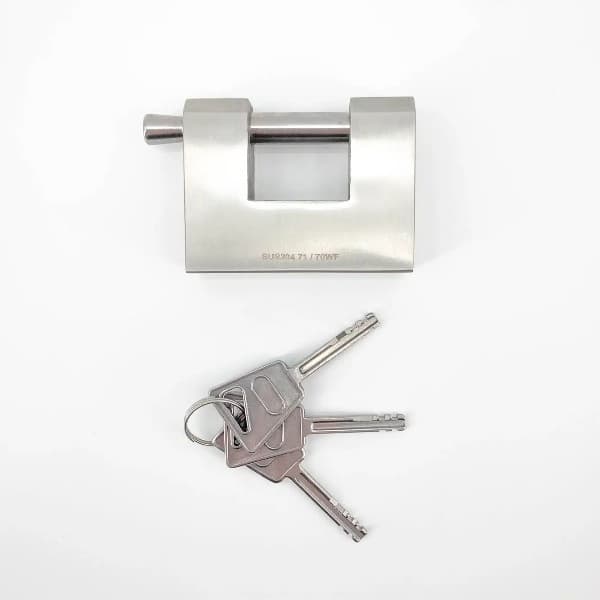
The high-security container padlock is an essential accessory for protecting your goods and equipment stored in a shipping container. Unlike standard padlocks, it is specifically designed to withstand the most common break-in attempts on ISO containers. Its hardened steel construction gives it high mechanical resistance, whether against bolt cutters, hacksaws, drilling or picking techniques. This padlock is therefore particularly recommended for containers used in outdoor storage, in transit, on construction sites or in logistics areas. It fits onto the standard locking bars of container doors, making it compatible with the vast majority of 20-foot and 40-foot shipping containers, whether dry, high cube, open top or flat rack.
When choosing a container padlock, it is not simply about closing a door: it is about deterring and delaying any break-in attempt. Containers are often left unattended on land, in car parks or in port areas. A standard padlock, even a good quality one, can be forced in minutes with portable tools. The high-security padlock, thanks to its thick shackle and massive body, offers far greater resistance. It is important to note that no padlock is tamper-proof, but the goal is to make access difficult enough to discourage an opportunistic thief or to waste a considerable amount of their time.
This padlock is made of hardened steel, a material that has undergone heat treatment to increase its hardness and toughness. Hardened steel is commonly used in security applications where wear and impact resistance is paramount. It resists corrosion thanks to a suitable surface treatment, allowing it to remain functional even when exposed to bad weather, the salt-laden humidity of coastal areas or temperature variations. This weather resistance is an important criterion for an accessory intended to remain outdoors for long periods.
The padlock is supplied with two keys. It is advisable to keep one key in a safe place and use the other daily. If lost, it is recommended to replace the padlock rather than attempt to have it opened by a locksmith, as high-security mechanisms are often difficult to manipulate without the original keys.
Installing it is simple: just pass it through the holes provided for this purpose on the container door locking bars. On most ISO containers, the doors are fitted with two vertical bars with handles and locks. The padlock is generally placed on the handle of the right bar, after checking that the locks are properly engaged. It is recommended to regularly check the condition of the padlock, particularly for corrosion on the mechanism and wear on the shackle. Minimal maintenance, such as cleaning with a cloth and light lubrication of the mechanism with a suitable product (for example a non-greasy lubricating oil), will extend its lifespan and ensure proper operation.
This padlock can also be used to secure other types of doors or hatches, provided the shackle dimensions are compatible. However, it is specially sized for shipping containers, meaning its shackle is wide enough to fit around the locking bars and robust enough to withstand pulling attempts.
When buying a container padlock, several points should be considered. First, check compatibility with your container type: most standard ISO containers have locking bars with standardised thickness and spacing, but some special models may require a specific padlock. Next, ensure the padlock is indeed made of hardened steel and not ordinary steel, as the difference in resistance is significant. The presence of an anti-corrosion treatment is also a guarantee of durability. Finally, compare weight and dimensions: a heavier and more massive padlock is generally more resistant, but it must remain manageable.
In France, container transport is subject to regulations on the safety of dangerous goods (ADR) for certain contents, but the padlock itself is not subject to specific regulations. It is the user's responsibility to ensure that the container is properly locked and that security seals are in place if necessary. For international maritime transport, the International Maritime Organization (IMO) recommends the use of robust locking devices to prevent theft and intrusion.
This padlock is a new product, ready to use. Please note that exact characteristics (dimensions, weight) may vary slightly from batch to batch, but they remain in line with the general specifications of a high-security container padlock. For any technical questions, do not hesitate to contact our customer service.
In summary, the high-security container padlock is a reasonable investment to protect your property. It combines robustness, weather resistance and compatibility with ISO containers. It constitutes an effective first deterrent against break-ins. For enhanced security, it can be complemented by other accessories such as locking bars or seal systems.
Remember that container security relies on several factors: the quality of the padlock, the strength of the doors and hinges, the location of the container and surveillance. A high-security padlock is a key element, but it must be combined with rigorous access management and regular inspection.
This product is available from D.S. Globe Conteneur, in Marseille. We specialise in the sale and rental of shipping containers and offer a range of suitable accessories. For more information, visit our website or contact us directly.
Let us now look in more detail at the practical aspects of maintenance. A high-security padlock, even if designed to withstand external aggression, requires minimal maintenance to guarantee its long-term reliability. The first step is to regularly inspect the general condition of the padlock, especially after a period of prolonged exposure to humidity or salt air. If you notice traces of surface rust on the body or shackle, it is advisable to remove them using a soft wire brush or fine sandpaper, then apply a thin layer of anti-corrosion lubricant. The internal mechanism should not be dismantled: it is sealed to prevent the introduction of dirt and corrosive products. To lubricate the cylinder, use a product specifically for locks, such as graphite powder or PTFE-based lubricant, never thick oil which would attract dust. Once a year, or more frequently if the padlock is exposed to sea spray, spray a small amount of penetrating oil into the key slot and turn the key several times to distribute the product.
Regarding transport regulations in France, several frameworks must be distinguished. For national road transport, containers are considered load units and must comply with road safety rules, particularly regarding securing. The padlock is not covered by a specific standard, but it contributes to securing the goods. In the context of maritime transport, the SOLAS convention (Safety of Life at Sea) and IMO recommendations require that containers be properly locked and sealed before loading. Security seals, often bolt seals or cable seals, are mandatory for international shipments, but they do not replace a padlock: they complement security by guaranteeing the integrity of the cargo. For rail transport, the rules are similar: the operator must ensure that the doors are closed and locked. Finally, if you store goods subject to excise duty (alcohol, tobacco) or customs regulations, the authorities may require approved security devices. The high-security padlock we offer is a standard product, not certified for specific customs use, but it can be used in addition to a customs seal.
Let us now address sector-specific use cases. In the construction sector, containers are often used as site offices, temporary warehouses or welfare units. The high-security padlock allows access to tools, materials and electronic equipment to be locked. On a construction site, there is a lot of movement, and a robust padlock deters opportunistic theft. In the events sector, containers are used to store sound, lighting or furniture equipment. Here again, security is paramount, especially during assembly and dismantling phases when the container may remain on site unattended. For individuals, the padlock is useful for securing a personal storage container, whether for garden equipment, tools or valuables. In agriculture, containers are used to store crops, seeds or plant protection products; a weather-resistant padlock is essential. Finally, in logistics and e-commerce, containers can serve as mini-warehouses for order preparation; the padlock ensures that only authorised employees have access.
Let us now compare this padlock with other container security solutions. There are several types of padlocks and locking devices on the market. The long-shackle padlock, sometimes called a container padlock, is characterised by a longer than average shackle, allowing it to fit around thick locking bars. Our model falls into this category. Disc padlocks, or shielded padlocks, offer additional protection against saw and bolt cutter attacks thanks to their rounded shape which prevents gripping. They are often more expensive. Electronic or combination padlocks avoid key management, but they can be sensitive to electronic failures and extreme temperatures. Locking bars, meanwhile, are devices that attach to the doors and prevent opening even if the padlock is cut. They constitute a second line of defence. Security seals, finally, are single-use devices that guarantee the integrity of the cargo but are not designed to withstand repeated break-in attempts. The choice therefore depends on the desired level of security and the budget. For everyday use, a high-security padlock like ours offers a good compromise between price, resistance and ease of use.
It is also useful to know the typical dimensions and weight of such a padlock. Although exact characteristics may vary, a high-security container padlock generally weighs between 1 and 1.5 kg. Its shackle has a diameter of between 10 and 12 mm, making it difficult to cut with standard bolt cutters. The shackle length is often 50 to 70 mm, allowing it to fit most locking bars. The padlock body can measure 50 to 60 mm in width. These dimensions are important to check before purchase to ensure the padlock fits correctly into the openings of your container.
In conclusion, the high-security container padlock is a simple but effective accessory to protect your property. It requires no complex installation and fits the majority of ISO containers. Its maintenance is minimal and its lifespan is long if used correctly. Remember to regularly check its condition and replace it as soon as it shows signs of weakness. Security is an investment that can save you much more costly losses.
At D.S. Globe Conteneur, we understand the importance of security for your containers. That is why we offer this high-security padlock, tested to withstand outdoor conditions. Whether you are a transport professional, a container park manager or an individual, this product will meet your needs. For any questions about compatibility with your container model or complementary accessories, our team is at your disposal.
Finally, keep in mind that security is a global process. A high-security padlock is a key component, but it must be complemented by good practices: do not leave keys on the padlock, do not disclose the access code to unauthorised persons, park containers in lit and monitored areas, and regularly inspect doors and hinges. By following these tips, you will maximise the protection of your goods and extend the lifespan of your padlock.