Description
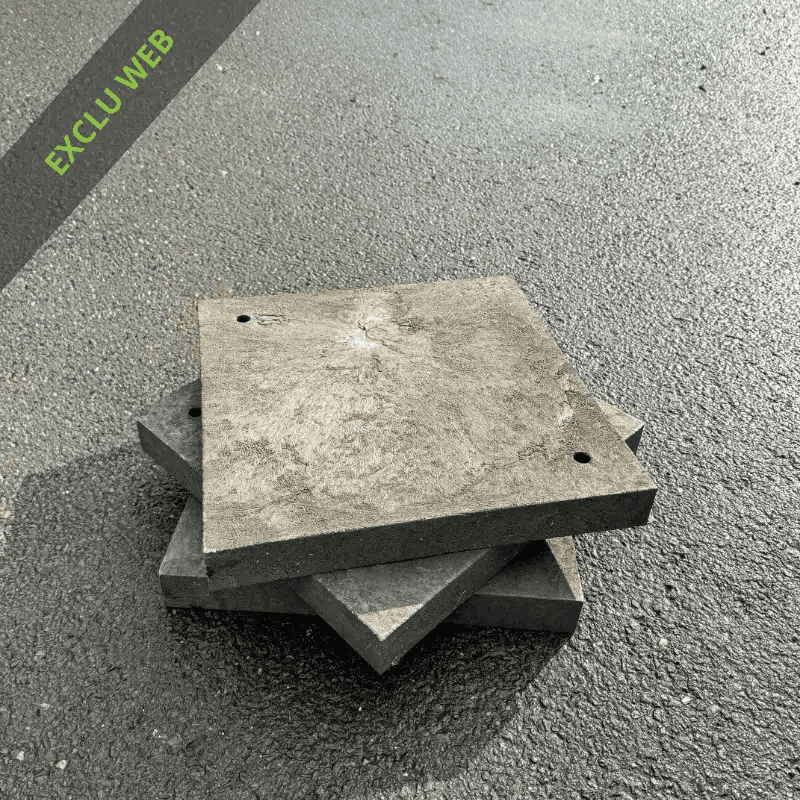
The polypropylene container shim is an accessory designed to ensure the stability and precise positioning of a shipping container on various types of ground. It is intended for professionals in logistics, construction, or events, as well as individuals installing a container for storage or conversion on their property. Its primary function is to distribute loads and compensate for ground irregularities to prevent tipping or unwanted movement. Unlike wooden shims, which are often sensitive to moisture and insects, this recycled polypropylene shim resists weather, impacts, and most cleaning products. It also stands out for its relative lightness (6.2 kg), which facilitates handling and repositioning without specific equipment.
Technically, the shim measures 40 cm in length, 26 cm in width, and 4.5 cm in height. This geometry was designed to provide a sufficient support surface under the corners or rails of a container while remaining compact for easy transport and storage. The material, recycled and recyclable polypropylene, gives the shim good mechanical strength and excellent UV resistance, limiting its aging outdoors. The maximum load supported on hard ground is 5.5 tonnes, while the recommended working load is 2.1 tonnes. The safety factor of 1.5 means the shim is sized to withstand loads greater than its nominal working load, providing a appreciable safety margin under normal use conditions. It is important to note that these values apply to hard and stable ground; on soft ground, the capacity may be reduced and requires case-by-case evaluation.
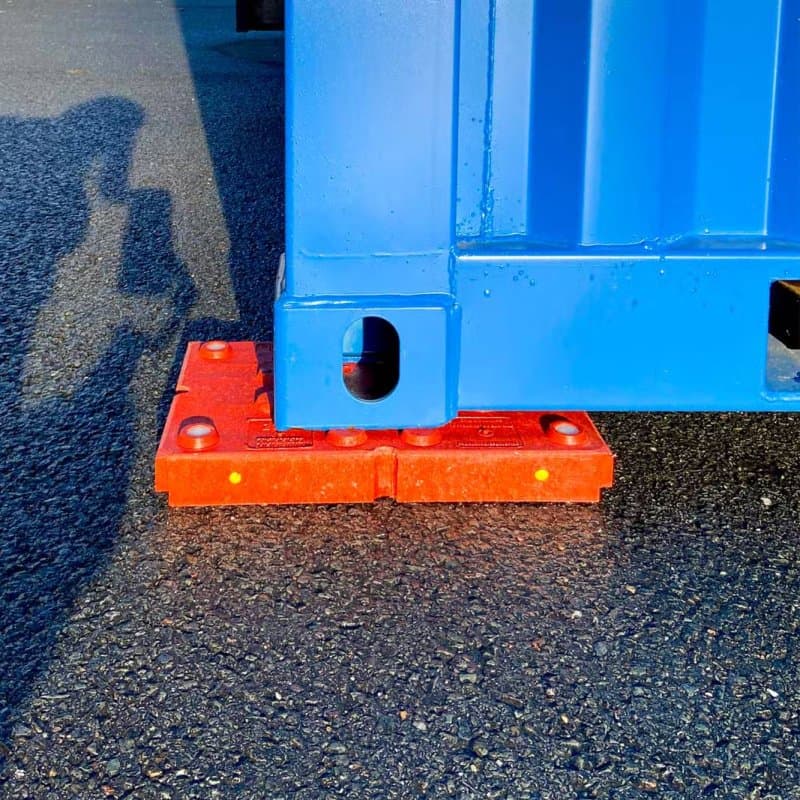
The main use of this shim is to stabilize a container placed on the ground, whether for temporary or permanent storage. It allows for correcting a slight slope, shimming an angle that tends to sink, or simply raising the container to prevent it from resting directly on a wet surface. On a construction site, it can be used to secure a containerized site office or a material storage container. For an individual, it will find its place under a container converted into a workshop, technical room, or storage space. The shims are also useful during unloading or moving a container, to maintain a stable position before final placement.
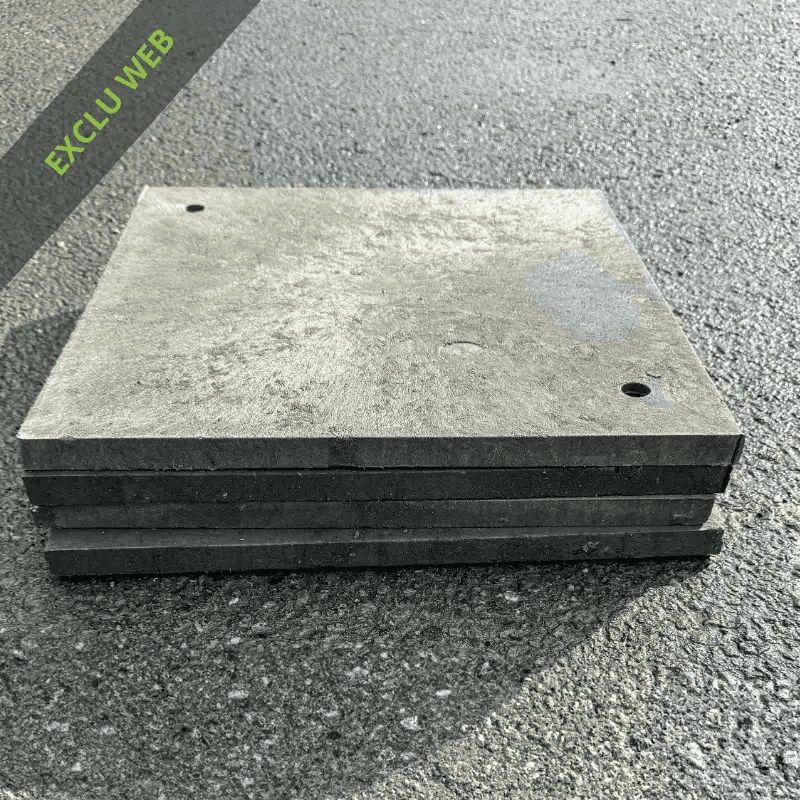
Installing the shim is simple and requires no special tools. Simply lift the container slightly using a jack or forklift, then slide the shim under the relevant support point. For optimal stability, it is recommended to use one shim per corner, i.e., four shims for a standard container. On very uneven ground, up to five shims can be stacked to raise an angle, but it should be checked that the stack remains stable and the load is properly distributed. The maximum stacking of five units is made possible by the shape of the shim, which partially nests into the one below. However, beyond two or three shims, it is advisable to check the flatness and load-bearing capacity of the assembly.
Maintenance of the shim is minimal. Cleaning with a water jet or pressure washer (up to 200 bar and 80 °C) is sufficient to remove mud, residue, or dirt. Polypropylene resists most common chemicals, but it is best to avoid strong solvents that could damage the surface. For prolonged storage, it is recommended to store the shims away from direct sunlight to limit UV aging, although the material is treated to withstand weather. Regular visual inspection is advised: check for cracks, crushing, or deformation that could reduce load capacity. If a shim shows a visible defect, it should be replaced.
When purchasing a container shim, several points require attention. First, compatibility with the container type and its weight: an empty 20-foot container weighs about 2.2 tonnes, a 40-foot about 3.8 tonnes. Once loaded, the weight can reach several tens of tonnes. The shim alone cannot support the entire load of a loaded container; it is designed to stabilize and distribute forces, not to replace concrete pads or foundations. It is therefore essential to check the ground's load-bearing capacity and use a sufficient number of shims. Next, ensure the shim is properly positioned under a structural area of the container (corner, cross member) and not under a fragile part. Finally, it is recommended to follow the manufacturer's instructions regarding maximum load and safety factor.
Regarding regulations, the transport and installation of shipping containers in France are subject to some rules. The container itself must meet ISO 668 and ISO 1496 standards, which define dimensions, loads, and tests. For permanent installation, a planning permission may be required, especially if the container is used as a dwelling or annex. Shims are not subject to specific regulations, but their use must ensure the safety of people and property. For road transport, the container must be properly secured and shims can serve as a complement to prevent movement, but they do not replace regulatory securing devices.
This shim is a simple but effective accessory for anyone wishing to install a container under good conditions. It is particularly suitable for stabilized ground (concrete, asphalt, compacted gravel) and can also be used on soft ground with caution. Its price of €14.00 makes it accessible to equip a complete container without straining the budget. In summary, the polypropylene container shim is a durable, recyclable, and easy-to-use product that contributes to the safety and longevity of your installation.
To go further, it is useful to compare this shim with other commonly used stabilization solutions. Solid wood shims (oak, treated pine) are traditionally used in maritime and road transport. They have the advantage of being inexpensive and easy to cut to size, but they degrade quickly in contact with moisture, can rot, split under heavy load, and sometimes attract wood-boring insects. Their lifespan is limited and their load capacity varies greatly depending on the wood species and quality. Recycled rubber shims, often used for chocking vehicle or trailer wheels, offer excellent grip but are generally more flexible and less suitable for heavy, concentrated static loads like those of a container. Concrete pads or reinforced concrete foundation blocks are designed for permanent installations: they offer very high load-bearing capacity and great stability, but they are heavy, difficult to move, and require ground preparation work. The polypropylene shim thus occupies a middle ground: more durable and stronger than wood, more rigid and stable than rubber, more mobile and lighter than concrete. It is particularly suitable for semi-permanent installations or frequent repositioning needs.
In terms of sizes and types, shims of various dimensions are available on the market. Some shims are lower (2 to 3 cm high) for simple anti-roll chocking, others are higher (7 to 10 cm) to significantly raise a container. The shim presented here, with its 4.5 cm height, offers an interesting compromise: it raises enough to create an air gap under the container and limit direct contact with ground moisture, without making access difficult or destabilizing the assembly. Wider or longer shims may be preferred for very heavy containers or very soft ground, as they distribute pressure better. Conversely, more compact shims are easier to transport but offer a reduced support surface. The choice therefore depends on the container's weight, the nature of the ground, and the frequency of movement.
In the construction sector, container shims are frequently used to stabilize site offices and storage containers installed at the start of a project. On dirt or gravel ground, they compensate for local subsidence and prevent the container from deforming under its own weight. Site managers appreciate their lightness: one person can move them, facilitating adjustments as work progresses. In events, containers are often used as dressing rooms, pop-up bars, or storage spaces. Shims allow them to be installed quickly on various surfaces (grass, gravel, asphalt) while ensuring public safety. In agriculture, containers are used for storing grain, tools, or equipment; shims prevent the floor from direct contact with wet ground, limiting corrosion and degradation of marine plywood. For individuals converting a container into a tiny house, garden office, or workshop, shims are an economical alternative to concrete slabs, provided the allowable loads are respected and a sufficient number of support points are planned.
Another important aspect concerns load distribution. A standard container rests on four reinforced corners, called corner castings. These corners are designed to support the entire weight of the container and its contents. When using shims, it is therefore logical to place them under these corners, as they are the strongest points. However, on soft ground, it may be useful to add shims under the longitudinal rails to prevent the floor from flexing. In this case, ensure all shims are at the same height to avoid creating stress points. Using stackable shims allows fine height adjustment, but keep in mind that stacking reduces lateral stability. It is not advisable to exceed five stacked shims, and beyond three, a stability check is strongly recommended.
The polypropylene used for this shim has several environmental advantages. Being made from recycled materials, it contributes to the recovery of plastic waste. At the end of its life, the shim itself can be recycled, limiting its impact. Compared to treated wood, which may contain preservative chemicals, polypropylene does not release toxic substances into the soil. It is also resistant to rot and fungi. These characteristics make it a relevant choice for sustainable installations, especially in humid or coastal areas where wood does not hold up well.
Regarding transport regulations, a distinction must be made between maritime, road, and rail transport. In maritime transport, containers are secured according to IMO (International Maritime Organization) rules and shipping company requirements. Shims can be used to chock cargo inside the container, but not to stabilize the container itself on the ship. In road transport, the container must be secured to the truck chassis with twist-locks, not simply placed on shims. Shims can, however, be used during temporary storage at the carrier's site. In France, the Highway Code requires that loads be secured so they do not move; shims do not exempt this obligation. For rail transport, containers are fixed to flatcars using specific devices. Again, shims do not replace standardized securing systems.
When purchasing, it is advisable to check the shim's compatibility with the container type. Dry, reefer, open top, flat rack, and high cube containers have different structures and weights. For example, a reefer (refrigerated) container is heavier when empty (about 3 tonnes for a 20-foot) and requires particular attention to ventilation and ground flatness. An open top or flat rack container may have different support points. In all cases, it is best to consult the container specifications and, if needed, seek professional advice. The shim presented here is designed for general use and fits most standard containers, but it must not be used for loads exceeding its stated limits.
Finally, it is worth remembering that safety is everyone's responsibility. Before any handling, ensure the ground is stable, the shims are in good condition, and the container is lifted in a controlled manner. Never work under a suspended container without reliable mechanical support. Shims are a stabilization accessory, not a lifting device. By following these principles, you will extend the life of your container and enjoy a safe and durable installation.