Description
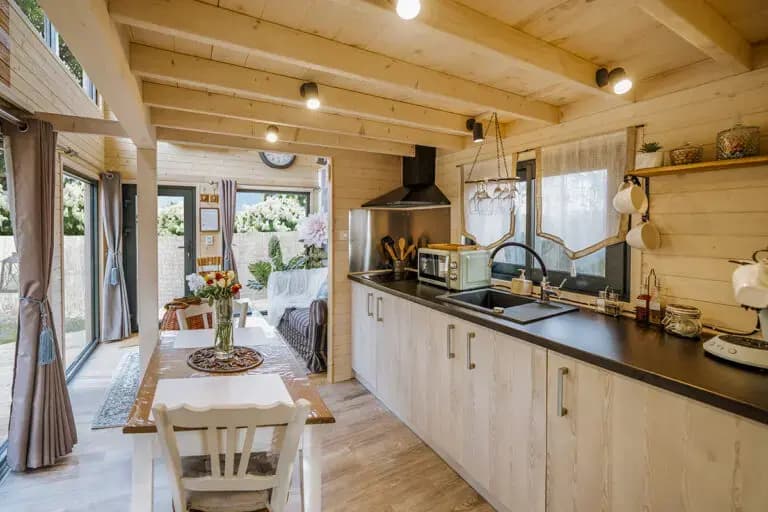
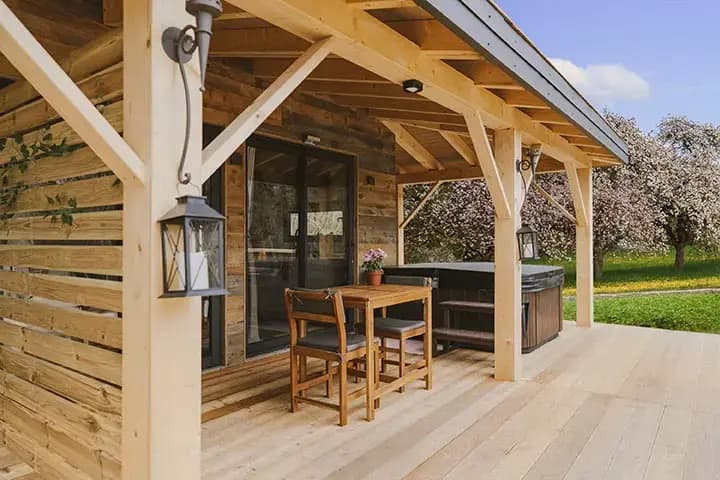
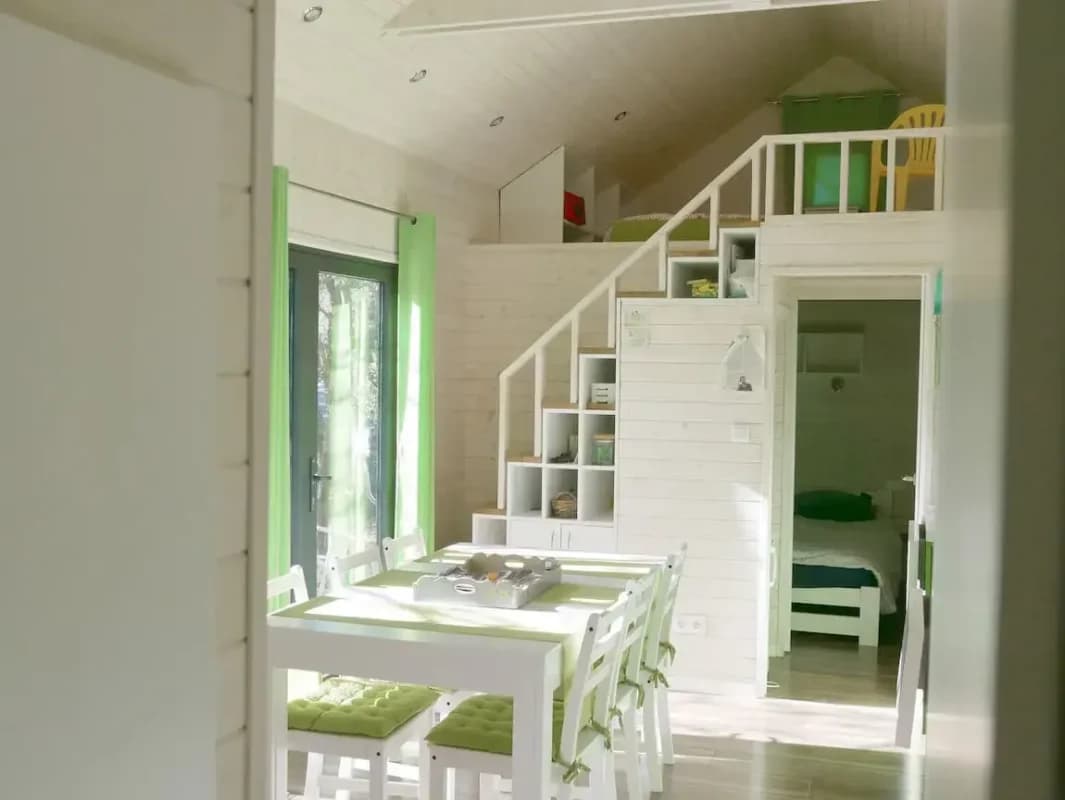
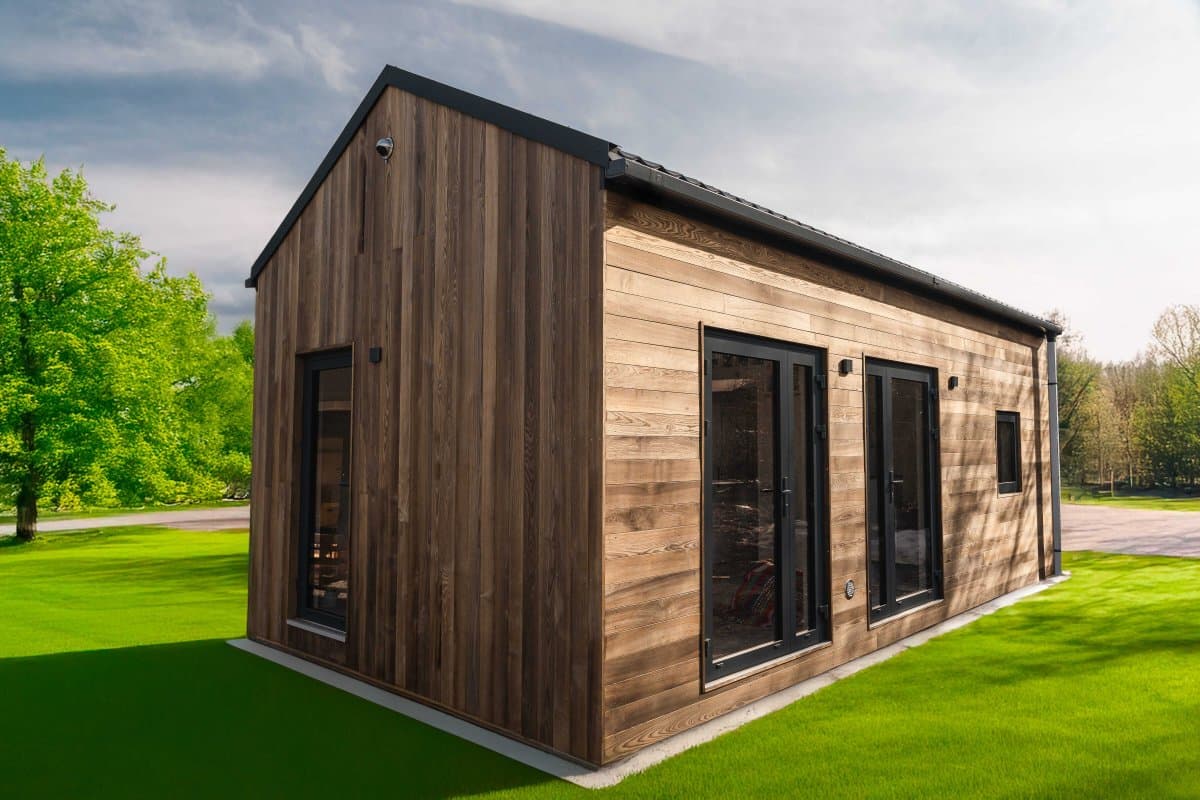
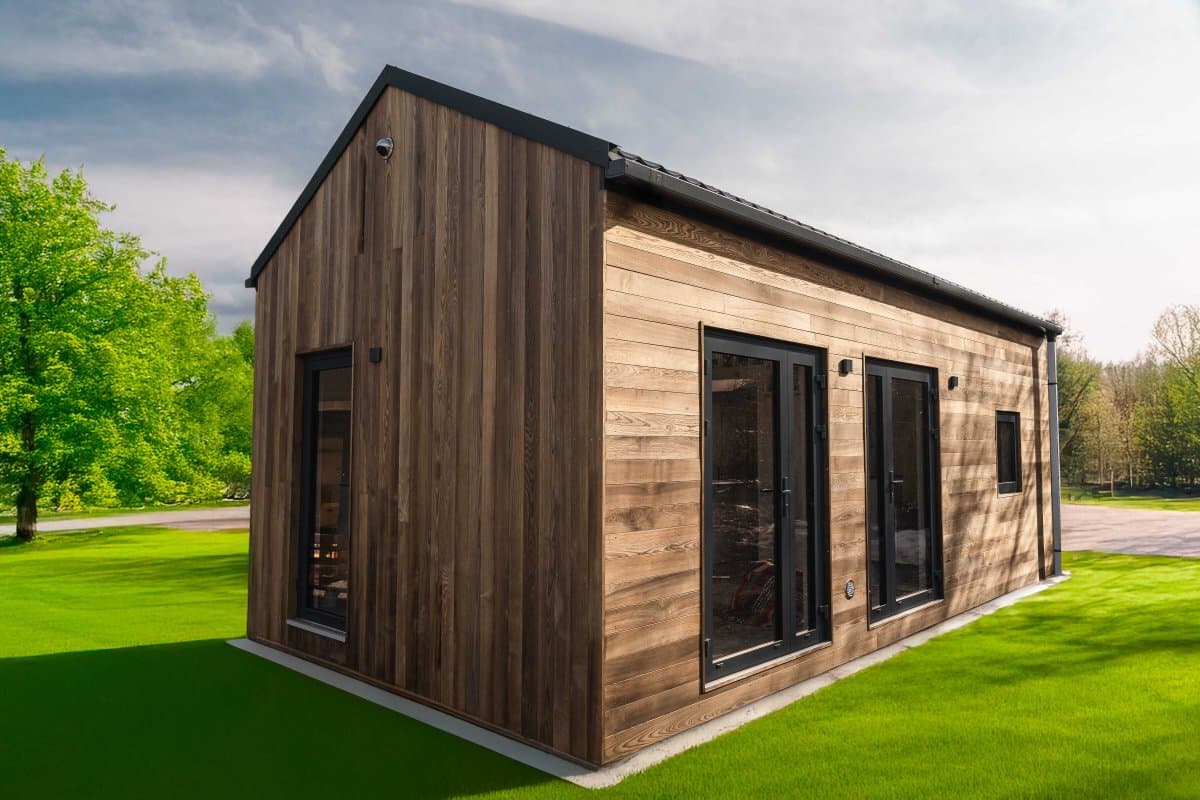
The Cabanon Bleu is a compact wooden chalet designed to provide a functional and pleasant living space for two people. It stands out for its robust Corten steel structure, a material known for its corrosion resistance and longevity, even when exposed to the elements. This material choice ensures excellent long-term durability, whether the chalet is installed by the sea, in the mountains, or in an urban setting. The floor is made of 28 mm marine plywood, offering a stable, moisture-resistant surface suitable for daily use. The rear doors are fitted with double container locks, ensuring secure closure and easy handling. The whole is ISO certified, attesting to compliance with international standards for the dimensions and safety of shipping containers. Although this product is categorized as a Tiny House, it adopts the principles of modularity and transportability of containers, making it easy to install on various sites.
This chalet is particularly suited to people looking for extra living space, a garden office, a workshop, or temporary accommodation. Its compact design allows it to be placed on modest plots without requiring heavy construction work. With transport included, the buyer gets a turnkey solution, simplifying logistics from our Marseille site to the destination. It is important to note that, as with any lightweight dwelling, installation must comply with local planning rules. In France, chalets under 20 m² may be exempt from a building permit under certain conditions, but a prior declaration is often required. We recommend checking with your town hall for the specific procedures for your plot. The Corten steel structure requires little maintenance: regular cleaning with clear water and a visual check of welds and fasteners are enough to maintain its integrity. The wood, if present on the facade, can be treated with a suitable stain or paint to preserve its appearance and UV resistance. The marine plywood floor must be kept dry; if dampness persists, adequate ventilation is recommended.
In terms of use, this chalet can serve as a refuge for nature lovers, a studio for artists, or extra accommodation for hosting family. Its versatility makes it an interesting alternative to traditional construction, with a reduced environmental impact thanks to material reuse and the possibility of relocating it. ISO certification guarantees standardized dimensions, which makes it easier to integrate accessories and adapt to different transport methods. Exact weight and dimensions are not provided, but a standard 20-foot container measures about 6.06 m long, 2.44 m wide, and 2.59 m high, with an empty weight of about 2.2 tonnes. These references can help you assess the footprint, but please contact us for the precise specifications of this model. Included transport covers delivery within mainland France, subject to site accessibility. For destinations requiring exceptional transport or a crane, additional fees may apply; contact us for a customized quote.
Routine maintenance consists of checking the sealing of openings, lubricating the locks, and ensuring effective drainage around the structure. If superficial corrosion appears on Corten steel, it forms a protective layer that stabilizes the metal; it therefore does not need treatment unless it affects the structure. An annual check of fasteners and seals is recommended. This chalet is delivered assembled, ready to be installed on suitable foundations, such as concrete blocks or slabs. We advise preparing a gravel bed or a stable platform to prevent settling. For optimal comfort, additional insulation can be added, especially for winter use. Options such as windows, extra doors, or interior fittings can be considered according to your needs. Feel free to contact us to discuss customizing your Cabanon Bleu.
In summary, the Cabanon Bleu is a reliable modular housing solution, designed to last and adapt to various projects. Whether for residential, professional, or leisure use, it offers an economical and ecological alternative to conventional construction. Its Corten steel structure and marine plywood floor make it a relevant choice for demanding environments. With transport included and ISO certification, it represents a safe investment to bring your compact housing project to life. For any technical questions or to place an order, our team based in Marseille is at your disposal.
Now let's look in more detail at the regulatory aspects related to transporting such a module on French roads. Due to its modular nature, the Cabanon Bleu can be likened to a container or transportable structure. Its transport is subject to exceptional transport regulations if its dimensions or weight exceed the limits allowed for a standard vehicle. In France, a convoy is considered exceptional when its length exceeds 16.50 m, its width 2.55 m, or its gross combined weight (GCW) exceeds 40 tonnes. For a container-type module, common dimensions (about 6 m long, 2.44 m wide) remain within standards, but height can reach 2.90 m for a high cube, requiring particular attention to bridges and tunnels. Transport included in our offer handles these procedures with the competent authorities, including circulation permit applications and route planning. We ensure the vehicle used is suitable, often a container truck or a flatbed with an unloading crane. If the delivery site is difficult to access (narrow lane, steep slope, no maneuvering area), alternative solutions such as transshipment onto a smaller truck or delivery by mobile crane can be proposed. It is essential to inform us of these constraints when ordering to avoid delays or extra costs.
Let's now discuss sector-specific use cases. In the events sector, this chalet can serve as an artist dressing room, reception stand, or ticket office at festivals. Its robust structure withstands repeated handling, and its wooden aesthetic fits well into varied environments. For construction professionals, it can be used as a site office, offering a secure enclosed workspace, with the possibility of installing desks, plans, and computer equipment. The rear doors with container locks provide security against theft. In agriculture, it can serve as storage for tools, seeds, or crops, thanks to its raised floor and moisture resistance. Vineyards or market gardens will find it a practical shelter for equipment and sensitive products. For local authorities, this chalet can be a temporary solution for after-school care, a technical room, or a tourist information point. Its modularity allows it to be moved according to seasonal needs. Finally, in tourism, it can be offered as unusual accommodation on a campsite or service area, providing an alternative to tents and caravans. Its warm appearance and basic comfort appeal to customers seeking nature and authenticity.
Let's now compare the Cabanon Bleu with other sizes and types of containers commonly used for housing or storage. The standard 20-foot shipping container (about 33 m³) is the most widespread; it offers a floor area of about 14.8 m² and an internal volume of 33 m³. The Cabanon Bleu, as a compact chalet, is probably in a smaller surface range, but with a more habitable finish. The 40-foot container (about 67 m³) doubles the surface and is suitable for more spacious layouts, but it is less suited to small plots and its transport is more restrictive. The high cube container (9'6" high) adds 30 cm of height, improving interior comfort, especially for tall people. The reefer container, insulated and equipped with a refrigeration unit, is intended for transporting perishable goods; it can be converted into housing, but its cost and maintenance are higher. Open top and flat rack are types without a roof or side walls, used for out-of-gauge loads; they are less suitable for housing without major work. The Cabanon Bleu, with its Corten steel structure and marine plywood floor, positions itself as a compromise between a raw container and a traditional chalet: it offers a warmer aesthetic and potentially better insulation, while retaining the robustness and transportability of a container. For permanent residential use, however, reinforced insulation and a heating system will be needed, as a simple steel wall can be prone to condensation. Solutions exist: insulating panels, wood lining, or sprayed coating. We can advise you on these fittings.
Let's also address the question of carbon footprint and sustainability. Corten steel is produced from iron ore, an energy-intensive process, but its long lifespan and recyclability at end of life make it an interesting material in a circular economy approach. Marine plywood, often sourced from managed forests, is also durable if maintained. By choosing this chalet, you opt for a construction that can be dismantled and reinstalled elsewhere, thus avoiding demolition and landfilling of materials. This is a strong argument for environmentally conscious projects. In addition, ISO certification guarantees standardized dimensions, making it easier to replace parts and adapt to other equipment. To go further in the ecological approach, you can consider installing solar panels on the roof, a rainwater harvesting system, or a dry toilet. These fittings are compatible with the structure and can be carried out by you or our partners.
Finally, let's not forget safety and compliance aspects. The chalet must be equipped with smoke detectors and a fire extinguisher, in accordance with current standards for accommodation. If you use it as a workplace, health and safety rules must be respected (ventilation, lighting, emergency exits). For seasonal use, remember to protect pipes from freezing. We recommend calling a professional for electrical and plumbing installation, to ensure compliance with NF C 15-100 and DTU standards. The Cabanon Bleu is delivered without these equipments, but we can direct you to qualified craftsmen in our network. In conclusion, this chalet is much more than a simple shelter: it is a truly modular tool serving your project. Whether you are an individual, a company, or a public authority, it will adapt to your needs, provided you take into account the technical and regulatory constraints. Our team in Marseille is at your disposal to support you through every stage, from design to delivery.
Let's now take a closer look at seasonal maintenance procedures, which determine the real longevity of the Cabanon Bleu over several decades. In spring, it is advisable to inspect the entire structure after the winter months: check the condition of the seals around doors and any windows, as frost and temperature variations can weaken them. Take this opportunity to clean the gutters if the model is equipped with them, and to clear the surroundings of any vegetation that would hold moisture against the steel. In summer, a ventilation check is useful: if the chalet remains closed for a long time, the indoor air can become confined and promote condensation on metal walls. Installing low and high vents, or a solar extractor, helps regulate humidity without consuming energy. In autumn, before the first rains, check perimeter drainage: a slight slope in the ground or a gravel bed prevents water from stagnating at the base of the structure. In winter, if the chalet is not occupied permanently, drain water circuits and protect any sensitive equipment from freezing. These simple actions, carried out twice a year, are generally enough to keep the chalet in good condition without major intervention.
Regarding French regulations applicable to installation, several texts are worth knowing. The Town Planning Code distinguishes constructions subject to a building permit, those requiring a prior declaration, and those exempt from any formality. For a construction of less than 5 m², no formality is in principle required, except in certain protected areas. Between 5 and 20 m², a prior declaration is usually necessary. Above 20 m², a building permit becomes the rule. These thresholds are assessed by floor area or footprint depending on the case, and may be modified by your municipality's local urban plan (PLU). In classified areas, listed sites, or near historic monuments, the opinion of the architect of the buildings of France may be required. If your plot is subject to subdivision rules or a free syndicate association, also check the specifications. Finally, if the chalet is intended for habitation, it may be subject to the development tax, calculated according to the surface and the applicable flat-rate value. Check with your urban planning department before ordering: these preliminary checks avoid unpleasant surprises and secure your project.
As for connection to utilities, several options exist depending on the intended use. In standalone mode, the chalet can operate with a photovoltaic solar installation coupled with batteries, a clean water tank, and a greywater collection tank. This configuration is particularly suited to isolated plots or seasonal accommodation. In connected mode, it is advisable to provide for electricity from the main panel, a drinking water supply, and wastewater disposal to a collective network or a non-collective sanitation system (ANC) compliant with regulations. In all cases, call on qualified professionals for electrical and plumbing work, and keep the compliance certificates. These documents may be requested during inspections or when reselling the property. Since the Cabanon Bleu is delivered without technical equipment, you remain free to choose the solutions that match your budget and site.
Let's finish with some practical recommendations to prepare for delivery. Before the truck arrives, make sure access is clear to a width of at least 3 meters and a free height of 4 meters if the carrier uses a crane truck. Provide a stable, level drop-off area large enough to maneuver. If the ground is soft, temporary decking may be necessary. On delivery day, a responsible person must be present to validate receipt, check the apparent condition of the chalet, and sign the delivery note. In case of visible anomaly, note it on the document and contact us immediately. Once installed, the chalet can be used as soon as the necessary connections are made. We remain available to answer your questions and support you in this final step. With a little preparation, the Cabanon Bleu quickly integrates into its environment and becomes a fully functional living or working space.