Description
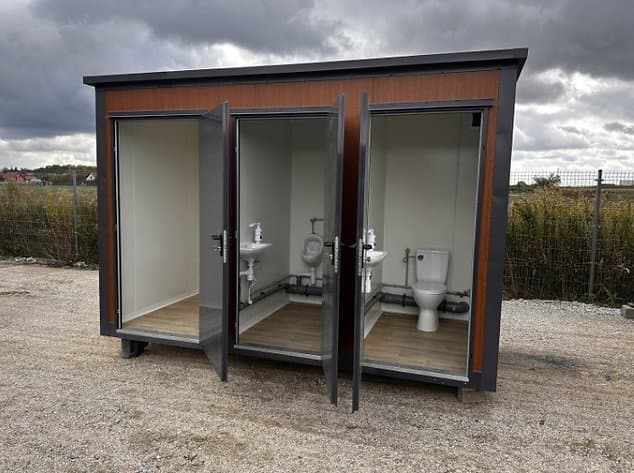
The modular sanitary container with triple cabin is a mobile and self-contained solution designed to meet hygiene needs on construction sites, at events or on any site lacking fixed facilities. This new module stands out for its configuration with three separate cabins, offering capacity suited to high-traffic areas. Each cabin is served by its own independent standard door, ensuring simultaneous use without mutual inconvenience. The first cabin is equipped with a WC, the second combines a WC and a urinal, and the third includes a toilet. All have a washbasin, an instant water heater for domestic hot water and a full electrical installation. A split air conditioning system ensures thermal comfort in all seasons. The frameless structure gives the whole unit a clean, modern design, making it easy to integrate on various sites.
Technically, this sanitary container is 3.76 metres wide, 1.76 metres long and 2.48 metres high, for a total area of 6.62 m². These non-standard ISO dimensions make it a compact module, easy to install in restricted spaces. The weight and construction materials are not specified, but this type of equipment is generally made with a metal frame and insulated panels, suitable for outdoor use. The absence of windows may be surprising, but it is offset by integrated artificial lighting and mechanical ventilation, often present in this type of sanitary unit to renew air and remove odours. The entrance door of each cabin is a standard type, with a lock to preserve user privacy.
The complete interior equipment includes, for each cabin, a washbasin with mixer tap and an instant water heater, providing hot water without storage. The split air conditioning system provides cooling in summer and may, depending on the model, offer a heating mode in winter. The electrical installation is complete: distribution board, sockets, lighting and power supply to equipment. The frameless structure means the walls are self-supporting or integrated so that no visible uprights are required, which simplifies cleaning and limits dirt retention areas. This design choice also contributes to the overall aesthetics of the module.
This sanitary container naturally finds its place on construction sites, where hygiene and safety standards require suitable sanitary facilities. It can also be deployed at cultural, sporting or professional events, to compensate for the lack of public toilets. Workers' camps, campsites, storage areas or temporary industrial sites can also use it. Its mobility is an asset: it can be transported by container truck or crane, then placed on stable, level ground. Once in place, it only needs to be connected to water, electricity and drainage networks to make it operational. Where no connection is possible, self-contained solutions (water tanks, wastewater collection tank, generator) can be considered, but they are not supplied as standard.
Maintenance of this sanitary container is simple but regular. Surfaces, WCs, washbasins and floors should be cleaned daily with suitable products. Sanitary facilities must be disinfected frequently to prevent bacterial growth. The instant water heater requires periodic descaling depending on water hardness. The split air conditioning system's filters must be cleaned or replaced regularly to maintain correct air quality and prevent breakdowns. The electrical installation must be checked annually by a qualified professional. Finally, a visual inspection of the condition of walls, doors and seals is recommended after each move of the module.
When purchasing, several points deserve attention. Check that the container is indeed new and that the sanitary equipment complies with current French standards. Ensure that the electrical installation complies with NF C 15-100 for residential premises or public-access buildings depending on use. Compliance with the Labour Code for construction sites requires separate sanitary facilities for men and women, or individual cabins; here, the three cabins are independent, which can facilitate compliance. For event use, it is advisable to provide a sufficient number of cabins according to the expected public. Transport and handling must be entrusted to professionals equipped with suitable machinery (forklift, mobile crane). Unloading requires flat, resistant ground. Finally, find out about any planning permissions if the container is to remain in place permanently.
To go further into routine maintenance, it is useful to distinguish daily, weekly and annual operations. Daily, cleaning bowls, urinals, washbasins and floors with a disinfectant detergent maintains a satisfactory level of hygiene. Bins must be emptied and consumables (toilet paper, soap, hand towels) replenished. Each week, a more thorough cleaning of walls, mirrors and taps is recommended, along with a check of the proper drainage of sinks and WCs. The salt level in the water softener should also be checked if such equipment is installed upstream, as water that is too hard reduces the lifespan of the instant water heater. Each month, it is prudent to test electrical safety devices (RCDs) and check for leaks under washbasins and around WCs. Once a year, a professional can carry out a full descaling of the water heater, a check of the roof and window seals, and cleaning of the air conditioning filters. If the container is exposed to sea spray or a saline atmosphere, as is common on the Mediterranean coast, more frequent corrosion inspection is advisable, with touching up of any paint scratches.
Regarding transport regulations, this sanitary container 3.76 m wide and 1.76 m long does not comply with standard ISO dimensions (width 2.44 m). It is an oversized module, which involves specific rules. In France, road transport of indivisible loads over 2.55 m wide requires a circulation permit issued by the prefecture, as well as signalling with panels or flashing lights. Depending on the exact width, the convoy may be classified as first or second category, with speed and route restrictions. For a width of 3.76 m, transport is generally classified as second category, which imposes reduced speeds (for example 60 km/h on roads, 80 km/h on motorways) and a ban on driving in certain urban areas without special permission. The carrier must also ensure that the vehicle is suitable (low-loader, exceptional convoy) and that the load is properly secured. It is recommended to use a carrier specialising in exceptional convoys, such as D.S. Globe Conteneur, to avoid any risk of fines or immobilisation. For sea transport, this module can be loaded on a flatbed or in an open top container, but its non-standard width can complicate stowage; a case-by-case study is necessary.
Sector-specific use cases are varied. In the construction sector, this sanitary container is particularly suited to building and public works sites, where it can be installed from the start of the project and moved as work progresses. It meets the requirements of the Labour Code regarding sanitary facilities: provision of sufficient toilets and washbasins, separation of men/women, hot water and heating in winter. For events, whether festivals, outdoor trade fairs, sports competitions or community gatherings, the triple cabin can absorb a large flow of visitors. Organisers appreciate the possibility of renting or buying several modules to create complete sanitary blocks. In the agricultural or forestry sector, this container can serve as a workers' camp for seasonal staff, offering decent sanitary facilities in the open countryside. Holiday camps, leisure centres or temporary holiday villages can also use it. Finally, public works companies or network managers (water, electricity, telecoms) can deploy it on isolated sites to improve working conditions for teams.
Compared to other sanitary solutions, this container stands out for its robustness and durability. Traditional chemical toilets, often used on small sites, have no running water, no water heater, no air conditioning, and their capacity is limited. Plastic mobile toilet cabins are light and easy to move, but they offer basic comfort and are not suitable for intensive use or permanent installation. Permanent sanitary facilities, built on site, are more comfortable but require masonry work, planning permissions and a significant completion time. The sanitary container positions itself as a compromise: it offers the comfort of a traditional sanitary facility (hot water, air conditioning, washbasins) while remaining mobile and quickly operational. Compared to a single-cabin sanitary container, this triple-cabin model can serve a larger number of users without excessive queuing, which is an advantage on high-traffic sites. It can also be compared to a 20-foot container (6.06 m long) fitted out as sanitary facilities, which would offer more surface area but would be bulkier and heavier to transport. The compact format of this model (1.76 m long) makes it easier to insert into restricted spaces, such as a building courtyard or a cramped construction area.
For installation, it is essential to provide earthworks or a stabilised platform (concrete, compacted gravel) to receive the container. Wedging with beams or blocks is recommended to avoid deformation and ensure horizontality. Water and electricity connections must be carried out by professionals. Wastewater can be discharged to a collective sewerage network, a septic tank or a collection tank. If the container is used in an urban area, it may be necessary to obtain a temporary occupation permit for public land. In rural areas, a prior declaration of works may be required if the installation exceeds a certain duration. It is advisable to contact the planning department of the relevant municipality.
Finally, for purchase, D.S. Globe Conteneur offers this sanitary container at the price of €2,000.00 excluding VAT. This price includes the new module and its equipment, but delivery conditions should be checked, particularly transport from Marseille to the place of use. Options may be available, such as adding an awning, outdoor lighting or a reinforced ventilation system. Do not hesitate to request a detailed quote to include these elements. Whether for a construction site, an event or a workers' camp, this triple-cabin sanitary container is a reliable, hygienic and durable solution, suited to the requirements of professionals.
To usefully complete this overview, the question of accessibility and adaptation for people with reduced mobility should be addressed. As it stands, this container does not appear to have a cabin accessible to disabled people, as the standard doors and the interior space of each cabin (approximately 2.2 m² per cabin) do not necessarily allow a wheelchair to turn. If the intended use involves receiving the public, it may be necessary to provide an additional module or to check the possibility of fitting out an accessible cabin. French regulations (decree of 20 April 2017 for public-access buildings) impose minimum dimensions and specific equipment (grab bars, manoeuvring space, height of controls). This point must be studied upstream with the manufacturer's technical department or a design office.
Another aspect rarely mentioned but important is wastewater management and environmental impact. Blackwater (from WCs) and greywater (washbasins) must be collected and treated in accordance with regulations. Connection to the collective network is the simplest solution, but on an isolated site, a septic tank or a micro wastewater treatment plant may be necessary. The volume of wastewater generated depends on the number of users: for a site with 20 people, production can be estimated at around 1 to 2 m³ per day, which requires a suitable storage tank if periodic emptying is chosen. It is also possible to install dry toilets or waterless urinals, but this would change the current configuration.
Regarding fire safety, sanitary containers are generally equipped with smoke detectors and fire extinguishers, but these are not mentioned in the product sheet. It is recommended to check their presence and supplement them if necessary, especially if the module is installed near other structures or used by a large public. Construction materials must also have sufficient fire resistance, particularly for walls and insulation. A fire reaction classification (M1, M2, etc.) may be required depending on use.
As for warranty and after-sales service, D.S. Globe Conteneur can provide additional information on the manufacturer's warranty conditions. Sanitary equipment (water heater, air conditioning) is commonly guaranteed for one to two years, while the metal structure may benefit from a longer warranty. It is advisable to keep the invoice and conformity certificates. In the event of a breakdown, a network of approved repairers can intervene, but it is preferable to check the availability of spare parts before purchase.
Finally, for professionals considering rental rather than purchase, this type of container can be offered for short- or long-term rental. Rental has the advantage of not tying up cash and allowing configuration changes according to needs. D.S. Globe Conteneur can study this option with you. Whether for purchase or rental, the essential thing is to clearly define your needs upstream: number of users, duration of use, installation constraints, budget. Our team in Marseille is at your disposal to advise and support you in your project.