Description
The self-built demountable bar container is a modular solution designed for specific outdoor layout needs, including creating bars, snack bars or storage spaces. This container stands out for its fully dismountable and self-supporting design, making transport, assembly and adaptation to various projects easy. In this text, we detail its technical characteristics, concrete uses, points to watch when buying, as well as maintenance advice and regulatory information.
Main technical characteristics. This container has external dimensions of 7767 mm length, 2142 mm width and 2088 mm height. Inside, the available space is 7612 mm length, 2062 mm width and 1950 mm height. The doors offer an opening of 1750 mm width by 1850 mm height. These dimensions correspond to an internal volume of about 30.6 cubic metres, providing generous space for various applications. The structure is fully self-supporting, including the floor, meaning it does not require heavy foundations or additional support to stand. This self-support is a major asset for quick installation on stabilised ground.
The container consists of two modules each 4 metres long, connected by a waterproof linking kit. This design creates a continuous space without an internal wall, offering great layout flexibility. For example, one part can be dedicated to a bar and the other to a snack bar, or one section can be used as enclosed storage. Modularity is at the heart of this product: it can be assembled and disassembled as needed, making transport and installation easier on temporary or permanent sites.
Materials and construction. Although the exact materials are not specified in the information provided, shipping containers are generally made of Corten steel, a low-alloy steel that resists atmospheric corrosion through the formation of a protective layer of surface rust. This type of steel is commonly used in container construction for its durability and weather resistance. The floor is often made of hardwood, such as marine plywood or apitong wood, treated to resist moisture and heavy loads. The factory's one-year anti-rust guarantee suggests that anti-corrosion treatments are applied, but it is advisable to check the exact specifications with the supplier.
Weight and handling. The total package weight is about 460 kg, the heaviest element being the floor, which weighs approximately 140 kg. This relatively low weight for a container of this size is explained by its demountable design and the use of optimised materials. During assembly, it is important to provide suitable lifting equipment, such as a forklift or crane, to handle the heaviest elements safely. Disassembly allows the whole to be transported in a reduced volume, which can lower transport costs compared with a standard one-piece container.
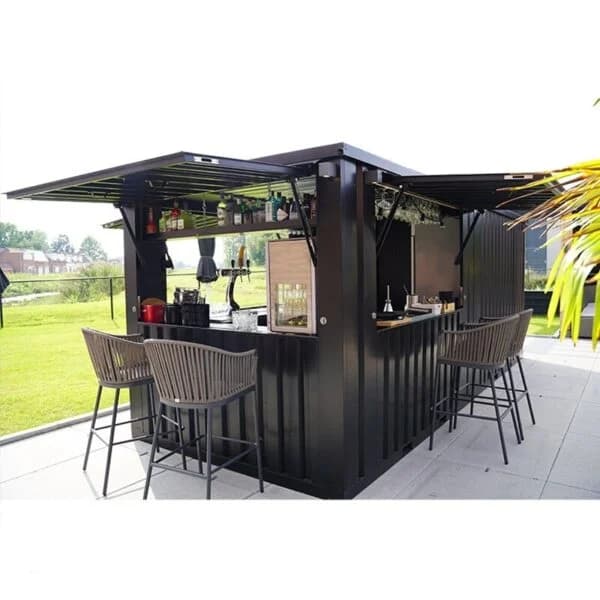
Concrete uses. This demountable bar container is used in many contexts. It is particularly suitable for outdoor events, festivals, markets, beaches, campsites or construction sites. Its configuration allows the creation of a spacious outdoor bar, with a covered part for service and another for storing drinks and equipment. The ability to dismantle it quickly makes it an ideal solution for seasonal or travelling activities. In addition, thanks to its modular aspect, it can be customised: adding counters, shelves, signs, etc. It can also serve as a site office, technical room or temporary sales point.
Points to watch when buying. Before acquiring this container, several aspects must be considered. First, check the quality of materials and finishes, especially the steel thickness and anti-corrosion treatment. Make sure the linking kit is included and ensures effective waterproofing. Ask about warranty conditions: here, a one-year anti-rust guarantee is mentioned, but it is prudent to request details on exactly what is covered. Then take into account local planning regulations: installing a container may require prior authorisation, especially if used as a residential or commercial structure. In France, a container is considered a construction and may be subject to building permit rules depending on its surface area and use. It is recommended to contact the town hall to find out the necessary procedures. Finally, assess transport and assembly costs: although demountable, assembly may require skilled labour and time.
Maintenance. To extend the life of your container, regular maintenance is advised. Periodically inspect the structure to detect any trace of rust or corrosion, especially at welds and contact points with the ground. Clean surfaces with a soft cloth and mild detergent; avoid abrasive products that could scratch the paint. If scratches appear, apply a suitable anti-rust paint. Check the waterproofing of the linking kit and replace seals if necessary. Lubricate hinges and locks to ensure proper operation. If the container is exposed to marine or humid environments, more frequent maintenance is recommended.
Transport regulations in France. Transporting a demountable container is subject to exceptional transport regulations if its dimensions or weight exceed authorised limits. Here, the external dimensions (7.767 m long, 2.142 m wide, 2.088 m high) are close to the standard limits for road transport without special authorisation (generally 2.55 m wide and 4 m high). However, the total weight of 460 kg is well below the thresholds requiring authorisation. It is advisable to check the applicable rules with the carrier, especially for securing and marking. For use as commercial premises, a planning authorisation may be necessary.
Comparison with other container types. This container stands out from standard dry shipping containers by its modularity and ability to be dismantled. Dry containers are one-piece and require heavy lifting equipment to be moved. Reefer containers are equipped with refrigeration systems, which is not the case here. Open top and flat rack containers are designed for out-of-gauge cargo. The demountable bar container is therefore an interesting alternative for projects requiring flexibility and easier transport.
Conclusion. In summary, the self-built demountable bar container is a versatile solution for creating a functional outdoor space. Its generous dimensions, modular design and reduced weight make it a relevant choice for professionals in events, catering or construction. By following maintenance instructions and checking regulatory aspects, you can fully enjoy this durable product. Do not hesitate to contact the supplier for details on materials, customisation options and delivery times.
To go further, let us now examine sector-specific use cases in more detail, a comparison with other container sizes and types, as well as recommendations for interior layout and safety.
Sector-specific use cases. In the catering and hospitality sector, this container can serve as a pop-up bar for restaurant terraces, hotels or beach clubs. Its ability to be quickly dismantled and reassembled allows adaptation to seasonal variations. For caterers and food trucks, it offers additional preparation and service space, with the possibility of separating hot and cold zones. In events, it is used as a drinks sales point at festivals, trade shows or sports competitions. Organisers appreciate its modularity, which allows installation on sites with difficult access. For local authorities, it can become an information kiosk, ticket sales point or storage room for municipal equipment. In construction, it serves as a site office, meeting room or changing room for workers. Farmers can use it as a direct farm sales outlet or processing space. Finally, for individuals, it can be fitted out as a garden bar, pool house or workshop.
Comparison with other sizes and types of containers. The demountable bar container positions itself as an alternative to standard 10, 20 or 40-foot shipping containers. A 10-foot container (about 3 m) is more compact but offers less space for a bar. A 20-foot (6 m) is more common and can be fitted out, but it is not demountable. A 40-foot (12 m) offers significant volume but requires a larger site and more powerful lifting equipment. The 7.7 m demountable container sits between the 20 and 40-foot, with the advantage of being transportable in parts. Compared with a high cube container, which offers additional internal height (about 2.69 m), this model has an internal height of 1.95 m, which may be sufficient for a bar but less comfortable for living space. Reefer containers, equipped with refrigeration units, are suitable for transporting perishable goods, but their cost and maintenance are higher. Open top and flat rack containers are designed for specific loads and are not enclosed. Finally, collapsible containers (such as 4FOLD containers) are also demountable but often more expensive and less common. The choice will therefore depend on budget, intended use and logistical constraints.
Interior layout and customisation. The layout of this bar container can be adapted to your needs. You can install a wooden or stainless steel counter, shelves for bottles, a worktop for preparation, a sink with water supply and drainage, electrical sockets, LED lighting, air conditioning or heating depending on use. The self-supporting structure allows elements to be fixed without additional reinforcements. Thermal insulation is recommended if the container is used in extreme climatic conditions. Outside, you can add a wooden terrace, an awning or an illuminated sign. Customisation can also include painting in your brand colours, display windows or roller shutters. Remember to check compliance with fire safety and accessibility standards if you receive the public.
Safety and compliance. During installation, ensure the container is stable and properly anchored to the ground, especially in windy areas. Openings must be secured: doors with locks, windows with shutters. If the container is used as commercial premises, it must comply with hygiene and food safety rules (for a bar or snack bar). For residential use, it must meet construction standards (insulation, ventilation, etc.). In France, regulations on habitable containers are still unclear, but they are generally considered light constructions. It is advisable to consult a design office to validate compliance.
Transport and logistics. The demountable container can be transported by truck, ship or train. Its dimensions once dismantled reduce the volume, which can facilitate transport over long distances. For example, panels can be stacked and strapped on a pallet. The total weight of 460 kg can be spread over several packages. For international transport, it is important to check customs documents and required certificates. The waterproof linking kit must be included in the shipment. It is recommended to use a carrier specialising in containers to avoid damage.
Preventive maintenance. In addition to routine maintenance, annual preventive maintenance is advised. Check the condition of welds, bolts and fastenings. Check the waterproofing of the roof and walls. If the container is exposed to sea salt, rinse it with fresh water regularly. Inspect the floor for rot or sagging. Treat the wood with a fungicide if necessary. Grease the locking mechanisms. When dismantling, store parts in a dry, ventilated place to prevent rust.
Costs and budget. The price of EUR 4500 is competitive for a new demountable container. Transport, assembly and fitting costs must be added. A new standard 20-foot container generally costs between EUR 2000 and 4000, but it is not demountable. A 40-foot container can cost between EUR 3000 and 6000. Reefer containers are more expensive. The demountable bar container therefore offers good value for money for those seeking flexibility and modularity. Also budget for possible authorisations and local taxes.
In conclusion, this self-built demountable bar container is an innovative solution for creating a functional and customisable outdoor space. Its technical characteristics, modularity and ease of transport make it a wise choice for many professionals. By following maintenance advice and complying with regulations, you can enjoy this product for a long time. For any specific question, do not hesitate to contact D.S. Globe Conteneur, who will be able to support you in your project.