Description
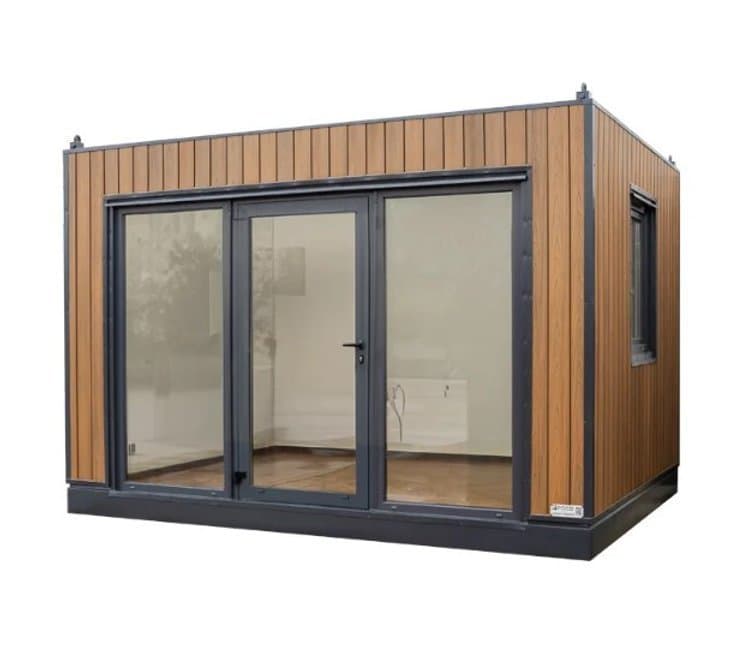
The new 4 × 3 metre office container, model Berlin, is a modular solution designed to provide a functional and attractive workspace, delivered ready to use. It stands out from standard shipping containers with its exterior finish in wood-look composite panels, giving it a natural and warm appearance that blends easily into various settings such as a residential courtyard, garden or professional area. Inside, the walls are painted pure white (RAL 9010), creating a bright atmosphere, while the floor is covered with oak-look vinyl, combining visual comfort and easy maintenance.
This office container is a self-contained unit 4 metres long and 3 metres wide, giving a floor area of 12 square metres. This compact size allows installation on modest plots while offering an interior optimised for an individual workstation or a small meeting space. The standard height of this type of unit is generally between 2.50 and 2.80 metres, but the exact height should be checked with the manufacturer, as it is not specified in the product information. The empty weight, not provided, depends on the materials used: a 20-foot Corten steel shipping container weighs about 2.2 tonnes, but this composite-panel construction with integrated insulation may have a different weight, generally lower or equivalent depending on the structure. It is advisable to find out the exact weight before installation, particularly to determine lifting or foundation requirements.
Structure and insulation are key features of this office container. Thermal and acoustic insulation is provided by 100 mm of expanded polystyrene (EPS) integrated into the walls, roof and floor. This thickness helps maintain a stable indoor temperature, reducing heating needs in winter and air conditioning in summer, while also dampening outside noise. The windows and door also play a role in energy performance: the steel door is fully insulated, and the windows are fitted with sealed glazing. An 800 × 1100 mm tilt-and-turn window in RAL 7016 (anthracite grey) is positioned on the short side, allowing natural ventilation and light. Two 900 × 1900 mm glass window panels complete the set, providing a large glazed area that floods the space with natural light. These generous dimensions promote a pleasant working environment and reduce reliance on artificial lighting during the day.
The electrical installation is designed for immediate use. The container is equipped with a 230 V network with a 16 A, 3-pin socket, compliant with French standards for domestic and office appliances. Lighting is provided by two integrated LED luminaires, offering efficient and energy-saving light. Two double sockets are available for connecting computers, printers or other equipment. An external 230 V counter socket allows powering devices outside, which can be useful for cleaning or tools. A switch and a fuse box complete the electrical panel, ensuring safety and overload protection. The "Plug and Play" system means the whole unit is pre-wired and ready to be connected to an external power source, without the need for complex electrical work. However, a qualified electrician should be called for the final connection to the mains, to comply with current safety standards.
The uses of this office container are many. It can serve as a site office, providing a comfortable and secure workspace for teams, with insulation that makes it usable all year round. In a residential context, it can become a separate home office for remote work, a creative workshop, a music studio or a leisure space. Businesses can use it as a temporary reception area, counter or sales office on a site. Its modular design also allows it to be integrated into a larger complex by juxtaposing several units to create larger spaces, subject to checking structural compatibility. The wood-look exterior finish and the anthracite grey colour of the frames give it a neat aesthetic that blends with many environments, whether urban or natural.
Maintenance of this office container is simple and low-effort. The exterior composite panels can be cleaned with soapy water or a mild cleaner, without using abrasive products that could scratch the surface. It is advisable to regularly check the condition of the seals around the windows and door, and replace them if necessary to prevent water ingress. Gutters and rainwater drains, if present, must be cleared of leaves and debris. Inside, the vinyl floor can be cleaned with a damp cloth and a suitable product; avoid excess standing water. LED luminaires have a long service life, but it is prudent to periodically check that sockets and the fuse box are working properly. Finally, a visual inspection of the structure and fixings after severe wind events is recommended.
When buying an office container, several points require attention. First, transport and installation: this type of container can be delivered by truck crane or gantry, and it is essential to check site access (road width, overhead cables, stable ground). The exact weight and dimensions must be known to organise handling. Second, local regulations may require planning permission for installing a modular structure, even temporary. In France, it is advisable to check with the town hall for applicable rules (prior declaration, building permit depending on surface area and duration). Furthermore, if the container is to be connected to the public electricity network, compliance with NF C 15-100 standards is necessary, and the connection must be carried out by a professional. Finally, it is important to check the origin and quality of the materials, particularly the UV and weather resistance of the composite panels, as well as any warranty offered by the manufacturer. No specific certification is mentioned in the product information, but shipping containers are generally subject to ISO 668 and ISO 1496 standards; this composite-panel construction is not a standard shipping container, so it does not necessarily fall under those standards. It is recommended to request detailed technical data sheets from the supplier.
Compared to a standard shipping container, this new office container offers several advantages. It comes with integrated insulation and a complete electrical installation, avoiding additional fitting work. Its neat aesthetics make it suitable for environments where a raw container would be unsightly. Its 12 m² area is optimised for an office, with a comfortable ceiling height. However, it does not have the structural robustness of a Corten steel shipping container, which can be stacked and transported by sea. This model is designed for static installation and should not be subjected to repeated lifting stresses without precautions. It is therefore important to define the intended use precisely before purchase.
Regarding transport regulations, if this container is to be moved on public roads, it must be loaded onto a suitable truck and comply with the size and weight rules in force in France (maximum width 2.55 m, maximum height 4 m, authorised gross vehicle weight depending on the vehicle). An exceptional convoy may be necessary if dimensions exceed standard limits. It is advisable to use a specialised carrier to organise the move safely.
In summary, the new 4 × 3 metre office container is a turnkey solution for creating a modular, insulated and attractive workspace. Its technical features (100 mm EPS insulation, quality frames, complete electrical installation) make it a relevant choice for many applications. However, the exact specifications (weight, height, warranty) should be checked with the supplier and compliance with local planning and electrical safety rules ensured. This product is available at €4,350.00 excl. VAT, and can be ordered directly via our website. For any technical questions or to obtain a personalised quote, our team is at your disposal.
Let us now look in more detail at aspects related to seasonal maintenance and durability. Although the wood-look composite panels are designed to withstand weather, regular maintenance extends their service life and preserves their appearance. In spring, a full cleaning of the facades removes pollen, dust and any pollution marks. For stubborn stains, a pressure washer can be used at low pressure (less than 50 bar) and at a reasonable distance to avoid damaging the coating. Solvents or chlorinated products should not be used as they could alter the surface. For glazing, a standard glass cleaner is sufficient; avoid abrasives. Window and door seals should be inspected twice a year: a cracked or detached seal lets air and water through, which can reduce insulation and cause leaks. Replacing a seal is a simple and inexpensive operation. The insulated steel door deserves particular attention: grease the hinges and lock once a year with a suitable lubricant (silicone or white grease) to prevent squeaking and ensure smooth operation. Also check that the door frame is not warped and that the threshold remains watertight. Regarding the electrical system, it is recommended to test the fuse box and sockets once a year, and have the installation checked by a professional every five years, as for any electrical installation. LED luminaires have a very long service life (often over 20,000 hours), but if one fails, it can be replaced with an equivalent model. Finally, if the container is installed in a region with heavy snowfall, it is prudent to clear snow from the roof to avoid overloading, although the structure is designed to support a standard snow load. These simple steps ensure a healthy and durable workspace.
Let us now address more specific sector use cases. In the construction sector, this office container can serve as a site base for works managers, site foremen or project management teams. Its 12 m² area allows several workstations, a meeting table and storage space. The reinforced insulation makes it usable in all weather, and the integrated electricity allows powering computers, printers and communication equipment. In events, it can be used as a reception office, technical control room or ticketing space. Its neat aesthetics, with wood-look panels, fits well into festivals, outdoor trade shows or sports competitions. For local authorities, it can become a temporary administrative office during renovation work, an office for sports facility caretakers, or a seasonal tourist information point. In healthcare, it can serve as an advanced consultation office or screening unit, subject to compliance with current health standards. Service companies can use it as a sales office on an industrial site, a room for maintenance teams, or a remote work space for travelling employees. Finally, for individuals, it offers a solution for creating a separate home office, a DIY workshop, a soundproofed music studio (thanks to EPS insulation), or a leisure space. The versatility of this container makes it a cost-effective investment for many projects.
Let us now compare this 4 × 3 metre model with other sizes and types of containers available on the market. Standard 20-foot shipping containers (about 6.06 m long × 2.44 m wide) offer an area of about 14.8 m², but they are longer and narrower than the 4 × 3 m model. A 20-foot container is often used for storage or transport, and converting it into an office requires insulation and electrical work. The 4 × 3 m container, however, is specially designed for living or office use, with integrated insulation and finish. 10-foot containers (about 3 m long) are more compact and suitable for a single workstation or small technical room. 40-foot containers (12.19 m long) offer nearly 30 m², ideal for open spaces or meeting rooms, but they require a larger site and more complex transport. In terms of types, there are dry (standard), high cube (increased internal height), reefer (refrigerated), open top (open roof) and flat rack (no side walls) containers. The Berlin model is a habitable container, which does not fall into these maritime categories; it is a lightweight modular structure, optimised for comfort and aesthetics. Compared to a converted shipping container, it has the advantage of being lighter, easier to install and ready to use, but it cannot be stacked or transported by sea. The choice between these solutions therefore depends on the intended use: for a permanent or semi-permanent office, the 4 × 3 m habitable container is an excellent compromise between area, comfort and ease of installation. For itinerant use or frequent transport, a standard shipping container will be more robust. For a large area requirement, a fitted 40-foot container will be more suitable. It is also possible to combine several 4 × 3 m modules to create a larger complex, for example two units side by side to obtain 24 m², or in an L shape to define separate areas. This modularity is an asset for evolving projects.
Finally, let us not forget aspects related to safety and protection. This office container is equipped with an insulated steel door with a lock. It is recommended to check the quality of the lock and, if necessary, install an additional locking system (padlock, electronic lock) to protect computer equipment or sensitive documents. The windows, although glazed, are not necessarily fitted with bars or roller shutters; in a low-security environment, it may be wise to provide protective grilles or anti-burglary film. Outdoor lighting can be supplemented with a motion detector to deter intruders. Regarding fire safety, the container does not contain highly flammable materials, but it is prudent to install a smoke detector and a fire extinguisher suitable for electrical fires. Electrical installations must be compliant and protected by residual current devices to avoid the risk of electrocution. If installed in a flood-prone area, it is advisable to raise the container on blocks or foundations to prevent water ingress. All these precautions help make this office container a safe and durable workspace.