Description
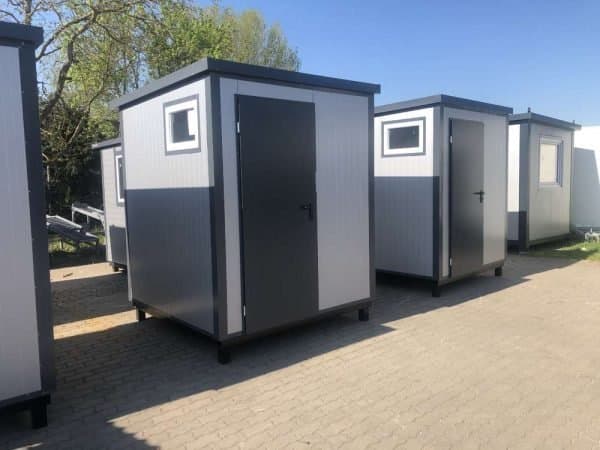
The new 2×2 metre sanitary container we offer is a self-contained and functional solution for on-site hygiene. Designed for quick installation, it packs the essentials of a complete sanitary unit into a compact volume. This container is particularly suited to construction sites, temporary events, base camps in isolated areas, or companies looking to improve working conditions for their teams. Its modular design allows it to be moved and reused as needed.
From a technical standpoint, this container is built on a Corten steel frame, an alloy that offers good corrosion resistance thanks to its protective oxide layer. The walls are generally insulated sandwich panels with a polyurethane foam or rock wool core, providing adequate thermal and acoustic insulation. The floor is made of marine plywood or moisture-resistant particleboard, covered with a non-slip surface in wet areas. The roof is waterproof and slightly sloped to drain rainwater. This 2×2 m model is a compact format, often called a "10-foot container" or "mini-container", but its exact dimensions may vary slightly by manufacturer. As a guide, a container 2 metres square offers a floor area of about 4 m², enough to install a shower cabin, toilet and sink area without excessive crampedness.
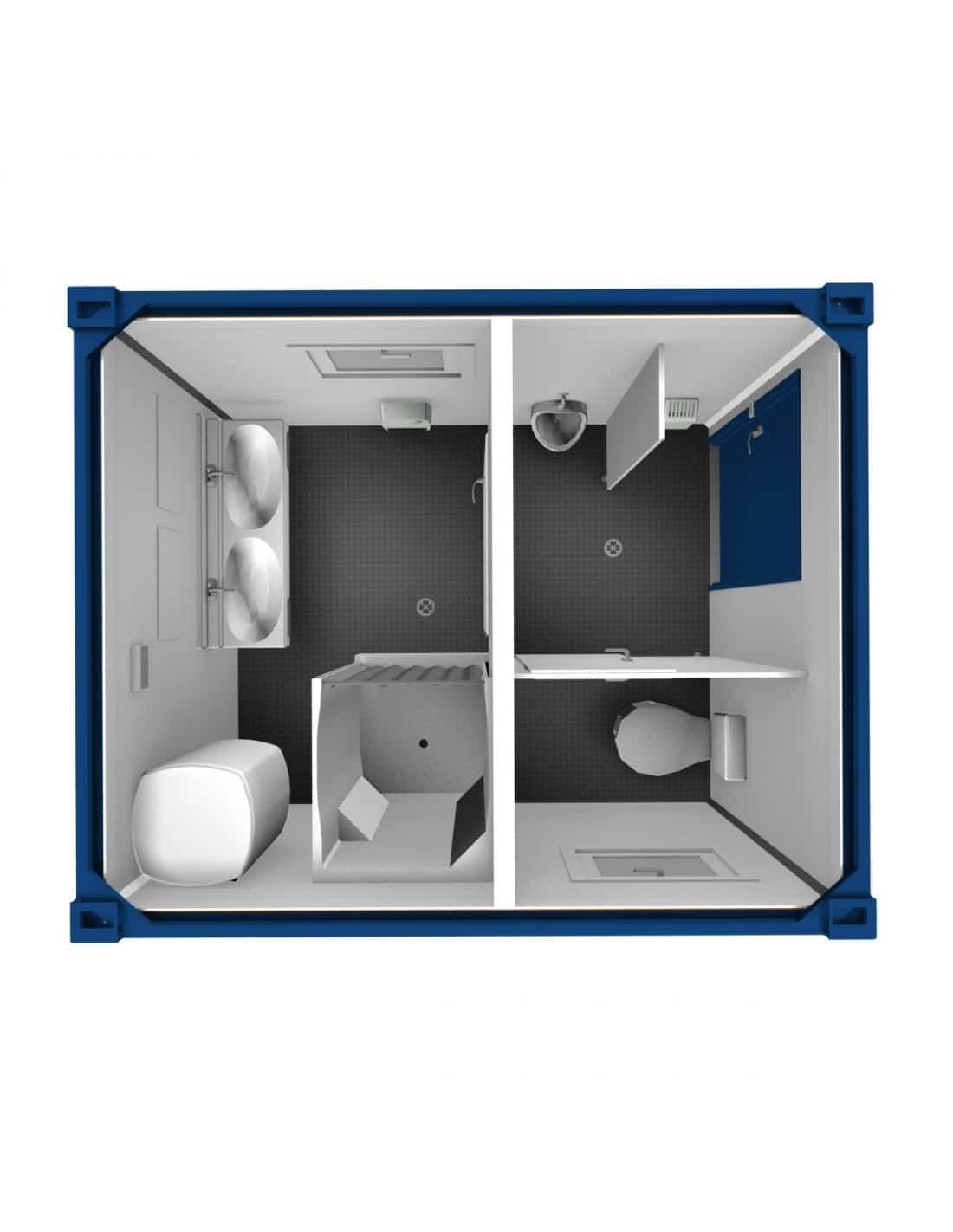
The interior equipment includes a shower cabin with tray and walls, a toilet (likely flush or chemical system depending on the model), a sink with base cabinet, a 1500 W electric wall heater and an 11 kW instant water heater operating on 400 V three-phase. This water heater provides continuous domestic hot water without storage, an advantage for intensive use. The integrated window provides natural light and essential ventilation to remove humidity. The electrical installation must comply with current standards (NF C 15-100 for low-voltage installations) and include a protection panel with residual current circuit breakers. Water supply and drainage connections must be provided: pressurised potable water supply and wastewater discharge to a network or septic tank.
This sanitary container can be used in many ways. On a construction site, it provides workers with decent showers and toilets, which is a legal obligation for employers (French Labour Code, articles R4228-1 et seq.). For a sporting or cultural event, it offers a mobile and hygienic solution. In rural areas or work camps, it is an economical alternative to traditional construction. It can also serve as a changing room with shower for leisure bases, campsites or farms. Its small size allows it to be transported on a container truck or suitable trailer, and placed on the ground on concrete blocks or sleepers to ensure perfect stability.
When purchasing, several points must be checked. First, electrical compliance: the 11 kW water heater requires a 400 V three-phase supply with sufficient power (at least 16 A per phase). The 1500 W heater can operate on single-phase 230 V. It is recommended to use a qualified electrician for the connection. Second, plumbing: pipes must be protected against frost if the container is used outdoors in cold weather. A purge system or heating trace may be necessary. Ventilation must be sufficient to avoid condensation: the window can be supplemented by an air vent or extractor. Finally, the waterproofing of the roof and openings must be checked regularly.
Routine maintenance consists of cleaning surfaces, checking seals, descaling the water heater if the water is hard, and checking that electrical equipment works properly. Annual servicing by a professional is advised for the water heater and electrical system. The lifespan of a well-maintained sanitary container can exceed 15 to 20 years, especially if the metal structure is protected against rust (regular painting).
Regarding regulations, installing a sanitary container on private land may require planning permission depending on the surface area and duration. In France, a container is considered a construction if permanently fixed to the ground; in that case, a building permit or prior declaration may be required. For temporary use (less than 3 months), a simple notification to the town hall may suffice, but it is always wise to check. Transporting the container must comply with size and axle load rules; an exceptional convoy may be necessary if dimensions exceed standard limits (2.55 m wide, 4 m high, 16.5 m long). A 2×2 m container remains within standard transport norms.
In terms of safety, the installation must be equipped with a smoke detector and a fire extinguisher suitable for electrical fires. Electrical equipment must be earthed. If the container is used as a changing room, it must comply with hygiene and food safety rules if food is handled nearby.
Our container is offered new, guaranteeing the absence of hidden defects and an optimal lifespan. We can also produce other sizes, colours or configurations to your specifications. Monthly rental at a low rate is possible, allowing you to test the solution before a definitive purchase or to meet a one-off need. Whether for a few weeks on a construction site or for permanent use, this 2×2 m sanitary container is a reliable, quick-to-deploy and scalable solution.
To summarise, this new 2×2 m sanitary container is a complete sanitary unit, ready to be connected. It includes a shower, toilet, sink with cabinet, 1500 W heater and 11 kW instant water heater. Its Corten steel structure and sandwich panel insulation give it robustness and comfort. It is aimed at construction professionals, event organisers, local authorities and individuals. Remember to check connections, maintenance and local permits. Do not hesitate to contact us for a custom quote or rental.
Now that the technical basics and general uses are set out, let us examine in more detail the specific maintenance of each piece of equipment, because the durability of a sanitary container largely depends on the regularity of interventions. The shower cabin first requires weekly cleaning of the walls and tray with non-abrasive products to avoid scratches. Silicone seals should be inspected every six months: if they blacken or peel off, they must be replaced to prevent infiltration behind the walls. The shower drain must be regularly cleared of hair and soap residue, the leading cause of blockages. Once a year, a full descaling with a suitable product (citric acid or white vinegar) removes accumulated limescale, especially in hard water areas.
The toilet then requires particular attention depending on the type installed. If it is a standard flush toilet, the flush mechanism (float, valve seal) should be checked every three months and the bowl cleaned with a disinfectant gel. In case of intensive use, descaling the tank may be necessary. If the model is a chemical or macerator system, the tank must be emptied according to usage frequency (generally every one to two weeks for daily use by several people) and the active product replaced. Macerator toilets, increasingly common in containers, require an electrical supply and pressurised discharge; their maintenance involves checking the pump works properly and avoiding throwing non-degradable objects into them.
The sink and its base cabinet must be cleaned daily. The mixer tap can scale up: soaking the aerator in white vinegar once a month is enough to regenerate it. The cabinet, if made of melamine or PVC, is sensitive to standing moisture: splashes should be wiped and the worktop checked for proper sealing to the wall. Hinges and drawers can be lubricated once a year.
The 1500 W electric wall heater is a simple device, but its fins or front must be dusted monthly to prevent dust burning and giving off an unpleasant smell. A check of the thermostat and heating element by an electrician every two years is recommended. The 11 kW instant water heater is more sensitive: the heating elements should be checked annually and descaled if necessary, as limescale reduces flow and increases consumption. The heating body seal must be replaced if it leaks. A temperature rise test can detect a loss of power.
The container structure itself requires minimal but regular maintenance. A visual inspection of the roof after each storm identifies debris or accumulated leaves that could retain moisture. Gutters, if any, should be cleaned twice a year. Exterior paint, if flaking, should be touched up with anti-rust paint suitable for Corten steel. Door and window seals should be checked and lubricated (with silicone grease) to prevent them sticking or cracking. Finally, foundation blocks must remain stable: ground subsidence can unbalance the container and cause deformation.
Let us now turn to the specific regulations for transporting this type of container in France. A 2×2 metre container, often called "10-foot" although its dimensions do not exactly match a standard 10-foot (about 3 m long), falls into the category of indivisible loads. Its road transport is subject to the Highway Code and, for exceptional convoys, to the amended decree of 4 May 2006. The size limits without special authorisation are 2.55 m width, 4 m height and 16.5 m length for an articulated combination. A 2×2 m container, generally under 2.60 m high, remains within these limits. However, the total weight (container + equipment + water) can reach several tonnes, requiring a suitable truck and compliance with axle loads. The carrier must ensure the container is properly secured on the trailer with compliant straps or chains, and that the centre of gravity is low.
If the container is to be shipped by sea, it may be considered an out-of-gauge package and be subject to full container load (FCL) or less than container load (LCL) transport. ISO 668 and ISO 1496 define the dimensions and strengths of maritime containers, but a fitted-out container may not meet all stacking or corner lifting requirements. It is therefore important to check that the four lifting corners are accessible and compliant. For rail transport, the same size rules apply, with additional restrictions depending on tunnels and track categories.
In terms of planning, installing a sanitary container may be subject to authorisation. In France, the Planning Code distinguishes permanent constructions from temporary installations. A container placed on blocks and not fixed to the ground may be considered a light installation, but if connected to utilities (water, electricity, drainage) and used for more than three consecutive months, it may be treated as a construction and require a building permit. In protected areas (listed sites, near historic monuments), prior declaration is often required. It is advisable to consult the town hall planning department before any installation.
For construction sites, regulations on sanitary facilities are precise. Article R4228-1 of the Labour Code requires employers to provide workers with appropriate sanitary facilities, including at least a sink, shower and toilet. The number of cabins depends on the workforce. A 2×2 m container with shower and WC can be suitable for a small workforce (up to 5 to 10 people depending on duration and conditions). For larger workforces, more units will be needed or a larger container chosen.
Let us now address sector-specific use cases, as each sector has specific constraints. In construction, the sanitary container is often used alongside larger base camps. It can be rented for the duration of the project, then returned. Public works companies appreciate its mobility: it can be moved as the site progresses. In events, organisers of festivals, trade shows or sports competitions need temporary sanitary facilities. A 2×2 m container with shower is particularly sought after for multi-day events where participants sleep on site (campsites, gatherings). In agriculture, farms hiring seasonal workers must provide sanitary facilities; this container can be installed near fields or greenhouses. In humanitarian or military contexts, it serves as a field sanitary unit, transportable by truck or helicopter (if lightened). Finally, for individuals, it can serve as a site bathroom during major renovation, or additional sanitary facilities for a pool or guesthouse.
Let us now compare this 2×2 m container with other sizes and types. The standard 20-foot sanitary container (about 6 m x 2.4 m) offers about 14 m² and can be divided into several cabins (showers, separate WC, changing room). It is more suited to large sites or permanent base camps. The 10-foot container (about 3 m x 2.4 m) is an intermediate: more spacious than the 2×2 m, it allows adding a changing area or a second cabin. The 2×2 m container is the most compact: it fits into tight spaces, transports on a simple flatbed truck and can be handled by a small crane or forklift. In terms of cost, it is generally cheaper to buy and rent than a 20-foot, but its price per square metre may be higher. The choice therefore depends on the number of users, duration of use and available space.
There are also high-end sanitary containers, with air conditioning, solar water heating, or greywater treatment by filtration. The model we offer is a new standard model with essential equipment. It can be supplemented with options such as an air extractor, water softener, or a more powerful heating system for cold regions. We can study any specific request.
Finally, let us not forget the financial and logistical aspect. Buying a new container represents an investment that can be amortised over several years. Monthly rental at a low rate is attractive for one-off needs or to test the product. Transport and installation are the buyer's or renter's responsibility, but we can refer you to partners. Also allow for the cost of connections (electricity, water, drainage) and, if necessary, rental of a temporary septic tank. A precise quote will be provided on request.
In conclusion, this new 2×2 m sanitary container is a complete, robust and scalable solution for on-site hygiene. Its equipment (shower, WC, sink, heater, water heater) makes it a functional unit ready for immediate use. Regular maintenance and compliance with transport and planning rules guarantee a long lifespan. Whether you are a construction professional, event organiser, local authority or individual, this container will meet your needs. Contact us for a custom quote or to learn more about our rental options.