Description
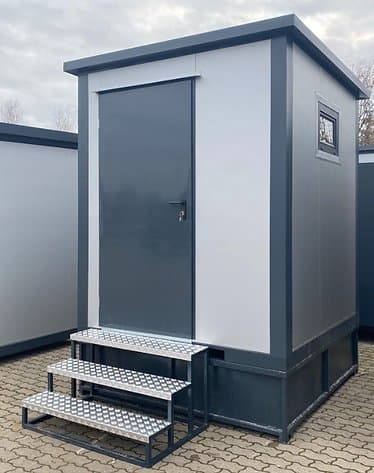
The new WC Box sanitary container with double cabin is a mobile, self-contained solution designed to meet hygiene needs on construction sites, at events or on any temporary site without fixed facilities. This model, reference KWCT2X2, features a 2 m x 2 m double cabin, offering optimised interior space for installing functional sanitary facilities. Unlike a standard shipping container, it is a specially fitted module, ready to be connected to utilities or used autonomously depending on the chosen configuration.
The structure is based on a metal frame and walls made of 80 mm thick thermally insulated sandwich panels. This insulation ensures efficient regulation of the interior temperature, limiting energy losses and maintaining a comfortable level, whether in summer or winter. The exterior finish is grey and white, while the interior is designed to facilitate maintenance and daily use. The PVC flooring, resistant and easy to clean, completes this interior layout.
In terms of equipment, this sanitary container includes a retention tank for wastewater management, a urinal, and a window providing ventilation and natural light. The electrical installation is fully carried out in accordance with CE directives: it includes 230V sockets, a ceiling light and an electric wall heater. This equipment allows quick commissioning once the module is connected to a power source and, if applicable, a water point. The configuration is modular: the cabin can be fitted as a WC with retention tank or as a shower, depending on the specific needs of the project.
This sanitary container is suitable for a wide variety of applications. On construction sites, it provides an immediate hygiene solution for teams, without requiring heavy works. At cultural, sporting or private events, it allows clean and functional sanitary facilities to be installed within a few hours. Temporary sites, living bases, storage areas or farms also find a practical answer. Its compact design (2 m x 2 m) facilitates transport and installation in restricted spaces, while offering sufficient interior volume for comfortable use.
From a technical point of view, this module follows the construction principles of shipping containers, although it is not intended for maritime transport. The cabin dimensions (2 m x 2 m) are smaller than those of an ISO 1C (20 ft) or 1A (40 ft) container, making it lighter and more manoeuvrable. The height is not specified, but sanitary modules of this type generally have an interior height of between 2.2 and 2.5 metres, allowing comfortable standing. The empty weight depends on the materials used; for a module of this size with insulation and equipment, an order of magnitude of 1,000 to 1,500 kg can be estimated, without this being contractual data. It is advisable to verify this information with the supplier before any lifting or transport.
The 80 mm sandwich panel insulation is a key element for energy performance. It reduces thermal losses and helps maintain a pleasant temperature with a simple electric heater. In summer, it limits overheating, especially if the window is fitted with a blind or sun protection. This insulation also helps to reduce outside noise, an asset on noisy construction sites or near residential areas.
The CE-compliant electrical installation includes 230V sockets, a ceiling light and a wall heater. This means the container can be connected to a standard electrical network via a plug or panel, depending on the configuration. It is important to comply with current standards for connection, particularly regarding earthing and residual current protection. For isolated use, a generator can be used, provided the power is correctly sized according to the installed equipment (heater, lighting, possibly water heater if shower).
Wastewater management is ensured by an integrated retention tank. This tank allows autonomous use without immediate connection to a sewer system. It must be emptied periodically by a specialised company or discharged into an appropriate treatment station. The tank capacity is not provided in the known specifications; it is advisable to check with the manufacturer for its exact volume and emptying frequency based on the number of users. For shower use, the retention tank collects grey water, while for WC it collects black water. In both cases, a lifting pump may be necessary if gravity drainage is not possible.
The included urinal is appreciated on sites with high male traffic, as it reduces water consumption and limits wear on installations. The window provides natural light and ventilation, two factors of hygiene and comfort. The PVC flooring is resistant to moisture and common cleaning products; regular maintenance with non-abrasive products helps extend its lifespan.
When purchasing a new sanitary container, several points deserve attention. Check the compliance of the electrical installation (CE certificate, wiring diagram) and the presence of a 30 mA residual current device for personal protection. Ensure that the insulation is continuous, without major thermal bridges, particularly at openings. Check water and air tightness, especially around the window and cable passages. Request material certificates if you have environmental requirements. Finally, confirm the retention tank capacity and the planned emptying method.
Transport of this module in France is subject to abnormal load regulations if its dimensions or weight exceed the limits allowed for a standard vehicle. For a 2 m x 2 m module, transport can often be carried out on a flatbed truck or in a large van, but the total height (module + vehicle) must remain below 4 metres to avoid a special permit. The weight must be compatible with the driver's licence (3.5 tonnes for a B licence). It is recommended to use a transport professional for lifting and installation, to ensure the safety and integrity of the container.
On-site installation requires a flat, stabilised surface, for example concrete pads or crossbeams. Correct shimming prevents deformation and ensures the proper operation of doors and equipment. If the container is intended to remain in place for a long time, anchoring to the ground may be necessary to withstand strong winds. Also provide access for tank emptying and routine maintenance.
In terms of maintenance, regular visual inspection of seals, fastenings and paint helps prevent corrosion. Sandwich panels are generally protected by a plastic film or paint; in case of deep scratches, touch-up is advisable. Clean the window and check that ventilation works properly. For the electrical installation, have the tightness of connections and the condition of cables checked periodically. The wall heater must be dusted to maintain its efficiency.
This sanitary container can be integrated into a larger living base, including office, canteen or changing room modules. Its modularity and standardised design facilitate extensions or relocations. It represents an economical alternative to traditional construction, with reduced implementation time and the possibility of reuse on several sites.
To further explore the use of this module, it is useful to examine sector-specific use cases in more detail. In the building and public works sector, sanitary containers are often required by project owners to ensure hygiene conditions compliant with the Labour Code. On a renovation site in an urban environment, available space is often limited; the 2 m x 2 m double cabin fits into a courtyard or on a narrow platform, without encroaching on traffic areas. For linear sites (roads, networks, railways), this type of module can be moved as work progresses, provided a vehicle-accessible route and a stabilised installation area are available. In the events sector, organisers look for clean, lit and heated sanitary facilities capable of operating autonomously for several days. The retention tank avoids complex connections on sites without utilities; emptying must then be planned according to attendance. For festivals, it is common to group several modules to increase capacity, installing them in dedicated areas with access for pumping trucks. In the agricultural or forestry sector, isolated farms use these containers as living base sanitary facilities for seasonal workers, with connection to a water tank and discharge to an existing sanitation system or regular emptying. Temporary living bases for industrial maintenance, production shutdowns or wind farm sites also use this type of module, appreciated for its robustness and ease of implementation.
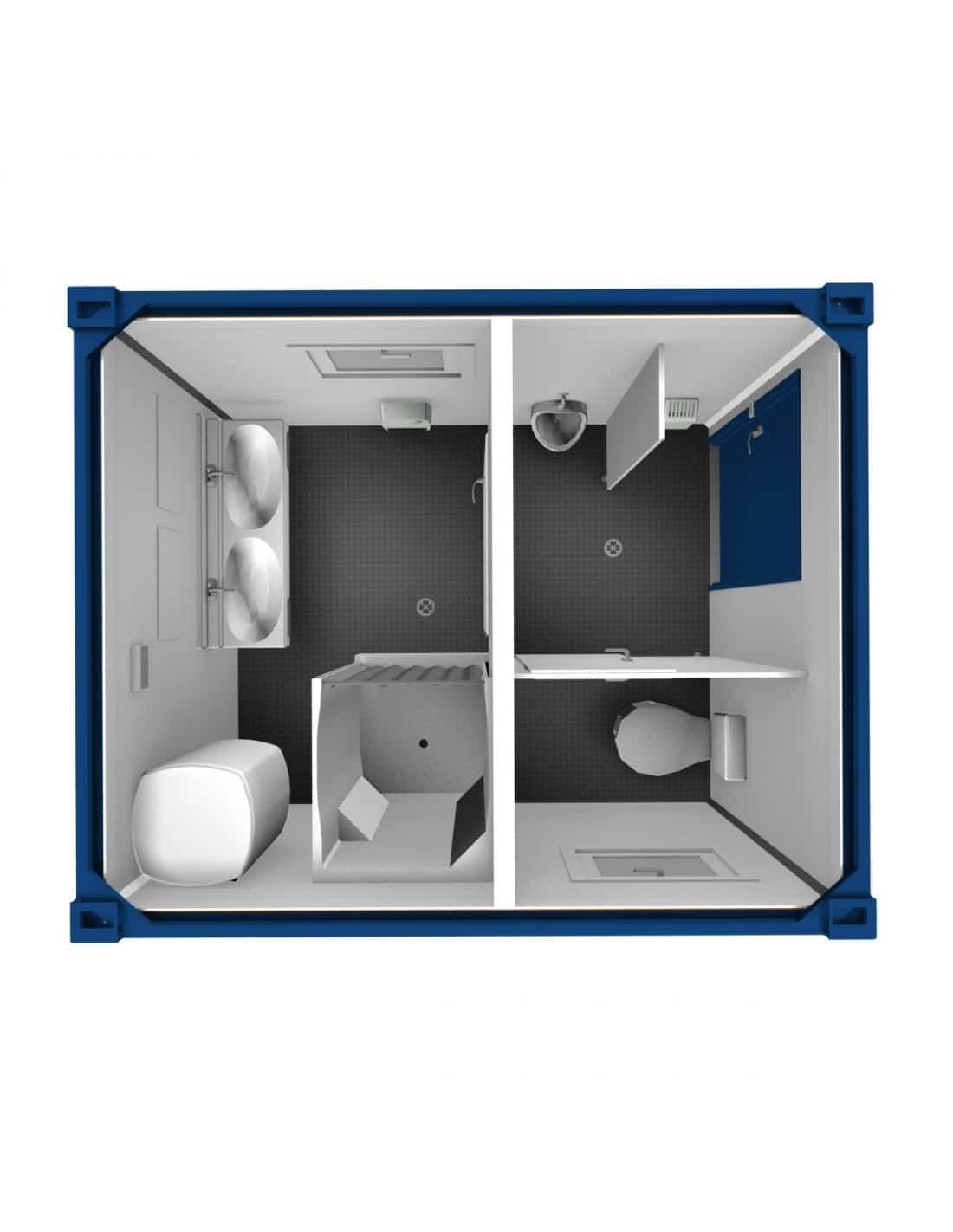
Another important aspect concerns comparison with other sizes and types of sanitary containers. The 2 x 2 m model is compact and suitable for individual or low-traffic use. For larger needs, there are 10, 20 or 40 ft sanitary containers, including several cabins, collective showers, multiple washbasins and sometimes changing rooms. These larger modules offer greater capacity but require heavier transport and handling, as well as a larger floor area. The choice depends on the number of simultaneous users, duration of use and installation constraints. A 20 ft container (approximately 6 m x 2.4 m) can accommodate several cabins and a common area, while a 40 ft (approximately 12 m x 2.4 m) allows complete sanitary blocks with male/female separation. The 2 x 2 m model presented here stands out for its relative lightness and modularity: it can be combined with other modules to create a customised set. In terms of standards, shipping containers are governed by ISO 668 (dimensions and masses) and ISO 1496 (specifications and testing). Derived sanitary modules generally follow these construction principles, but they are subject to local regulations applicable to sanitary and electrical installations. In France, the electrical installation must comply with NF C 15-100 for low-voltage installations, and equipment must bear the CE marking. It is recommended to have the installation checked by a competent body before commissioning, especially if the module is intended to receive the public. For ERP (establishments receiving the public), additional requirements may apply regarding accessibility, fire safety and hygiene. In this case, the competent safety commission should be consulted.
Routine maintenance deserves detail to ensure the container's longevity. The metal structure, if made of Corten steel or galvanised steel, resists corrosion well, but fastening areas and welds may be sensitive. An annual check of the paint and any touch-ups help prevent rust. Sandwich panels should be inspected for possible infiltration at joints. The PVC floor can be cleaned with a mild detergent; avoid aggressive solvents that could dull or weaken it. Sanitary facilities (WC, urinal) require regular descaling and checking of seals. The retention tank must be emptied before saturation, and it is advisable to keep an emptying log for traceability. The window should be cleaned and its seal checked; if broken, replacement is simple. The electrical installation should be checked periodically: test the residual current device, check terminal tightness, replace bulbs or heater if necessary. In winter, if the module is not in use, it is recommended to drain water pipes to prevent freezing. If the module is equipped with a shower, more frequent maintenance is necessary to prevent mould; adequate ventilation is essential.
Regarding transport regulations in France, the sanitary container is considered an indivisible load. Its transport is subject to the rules of the Highway Code and, where applicable, abnormal load regulations (Decree No. 2017-16 of 6 January 2017). The size limits for a standard vehicle are 2.55 m wide, 4 m high and 16.5 m long for an articulated combination. A module 2 m wide and 2 m long, placed on a truck, remains within these limits, but the total height must be checked. If the module exceeds 4 m in height once loaded, an abnormal load permit is required, possibly with a pilot vehicle. The authorised gross combination weight (GCW) must not be exceeded. For abnormal transport, prior authorisation must be obtained from the DREAL and imposed routes must be followed. It is also necessary to signal the convoy if the dimensions exceed the limits. For a light module, a simple crane truck may suffice, but the lifting capacity and site accessibility must be checked. Unloading must be carried out by a professional, with suitable slings and a lifting plan. Finally, if the container is imported from a country outside the European Union, customs formalities apply; CE marking is required for placing on the European market.
Another point to consider is the environmental impact and layout possibilities. Shipping containers are often reused as part of a circular economy approach, but this model is new. Sandwich panels generally consist of insulating foam (polyurethane or polystyrene) between two steel sheets. At end of life, steel recycling is possible, but separating composite materials can be complex. It is therefore advisable to favour recyclable materials and ensure the supplier can take back the module at end of life. To improve comfort, optional equipment can be added: water heater, washbasin, mirror, soap dispenser, hand dryer, LED lighting, motion detector, etc. These additions must be compatible with the existing electrical installation and not overload the circuit. A power balance is recommended before any modification.
Finally, it is useful to recall good purchasing practices. Always request a detailed technical data sheet, a dimensioned drawing and conformity certificates. Check that the container is indeed new and not refurbished, unless otherwise stated. Compare offers taking into account included equipment and options. Budget for transport, handling, connection and maintenance. For professional use, a site visit before delivery helps anticipate access constraints. Finally, ensure the supplier offers after-sales service and spare parts. With these precautions, the new WC Box sanitary container with double cabin is a reliable and durable solution for many projects.