Description
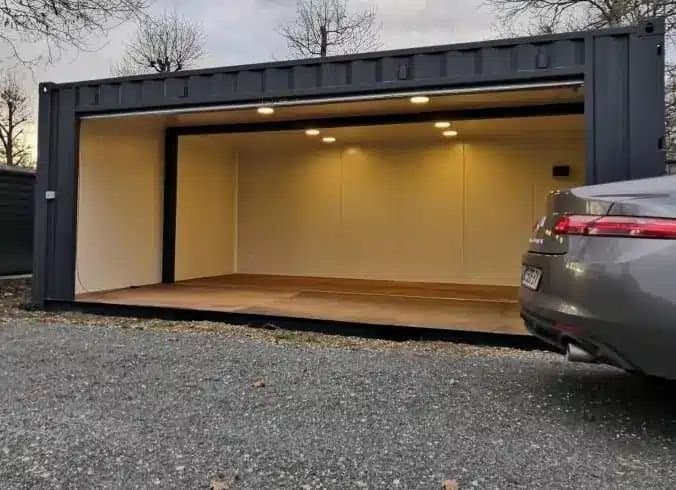
A shipping container garage is a robust, modular storage solution designed to shelter one or more vehicles. It is built by assembling standard shipping containers, usually 20 ft (about 6 m long) or 40 ft (about 12 m long), which offer a usable area of 15 m² or 30 m² per unit. These Corten steel structures, originally designed for maritime transport, are particularly resistant to weather and corrosion. Their implementation creates a closed, secure and durable space, suitable for both personal and professional use.
The most common configuration for a two-car garage is to line up three 20 ft containers side by side, representing an area of about 45 m², with a width of 6 m and a depth of 7.5 m. This layout offers enough interior volume to park two passenger cars, but also motorcycles, vans, light trucks, minibuses, motorhomes, trailers or even a small boat. Depending on the number of vehicles to be stored and the space available on your land, it is possible to combine 20 and 40 ft containers, or add modules to create custom configurations. The garage can be installed on a concrete slab, blocks or stabilized ground, subject to local planning rules.
Each shipping container is built to international standards (ISO 668 and ISO 1496) that guarantee proven dimensions and mechanical strength. The walls, roof and floor are made of Corten steel, a low-alloy steel with good resistance to atmospheric corrosion. The floor is usually 28 mm marine plywood, treated to withstand moisture and heavy loads. Containers are stackable and can support significant loads, allowing multi-level arrangements if foundations and permits allow. The original double doors are fitted with locking bars and seals that protect the contents from weather and intrusion.
Using a container garage has several advantages. The structure is immediately available and can be installed quickly, without heavy groundwork. It is demountable and movable, which can be an asset if you move or want to change the layout. Corten steel requires no special maintenance apart from regular visual checks and occasional anti-corrosion treatment on scratched areas. Finally, the cost of acquisition and installation is often lower than that of a masonry garage of equivalent surface area, especially if you choose used containers in good condition.
For a garage, dry containers (with solid walls) of 20 or 40 ft are generally preferred, in standard or high cube version. The high cube version offers an internal height of about 2.69 m versus 2.39 m for a standard container, which can make it easier to park tall vehicles or fit a mezzanine. Open top containers, with a removable roof, or flat racks, without side walls, are less suitable for a closed garage, except for specific top-loading needs. Reefer containers, insulated and fitted with a refrigeration unit, are not necessary for a garage, but can be considered if you want enhanced thermal insulation.
Before buying a container for a garage, it is essential to check several points. The general condition of the structure: look for perforating rust, major deformations, holes in the roof or walls, and make sure the doors close properly. The floor must be sound, without rot or sagging. The door seals must be flexible and intact. If the container has been used to transport dangerous goods, ask for a cleaning certificate or avoid it. The CSC (Convention for Safe Containers) marking must be legible and up to date, even if for static use this certification is not mandatory. Finally, check for the identification plate and identification numbers to learn the container's history.
Installing a container garage must comply with French regulations. As a general rule, a prior declaration of works is required for any new construction, even demountable, if its floor area exceeds 5 m² or if it changes the exterior appearance of the building. For a floor area over 20 m², a building permit is often required. It is advisable to check with your local planning department before any installation. In addition, if the garage is located in a protected area (classified site, near a historic monument), specific requirements may apply. Finally, transport and handling of containers must be carried out by equipped professionals (crane truck, forklift), as a 20 ft container weighs about 2.2 tonnes empty and a 40 ft about 3.8 tonnes.
Maintaining a container garage is simple. Periodic washing with clean water or a mild detergent removes dirt and limits corrosion. Scratched or rusted areas should be treated with rust remover and repainted. Door seals can be lubricated with a silicone-based product to prevent them from sticking or cracking. Hinges and locking bars should be greased once or twice a year. If the garage is for daily use, it may be wise to add ventilation to prevent condensation, especially if the container is exposed to large temperature variations. Interior insulation (foam panels, mineral wool) can improve comfort in summer and winter, but slightly reduces usable volume.
In terms of security, a container garage can be fitted with an additional lock, a padlock or an alarm system. The original doors are already robust, but it is possible to install a sectional door or a gate for more convenient access. For professional use, a workshop, office or storage space can be fitted inside the garage, ensuring compliance with fire safety rules if flammable materials are stored.
The container garage is part of a circular economy approach, as it reuses shipping containers that have already travelled the seas. This second life avoids the production of new structures and reduces the carbon footprint compared to traditional construction. In addition, steel is fully recyclable at end of life. For these reasons, it is increasingly used for modular housing, site offices, technical rooms or garages. D.S. Globe Conteneur, based in Marseille, offers shipping containers suitable for this type of project, with the possibility of choosing the size, condition and fitting options. Do not hesitate to contact us to study your configuration and obtain a personalised quote.
To choose between a 20 ft and a 40 ft container, you must consider the available space and the number of vehicles. A 20 ft container offers a usable length of about 5.90 m, an internal width of 2.35 m and a ceiling height of 2.39 m (or 2.69 m in high cube). A 40 ft container doubles the usable length (about 12.03 m) for the same width and height. To park a car, a 20 ft is more than enough in length, but the internal width of 2.35 m leaves little room to open the vehicle doors once inside. This is why many garage projects use several containers side by side, or a 40 ft container to park two cars in a row. The 40 ft high cube is particularly popular for motorhomes and converted vans, whose height can exceed 2.50 m. The 20 ft container remains more manageable for tight plots and its transport is less expensive. The 40 ft, being longer, requires a suitable truck and enough manoeuvring space for delivery.
Compared to a solid garage, the container garage stands out for its speed of implementation and modularity. A masonry garage requires deep foundations, weeks of work and a building permit. The container can be delivered and installed in one day, provided the ground is prepared. It is also possible to start with one container, then add a second a few years later to enlarge the garage. This scalability is difficult to achieve with traditional construction. However, a container garage offers less architectural freedom: dimensions are standardised and the exterior appearance remains that of a container, unless cladding is added (wood siding, render, paint). Thermal and acoustic comfort is also lower without insulation, but it can be improved with interior fittings.
Sector-specific use cases are numerous. For individuals, the container garage is used to protect a classic car, a motorhome, a boat or gardening equipment. For construction professionals, it becomes a secure equipment depot on a site, a repair workshop or a tool storage room. Farmers use it to shelter tractors, trailers or seed drills. Vehicle rental companies can park their fleet there between rentals. Local authorities see it as a solution for storing municipal equipment. Finally, logistics companies can set up a light loading dock from containers. In all these cases, the strength of Corten steel and the secure closing of the doors are major assets.
Transport regulations in France govern container delivery. A 20 ft container can be transported on a container truck or a crane truck, while a 40 ft requires a longer vehicle, often subject to traffic restrictions (peak hours, authorised gross vehicle weight). Exceptional transport may be required if the container exceeds standard dimensions or if the convoy exceeds 2.55 m in width. In this case, a traffic permit is required, issued by the prefecture. It is also important to check the height of bridges and overhead lines on the route. For home delivery, the truck must be able to access the land and have manoeuvring space to drop the container. A crane truck is often used to place the container in the exact spot, without having to roll it. If access is difficult, a forklift can take over, but the ground must be stabilised. Finally, the container must be wedged and stabilised after placement to prevent any movement.
Long-term maintenance of a container garage involves a few simple steps. Check the condition of the paint and seals once a year. If blisters appear, they may indicate underlying corrosion: scrape, treat and repaint. Check the tightness of the hinge and locking bar bolts. Clean the natural roof gutters (the ribs) to prevent water from stagnating. If the container is placed on soft ground, monitor for subsidence and add gravel if needed. In case of high humidity, a dehumidifier or mechanical ventilation can be installed. For intensive professional use, an annual maintenance contract with a specialist can be considered, but it is not mandatory.
Finally, the container garage can be customised to your needs. You can add a service door, windows, interior lighting, a power socket, insulation, a non-slip floor covering, or even air conditioning. These fittings must be carried out in compliance with electrical and fire safety rules. It is advisable to call on professionals for steel cutting and equipment installation, so as not to compromise the structure. D.S. Globe Conteneur supports you in defining your project and offers solutions adapted to your budget and your land.