Description
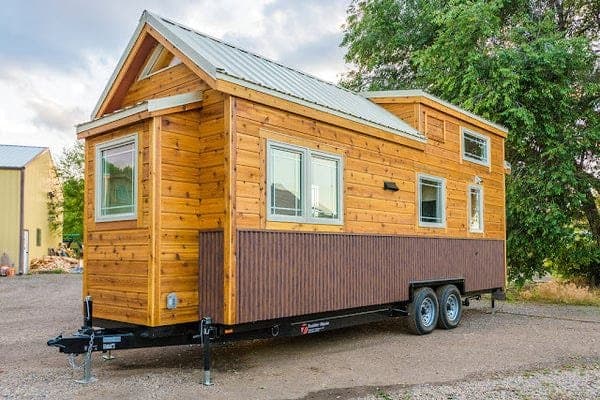
The THK 1 mobile home is a mobile dwelling designed to offer a functional and comfortable living space, without sacrificing a refined aesthetic. Mounted on a double-axle trailer, it stands out for its rustic design and raw materials that create a warm atmosphere from the moment you enter. This model is aimed at those looking for a flexible housing solution: second home, temporary accommodation, fitted-out site office or tourist accommodation. Its 24 m² of living space allows several distinct areas to be arranged, while maintaining smooth circulation.
Structurally, the mobile home rests on a double-axle trailer, which makes it easy to move and install on a plot of land. This configuration makes it suitable for mobile home parks, campsites or private land, subject to compliance with local planning rules. The design emphasizes insulation: the sprayed foam used in the walls and roof provides a valuable thermal and acoustic barrier, helping to maintain a stable indoor temperature in summer and winter. This insulation also helps reduce outside noise, an asset for residential or professional use.
The interior layout has been designed to combine comfort and practicality. The kitchen includes a stainless steel refrigerator, a four-burner cooker with extractor hood, storage cupboards and a glass splashback that adds a modern touch. The dining area and office corner provide a versatile space, ideal for meals as well as remote work. The main bedroom, accessible via a staircase, has built-in storage and a sleeping platform. Additional storage space is provided in the loft, optimizing every available volume.
The bathroom is equipped with a shower with a copper grab bar, a washbasin with vanity unit, a Separett composting toilet and a washer/dryer. This choice of composting toilet removes the need for a mains sewer connection, which can be an advantage on unserviced land. The integrated washer/dryer enhances the home's self-sufficiency for daily use.
Technically, the THK 1 mobile home is built on a double-axle trailer, with a floor area of 24 m². The exact dimensions (length, width, height) are not provided in this listing, but this type of mobile dwelling generally complies with the sizes allowed for road transport, subject to a maximum width of 2.55 m and a suitable trailer length. The unladen and laden weight depends on the layout and equipment; the trailer's payload should be checked before any movement. The materials used for the structure and interior finishes (raw pine for the ceilings, glass for the splashback, copper for the grab bar) contribute to the mobile home's rustic and durable atmosphere.
Installing a mobile home in France is governed by the Town Planning Code. As a general rule, a mobile home is considered a leisure mobile residence (RML) and its installation is permitted in residential leisure parks, campsites and certain private plots, after obtaining a development permit or a prior declaration depending on the case. It is advisable to contact the planning department of the relevant municipality to find out the local rules (zoning, installation duration, connections). For use as a main residence, the regulations are stricter and may require specific authorizations. Transporting the mobile home must be carried out by an equipped professional, with an exceptional convoy if the dimensions exceed the regulatory limits. The THK 1, due to its trailer-based design, can be moved more easily than a traditional construction, but traffic rules (size, signage, escort) must be respected.
Maintaining a mobile home like the THK 1 requires regular monitoring to preserve its condition and lifespan. It is advisable to periodically check the waterproofing of the roof and openings, clean the gutters and inspect the seals. Raw pine ceilings can be treated with a suitable oil or varnish to prevent drying out and stains. The glass splashback should be cleaned with a non-abrasive product. The copper grab bar can be polished to keep its shine. Separett composting toilets require specific maintenance: regular emptying of the compost bin, addition of carbon-rich material and checking the ventilation. The washer/dryer must be maintained according to the manufacturer's recommendations. Finally, an annual check of the trailer (axles, brakes, tires, lighting) is essential to ensure safety during travel.
Before buying a new or used mobile home, several points deserve your attention. Check the condition of the trailer and axles, as well as the presence of mandatory documents (certificate of conformity, registration document if applicable). Make sure the insulation is in good condition and that there are no signs of damp or mold. Check that the equipment works (cooker, refrigerator, hood, shower, toilet, washing machine). Find out about electrical and gas compliance, and ask for the corresponding certificates. For use in a campsite or residential park, check that the mobile home meets current standards (NF EN 1647 for leisure mobile residences, for example). Finally, assess the transport and installation costs, as well as any connection work (water, electricity, sanitation).
The THK 1 mobile home positions itself as an interesting alternative to conventional constructions for those seeking a modular, quick-to-install housing solution with rustic charm. Whether for an alternative lifestyle project, seasonal accommodation or a mobile workspace, it offers a pleasant and functional living environment. Its price of €12,550 makes it accessible for a turnkey home, subject to checking the options and additional costs. For any questions about availability, options or delivery arrangements, do not hesitate to contact D.S. Globe Conteneur, a specialist in the sale and rental of containers and mobile dwellings in Marseille.
To take the reflection further, it is useful to place the THK 1 in the broader landscape of mobile dwellings and fitted-out containers. The market today offers several families of solutions: converted shipping containers (often made of Corten steel, available in 20-foot or 40-foot, with high cube, open top or flat rack variants), trailer-mounted mobile homes like this one, tiny houses on road chassis, and off-site prefabricated modules. Each family responds to different logics in terms of mobility, durability, cost and administrative formalities. The standard shipping container, for example, offers excellent structural strength and interesting modularity (stacking, juxtaposition), but it generally requires heavier insulation and interior fitting work to become habitable, and its high weight complicates frequent moves. The THK 1 mobile home, by contrast, is designed from the outset as a living space: insulation is integrated, utilities are provided for, and the double-axle trailer allows occasional moves without a crane or container truck. This difference in design translates into a lower entry cost and often more favorable commissioning time for the mobile home, even though the container retains the advantage in structural longevity and resistance to extreme weather.
In terms of dimensions, the standard 20-foot shipping container offers about 33 m³ of interior volume and a floor area of about 14.8 m², while a 40-foot container approaches 67 m³ and 29.7 m². The THK 1, with its 24 m² of living space, therefore sits between a 20-foot and a 40-foot container in terms of area, but with an interior layout already optimized for living: mezzanine bedroom, full bathroom, equipped kitchen. A 20-foot container fitted out as a studio generally offers less sanitary comfort and storage, unless you invest in a custom fit-out. The 40-foot high cube, about 30 cm taller than a standard container, provides valuable additional volume to create a mezzanine, but it requires more demanding land and transport logistics. The THK 1 thus represents an interesting compromise for projects that prioritize ease of installation and relative mobility.
The sector-specific use cases for the THK 1 deserve to be detailed. In the construction and public works sector, it can serve as a comfortable site office, with a dedicated office corner, possible connection to electricity and water, and a rest area for teams. Its mobility on a trailer allows it to be repositioned as the site progresses, which is an advantage over a conventional site container that requires a crane truck for each move. In the tourism sector, it can be operated as unusual or seasonal accommodation in a campsite, a vineyard or an ecolodge, leveraging its rustic aesthetic and warm materials. For individuals, it is an option for a second home on family land, or a temporary housing solution during renovation work. In the tertiary sector, it can become a remote-work office at the bottom of the garden, a creative studio or an off-site meeting room. Finally, for local authorities, it can meet emergency accommodation or transitional housing needs, subject to the appropriate planning authorizations.
The question of transport and regulations deserves further exploration. In France, transporting a mobile home or a 24 m² trailer must comply with the Highway Code and the rules on weights and dimensions. For a trailer, the gross vehicle weight rating (GVWR) determines the category of license required: up to 750 kg, no specific license is required beyond a category B license; between 750 kg and 3,500 kg, a category B license is sufficient if the combined GVWR of the towing vehicle and trailer does not exceed 3,500 kg, otherwise a BE license is required. Above 3,500 kg, other categories apply. The maximum authorized width for a vehicle in traffic is 2.55 m; beyond that, an exceptional convoy is required, with prior authorization and possibly an escort. The maximum length of a vehicle + trailer combination is generally 18.75 m, but local restrictions may apply. The maximum height is 4 m; beyond that, a first-category exceptional convoy is necessary. It is therefore essential to check the exact dimensions of the THK 1 before any transport, and to use a qualified professional for exceptional movements. D.S. Globe Conteneur, based in Marseille, can assist its clients with these procedures and organize transport under the best conditions.
Routine maintenance of the THK 1 can be structured by area. Outside, the body and chassis should be washed regularly with clean water and mild soap, paying attention to areas exposed to spray or pollution. A visual inspection of welds, fastenings and any rust spots should be carried out at least twice a year. Axles, brakes and tires must be checked before each trip, and bearings greased according to the manufacturer's recommendations. Window and door seals should be checked and replaced if necessary. Inside, regular cleaning of surfaces and daily ventilation help limit humidity. Raw pine ceilings can be dusted with a soft cloth and treated once a year with a natural oil. The glass splashback should be cleaned with an ammonia-free glass cleaner. The copper grab bar can be revived with a mixture of white vinegar and salt, then rinsed and dried. Separett toilets should be emptied every two to four weeks depending on use, and the compost should be kept at the correct moisture level. The washer/dryer requires monthly filter cleaning and periodic descaling. Finally, an annual check of the electrical and gas installation by a professional is strongly recommended to ensure occupant safety.
Compared to other types of mobile dwellings, the THK 1 has advantages and limitations that are useful to know. Against a tiny house on wheels, it offers comparable living space, but with a generally more standard ceiling height and a design closer to a traditional mobile home, which can make it easier to obtain specific financing or insurance. Against a fitted-out shipping container, it is lighter and easier to move, but probably less resistant to impacts and corrosion over the very long term. Against an off-site prefabricated module, it is more mobile, but may offer fewer high-end finishes. The choice will therefore depend on the project: for long-term sedentary use, a container or prefabricated module may be more relevant; for semi-nomadic use or quick installation on a plot, the THK 1 mobile home is a serious candidate. It is also possible to consider combinations: using the THK 1 as the main unit and adding a storage container or office container, ensuring aesthetic harmony and consistency of connections.
Finally, financial and insurance aspects should not be overlooked. The advertised price of €12,550 corresponds to the mobile home as described; transport, installation, connection to utilities (water, electricity, sanitation) and, where applicable, development taxes should be added. Home insurance suitable for leisure mobile residences is necessary, and some companies offer specific policies. For rental use, non-occupant owner insurance may be required. It is advisable to obtain several quotes and check the cover offered (fire, water damage, theft, liability). Finally, if the mobile home is intended to be resold, its value will depend on its condition, age and equipment; rigorous maintenance and keeping invoices and certificates will facilitate the transaction. The THK 1, with its timeless design and complete equipment, should retain a decent resale value on the second-hand market, especially if kept in good condition.