Description
The storage container with containment is a solution dedicated to the confinement of hazardous and polluting liquids. Entirely made of HDPE (high-density polyethylene), it combines a closed storage structure with an integrated containment sump. This product meets safety and environmental protection requirements for the storage of corrosive, acidic, alkaline, varnish, paint, hydrocarbon products or various waste. It is particularly suitable for industrial sites, workshops, logistics platforms and companies subject to regulations on classified installations.
The one-piece HDPE design ensures excellent chemical and corrosion resistance. Unlike metal structures, HDPE does not rust and withstands contact with many aggressive products. It is also 100% recyclable, which is part of a sustainable equipment management approach. The material offers good impact and UV resistance, allowing outdoor use without premature degradation. The gray color (close to RAL 7016) ensures discreet integration on most sites.
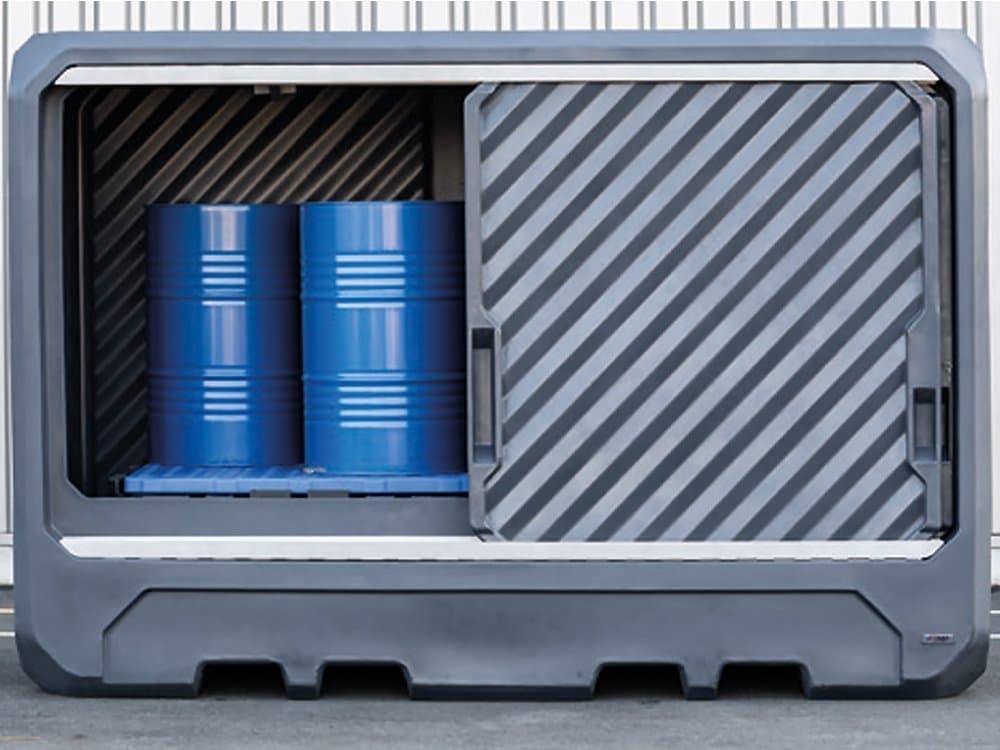
This container is sized to receive two separate slots, each able to accommodate an IBC or a pallet of four 220 L drums. The useful internal dimensions of each slot are 1370 mm long, 1370 mm wide and 1368 mm high. These volumes allow standardized containers to be housed while facilitating handling operations. The maximum allowable load is 1500 kg per slot, for a total capacity of 3000 kg distributed over the two zones. This robustness is made possible by the HDPE structure and by a design that distributes forces.
Access to the products is facilitated by a wide opening and two sliding doors mounted on stainless steel rails. These doors are equipped with a key lock, which secures storage and protects products from intrusion. The sliding system limits floor space and allows the container to be opened even in tight spaces. The design also promotes natural ventilation, reducing the risk of vapor accumulation. The roof is fitted with a rainwater drainage system, preventing stagnation and overflow into the interior.
The integrated containment offers a volume of 2800 L, compliant with regulatory requirements for the storage of polluting liquids. According to the French decree of February 2, 1998, the containment capacity must be at least equal to 100% of the volume of the largest container for a single vessel, or 50% of the total volume for several containers, without being less than 100% of the volume of the largest. With 2800 L, this container covers the common needs for two 1000 L IBCs or eight 220 L drums. It is important to check the chemical compatibility of HDPE with the stored products and to regularly check for the absence of cracks or deformations.
Handling is ensured by integrated fork passages, compatible with forklifts and stackers. This design allows the container to be moved loaded or empty without particular effort. The empty weight of 220 kg remains reasonable for equipment of this size, and the container is delivered assembled, ready for use. It can be placed on a flat, stabilized surface, preferably concrete or asphalt, to ensure stability and prevent settling.
Outdoor use is possible thanks to HDPE's resistance to weather and UV. However, it is recommended not to expose the container to extreme temperatures beyond the ranges recommended by the manufacturer. In the event of installation in a flood zone, additional precautions may be necessary to avoid floating. The container must not be used to store products that are incompatible with each other without suitable separation measures.
Routine maintenance consists of cleaning the interior and exterior walls with soapy water or a mild detergent, avoiding aggressive solvents that could alter the HDPE. It is advisable to periodically check the condition of the rails, locks and seals, and to ensure that the rainwater drainage system remains clear. The containment must be drained according to current procedures and the recovered liquids treated as hazardous waste.
This storage container with containment is a relevant alternative to open containment trays or metal shelters. It offers full protection against bad weather, safe confinement and easy handling. It is suitable for companies that must store hazardous liquids while complying with regulatory obligations, while optimizing space and facilitating inspections. For sites subject to authorization or registration under ICPE, it is recommended to verify the conformity of the installation with prefectoral requirements and the departmental health regulations.
In summary, this HDPE container with 2800 L containment combines robustness, safety and functionality. Its two modular slots, key lock, sliding doors and forklift handling make it a versatile piece of equipment for storing chemicals and waste. It is part of a pollution prevention and regulatory compliance approach, while offering a durable and recyclable solution.
To go further in the use of this container, it is useful to detail good operating practices and the points of vigilance that condition its performance over time. The first step is to precisely define the products intended for storage. Not all liquids react in the same way with HDPE. While this material has excellent inertness against many acids, bases and hydrocarbons, certain chlorinated or aromatic solvents or highly concentrated products can cause swelling, softening or stress cracking. It is therefore imperative to consult the safety data sheets (SDS) of the products and verify their compatibility with HDPE before any commissioning. In case of doubt, an aging test or consultation with the material supplier is recommended. This prior verification avoids irreversible damage and guarantees the containment's integrity.
Preparing the installation site is another key factor. The container must be placed on a flat, stable surface capable of supporting a total load that can reach several tons once filled. A concrete slab or compacted asphalt are the safest solutions. Too steep a slope could cause stress on the structure and hinder the flow of liquids toward the drainage point. It is also advisable to provide sufficient maneuvering space for the forklift, as well as clear access for operators. If the container is installed outdoors, a safety distance from networks, watercourses and traffic areas may be required by local regulations or the urban plan.
The internal organization of the container deserves particular attention. The two slots are independent and can receive different containers. It is recommended not to mix incompatible products in the same slot, even if they are contained in separate drums or IBCs. An accidental leak could bring reactive substances into contact. For better traceability, it is possible to label each zone and keep a register of entries and exits. Palletized drums must be stably positioned, without exceeding the limits of the slot, so as not to obstruct the sliding doors or hinder closing.
Rainwater management is integrated into the design: the roof has a drainage system that prevents water from accumulating and entering the storage area. However, it is recommended to regularly check that this system is not obstructed by leaves, debris or insect nests. A blocked flow could cause overflow onto the walls and lateral infiltration. In windy areas, anchoring the container can be considered, although its empty weight of 220 kg and low wind exposure provide natural stability. Anchoring kits suitable for HDPE are available on the market.
Preventive maintenance extends the service life of the equipment. A monthly visual inspection allows possible cracks, discolorations or deformations to be detected. The stainless steel door rails must be cleaned and lubricated with a product compatible with stainless steel and HDPE. Locks must be checked and protected against frost in winter. The containment must be inspected to ensure it is empty or that the liquid level does not exceed the intended capacity. In the event of an accidental spill, the spilled product must be pumped or absorbed, then the area cleaned with an appropriate detergent and the waste disposed of through the regulatory channel. A maintenance log is a good tool for tracking these operations and anticipating part replacements.
Regular cleaning of the interior and exterior can be done with a low-pressure water jet, with a neutral soap. High pressures and high temperatures should be avoided because they can scratch or deform the HDPE. Powerful solvents, acetone, ketones and chlorinated hydrocarbons must not be used for cleaning. A soft cloth or non-abrasive brush is sufficient for ordinary soiling. After cleaning, abundant rinsing and natural drying help preserve the appearance and properties of the material.
The regulations applicable to the storage of hazardous products are not limited to the decree of February 2, 1998. Depending on the activity and classification of the establishment, other texts may apply, in particular the ICPE nomenclature (installations classified for environmental protection), the CLP regulation for the labeling and packaging of chemical substances, as well as specific prefectoral decrees. Companies that store flammable liquids must comply with additional rules regarding fire prevention, ventilation and safety distances. The HDPE container can be integrated into a risk prevention plan, but it does not replace the structural measures required for certain highly hazardous storages. It is therefore essential to consult a design office or the inspection of classified installations to validate the conformity of the whole.
The transport and handling of the container itself are subject to a few common-sense rules. Although it can be moved by forklift, it must never be lifted by the roof or doors. The fork passages are designed for lifting from below, respecting any markings. During road transport, the container must be strapped or chocked to prevent slipping. Empty, it can be loaded onto a flatbed truck or into a shipping container, but its volume (about 11.3 m³) requires suitable organization. For exceptional transport, authorization may be required if the dimensions exceed regulatory limits, which is not the case here (width 1.60 m, height 2.20 m).
Compared to other storage solutions, this container offers specific advantages. Open containment trays, often also made of HDPE, offer less protection against rain and intrusion. Metal shelters with integrated containment are heavier, susceptible to corrosion and require paint maintenance. Shipping containers converted into storage areas are generally not equipped with integrated containment and must be fitted out, which increases cost and complexity. Finally, safety cabinets for chemicals are suitable for small volumes, but not for IBCs or pallets of drums. The HDPE container with 2800 L containment therefore positions itself as an intermediate solution, offering large capacity, good chemical resistance and easy handling.
In terms of capacity, there are models of different sizes. Some containment containers have only one slot, for one IBC or four drums. Others, larger, can accommodate four slots, with containment that can reach 5000 L or more. The choice depends on the volume of products to be stored, the available space and containment requirements. The two-slot model with 2800 L containment is a good compromise for sites that must store two IBCs or eight drums while complying with the 50% or 100% rule. It also allows two different types of products to be separated without mixing in the event of a leak.
The sectors concerned are numerous. In the chemical and pharmaceutical industry, the container allows the storage of liquid raw materials, solvents or waste awaiting treatment. In the automotive and mechanical sector, it holds oils, lubricants, antifreeze or paints. Surface treatment and electroplating companies store acid or alkaline baths in it. Construction and public works use it for hydrocarbons, resins and additives. Local authorities and waste collection centers can store hazardous liquid waste there, such as used oils or plant protection products. Finally, laboratories and research centers find a containment solution for various chemical products.
For companies subject to ISO 14001 or committed to a CSR approach, this container contributes to reducing pollution risks and regulatory compliance. Its recyclability at end of life is an additional asset. HDPE can be shredded and reused to manufacture new products, thus reducing the environmental footprint. It is recommended to inquire with local recycling channels to organize end-of-life collection.
Finally, purchasing such equipment must be accompanied by reflection on staff training. Operators must be made aware of chemical risks, emergency procedures in the event of a spill and the correct use of sliding doors and locking systems. Periodic drills can be organized to test responsiveness in the event of a leak. Clear display of safety instructions and emergency numbers near the container is recommended.
In conclusion, the 2800 L HDPE storage container with containment is a complete, durable piece of equipment that complies with basic requirements for the storage of hazardous liquids. Its optimal use relies on good knowledge of the products, suitable installation, regular maintenance and regulatory monitoring. It offers a turnkey solution for companies that want to secure their storage while facilitating handling and reducing environmental risks.