Description
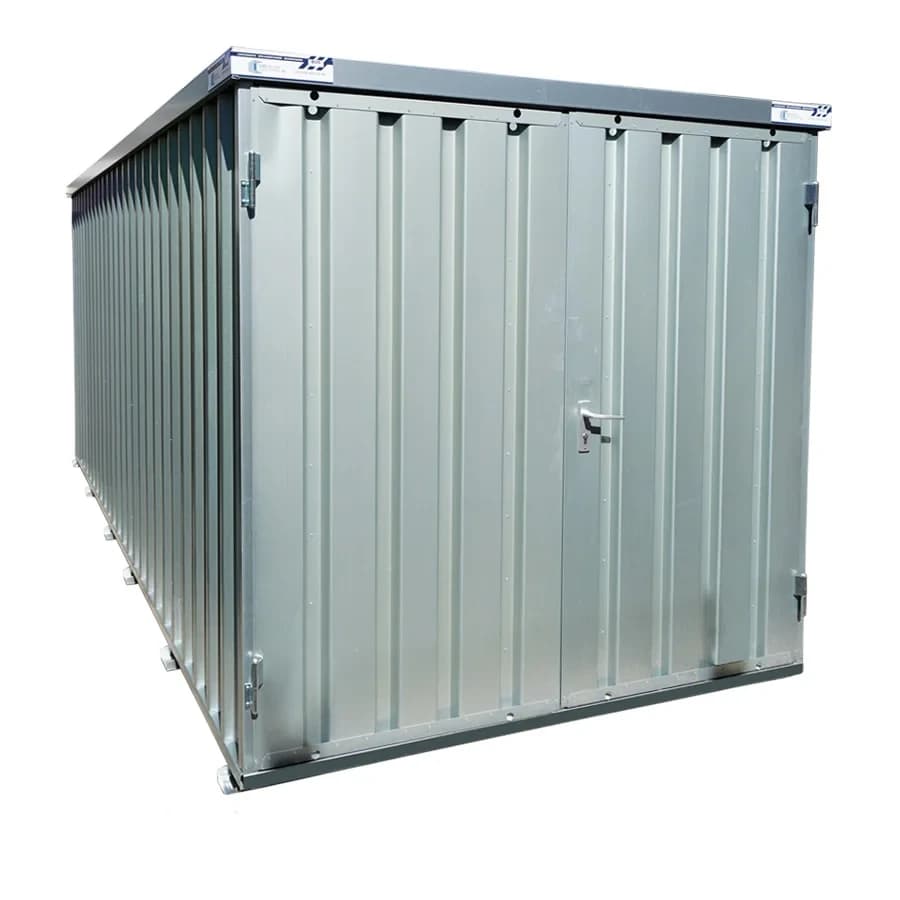
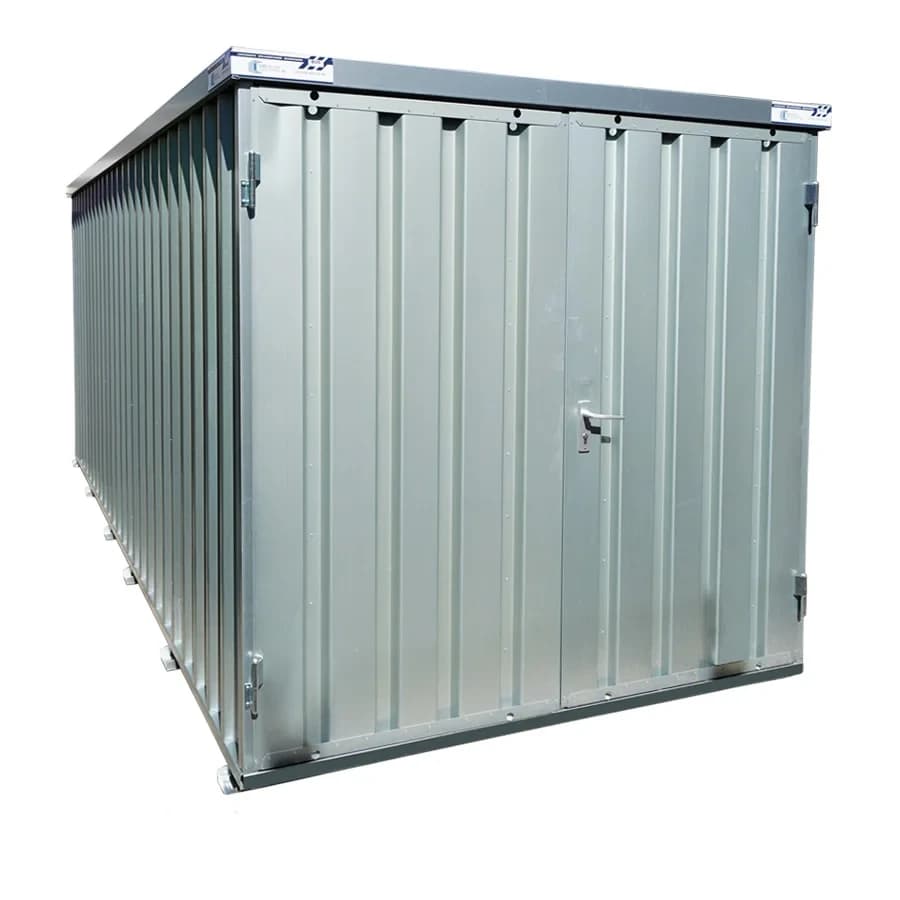
The 4x2 demountable container is a modular storage and shelter solution designed to be assembled and disassembled quickly, without requiring complex tools. Its distinctive feature is its snap-lock assembly system, which allows the walls and roof to be attached to the base structure in just a few minutes. This container stands out from standard shipping containers by its ability to be transported flat, which significantly reduces logistics costs and facilitates installation on hard-to-reach sites.
This model has external dimensions of 4100 mm in length, 2100 mm in width and 2100 mm in height, for a total weight of 450 kg. The internal dimensions are 3975 mm x 1975 mm x 1935 mm, offering a usable volume of approximately 15 m³. The floor is made of wood, capable of supporting a load of up to 500 kg per square meter, which allows the storage of heavy materials or pallets. The walls are made of profiled steel sheet, and the whole unit benefits from a hot-dip galvanized surface, ensuring good corrosion resistance.
The structure of the 4x2 demountable container is based on 0.8 mm thick galvanized steel panels. This thickness, combined with hot-dip galvanization, gives the container resistance to weather and wind. According to the manufacturer's information, it can withstand a snow load of up to 210 kg per square meter and wind gusts of up to 160 km/h. These characteristics make it suitable for outdoor use in most French regions, subject to compliance with local safety rules.
Assembly of the 4x2 demountable container is facilitated by the presence of four pre-mounted lifting rings on top, as well as metal forklift supports underneath. This equipment allows the container to be handled with common lifting equipment (crane, forklift, truck-mounted crane) without having to add accessories. The snap-lock system ensures quick and secure assembly of the various parts: base, walls, roof and doors. Once assembled, the container offers an enclosed and protected space, suitable for storing goods, equipment or for setting up a technical room.
This type of container is commonly used on construction sites to store tools, materials or sensitive equipment. It can also serve as a site office, changing room or break room for teams. In the industrial sector, it finds its place as a temporary or permanent storage area, particularly when built surfaces are insufficient. For private use, it is an economical alternative to traditional garden sheds, offering increased security thanks to its steel structure. It can also be fitted out as a workshop, DIY room or storage space for bulky items.
One of the main advantages of the demountable container lies in its modularity. When disassembled, it takes up little space, which simplifies transport and storage. This characteristic is particularly interesting for companies that need to move their installations frequently or for individuals who do not have permanent access for a truck-mounted crane. Assembly can be done by two people, without special technical skills, using simple tools. However, it is recommended to follow the manufacturer's instructions to ensure the stability and watertightness of the assembly.
In terms of maintenance, the 4x2 demountable container requires little care. The hot-dip galvanized surface protects the steel against rust, but it is advisable to regularly check the condition of the junctions and fasteners. Periodic cleaning with clear water and mild soap removes dirt and preserves the shine of the galvanization. If deep scratches appear, anti-rust paint can be applied to prevent corrosion. Seals, if any, should be checked and replaced if necessary to maintain water and air tightness.
When purchasing a demountable container, several points of vigilance deserve attention. It is important to check the thickness of the sheet metal and the quality of the galvanization, as these elements determine the durability of the product. The permissible floor load must be adapted to the intended use: here, 500 kg/m² allows the storage of heavy loads, but loads should be distributed to avoid deformation. The wind and snow resistance announced by the manufacturer must be compared to local climatic conditions; in exposed areas, additional reinforcements may be necessary. Finally, it is recommended to inquire about any urban planning restrictions before installing a container permanently, as some local regulations may require administrative procedures.
Transporting a demountable container is subject to French regulations on road freight transport. When disassembled, it can be loaded onto a truck or trailer, provided weight and size limits are respected. The gross combined weight rating (GCWR) and the vehicle's payload must be taken into account. If the container is transported assembled, it constitutes a bulky load that may require a special traffic permit due to its width (2100 mm) and height (2100 mm). It is advisable to use a specialized carrier to avoid any problems.
From a regulatory standpoint, a demountable container used as a storage room or office is not considered a permanent building, but may be subject to urban planning rules. In France, installing a light construction may require a prior declaration of works if its floor area exceeds 5 m² and its height exceeds 12 meters, or if it modifies the exterior appearance. It is therefore prudent to contact the town planning department of the municipality before any installation. Furthermore, if the container is intended to receive the public, it must comply with current fire safety and accessibility standards.
Compared to a standard shipping container, the 4x2 demountable container offers greater installation flexibility. It does not require stabilized ground to be placed, as its base can rest on blocks or slabs. Its moderate weight (450 kg) allows it to be moved with light lifting equipment. On the other hand, it has lower structural resistance than a Corten steel shipping container, which is designed to stack several units and withstand extreme marine conditions. The demountable container is therefore more intended for land and temporary uses.
To optimize the use of the 4x2 demountable container, accessories such as shelves, hooks, lighting or ventilation can be added. These modifications must be made without drilling through the walls so as not to compromise watertightness. Installing thermal insulation can be considered to improve comfort when used as an office or workshop. It is also possible to install an additional lock to enhance security.
In summary, the 4x2 demountable container is a versatile and economical solution for storage, shelter or setting up temporary spaces. Its modular design, hot-dip galvanization and load capacity make it a product suitable for many professional and private uses. As with any equipment, it should be regularly maintained and installation instructions followed to ensure its longevity and safety.
To go further, let's examine in more detail the practical aspects of long-term care and maintenance. Hot-dip galvanization is a process that involves dipping steel in a bath of molten zinc, creating a protective layer that sacrifices the zinc before the steel in case of corrosion. This protection lasts several decades in rural atmospheres, but can wear out faster near the sea or in polluted industrial areas. It is therefore recommended to visually inspect the container at least once a year, paying attention to contact areas between panels, fasteners and welds. If you notice traces of white rust (zinc oxide) or red rust (iron oxide), act quickly: brush the area, degrease and apply a zinc-rich paint or a suitable epoxy coating. Never use lead-based paint or aggressive solvents that could damage the surrounding galvanization.
The OSB (Oriented Strand Board) wooden floor is a panel composed of oriented wood strands bonded with resin. It resists moisture thanks to a water-repellent treatment, but it is sensitive to prolonged immersion. It is therefore important to check for leaks at the roof and walls. In case of stains or mold, cleaning with a diluted bleach solution may be sufficient, followed by complete drying. To extend the life of the floor, you can apply a stain or a specific paint for exterior wood. Avoid sliding heavy and sharp objects directly on the wood, as this could scratch the surface and create weak points. Using pallets or plywood sheets as load distributors is good practice.
The doors of the demountable container are generally equipped with rubber or silicone seals to ensure watertightness. These seals can harden over time, crack or come off. Regular inspection and preventive replacement every five to ten years is recommended. For hinges and locking mechanisms, a silicone or Teflon-based lubricant will prevent squeaking and facilitate opening. Do not use thick grease that would attract dust and form an abrasive paste.
During assembly, it is crucial to follow the order indicated by the manufacturer. Generally, you start by positioning the base on flat, stabilized ground. If the ground is soft, concrete blocks or wooden beams distribute the load and prevent the container from sinking. Then, assemble the side walls, then the front and rear walls, and finally the roof. The snap-lock system must engage firmly; a sharp sound often indicates that the lock is in place. It is advisable to check squareness using a spirit level and a tape measure. Once assembled, the container must be stable and show no play. If necessary, shims can be added under the base.
For disassembly, the reverse procedure applies. Start by removing the roof, then the walls, and finally the base. The parts must be stored flat, in a dry place, preferably on pallets to avoid direct contact with the ground. Small parts (bolts, pins, seals) should be kept in a labeled bag to avoid losing them. A disassembled container can be transported in a van or on a trailer, which considerably reduces transport costs compared to an assembled container.
In terms of sector-specific use cases, the 4x2 demountable container has various applications. In the events sector, it can serve as a storage room for equipment (sound, lighting, marquee) or as a changing room for staff. Its quick assembly allows it to be installed on a temporary site, such as a festival or fair, and then disassembled at the end of the event. In agriculture, it can shelter tools, seeds or plant protection products (subject to compliance with chemical storage rules). Market gardeners sometimes use it as a farm sales room or as a mobile cold room, after insulation and installation of a refrigeration unit. In the construction sector, it is valued for storing sensitive materials (cement, paint, power tools) and as a site office. Public works companies use it to store spare parts or as a break room for teams. In logistics, it can serve as a temporary deconsolidation area or a returns management room. Finally, for individuals, it offers a storage solution for gardening, DIY, bicycles, motorcycles or quads, with greater security than a wooden or resin garden shed.
Let's now compare the 4x2 demountable container with other sizes and types of containers available on the market. The 5x2 demountable container, mentioned in the initial description, offers a length of 5 meters, about 1 meter more. This additional surface can be useful for storing long objects (pipes, planks, ladders) or for setting up a small workshop with a workbench. The 4x2 container, more compact, is easier to transport and install on cramped sites. The 6x2 demountable container, even larger, is intended for intensive storage needs, but it is heavier and requires more powerful lifting equipment. There are also 3x2 demountable containers, smaller, suitable for light domestic use.
Compared to a standard 20-foot shipping container (approximately 6.06 m x 2.44 m x 2.59 m), the 4x2 demountable container is shorter and lighter. A 20-foot container weighs about 2.2 tons empty and can support a payload of over 20 tons. It is stackable and designed for maritime transport, which implies strict ISO standards (ISO 668, ISO 1496). The demountable container, however, is not intended for stacking (unless otherwise indicated by the manufacturer) and is not certified for maritime transport. It is therefore more reserved for land use. On the other hand, its purchase price is generally lower than that of a new shipping container, and its transport costs less. For temporary use or a need for mobility, the demountable container is often more advantageous.
There are also used shipping containers, which can be an economical alternative. A used 20-foot container can cost between 1,500 and 3,000 euros, depending on its condition. The 4x2 demountable container, priced at 899 euros, is therefore positioned in a lower price segment. However, the lifespan and resistance must be taken into account: a Corten steel shipping container can last several decades, even outdoors, while a demountable container made of 0.8 mm galvanized steel will have a more limited lifespan, especially in corrosive environments. The choice will therefore depend on the intended use, frequency of movement and budget.
Regarding transport regulations in France, a distinction should be made between transporting the container itself and transporting goods inside it. The demountable container, when empty, is considered a bulky package. If transported on a utility vehicle or trailer, loading rules must be respected: solid securing, signaling if the load exceeds the rear of the vehicle, and compliance with weight limits. The vehicle's gross vehicle weight rating (GVWR) must not be exceeded. For an assembled container of 450 kg, a 750 kg trailer is sufficient, but the trailer's payload must be checked. If the container is transported on a truck, the driver must ensure that the container is properly secured and that the doors are locked. In case of exceeding dimensions (width > 2.55 m, height > 4 m), a traffic permit is required. Here, the width of 2.10 m and height of 2.10 m remain within standard limits, so no special formality, unless the total load exceeds the thresholds.
If the container is used to transport goods, it must comply with road freight transport rules (maximum weight per axle, securing, etc.). For international transport, since the demountable container is not ISO certified, it cannot be used as an ITU (Intermodal Transport Unit) within the meaning of the CSC (Convention for Safe Containers). It therefore cannot be loaded onto a ship or train as a shipping container. It will have to be disassembled and shipped as an oversized package.
Finally, for installation on a site, it is recommended to check local urban planning rules. In some municipalities, installing a container, even demountable, may be considered a construction and require a building permit if its floor area exceeds 20 m². Here, the ground area is approximately 8.6 m² (4.1 m x 2.1 m), which is below the 20 m² threshold, but above 5 m², which may trigger a prior declaration. It is therefore imperative to inquire with the town planning department. Moreover, if the container is located in a subdivision or protected area (classified site, nature reserve), additional restrictions may apply. In case of doubt, an architect or legal advisor can guide you.
To summarize, the 4x2 demountable container is a versatile, economical and easy-to-implement product. It is suitable for many uses, from temporary storage to setting up a workspace. Its maintenance is simple, but requires regular inspection to prevent corrosion. Its transport is easy, especially disassembled, and it can be installed on most sites, subject to compliance with urban planning rules. Compared to other solutions, it offers a good compromise between price, mobility and functionality. For intensive or permanent use, a shipping container may be preferred, but for a one-off or mobile need, the 4x2 demountable container is a relevant choice.