Description
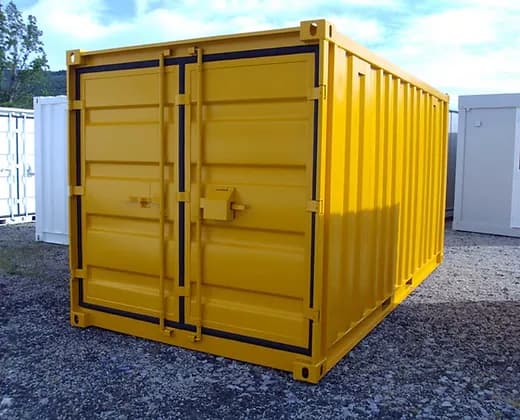
The 15ft yellow container is a robust storage and fit-out solution, designed to meet a variety of needs, whether on a construction site, in an industrial area or for domestic use. Its design is based on a fully welded steel profile frame, 3 mm thick, ensuring high mechanical strength. The walls and roof are made of 1.5 mm profiled steel, a material commonly used in the manufacture of shipping containers for its durability and corrosion resistance. This container stands out for its compact dimensions: 4.50 m long, 2.20 m wide and 2.25 m external height, offering an internal volume of 18 m³. Its internal dimensions of 4.30 m x 2.07 m x 2.02 m allow optimised layout. The 9000 kg load capacity allows the storage of heavy loads, such as construction materials, equipment or palletised goods. The 25 mm solid wood floor, treated against moisture, guarantees good insulation and resistance to distributed loads. The double doors, located on the width, are fitted with rubber seals for effective sealing against weather and dust. A protective flap for a padlock reinforces security against intrusion. For movement, the container has long forklift pockets with a spacing of 90 cm, compatible with a forklift, as well as four corner pockets for crane lifting. This equipment facilitates handling and positioning on site. This container can be used as secure storage space, mobile workshop, site office, technical room or even as a base for modular housing after fit-out. Its yellow colour, often associated with visibility and safety, is particularly suited to industrial environments or traffic areas. Optionally, it is possible to choose a custom colour, add extra doors (service doors, double or quadruple), install an anti-slip steel floor to increase load-bearing capacity and resistance (ideal for storing shelving), set up an electrical installation (power sockets, neon lights) and add additional anti-burglary devices such as a key-crank lock with handle and lock or a special container padlock. These options allow the container to be adapted to specific needs, whether for comfort, security or functionality. In terms of maintenance, regular checking of the paint and seals is recommended to preserve sealing and prevent corrosion, especially in marine or humid environments. Periodic cleaning and checking of the closing systems ensure a long service life. For purchase, it is advisable to check the structural condition (no deformation, no perforating rust), the quality of the welds and the proper functioning of the doors. French regulations govern the transport and installation of such containers: a building permit may be required depending on use and duration of installation, and road transport must comply with size and weight rules. This 15ft container is an interesting alternative to 10 or 20ft models, offering a good compromise between footprint and capacity. Whether for professional or private use, it represents a durable and modular solution, manufactured according to proven industry standards. With its steel structure and customisation options, it adapts to many projects, from simple storage to complete fit-out.
To go further, it is worth examining in detail the practical aspects of maintenance, the regulatory obligations related to transport and installation, as well as sector-specific use cases and comparisons with other container formats. These elements are essential to make an informed choice and make the most of this 15ft container.
The maintenance of a shipping container, whether new or used, determines its longevity and performance. The steel structure, although robust, remains susceptible to corrosion, particularly in aggressive environments: seaside, industrial areas, atmospheres laden with salt or chemicals. It is therefore recommended to regularly inspect the paint and welds. Any scratch or paint chip must be treated quickly with a rust inhibitor then a suitable finishing paint (generally an epoxy or polyurethane paint). The rubber seals of the doors are wearing parts: they must be checked at least once a year, cleaned and possibly replaced if they show cracks or loss of elasticity. A defective seal can let in water, air and dust, compromising sealing and promoting condensation. The solid wood floor treated against moisture must be kept clean and dry. When storing damp products or liquids, it is advisable to use tarpaulins or raised pallets to avoid prolonged direct contact with the wood. Regular visual inspection allows detection of any traces of mould or wood-boring insects. For containers fitted with an electrical installation, periodic checking of connections and protective devices (circuit breakers, sockets) is necessary to ensure safety. Finally, the closing systems (locks, latches, padlocks) must be lubricated and tested regularly to avoid jamming and maintain an optimal level of security.
French regulations applicable to containers used as storage or living spaces are multiple. From a transport point of view, a 15ft container can be transported by truck, train or boat. On the road, it must comply with the size and weight rules in force. A 15ft container has a length of 4.50 m, which remains compatible with most rigid trucks and trailers. However, the total weight (container plus contents) must not exceed the limits authorised for the vehicle and road infrastructure. For exceptional transport, special permits may be required. Regarding installation, setting up a container on a plot of land may be subject to planning permission. In France, if the container is intended for temporary use (less than three months), it may be considered a temporary installation and escape certain formalities. Beyond that, a building permit or prior declaration may be required, depending on the surface area, the nature of the project and local planning rules. It is therefore imperative to check with the town hall before any installation. In addition, if the container is used as a workplace, it must comply with safety and hygiene standards (ventilation, lighting, emergency exits). For residential use, the standards are even stricter (insulation, heating, sanitary facilities). Finally, customs regulations may apply if the container is imported or exported outside the European Union.
The sector-specific use cases for this 15ft container are numerous. In the construction sector, it serves as a site office, storage room for tools and materials, or changing room for workers. Its compact size makes it easy to install on urban sites where space is limited. In industry, it can be used as a technical room to house generators, compressors or spare parts. Its 9000 kg load capacity allows the storage of heavy parts. In the agricultural sector, it can serve as a shed for equipment, crop storage or housing for small animals, after fit-out. For shops and events, it can be transformed into a stand, pop-up sales point or storage room. In logistics, it can be used as a storage annex or transfer unit. Finally, for individuals, it offers a secure storage solution for garden tools, bicycles, furniture, or can be fitted out as a workshop, office or gym. Its yellow colour, visible from afar, is an asset for safety on high-traffic sites.
Compared to other sizes, the 15ft container sits between the 10ft (about 3 m long) and the 20ft (about 6 m long). The 10ft is easier to move and install, but offers reduced volume (about 15 m³ for a standard 10ft, compared to 18 m³ for the 15ft). The 20ft, on the other hand, offers double the volume (about 33 m³) but requires more space and a more powerful lifting device. The 15ft is therefore an interesting compromise for those who need more space than a 10ft without the constraints of a 20ft. In terms of types, the dry (or standard) container like this one is the most common and versatile. The high cube container offers greater internal height (about 2.69 m versus 2.39 m for a standard), which can be an advantage for storing tall loads or fitting out a living space. The reefer container is equipped with a refrigeration system for transporting perishable goods. The open top has a removable roof for loading bulky objects from above. The flat rack has no walls or folding walls for transporting out-of-gauge loads. The choice therefore depends on the intended use. For dry and versatile storage, a dry container like this 15ft is ideal. For fitting out as an office or dwelling, a high cube may be more comfortable. For transporting specific goods, other types will be more suitable.
In conclusion, the 15ft yellow container is a versatile, robust and customisable product that meets many needs. Its purchase should be accompanied by consideration of maintenance, regulations and final use. With the available options, it can be adapted to various projects, from simple storage to complete fit-out. Whether you are a building professional, an industrialist, a farmer, a trader or an individual, this container offers a durable and scalable solution. Do not hesitate to consult a specialist to assist you in your project and check local constraints.
To delve deeper into the question of maintenance, it is useful to distinguish preventive from curative interventions. Prevention consists of limiting exposure to moisture and impacts. For example, placing the container on blocks or wooden sleepers avoids direct contact with the ground, thus reducing the risk of corrosion from below and facilitating air circulation. A gap of at least 10 cm between the base and the ground is recommended. Similarly, installing a gutter or channel is not necessary on a standard container, but a slight slope can be created to drain rainwater. When storing materials sensitive to moisture, adding a dehumidifier or absorbent sachets may be wise. Natural ventilation can be improved by periodically opening the doors in dry weather. For curative interventions, treating rust spots must be done as soon as they appear: brushing, applying a rust converter, then painting. Welds must be inspected: a cracked weld can compromise the rigidity of the whole. Finally, replacing wearing parts (seals, locks) must be done with parts compatible with shipping containers, available from specialist suppliers.
Regarding transport regulations, it should be noted that transporting a container on the road is subject to precise rules. In France, an exceptional convoy is necessary if the dimensions exceed 2.55 m in width, 4.00 m in height or 16.50 m in length for an articulated vehicle. A 15ft container, with its 2.20 m width and 2.25 m height, falls within standard norms. However, the maximum authorised gross combination weight (GCW) of the truck must be respected. The load must be properly secured, with suitable straps or chains. Rail transport is also possible, particularly for long distances, and sea transport for international shipments. In the latter case, the container must be CSC (Convention for Safe Containers) certified to be stackable and handled safely. Most new or used shipping containers have this certification, but it is advisable to check the CSC plate fixed to the container. For import, customs duties and taxes may apply depending on the country of origin and the declared value.
For sector-specific use cases, one can also mention the events sector, which uses containers fitted out as bars, ticket offices or rest areas. The humanitarian sector uses them as temporary warehouses or mobile clinics. The energy sector uses them as control rooms for wind or solar farms. The recycling sector uses them as collection points. The fishing sector uses them as cold rooms or repair workshops. In all these cases, the modularity and robustness of the 15ft container are assets. Its size allows it to be inserted into restricted spaces while offering significant useful volume. The possibility of adding extra doors facilitates access and circulation. The electrical installation allows powering tools, lighting or an air conditioning system. The anti-slip steel floor is a plus for work areas where liquids may be spilled.
Finally, the comparison with other types of containers can be extended to specialised containers. The tank container is designed for transporting liquids. The open side container has an openable side wall for loading wide loads. The open top container allows loading from above. The flat rack container is used for heavy and bulky loads. The reefer container is refrigerated. The high cube container is taller. The standard container, like our 15ft, is the most versatile and economical. It can be easily transformed, insulated, air-conditioned, fitted out. This is why it remains the preferred choice for most storage and fit-out applications. With its 18 m³, it suits moderate domestic or professional needs. For larger volumes, a 20ft or 40ft will be more suitable. For occasional needs, a 10ft may suffice. The 15ft is therefore a happy medium, offering a good volume-to-footprint ratio.