Description
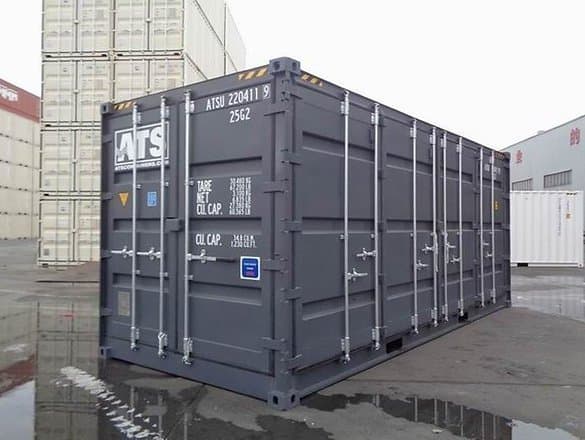
The 20ft High Cube Open Side container is a Corten steel shipping container designed for transporting and storing goods while offering full side access. Its special feature is its openable side wall, which complements the traditional rear doors and allows loading or unloading of large, long or hard-to-maneuver items in a standard container. The High Cube version stands out with an external height of 2.89 m and an internal height of 2.69 m, offering more usable volume than a standard 20ft container. This model is new (first trip) and benefits from a robust construction in corrosion-resistant Corten steel, known for its corrosion resistance and structural durability. The floor is made of 28 mm marine plywood, composed of 19 plies of Keruing-Apitong wood, a dense and moisture-resistant material suited to heavy loads and marine environments. With an interior area of approximately 14 m² and a volume of approximately 37 m³, it can hold around 10 Euro pallets. Its external dimensions are 6.06 m long, 2.44 m wide and 2.89 m high. The internal dimensions are 5.90 m long, 2.35 m wide and 2.69 m high. The side opening and rear doors provide a passage width of 2.34 m and a height of 2.58 m. The 2050 mm forklift passage facilitates handling operations. This container is a versatile solution for transport, storage and fit-out, and can be used as a site office, technical room or modular space after conversion. It complies with ISO 668 and ISO 1496 standards, ensuring compatibility with international transport infrastructure. In France, its road transport is subject to weight and dimension regulations, and its use as a room requires compliance with urban planning rules. For maintenance, regular inspection of paint and seals is recommended, with touch-up of scratches to prevent rust. Before purchase, check the condition of the walls, floor, seals and opening mechanisms, as well as the presence of the CSC plate. This new container offers a practical alternative to the standard container, with valuable side access for bulky loads or those poorly suited to rear doors. It is important to note that the Open Side container is not watertight in the same way as a standard dry container due to its opening walls, and is therefore less suitable for long-term sea transport without additional precautions. For land use or sheltered storage, it is an excellent solution. In summary, the 20ft High Cube Open Side container combines the interior height of a High Cube with the flexibility of side access, making it a relevant choice for many professional and industrial uses.
To choose this container well, it is useful to place it within the family of standardized shipping containers. ISO containers meet standardized dimensions and fastening systems, allowing them to be stacked, lifted and secured on ships, trains or trucks without specific adaptation. The 20ft (about 6.06 m long) is the reference format for land and sea transport, while the 40ft (about 12.19 m) offers double capacity but requires heavier logistics. The High Cube adds about 30 cm of height compared to a standard container, resulting in greater interior volume without increasing the footprint. The Open Side container differs from classic dry models by its side wall that opens fully or partially, depending on the design. It should not be confused with the Open Top container, whose roof is removable or openable for top loading, nor with the Flat Rack, which has neither roof nor side walls and is limited to a platform with folding sides. The choice between these types depends on the nature of the goods and the handling method available at the loading and unloading site.
Technically, the structure of the 20ft High Cube Open Side container is based on a Corten steel frame comprising corner posts, uprights and cross members. Corten steel, also known as weathering steel, develops a surface oxide layer that slows the progression of corrosion. This property is particularly useful in marine environments, where salt air and humidity accelerate the oxidation of ordinary steels. The opening side walls are generally made of two leaves or a single panel, equipped with reinforced hinges and locking systems. These mechanisms must be handled with care and maintained regularly to keep them working properly. The 28 mm marine plywood floor, composed of 19 plies of Keruing-Apitong wood, is fixed on metal cross members. This type of floor is common in shipping containers: it resists moisture, impacts and rolling loads, provided it is not exposed to standing water for long periods. The interior walls may be bare or coated steel, depending on the version, and the ceiling is generally made of profiled sheet. The rear doors are equipped with rubber seals and locking bars. The whole is designed to withstand the stresses of sea transport, but the opening nature of the side wall requires additional checks during lifting and securing operations.
Maintaining a 20ft High Cube Open Side container does not require special skills, but it must be regular to preserve the structure and watertightness. It is advisable to visually inspect the container at least once a year, and more frequently if it is exposed to an aggressive environment: seaside, industrial area, humid or saline atmosphere. The inspection covers paint, welds, seals, hinges, locks and the floor. Scratches and areas of surface rust should be brushed, degreased and then repainted with a paint suitable for exposed metal surfaces. The seals of the rear doors and side wall must be checked: a cracked or detached seal lets water in and can damage stored goods. Hinges and locking mechanisms benefit from periodic lubrication with a product that does not retain dust. The floor should be swept and checked: broken or rotten boards can be replaced, and a water-repellent treatment can extend its life. When storing moisture-sensitive products, the use of dehumidifiers or a ventilation system is recommended. Finally, it is prudent not to let water stagnate on the roof or around the seals, and to check that the container is placed on stable, drained ground.
The regulations applicable in France depend on the use of the container. For road transport, a 20ft High Cube container complies with the maximum dimensions authorized for an articulated vehicle, subject to compliance with the authorized gross vehicle weight and signage rules. Exceptional transport is generally not necessary for this format, but it is up to the carrier to verify the conformity of the load, the securing and the distribution of masses. The container must keep its CSC plate (Convention for Safe Containers), which certifies its compliance with international safety rules and must be kept legible. For use as a storage room, office or dwelling, the container is considered a construction: it may be subject to urban planning formalities, including a prior declaration of works or a building permit depending on the surface area, location and duration of installation. It is recommended to inquire with the town planning department of the municipality before any fixed installation. If the container is intended to receive the public or to be used as a workplace, safety, accessibility and fire protection rules may apply. Finally, handling the container must be entrusted to professionals with suitable equipment, as an empty container already weighs several tons and its lifting presents risks.
Sector-specific use cases for this container are varied. In construction, it serves as a site office, tool storage room or changing room, and its opening side wall facilitates access to equipment without having to take everything out through the rear. In industry and logistics, it allows storing long parts, profiles, machines or bulky pallets, and organizing rapid rotations thanks to the side opening. In events, it can be fitted out as a control room, technical room or sales space, with a side facade that opens to create a counter or display window. In agriculture, it provides shelter for equipment, crops or animals, provided suitable ventilation is arranged. In temporary storage, it is a mobile solution for companies that need extra space without building permanently. Finally, after conversion, it can become an office, workshop, caretaker's dwelling or modular space, but these projects require insulation, electrical, plumbing and finishing work that go beyond the raw container.
Compared to other solutions, the 20ft High Cube Open Side container has advantages and limitations. Against a standard 20ft dry container, it offers side access and greater interior height, but it is generally more expensive and slightly less watertight. Against a 40ft High Cube, it is more maneuverable and easier to move, but offers less volume. Against an Open Top container, it allows side loading rather than vertical loading, which is better suited to long and wide loads than tall loads. Against a Flat Rack, it better protects goods from weather and theft, but is less suited to out-of-gauge loads. The choice therefore depends on the type of goods, the handling method, the budget and the duration of use. For a single sea transport use, a standard dry container is often sufficient. For versatile use, with frequent loadings and bulky objects, the Open Side High Cube provides real operational convenience.
Before purchase, several points of vigilance deserve attention. Check the general condition of the container: paint, rust, deformations, floor condition, operation of doors and side wall, presence and legibility of the CSC plate. For a new container (first trip), these checks remain useful to ensure it has not been damaged during transport. It is also important to confirm the exact dimensions and tare weight, as these data may vary slightly depending on the manufacturer. The displayed price, 4250.00 EUR, corresponds to the container alone: transport, unloading and, if applicable, quay or storage fees must be added. Delivery of a 20ft container requires a truck with a crane or a suitable forklift, and site access must be checked (width, height, ground bearing capacity). Finally, it is advisable to request recent photos and, if possible, to visit the container before purchase, especially for intensive professional use.
In terms of safety, the 20ft High Cube Open Side container must be used in accordance with its intended purpose. It must not be stacked beyond the limits provided by its structure, nor loaded beyond its payload. The opening side walls must not be used as anchor points for lifting. During transport, the doors and side wall must be locked and, if necessary, sealed. Inside, proper ventilation is essential if the container is occupied or if it stores products releasing vapors. In the case of fit-out, the work must comply with good practice and current standards, particularly for electricity and fire protection. The container must not be structurally modified without professional advice, as any cut in load-bearing elements can reduce its strength.
In summary, the new 20ft High Cube Open Side container in Corten steel with 28 mm marine floor is a robust and versatile solution. It is intended for professionals who need side access to load wide or palletized goods, while benefiting from the interior height of a High Cube. Its volume of approximately 37 m³ and area of approximately 14 m² make it a useful storage or work space. It can be used raw for transport and storage, or converted for modular use. Like any container, it requires regular maintenance and use in accordance with safety rules. Before acquiring it, it is recommended to precisely define its use, check access and transport constraints, and ensure the regulatory compliance of its installation. This container is thus a relevant alternative to the standard 20ft when side access and greater interior volume are needed.