Description
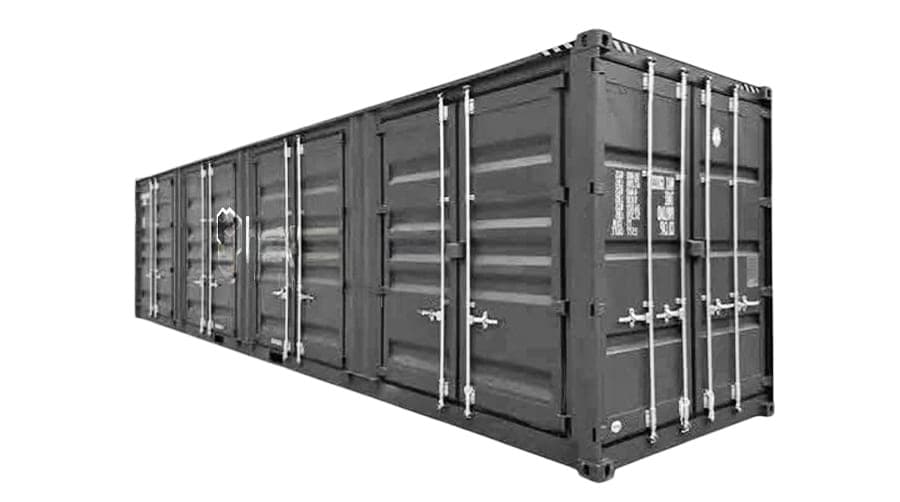
The 40ft High Cube container with four side doors is a storage and transport solution that combines a generous internal volume with exceptional accessibility. Unlike a standard container whose only opening is at the rear, this model is equipped with four large side doors distributed along its length, in addition to the two classic rear doors. This configuration allows access to the contents along almost the entire length of the container, which considerably simplifies loading and unloading operations, particularly when goods are palletised or when manoeuvring space is limited.
This container is of the High Cube type, meaning its external height is about 30 cm greater than that of a standard dry container. With an external height of 2.89 m and an internal height of about 2.69 m, it offers an internal volume of approximately 76.7 m³. This extra height is a valuable advantage for storing stacked goods, for installing shelves or racking, and for all fit-out projects requiring increased vertical space. The external length is 12.19 m and the external width is 2.44 m, dimensions compliant with ISO 668 and ISO 1496-1 standards governing series 1 maritime containers.
The structure is made of corten steel, also known as weathering steel. This alloy contains copper, chromium and nickel, which allows it to develop a protective oxide layer on its surface when exposed to the weather. This patina slows corrosion and gives the container great resistance to climatic aggression, whether rain, spray or ambient humidity. Corten steel has been the reference material in maritime container construction for several decades, and it largely explains the longevity of these structures when properly maintained. The floor is made of 28 mm thick marine plywood, a glued wood panel resistant to moisture and capable of supporting heavy loads, such as forklifts or loaded pallets. This floor is treated to resist mould and insects, and is fixed on metal cross members welded to the structure.
The four side doors are fitted with rubber seals and container locks, ensuring secure closure and protection against water and dust ingress. The two rear doors, also fitted with locks, complete the access. The whole is designed to be airtight and watertight, in accordance with the requirements of the ISO standards applicable to maritime containers. This means the container can be used for international maritime transport, but also for long-term outdoor storage without fear of goods being damaged by the weather.
One of the main advantages of this container lies in its versatility of use. In logistics, it allows goods to be loaded or unloaded at several points simultaneously, which reduces downtime and facilitates flow management. For example, in a warehouse or on a distribution platform, a side door can be opened to quickly extract a pallet without having to move the other packages. This configuration is particularly appreciated for rotating stocks, where products must be accessible quickly and without unnecessary handling. Similarly, for transporting bulky machinery or equipment, the side opening allows a forklift or crane to be used to insert the load directly from the side, which is sometimes impossible with a standard container.
In the construction sector, this type of container is often used as a site office, site accommodation, changing room or storage room for tools and materials. The presence of multiple side doors allows several accesses to be created, which improves team circulation and safety. The interior space can also be divided into several zones using partitions, each zone having its own access door. This modularity is an asset for long-term projects, where needs evolve over the phases of the project.
For modular fit-out projects, the 40ft High Cube container with 4 side doors offers an interesting base. Its internal height of 2.69 m allows insulation to be installed on the floor and ceiling while retaining a comfortable ceiling height, often greater than 2.40 m after works. The side doors can be kept as main openings, or replaced by glazed bays, glass doors or solid panels, depending on the intended use: office, workshop, meeting room, pop-up sales space, studio, etc. The corten steel structure is robust enough to withstand the constraints of an interior fit-out, and it can be painted or clad to blend into the environment.
Maintaining a corten steel container is relatively simple. It is recommended to regularly inspect the condition of the paint and seals. Deep scratches that expose bare steel must be treated with a suitable anti-rust paint to prevent corrosion from progressing. Door seals must be cleaned and checked periodically; if they are cracked or hardened, they can be replaced, as they are what guarantee water and air tightness. The marine plywood floor must be kept clean and dry; if worn, it can be lightly sanded and treated with a protective oil or paint. Hinges and locking mechanisms must be lubricated once or twice a year to ensure smooth operation and prevent jamming.
When buying a container, several points deserve attention. First, the general condition of the structure must be checked: presence of perforating rust, significant deformation, cracked welds or rotten flooring. A new container, such as this one, does not have these defects, but it is always good to check on delivery. Then, it must be ensured that the doors close properly and that the seals are in good condition. For a container with side doors, it is essential to check the alignment of the four doors and the correct operation of the locks, as these elements are more complex to adjust than on a standard container. Finally, ISO conformity should be verified, in particular the CSC plate (Convention for Safe Containers) which certifies that the container is suitable for international maritime transport. This plate is mandatory for any container used in maritime transport.
In France, the use of a maritime container for storage or habitation purposes is subject to certain regulations. For temporary use on a construction site, a prior declaration may be required depending on the municipality. For permanent use, particularly as a dwelling or professional premises, it is imperative to enquire with the local urban planning department, as a container may be considered a construction and require a building permit. Rules vary from one municipality to another, and it is advisable to consult an urban planning professional before any project. Moreover, transporting a 40ft container on the road requires an exceptional convoy due to its length (12.19 m) and weight (4,100 kg empty). The carrier must obtain the necessary authorisations and comply with imposed routes. It is therefore important to plan these logistical aspects upstream of the purchase.
This container is sold new, with a corten steel structure, a 28 mm marine plywood floor and ISO certification. It is delivered with its side and rear doors fitted with container locks. Its external dimensions are 12.19 m long, 2.44 m wide and 2.89 m high, for an internal volume of approximately 76.7 m³. Its empty weight is 4,100 kg. These characteristics make it a relevant choice for logistics companies, construction professionals, farmers, manufacturers or individuals with fit-out projects. Thanks to its specific design, it provides access flexibility rarely found on the maritime container market, while retaining the robustness and durability specific to corten steel containers.
To go further into routine maintenance, it is useful to distinguish two levels of intervention: preventive maintenance and corrective maintenance. Preventive maintenance consists of carrying out a complete visual inspection at least once a year, and more frequently if the container is exposed to an aggressive environment (seaside, industrial area, saline atmosphere). This inspection must cover the roof, side walls, corner posts, floor cross members, doors and their seals. Priority should be given to looking for paint blistering, rust spots, traces of moisture inside, deformation or loose fixings. Corrective maintenance comes into play when a defect is detected: scraping and treating rusted areas, replacing a seal, tightening bolts, replacing a hardware part. For containers with side doors, particular attention must be paid to hinges and locking rods, which are subject to greater stress than on a two-door container. Regular greasing and alignment checks help avoid excessive effort when closing. If the container is used to store moisture-sensitive products, it is recommended to install a dehumidifier or desiccant bags, and to regularly check for condensation. Passive ventilation can also be added to limit temperature variations and residual humidity.
Regarding transport regulations in France, several points must be anticipated. The 40ft High Cube container with 4 side doors is a heavy and bulky package. Its road transport is subject to exceptional transport regulations as soon as its dimensions or weight exceed the limits of the highway code. A 40ft container measures 12.19 m long, which exceeds the maximum length authorised for a standard articulated vehicle (16.50 m for a tractor + semi-trailer combination, but the body alone may exceed the authorised gauge depending on the chassis used). In addition, the total height of the convoy (chassis + container) can reach approximately 4.20 m to 4.50 m, which requires a traffic permit and sometimes a marked route. The empty weight of 4,100 kg is added to that of the chassis and tractor, which can bring the authorised gross combination weight close to regulatory limits. It is therefore essential to use a specialised carrier with the appropriate authorisations and insurance covering this type of convoy. For maritime transport, the container must be stackable and compliant with ISO 668, which is the case here. It must also have a valid CSC plate to be shipped. For rail transport, the container is compatible with standard container wagons, subject to compliance with railway gauge limits. Finally, for inland waterway transport, it can be loaded onto suitable barges, which is an interesting alternative for links between ports and inland areas.
Sector use cases are numerous and varied. In agriculture, this container can serve as a storage room for harvests, seeds, fertilisers or equipment. Its side doors facilitate access for handling machinery, such as telehandlers or mini-excavators, and allow storage zones to be separated. In events, it is used as a technical control room, dressing rooms, bar, sales stand or temporary storage space. The possibility of opening several sides creates an interesting interaction with the public and allows counters or display stands to be fitted out. In retail, it can become a pop-up sales point, a drive-through or a stockroom. In industry, it serves as a spare parts store, technical room or maintenance area. Multiple side doors reduce movements and improve team productivity. In the construction sector, it is used as a site office, break room, changing room or workshop. The High Cube height allows changing rooms to be installed on two levels or high-level storage. For domestic storage, it can accommodate furniture, vehicles, gardening equipment or archives. Finally, for alternative housing projects, it constitutes a solid base for a tiny house, a garden studio or an independent office, subject to obtaining the necessary urban planning authorisations.
Let us now compare this model with other container sizes and types. A standard 20ft container offers a volume of approximately 33 m³ and a length of 6.06 m. It is more manoeuvrable, lighter (about 2,200 kg empty) and less expensive, but it has a single rear opening and an internal height of 2.39 m. It is suitable for small storage, short-term projects or individual projects. A standard 40ft container (dry) offers a volume of approximately 67 m³ and an internal height of 2.39 m. It is longer than the 20ft but lower than the High Cube. A standard 40ft High Cube container (without side doors) offers the same volume as our model, but with rear access only. It is less versatile for multi-point operations. An open top container has a removable roof, allowing objects to be loaded from above, but it is less watertight and less suitable for long-term storage. A flat rack container has no side walls or roof, making it suitable for transporting out-of-gauge loads, but it does not protect goods. A reefer container is equipped with a refrigeration unit and can maintain a controlled temperature, but it is heavier, more expensive and requires a power supply. The 40ft High Cube container with 4 side doors therefore stands out for its ability to combine volume, height and multiple accessibility, making it a versatile tool for many uses. Finally, there are 45ft High Cube containers, longer, but less common and more difficult to transport on the road. The choice will therefore depend on the actual need: prioritising side accessibility, height or length depending on the project.