Description
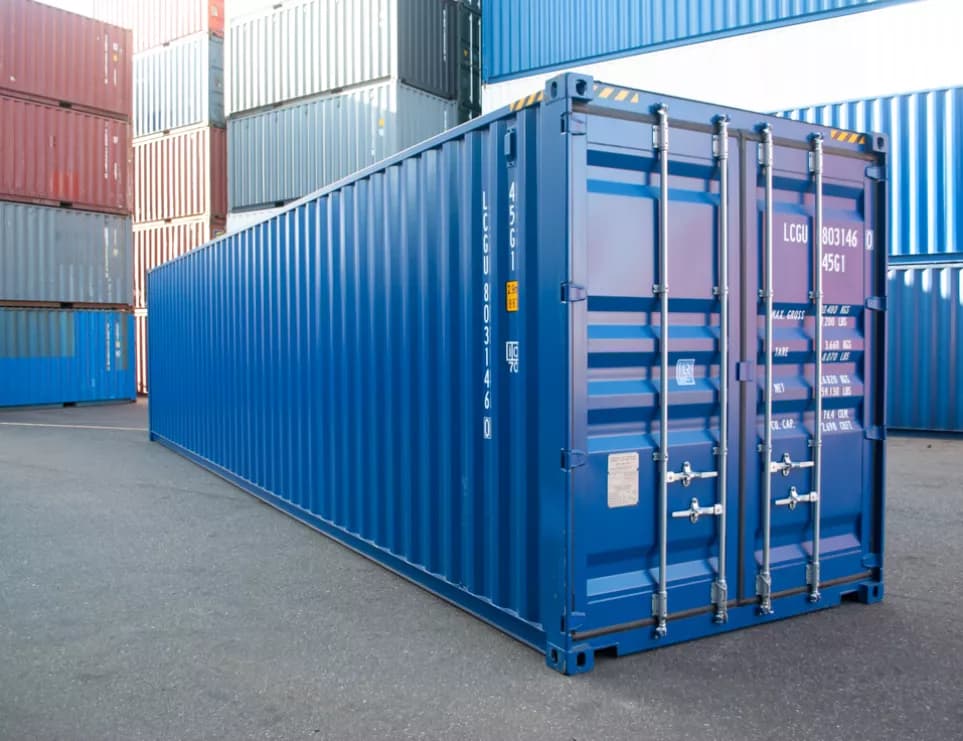
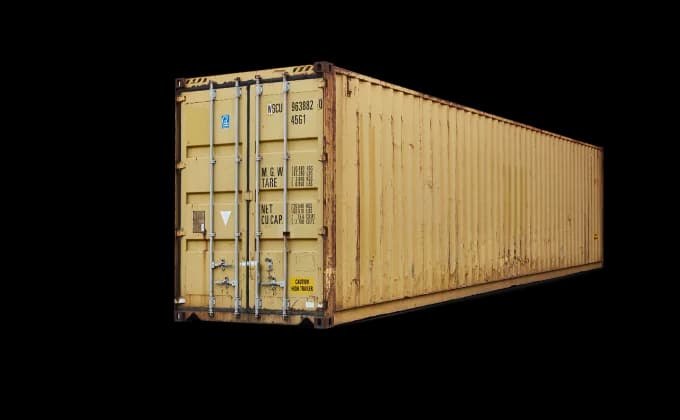
The used 40ft High Cube shipping container is a steel transport and storage unit built to standard ISO series 1 dimensions. Its distinguishing feature is its external height of about 2.89 m, versus 2.59 m for a standard 40ft, giving an internal height of roughly 2.69 m. This extra 30 cm may seem modest, but across a floor area of nearly 30 m² it amounts to an internal volume of about 76 m³, roughly 9 m³ more than a classic 40ft dry container. For storing stacked pallets, tall equipment, tubes, panels or light bulky goods, this extra height genuinely changes how the space is organised.
Structurally, this container is made of corten steel, a low-alloy steel that resists atmospheric corrosion better than ordinary steel thanks to a protective oxide layer that forms on the surface. The side walls are corrugated, giving them high rigidity while remaining relatively light. The roof is also corrugated and treated to shed rainwater. The floor is marine plywood about 28 mm thick, laid on steel cross members welded to the frame. This plywood, hot-bonded with phenolic resins, supports moderate rolling loads and resists residual moisture, although it should be protected from prolonged water ingress. The interior walls are generally left bare, sometimes with a paint coating or liner depending on the container's history.
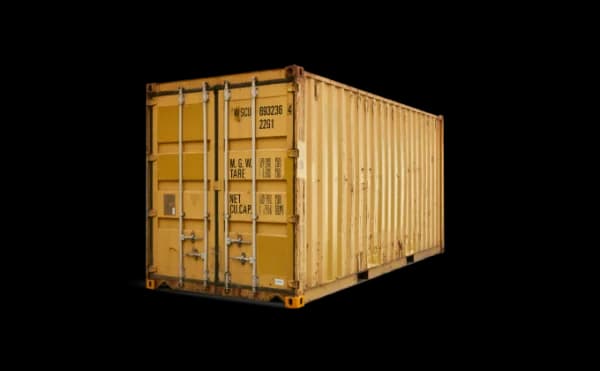
The rear face has two steel door leaves on sturdy hinges, held by vertical locking bars. There are four bars per leaf on a 40ft container, operating cams that engage the frame. The handles are designed to be operated with a key or lever, and EPDM rubber gaskets provide an airtight, watertight seal when the doors are properly closed. On a used container, gaskets are often slightly crushed or hardened by the sun; replacing them is simple and inexpensive, and worth considering if perfect sealing matters for your intended use.
The standard external dimensions of this container type are about 12.19 m long, 2.44 m wide and 2.89 m high. Typical internal dimensions are about 12.03 m long, 2.35 m wide and 2.69 m high. The internal width is slightly reduced by the thickness of the corrugated walls and corner posts, leaving a usable width of about 2.35 m. The door opening measures about 2.34 m wide by 2.58 m high, allowing most Euro pallets and many handling machines to pass through, provided the lift height of the forklift used is checked.
The tare weight of a 40ft High Cube is generally around 3.9 to 4.2 tonnes depending on equipment and history. The maximum payload stated for this container is 3,660 kg, corresponding to a road or sea transport configuration subject to weight limits. It is essential to understand that this payload is a regulatory figure, not an absolute structural limit: the container itself can bear more in static stacking, but road transport in France is governed by the Highway Code and authorised gross vehicle weight limits. For static ground-level storage, the permissible distributed load is generally higher, but depends on the ground and load distribution. A container placed on soft ground must be set on concrete blocks or beams to prevent sinking and floor deformation.
The most common use of this container remains on-site storage: construction sites, farms, logistics depots, workshops, seasonal retail. Its double rear doors allow wide access, and its internal height makes it easy to store tall equipment, scaffolding, tubes, insulation panels or medium-sized machines. In agriculture, it often serves as a store for grain, seeds or fodder, provided adequate ventilation is arranged to prevent condensation. In construction, it can be fitted out as a site office, changing room or technical room, with added insulation, a raised floor and a power supply.
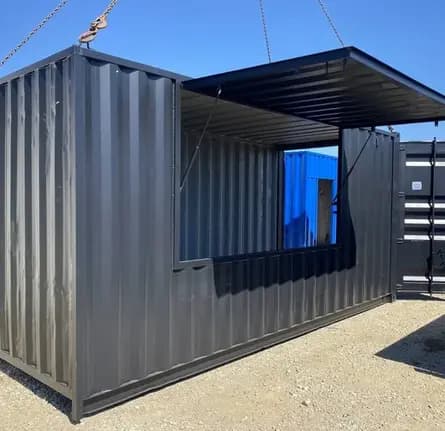
Converting it into a workspace or modular housing is common practice. A High Cube container offers a more comfortable internal volume for such projects, notably because it allows a false ceiling to be installed without excessively reducing headroom. Openings can be cut for windows, an extra door or service ducts, but these modifications must be carried out by a professional so as not to compromise the structure's rigidity. The corner posts and top and bottom rails are load-bearing elements that must never be cut without prior structural assessment. Likewise, thermal insulation is essential if the container is to be occupied: steel conducts heat and cold, and without insulation the internal temperature can become unbearable in both summer and winter.
Maintaining a used corten steel container is relatively simple. Check the paint regularly and touch up scratches with a suitable anti-rust paint to limit corrosion. Sensitive areas are the bottom of the walls, the floor perimeter, the corner posts and the door bottoms, where standing water can accelerate oxidation. An annual clean with a water jet, without excessive pressure on the gaskets, removes deposits and helps spot any leaks. If the container is stored on grassy ground, clear vegetation around the base to avoid moisture build-up. Finally, greasing the hinges and locking mechanisms once or twice a year makes the doors easier to operate and extends their life.
When buying a used container, several points deserve particular attention. First, examine the general condition of the structure: deep dents, deformation of the corner posts, holes or cracks in the walls. Minor knocks and scratches are normal on a container that has travelled, but structural deformation can affect stacking and strength. Next, check sealing: close the doors, make sure the gaskets are in good condition and that no light passes between the leaves and the frame. A simple test is to look inside during rain or with a powerful lamp. The floor must be inspected: look for soft spots, delamination, persistent damp marks or mould. A sound floor is essential to support loads and prevent odours. Finally, check the presence and condition of the CSC (Convention for Safe Containers) approval plates, which certify that the container has been inspected and deemed fit for sea transport. Even for static use, this plate is a useful indicator of the container's history and compliance.
Regulatorily, a shipping container used for international transport must meet ISO 668 and ISO 1496 standards and carry a valid CSC plate. For static use in France, no specific approval is required, but if the container is installed on a plot, local planning rules may apply. Depending on the municipality, a container placed on the ground may be considered a construction and require prior declaration, or even a building permit if fixed to the ground and intended for long-term use. It is therefore advisable to check with the town planning department before installation. Similarly, using a container as a workplace must comply with the safety and hygiene rules applicable to professional premises, particularly regarding ventilation, lighting and emergency exits.
Transporting a 40ft High Cube container requires a suitable container truck with a chassis capable of supporting the unit's length and height. Total height when loaded on a truck can exceed 4 m, so routes, bridge heights and traffic restrictions must be checked. The container's tare weight plus the truck's must remain within authorised gross vehicle weight limits. For delivery to private land, sufficient truck access and manoeuvring space for unloading are needed, usually by hydraulic arm or crane. Stable, level ground is essential to set the container down without risk of deformation.
This used 40ft High Cube container is a cost-effective alternative to new. It shows normal signs of wear such as scratches, superficial dents or dull paint that do not affect operation. Each unit is visually checked before sale, and the container can be examined on site before purchase. For dry storage, land transport or fit-out, it offers good value for volume, provided you clearly define your needs in terms of sealing, load and installation. A well-maintained used container can serve for many years, whether on a building site, a farm or as domestic storage.
To extend the container's life, a few preventive maintenance habits make a real difference. After each period of heavy rain or strong wind, a quick check of door gaskets, corners and welds detects early leaks before they damage the floor or stored contents. If the container is used for moisture-sensitive storage, adding a passive dehumidifier, a moisture absorber or low and high ventilation greatly reduces the risk of condensation. Steel cools at night and can cause condensation on the inside of the roof, which then drips onto goods. This phenomenon, known as internal rain, is common in unventilated containers and is easily addressed with cross-ventilation. It is also advisable never to store moisture-sensitive products directly on the floor: a pallet or raised floor isolates goods from the plywood. Finally, if the container remains unused for long periods, leaving the doors ajar in dry weather renews the internal air and prevents musty odours.
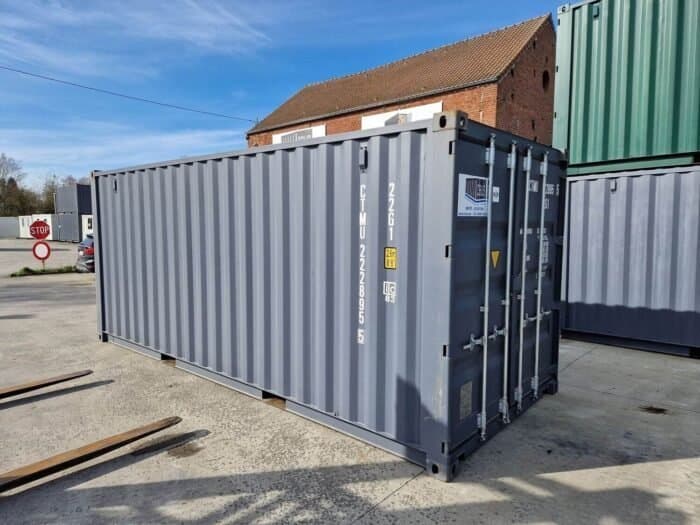
Choosing a 40ft High Cube over another format is worth comparing with the main alternatives on the market. The standard 20ft offers a length of about 6 m and a volume of about 33 m³; it is more manoeuvrable, easier to transport and suits small storage or tight sites, but its cost per cubic metre is generally higher. The standard 40ft, at about 67 m³, remains the most widespread format for sea transport, but lacks the extra height that makes the High Cube worthwhile. The 40ft High Cube covered here therefore adds about 9 m³ of usable volume compared with the 40ft dry, giving better value per cubic metre for the same footprint. The 45ft High Cube, rarer and often reserved for certain sea corridors, offers even more volume but is harder to transport and resell in Europe. Finally, reefer (refrigerated) containers and open top or flat rack units meet specific needs: the reefer includes a refrigeration unit and insulation, useful for perishable goods but more expensive to buy and run; the open top allows top loading for tall or oversize items; the flat rack, with no side walls, is used for heavy machinery. For everyday storage or fit-out, the used 40ft High Cube dry remains one of the best compromises between volume, price and availability.
Uses vary significantly by sector. In logistics and e-commerce, the container serves as a mini buffer warehouse on a platform or car park, with direct access for order picking. In industry, it houses spare parts, consumables or tooling, often on internal racks fixed to the walls. In events, it becomes a stand, technical control room or temporary storage, sometimes clad and customised. In agriculture and viticulture, it stores harvests, irrigation equipment or plant protection products, subject to ventilation and safety rules specific to those products. In the maritime and port sector, it returns to its original use as a transport unit, but also as buffer storage on terminals. Finally, for individuals, it serves as a garage, workshop, garden room or equipment store, provided local siting rules are checked.
Regarding road transport in France, several practical rules apply. A convoy carrying a 40ft container must comply with a maximum width of 2.55 m, a maximum length of 16.50 m for an articulated combination and a maximum height of 4 m, unless an exemption or special authorisation applies. However, a 40ft High Cube loaded on a low-bed chassis may reach or slightly exceed this height: the carrier must therefore check the exact configuration and, if necessary, apply for a traffic authorisation from the competent authorities. The authorised gross vehicle weight for a standard road combination is 40 tonnes in France; the container's payload must therefore be calculated taking into account the tare weight of the container and the vehicle. For international use, the container must keep a valid CSC plate and comply with the requirements of the international convention for safe containers. Finally, for delivery, it is advisable to provide an accessible, flat and clear drop-off area, and to check in advance for overhead cables or low branches along the route.
In summary, this used 40ft High Cube container suits those seeking substantial volume on a controlled budget, with a robust structure and ISO compliance allowing both transport and static storage. It requires a minimum of attention at purchase, particularly regarding sealing and floor condition, and simple but regular maintenance to last. Well chosen and correctly installed, it is a durable and versatile solution for many professional or personal projects.