Description
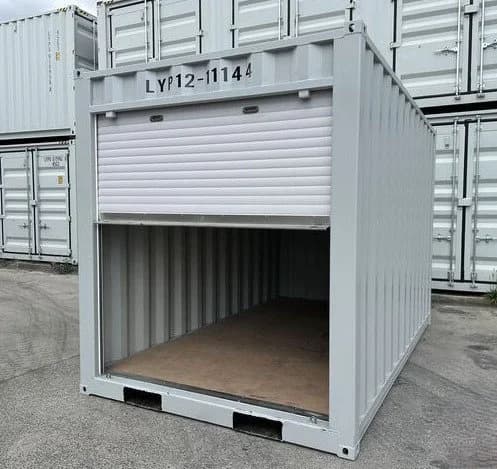
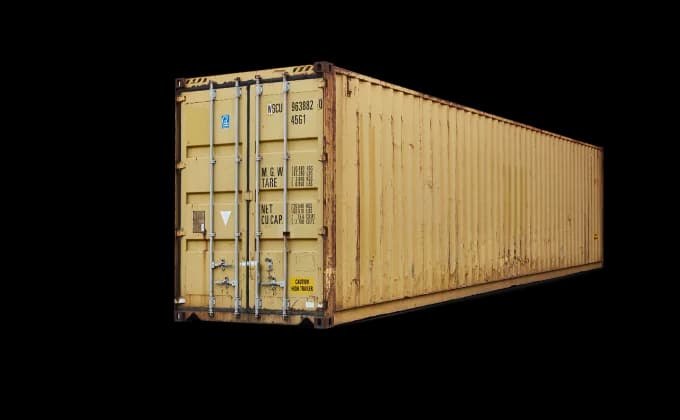
The 12ft storage container with forklift pockets is a compact and robust storage solution, designed for professionals who need to secure equipment on a site or in an enclosed space. This new model features a roller door and integrated forklift pockets, which greatly facilitate movement. Here we will detail its technical characteristics, concrete uses, points to watch when purchasing, as well as regulatory aspects related to its transport and installation in France.
Let's start with dimensions and capacity. This container has an external length of 3.66 meters, a width of 2.44 meters and a height of 2.59 meters. Inside, the usable space is 3.50 meters long, 2.29 meters wide and 2.39 meters high. This represents an internal volume of approximately 19 cubic meters. These dimensions are slightly larger than those of a standard 10ft container, which offers a little more floor space without requiring too much maneuvering space. The width of 2.44 meters corresponds to the standard width of ISO maritime containers, which allows road transport without an exceptional convoy in most cases, subject to compliance with size limits. The height of 2.59 meters remains below the maximum authorized height for vehicles in France (4 meters), which simplifies transport on container ships or trucks.
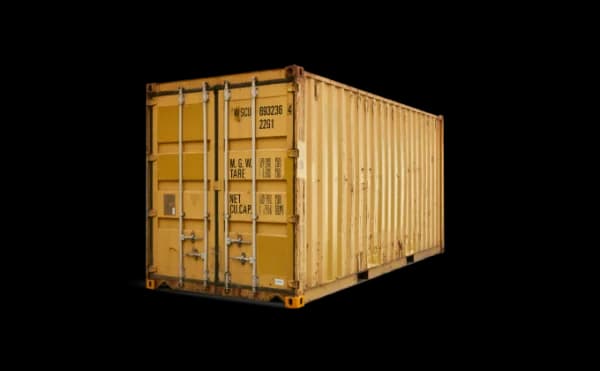
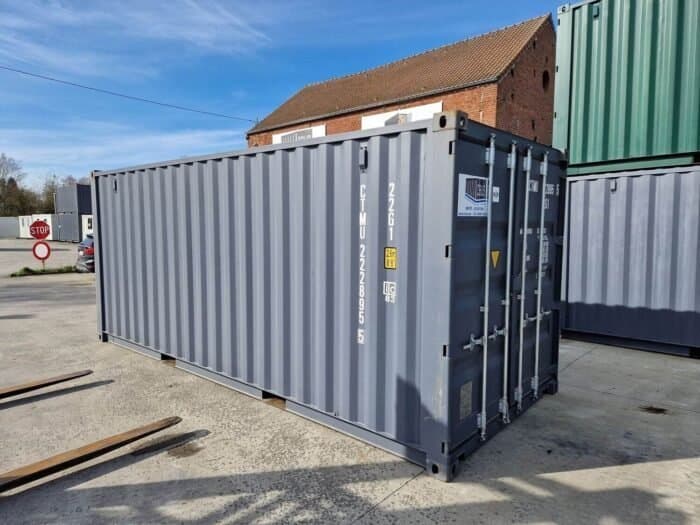
The main material is steel, with an anti-corrosion treatment. It is generally Corten steel (weathering steel) or galvanized steel, which resists weather and surface rust well. This type of steel is commonly used in the manufacture of maritime containers, as it withstands marine environments and climatic variations. Gray is the most common color, but it may vary by batch. The structure is reinforced at the corners and on the cross members, which allows it to support heavy loads and possible stacking, although this model is not specifically designed to be stacked on multiple levels, unlike CSC-certified maritime containers. It is therefore recommended not to stack this container beyond two units, and only if the manufacturer provides for it.
The roller door is a distinctive element. Unlike the classic swinging doors of maritime containers, this system opens by rolling upward, like a metal shutter. This has several advantages: opening is smoother and requires less free space in front of the container, which is practical in congested areas or on sites where space is limited. In addition, the roller door can be equipped with a locking system, often a padlock or integrated lock, to secure the contents. However, it should be noted that this type of door may be less airtight and watertight than a swinging door with rubber seals. For outdoor storage, it is advisable to regularly check the condition of the seals and sheet metal to avoid infiltration.
Forklift pockets, also called sleeves or tubes, are rectangular openings welded to the base of the container, allowing the forks of a forklift to be inserted. This facilitates handling and moving the container without having to use slings or chains. This is a major asset for professionals who must frequently move their storage, for example on a traveling construction site. These pockets are generally designed for standard-sized forks, but it is important to check compatibility with your forklift (fork spacing and section). In addition, the maximum authorized load for lifting must be respected; it is often indicated on a plate or in the technical documentation. In the absence of indication, reference should be made to the safety rules in force and the nominal capacity of the forklift should never be exceeded.
Let's move on to concrete uses. This 12ft storage container is particularly suitable for construction sites, warehouses, craft workshops, farms, or temporary logistics bases. It allows the storage of tools, power tools, spare parts, materials, or small equipment. Thanks to its roller door, access is quick and does not require clearing a large space in front, which is appreciable in dense urban areas or cramped courtyards. It can also serve as a technical room for generators, compressors, or pumping systems, provided sufficient ventilation is provided if the equipment gives off heat. For use as a site office, it can be fitted with lighting, a power outlet and basic insulation, but this goes beyond the standard product and requires additional work.
Another common use is the storage of seasonal equipment: lawnmowers, garden furniture, decorations, or various goods for shops. Its compact size allows it to be installed in a garden, courtyard, or parking lot, subject to compliance with local planning rules. Indeed, in France, the installation of a storage container may be subject to authorization depending on its surface area and duration of presence. We will return to this.
Let's now address the points to watch when purchasing. First, it is essential to check the general condition of the container: the presence of perforating rust, significant dents, or sealing defects. A new container should have a uniform surface, without traces of deep corrosion. Welds must be regular and non-porous. The roller door must slide without effort and lock correctly. The forklift pockets must be straight and undeformed, as they support the weight of the container during lifting. It is also recommended to check the flatness of the floor: often made of marine plywood or steel, it must not have soft or rotten areas. If the floor is wooden, check that it is treated against insects and humidity.
Next, the question of certification must be considered. Maritime containers intended for international transport must be certified CSC (Convention for Safe Containers) and bear an approval plate. This 12ft storage container is not necessarily CSC certified, as it is designed for static use. If you plan to transport it on public roads, it must be loaded onto a truck or trailer, and not rolled on its own. Road transport in France is governed by the Highway Code: the authorized gross combination weight (PTRA) and dimensions must comply with vehicle limits. A 12ft container can be transported on a container truck or flatbed, but it must be ensured that the vehicle is suitable and the load is properly secured. The empty weight of this container is not provided in the specifications, but a steel model of this size generally weighs between 1,200 and 1,800 kg. It is therefore important to know the exact weight before planning transport, as this influences the choice of vehicle and any authorizations.
Let's talk about maintenance. An anti-corrosion treated steel container requires little maintenance, but regular inspection is advisable. The surface should be cleaned with a soft cloth and soapy water, without using abrasive products or strong solvents that could damage the paint. Deep scratches should be treated quickly with anti-rust paint to prevent the spread of corrosion. The roller door seals should be lubricated periodically (with silicone grease, for example) to ensure proper operation. The forklift pockets should be inspected to detect any deformation or cracks. Finally, if the container is exposed to a marine or industrial environment, more frequent washing is recommended to remove salt or pollutants.
Regarding French regulations, the installation of a storage container on private land may be considered a construction if it is fixed to the ground and has a floor area greater than 5 m². In this case, a building permit or prior declaration may be necessary. The area of this container is approximately 8.9 m² (3.66 x 2.44), which exceeds the 5 m² threshold. It is therefore prudent to inquire with the town hall before any permanent installation. If the container is simply placed on the ground, without foundation, and is demountable, it may be assimilated to a temporary installation, but this depends on local regulations. In urban areas, the rules may be stricter. It is also important to respect setback distances from property boundaries and public roads.
From a tax perspective, the purchase of a storage container for a business can be depreciated over several years, according to the accounting rules in force. For individuals, there is no specific reduced VAT, except under certain energy renovation programs, which is not the case here. The applicable VAT is the standard rate of 20%.
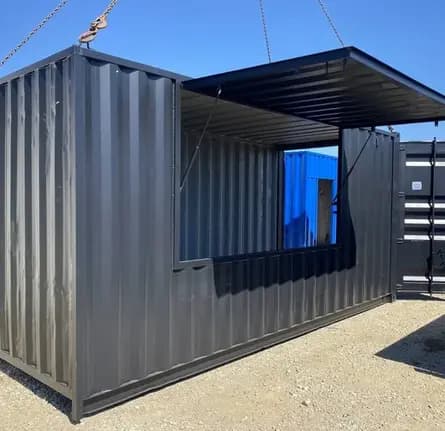
As for customization, this container can be equipped with options such as shelves, hooks, interior lighting, ventilation, or insulation. These modifications must be carried out properly to avoid compromising the structure. For example, drilling the sheet metal to install ventilation requires treating the edges to prevent rust. It is advisable to call a professional for any major modification.
Finally, let's compare this model to other storage solutions. A standard 20ft maritime container offers a volume of approximately 33 m³, but it is longer (6.06 m) and heavier. The 12ft is an interesting compromise for restricted spaces. Wooden or metal garden sheds are less secure and less durable against bad weather. Maritime containers are designed to withstand extreme conditions, giving them a long service life. This model with roller door and forklift pockets is therefore particularly suitable for mobile professionals.
Before finalizing your purchase, check the availability of accessories: a quality padlock, wedges to stabilize the container on soft ground, and possibly a ventilation kit. Also ensure that the container is delivered with the necessary documents: invoice, certificate of conformity if applicable, and user manual. Do not hesitate to ask for real photos of the product, as the images may be generic.
In summary, the 12ft storage container with forklift pockets is a practical and robust tool for professional storage. Its compact dimensions, roller door and forklift pockets make it a relevant choice for construction sites, warehouses and other sites requiring a mobile and secure solution. However, local regulations, weight, and container condition should be checked before purchase. Minimal maintenance will extend its service life. For any specific questions, it is recommended to contact a container professional, who can advise you according to your use.
Let's now look in more detail at seasonal maintenance, an often neglected but decisive aspect for the longevity of your container. Over the months, exposure to UV, rain, frost and sea spray can gradually alter protective coatings. It is therefore wise to establish a biannual inspection schedule, in spring and autumn. In spring, take advantage of a dry day to examine the entire structure: roof, walls, base, door frames and forklift pockets. Look for paint blisters, emerging rust spots, seal detachment, or deformations. First clean with clear water under moderate pressure, then apply a mild degreaser if necessary. Once the surface is dry, apply a layer of protective wax or anti-rust paint to sensitive areas. In autumn, prepare the container for winter: check the sealing of the roller door, grease the rails and rollers, and ensure that drainage around the container is effective to avoid water accumulation. If the container is placed on bare ground, consider creating a slight slope or a gravel bed to keep moisture away. These simple actions, carried out twice a year, help avoid costly repairs and maintain the value of the property.
Let's now address in more detail the regulations relating to road transport in France, as they condition delivery and any movements of the container. A 12ft container is not driven like a vehicle: it must be loaded onto a truck, trailer or container carrier. Road freight transport is subject to the Highway Code, which sets dimension and weight limits. For vehicles over 3.5 tonnes, specific rules apply, particularly regarding driving time, rest, and driver training (FCO, professional card). The authorized gross combination weight (PTRA) must not exceed 40 tonnes for a standard articulated combination, except for derogations. The container itself, once loaded, must not exceed these limits. The maximum authorized width for a vehicle is 2.55 meters, which is compatible with the container width (2.44 m). The maximum height is 4 meters; with a container 2.59 m high, there remains a margin for the truck chassis, generally around 1 m to 1.2 m, giving a total height of approximately 3.6 to 3.8 m, below the limit. The maximum length of a road combination is 16.5 meters; a 3.66 m container fits without difficulty. However, if the container is transported on a low-bed trailer, the total height can be reduced, but the compatibility of the fixings must be checked. Securing is essential: the container must be firmly lashed to the vehicle using straps, chains or twist-locks if the chassis is equipped with them. Faulty securing can lead to serious accidents and criminal penalties. It is recommended to use a specialized carrier, accustomed to container transport, who has the appropriate equipment and knows the regulatory constraints. For site deliveries, ensure that access is possible for a large truck: road width, passage height, ground resistance. A 12ft container can be delivered by a crane truck or forklift if the site allows. If not, transshipment will need to be arranged.
Let's move on to sector-specific use cases, as not all professionals have the same needs. In the building and public works sector, this container is often used as a site store to store power tools, consumables (screws, plugs, cables), personal protective equipment, and sometimes site documents. Its roller door allows quick access even with hands full, and the forklift pockets facilitate its movement as the site progresses. In the events sector, it serves as a storage room for sound, lighting, stage, or decoration equipment. Organizers appreciate its mobility and its ability to be locked to protect expensive equipment. In agriculture, it can shelter tools, seeds, fertilizers, or small irrigation equipment. Its resistance to bad weather is an asset in rural areas exposed to wind and rain. In retail, it can serve as a reserve for seasonal stocks, sales, or unsold goods. Restaurants and caterers can store terrace furniture, tables, chairs, or bulky kitchen equipment. In the logistics sector, it can be used as a transit area for parcels or pallets, in addition to a main warehouse. Finally, for individuals, it offers a secure storage solution for gardening equipment, bicycles, motorcycles, or tools, provided that planning rules are respected. Each sector has its constraints: construction will prioritize robustness and ease of movement, events security and accessibility, agriculture resistance to humidity and rodents. This versatile container meets most of these expectations.
Let's finish with a comparison with other container sizes and types, to situate this model in the overall offer. Maritime containers are generally offered in 10, 20, 40 and 45 feet. The 10ft (about 3.05 m long) is shorter and lighter, but its internal volume is about 15 m³, which may be insufficient for some uses. The 12ft, the subject of this sheet, offers a good compromise between compactness and capacity. The 20ft (6.06 m) almost doubles the floor area and offers about 33 m³, but it requires more maneuvering space and weighs more (about 2.2 tonnes empty). The 40ft (12.19 m) is even more voluminous (67 m³) and is not suitable for small sites. In terms of types, there are dry containers (standard, for dry storage), reefers (refrigerated, with cooling unit), open top (open roof for loading tall objects), flat rack (without side walls, for out-of-gauge loads), and high cube (internal height increased by about 30 cm). This 12ft model with roller door and forklift pockets is a specific storage container, which is not intended for international maritime transport but for static or semi-mobile use. It differs from classic maritime containers by its roller door, more practical for frequent access, and by its forklift pockets, which avoid having to use slings. Compared to a standard 20ft container, it is more maneuverable and less bulky, but it offers less volume. Compared to a wooden or plastic site shelter, it is much more resistant, more secure and more durable. Compared to a 10ft maritime container, it offers a little more space without being much more bulky. The choice will therefore depend on available space, volume to be stored, frequency of movements, and budget. This 12ft model is particularly suitable when space is limited, movements are frequent, and security is essential. It should also be mentioned that used containers exist, cheaper, but which may show traces of rust or sealing defects. This new model guarantees better durability and a neat appearance, which can be important for an installation visible to customers. Finally, be aware that customization is possible: shelves, hooks, lighting, insulation, or even air conditioning can be added for office use. These options increase the cost but improve comfort and functionality. Before buying, compare offers and check that the container corresponds to your specifications. A professional will be able to advise you on the model best suited to your activity.