Description
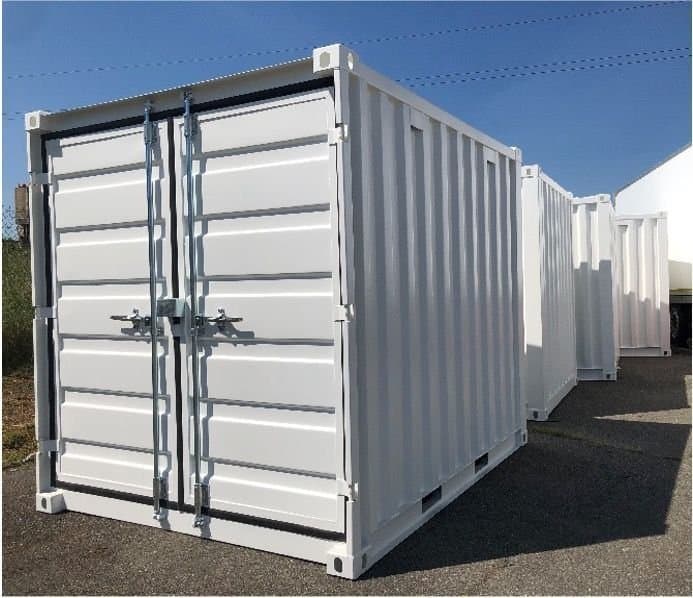
The new 10 ft storage container is a compact steel module designed for secure storage of equipment, tools or goods on a fixed site. Its small size allows installation in spaces where a standard 20 or 40 ft container would not fit, while offering a usable capacity of 12 m³ and a load capacity of 7200 kg. This model is suitable for both businesses and individuals seeking a movable, weather-resistant storage unit.
The structure is based on a fully welded steel profile frame, 3 mm thick, lacquered RAL 9010 white. The walls and ceiling are made of 1.5 mm lacquered rolled steel sheet, ensuring good rigidity and effective protection against common corrosion. The floor is made of solid wood treated against moisture, 25 mm thick, with an allowable load of 700 kg/m². The unit is ventilated by four air vents, limiting condensation inside.
External dimensions are 299.10 cm deep, 220 cm wide and 225 cm high. Inside, the usable space measures 279.10 cm deep, 207 cm wide and 202 cm high. These dimensions allow storage of pallets, crates, equipment or bulky materials. The tare weight is 900 kg, allowing a payload of 7200 kg. It is important to note that this container is not an ISO-certified maritime container for intermodal transport; it is a storage container intended for static use or occasional movement by lifting equipment.
Handling is done in two ways. By forklift, the base has a side fork passage, with a fork spacing of 90 cm; 250 cm long forks are recommended to distribute the load. By crane, four lifting points are provided on the roof for lifting hooks or slings. This equipment facilitates positioning on stabilized ground or a concrete slab. It is advisable to check the ground bearing capacity before installation, especially if the container is loaded.
The doors are located on the width. They consist of two lacquered rolled steel leaves in RAL 9010 white, fitted with black rubber seals for watertightness. A padlock protection flap is integrated, allowing access to be secured with a suitable padlock (not supplied). This system protects the lock bolt against sawing or simple break-in. For intensive use, additional locking options can be added.
This storage container has many uses. On a construction site, it serves as a tool room, spare parts store or site locker room. On a farm, it houses seeds, fertilizers or small equipment. For a business, it can serve as a goods reserve or seasonal storage room. Individuals use it to store furniture, bicycles, garden tools or leisure equipment. Its RAL 9010 white color blends discreetly into most environments, and can be changed according to the RAL palette as an option.
Maintenance is simple. A regular visual check of the roof allows leaves and debris that could retain moisture to be removed. Lacquered walls are cleaned with soapy water; avoid abrasive products that would scratch the paint. Door seals should be inspected to check their flexibility and watertightness; a worn seal can let in water or rodents. The solid wood floor treated against moisture does not fear ambient humidity, but it is preferable not to store damp products directly on it without protection. When storing sensitive materials, additional ventilation or a dehumidifier may be useful.
Before purchase, several points of vigilance deserve attention. First, check the compatibility of the dimensions with the intended location: 299.10 cm deep and 220 cm wide overall, plus the clearances needed for door opening and movement. Then, ensure that the ground can support the total weight (container + contents), up to 8100 kg. Soft or sloping ground requires shims or a slab. Finally, anticipate local permits: in some municipalities, installing a storage container may require prior declaration if it is considered a construction. It is recommended to check with the local planning department.
Regarding transport, this 10 ft container is not designed to be stacked or for maritime transport. Moving it on the road requires a truck with a loader or a flatbed with an auxiliary crane. The fork passage and roof lifting points facilitate loading and unloading operations. If the container is to be delivered to a site with difficult access, it is essential to provide suitable lifting equipment and check road permits for temporary truck parking.
The available options allow the container to be adapted to specific needs. The electrical installation includes a switch, an LED light, two power outlets, an electrical panel and a connection box. It provides lighting and power for tools or appliances. The steel floor is an alternative to wood for heavy loads or environments where humidity is frequent. Specific colors according to the RAL palette are offered to harmonize the container with its environment. Finally, a padlock can be supplied to immediately secure access.
This new 10 ft storage container is therefore a robust, compact and scalable storage solution. It meets the needs of professionals and individuals looking for a secure, movable and durable storage unit. Its lacquered steel construction and treated wood floor give it good weather resistance and a long service life, subject to minimal maintenance and correct installation.
To go further, it is useful to place this model within the entire range of containers and to specify its particularities compared to other commonly offered formats. The standard maritime container, known as "dry", exists mainly in 20 ft (about 6.06 m long, 33 m³) and 40 ft (about 12.19 m long, 67 m³), with high cube variants (internal height increased by about 30 cm) and special versions such as reefer (refrigerated), open top (open roof) or flat rack (without side walls). These containers are certified according to ISO 668 and ISO 1496 standards, which guarantees their stacking and intermodal transport (ship, train, truck). The 10 ft storage container, the subject of this sheet, does not fall into this category: it is shorter, lighter and not certified for stacking or maritime transport. It sits between the 8 ft container, often used as a small site storage unit, and the 20 ft container, which remains the reference for storing large volumes. The 10 ft format offers a good compromise: it is more spacious than an 8 ft while remaining maneuverable in tight spaces, and it can be moved by a forklift of suitable capacity, which is not always possible with a loaded 20 ft.
From a regulatory point of view, installing a storage container on private land generally falls under planning law. In France, a container can be considered a construction if its floor area is significant or if it is permanently fixed to the ground. For an area of less than 5 m², no formality is in principle required, except in certain protected areas (historic monuments, classified sites, areas subject to local advertising regulations or the local urban plan). Above 5 m², a prior declaration of works may be necessary; above 20 m², a building permit may be required. The 10 ft container described here has a footprint of about 6.6 m² (299.10 cm x 220 cm), which places it in the category requiring prior declaration in most municipalities. It is therefore strongly advised to consult the local planning department before any installation, especially as rules vary from one municipality to another. Furthermore, if the container is used as a workplace (locker room, site office), it must comply with general safety and health obligations applicable to workplaces, particularly regarding ventilation, lighting and emergency means. The electrical installation option offered must be carried out according to good practice, ideally by a qualified professional, and protected by a suitable residual current device.
Transport and handling of this container also deserve some clarification. On the road, an empty 10 ft container weighs 900 kg; loaded to its maximum capacity, it reaches 8100 kg. Truck transport must comply with current weight and size limits. A standard rigid truck can easily transport this module, but loading and unloading require lifting equipment: a forklift of sufficient capacity (generally 3 to 5 tonnes depending on fork length and load), a mobile crane or a truck-mounted crane. The four roof lifting points are designed for slings or hooks, but it is imperative to check their condition before each lift and to use compliant accessories. The side fork passage, with a fork spacing of 90 cm, requires the use of long forks (250 cm) to reach the center of gravity and avoid tipping. When moving on sloping ground, it is prudent to strap the container to the bed and limit speed. Finally, if the container is to be placed on unstabilized ground, wooden beams or concrete blocks can serve as foundation pads to distribute the load and prevent sinking.
Routine maintenance can be supplemented by a few good practices that extend the container's service life. An annual paint inspection helps identify scratches or emerging rust spots. Light sanding and a touch-up of anti-rust paint are enough to treat small oxidized areas before they spread. Door hinges should be lubricated once or twice a year with a suitable grease, to avoid stiff points and premature wear. Black rubber seals can be cleaned and treated with a rubber care product to preserve their flexibility. If the container is exposed to sea spray, rinsing with fresh water several times a year limits salt corrosion. The solid wood floor treated against moisture can be swept and, if necessary, cleaned with a damp cloth; avoid soaking it. When storing chemicals or liquids, provide retention trays and suitable ventilation. Finally, it is recommended not to overload the container beyond the stated 7200 kg, and to distribute heavy loads over the entire floor surface rather than concentrating them in a small area.
Sector-specific use cases are varied. In construction, this 10 ft container is often used as a tool room on renovation sites in city centers, where space is limited. It can also serve as a compact site welfare unit for a small team, with the electrical option for lighting and recharging tool batteries. In events, it acts as a technical control room or storage room for sound and lighting equipment. Farmers store seeds, plant protection products (with regulatory precautions related to chemical storage) or small irrigation equipment. Local authorities install it in waste collection centers or technical services to store municipal equipment. Building contractors see it as a mobile reserve for successive sites. Finally, individuals use it to declutter a garage or attic, or to store leisure equipment (quad, motorcycle, camping gear).
Compared to other storage solutions, the 10 ft container has advantages and limits. Compared to a wooden or resin garden shed, it offers much better resistance to intrusion, weather and fire. Compared to a 20 ft maritime container, it is more compact, lighter and easier to move, but it offers less volume and is not stackable. Compared to a rental storage unit, it represents a higher initial investment, but it becomes the owner's property and can be resold or moved. Compared to an 8 ft container, it offers greater volume (12 m³ versus about 8 to 10 m³ depending on the model) for barely more floor space. The choice therefore depends on the volume to be stored, the frequency of movement, the duration of use and local planning constraints.
To summarize, the new 10 ft storage container is a versatile, robust and scalable tool. It is aimed at those looking for a secure, movable and durable storage unit, without the constraints of a standard maritime container. Its lacquered steel design, treated wood floor and fitting options make it a solution suitable for many professional and private contexts. Before purchase, check the location, ground bearing capacity, planning permissions and available handling means. Once installed and maintained correctly, it offers a long service life and good protection against theft, humidity and weather.