Description
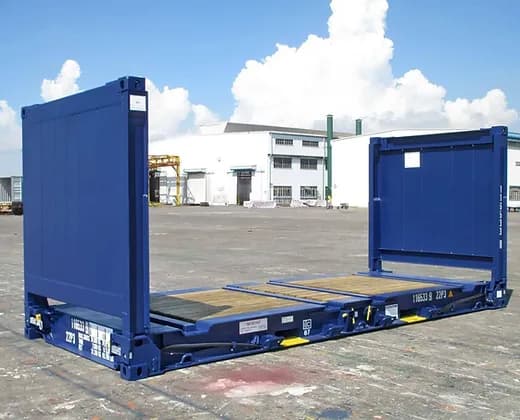
The new 20ft Flat Rack container is a specialized transport solution for loads that exceed the standard dimensions of a classic dry container. Unlike closed containers, the Flat Rack has no side walls or roof, allowing the loading of tall, wide or irregularly shaped objects. It is commonly used for sea, road and rail transport of goods such as boats, aircraft parts, agricultural machinery, mobile homes, heavy machinery, pipes, logs or construction materials. Its open design facilitates loading and unloading by crane or forklift, while providing a stable and sturdy base.
This container is made of Corten steel, a low-alloy steel that offers excellent resistance to atmospheric corrosion. This feature is essential for intensive outdoor use and in marine or industrial environments. The floor is reinforced, in steel or wood depending on the model, to support significant concentrated loads. The structure includes ISO corners at the four angles, compliant with ISO 668, allowing securing, lifting and stacking according to standard intermodal transport procedures. The container is CSC certified (International Convention for Safe Containers), guaranteeing its compliance with safety requirements for international transport.
The external dimensions of this 20ft Flat Rack are as follows: length 6060 mm, width 2440 mm. The external height may vary depending on the model (flat platform, flat fix hands or flat rack collapsible), but it is generally between 2590 mm for models with fixed walls. The useful internal dimensions are 5890 mm length, 2440 mm width and 2590 mm height for the version with walls. The available floor area is approximately 13.8 m². The tare weight is 2300 kg, the maximum allowed load is 26000 kg, and the maximum gross weight is 28300 kg. These values are indicative and may vary slightly depending on the manufacturer and exact model.
There are several variants of the 20ft Flat Rack. The Flat Platform model is a simple platform with forklift pockets for handling. The Flat Fix Hands model has four posts or two fixed walls with ISO corners. The Flat Rack Collapsible model has two removable and retractable walls, allowing several containers to be stored in a reduced space and reducing empty transport costs. The choice between these models depends on the nature of the cargo and logistical constraints.
Using a Flat Rack requires particular attention to securing and chocking the goods. Given the absence of walls, it is imperative to use straps, chains, chocks and suitable anchor points to prevent any movement during transport. Loads must be distributed evenly on the floor and respect point load limits. It is recommended to call on a professional for the loading and securing plan, especially for out-of-gauge loads. Failure to comply with these rules can lead to damage to the goods, the container or accidents.
For maintenance, a Corten steel Flat Rack requires little care. It is advisable to regularly check the paint condition and touch up scratches to prevent corrosion. The moving parts of collapsible models must be lubricated and checked. The floor must be inspected for wear or deformation. Periodic cleaning with clean water is generally sufficient. For prolonged storage, it is preferable to place it on a flat and stable surface, protected from stagnant moisture.
Buying a new Flat Rack container involves checking several points. Ensure that the container is CSC certified and has a valid CSC plate. Check dimensions and weights with the supplier, as they may vary. Check the quality of welds, paint condition and floor flatness. For intensive use, choose a model with a reinforced steel floor. If you plan to transport very heavy loads, check the load capacity and lifting points. Finally, take into account local regulations for road transport, particularly in France, where the authorized gross train weight (GTW) and maximum dimensions are strictly regulated. An exceptional convoy may be necessary for out-of-gauge loads.
D.S. Globe Conteneur, based in Marseille, offers this new 20ft Flat Rack container for sale. We provide delivery in Europe and unloading on site. Our team can advise you on choosing the model suited to your use and support you in your transport or storage projects. Whether for single use or for a fleet, we put our experience in maritime containers at your service. Contact us for a personalized quote and availability.
To go further, let's examine the sector-specific use cases that justify using a 20ft Flat Rack. In the construction sector, this type of container is often used to transport steel beams, frame elements, concrete prefabricated parts or bulky site equipment. Its open platform allows loading long parts that could not fit in a closed container. In the energy industry, it is used to transport pipe sections, industrial valves, heat exchangers or wind turbine components. The agricultural sector also uses the Flat Rack to move tractors, combine harvesters or irrigation parts. In the nautical field, pleasure boats, catamarans or marine engines are frequently shipped on Flat Racks. Finally, the events sector uses it for stage structures, stands or large decorative elements.
Let's now compare the 20ft Flat Rack with other container types and sizes. The standard 20ft dry container offers an internal volume of about 33 m³ and a payload of about 28 tonnes, but it is closed and can only accommodate goods entering through the door. The 20ft high cube container offers additional internal height of about 30 cm, but remains closed. The 20ft open top container has an opening roof, allowing tall objects to be loaded from above, but it retains side walls that limit width. The 40ft flat rack container offers double length (about 12 m) and a floor area of about 27 m², but it is bulkier and heavier when empty. The 20ft Flat Rack therefore offers a good compromise between capacity, maneuverability and cost, especially for loads that do not require excessive length. It can be stacked like a standard container when empty, which facilitates its storage and transport.
Regarding transport regulations in France, several rules apply. For road transport, the authorized gross train weight (GTW) of a tractor unit + semi-trailer combination is generally limited to 40 tonnes, unless exemptions apply. The maximum load of a 20ft Flat Rack container (26 tonnes) must therefore be compatible with the weight of the vehicle and trailer. The maximum dimensions allowed for a standard convoy are 2.55 m width, 4 m height and 16.50 m length for an articulated combination. If the cargo exceeds these limits, an exceptional convoy is necessary, with prior authorizations and traffic restrictions. For sea transport, the Flat Rack is subject to IMO (International Maritime Organization) rules and must be secured according to the vessel's prescriptions. The CSC certification must be valid and the CSC plate must be affixed to the container. Finally, for rail transport, the gauge must comply with rail network standards, and the container must be loaded on a suitable wagon.
Maintenance of a new 20ft Flat Rack is relatively simple, but a few regular actions extend its lifespan. After each use, inspect the floor for deformation, cracks or signs of corrosion. Clean debris and dirt, especially in corners and grooves. Check welds and anchor points. If scratches appear, apply rust-preventive paint suitable for Corten steel. For collapsible models, grease the hinges and check the proper functioning of locking mechanisms. Store the container on a flat surface, preferably on blocks to avoid direct contact with damp ground. If storing outdoors, ensure water does not stagnate on the floor. Annual maintenance by a professional can be considered for large fleets.
Points to watch when buying a new Flat Rack include checking compliance with ISO and CSC standards, the quality of materials (Corten steel, sheet thickness), the robustness of the floor, the presence of all accessories (straps, hooks, etc.) and the clarity of delivery conditions. Ask the supplier for a detailed technical sheet and, if possible, a visit to the unit before shipment. Check that the container has not been damaged during transport. Finally, ensure that the price includes any unloading and on-site placement costs.
To further the comparison with other solutions, it is useful to look at alternatives to the 20ft Flat Rack. The 20ft open top container is an intermediate option: it has an opening roof (tarpaulin or removable structure) and rigid side walls. It allows loading objects from above, but the useful width remains limited by the walls, and the loading height is constrained by the structure. The 20ft dry container, on the other hand, offers full weather protection and a closed volume, but it is unsuitable for out-of-gauge loads. The 40ft flat rack container doubles the floor area (about 27 m²) and useful length (about 12 m), which suits very long loads, but it is heavier, bulkier and generally more expensive to purchase and transport. The choice therefore depends on the nature of the cargo: for heavy and compact loads, the 20ft is sufficient; for long loads, the 40ft is preferable. There are also high cube flat racks, whose wall height is increased, offering better lateral retention for tall loads. Finally, the collapsible flat rack has a major logistical advantage: once folded, several units can be stacked, considerably reducing the cost of empty repositioning.
Let's now address aspects related to handling and lifting. The 20ft Flat Rack is equipped with four ISO corners at the upper and lower angles, compliant with ISO 668. These corners allow the use of spreaders for crane lifting, as well as locking on wagons or trailers. The forklift pockets, 2050 mm wide, allow handling by forklift when the container is empty or lightly loaded. For heavy loads, it is imperative to use slings and hooks suitable for the designated lifting points. It is recommended to check weight distribution and center the load to avoid tipping. When stacking, only empty containers can be stacked, and within the manufacturer's prescriptions. Lifting must always be carried out by qualified personnel, respecting safety instructions.
Multimodal transport is a major advantage of the 20ft Flat Rack. It can be loaded on a container ship, a freight train or a semi-trailer truck. This flexibility allows optimizing international logistics chains. For sea transport, the container is secured on deck or in the hold, according to the carrier's instructions. For rail transport, it is placed on a flat wagon specially designed for containers. For road transport, it is loaded on a container chassis or a flatbed trailer. In all cases, a loading and securing plan must be established, and safety rules must be respected. The 20ft Flat Rack is particularly appreciated for industrial projects and exceptional shipments, as it avoids the use of ro-ro ships or specialized transport solutions, which are often more expensive.
Finally, environmental and sustainability aspects should be mentioned. Corten steel is a 100% recyclable material, which is part of a circular economy approach. The lifespan of a well-maintained Flat Rack can exceed 20 years, or even more depending on usage conditions. Choosing a new container guarantees better resistance and full compliance with current standards. For companies concerned about their carbon footprint, multimodal transport (combining sea, rail and road) reduces emissions compared to road-only transport. The 20ft Flat Rack therefore fits into a logic of economic and environmental performance.
In conclusion, the new 20ft Flat Rack container is a versatile and robust tool for transporting out-of-gauge loads. Its open design, Corten steel structure and compliance with international standards make it a reliable solution for many sectors. D.S. Globe Conteneur supports you in choosing and delivering this container, with a service tailored to your needs. Do not hesitate to contact us to discuss your project and obtain a quote.