Description
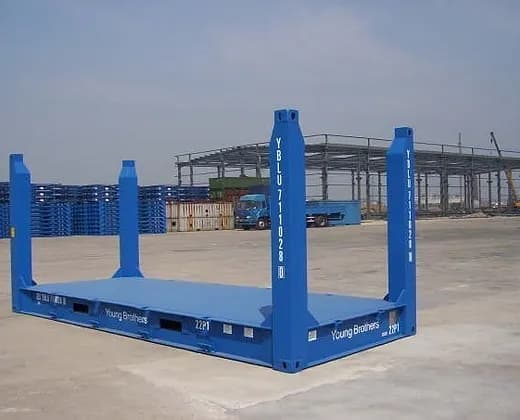
The new 20ft flat rack container is a transport and storage solution specifically designed for cargo that cannot be loaded into a standard dry container due to out-of-gauge dimensions. Unlike closed containers, the flat rack has no side walls or roof: it is a robust platform, optionally equipped with collapsible or fixed walls, allowing the loading of tall, wide or irregularly shaped objects. This type of container is commonly used for sea, road and rail transport of boats, aircraft parts, agricultural machinery, mobile homes, heavy machinery, piping, logs or construction materials. Its standardized design allows it to be handled with the same equipment as standard containers (spreader, forklifts, reach stacker) while offering great loading flexibility.
This new model is made of Corten steel, a low-alloy steel that resists atmospheric corrosion through the formation of a protective surface layer. This feature is essential for intensive outdoor use, whether on a construction site, in a port or for prolonged storage. The floor, made of steel or reinforced wood depending on the version, is sized to support concentrated loads and heavy equipment. The ISO corners, located at the four angles, comply with international standards (ISO 668 and ISO 1496) and allow stacking, lifting and securing on all types of ships and road chassis. The structure also complies with the International Convention for Safe Containers (CSC), guaranteeing its validity for international sea transport.
The external dimensions of this 20ft flat rack are 6060 mm long and 2440 mm wide, with a height varying according to the configuration (simple platform or with walls). The useful internal dimensions are 5890 mm long, 2440 mm wide and 2590 mm high when the walls are deployed, offering a floor area of 13.8 m². The tare weight is 2300 kg, the maximum allowed payload is 26000 kg and the total loaded weight (max weight) is 28300 kg. These characteristics make it a container suitable for heavy loads, with a static payload capacity of about 25 tonnes for the platform version. The 2050 mm forklift passage allows easy handling with a forklift, which is particularly useful on sites without gantry cranes.
There are several variants of the 20ft flat rack. The simple platform version, called flat platform, is a bare deck with a forklift passage for handling. It is ideal for very wide or very tall loads that do not require lateral support. The flat fix hands version, or flat rack with fixed walls, has four posts or two fixed walls with ISO corners, offering better lateral retention for cargo that could shift. Finally, the collapsible version has two removable and retractable walls: once folded, several containers can be stacked in a reduced space, considerably reducing storage and empty transport costs. This new model is available in 20ft, but the range also exists in 40ft for larger volume needs.
Using a new flat rack offers several advantages. First, the new structure guarantees maximum strength and no pre-existing deformation or corrosion, which is crucial for transporting high-value loads. Then, the ISO standard ensures universal compatibility with ships, trains and trucks, simplifying multimodal operations. The anti-slip floor surface and integrated lashing points allow effective securing of the cargo using straps, chains or tensioners. Finally, the flat rack can be used as a temporary storage solution on a construction site or in a depot, offering a raised platform that protects goods from ground moisture.
When buying a new flat rack, several points must be examined. It is essential to check CSC compliance and the presence of the approval plate, which certifies that the container has successfully passed strength and safety tests. The quality of the Corten steel and the thickness of the profiles must be checked, as some manufacturers offer lower-quality steels. The type of floor (wood or steel) must be chosen according to use: a wood floor is more flexible and absorbs shocks better, while a steel floor is more resistant to abrasion and heavy point loads. The presence of forklift passages is a plus for handling, but it can slightly reduce the useful area. Finally, ensure that the walls, if any, are properly movable and lockable, and that the seals have no leakage defects.
Maintenance of a new flat rack is relatively simple. Regular cleaning with clear water and mild detergent removes salt deposits, especially near the sea. A visual inspection of welds and ISO corners is recommended before each use to detect any cracks or deformation. In case of deep scratches, a touch-up of anti-rust paint can extend the life of the steel. The moving parts of collapsible versions must be lubricated periodically to prevent seizing. It is also advisable to store the container on a flat, stabilized surface to avoid any deformation of the chassis.
Transporting a flat rack in France is subject to regulations on vehicle weights and dimensions. An empty 20ft flat rack container weighs 2300 kg, which remains compatible with most container trucks. When loaded, the total weight must not exceed 28300 kg, and axle weight limits and signage rules for exceptional convoys must be respected if the cargo exceeds standard dimensions. Multimodal transport (sea, rail, road) is facilitated by ISO standardization, but it is necessary to provide compliant lashing points and verify that the ship or train accepts this type of container. For import-export, the flat rack is often used for goods that cannot be containerized, and it is important to properly declare the nature of the cargo to customs authorities.
In summary, the new 20ft flat rack container is a versatile and robust piece of equipment, suitable for transporting heavy and out-of-gauge loads. Its Corten steel design, compliance with international standards and load capacity make it a relevant choice for professionals in transport, logistics, construction and industry. Available in several models (platform, fix hands, collapsible), it can be adapted to specific loading and storage needs. With possible delivery in Europe and unloading on site, it represents a practical solution for companies wishing to have reliable and durable equipment.
To choose between a 20ft flat rack and a 40ft flat rack, consider the volume and weight of the cargo. The 20ft offers a useful length of 5890 mm, suitable for compact machinery, small boats, machine tools or pallets of long materials. The 40ft, with double length, is preferred for longer convoys, mobile homes, large boats or metal structures. However, the 20ft has the advantage of being lighter when empty (2300 kg versus about 5000 kg for a 40ft), allowing more goods to be loaded within the total allowed weight. Moreover, the 20ft is more maneuverable in tight spaces and can be transported on smaller trucks. The choice therefore depends on the ratio between the bulk and mass of the load, as well as the logistical constraints of the site or port.
Compared to an open top container, the flat rack stands out by the total absence of roof and rigid walls, allowing loading from the top and sides. The open top has side walls and an open end, but retains a flexible or rigid roof. For very tall loads, the flat rack is more suitable because there is no height limitation other than that of the ship or truck. For loads requiring protection from the weather, the open top with tarpaulin may be preferred. The flat rack leaves the cargo exposed to the elements, often requiring protective tarpaulins or custom covers. However, it offers full accessibility for strapping and shoring, which is an asset for heavy and bulky parts.
Compared to a standard dry container, the flat rack cannot be stacked on several levels when loaded, unless the cargo remains within the ISO corners and the ship allows it. However, when empty, it can be stacked in certain configurations, especially collapsible versions. The standard dry container is stackable up to 9 levels and offers full weather protection, but is limited by its fixed internal dimensions. The flat rack is therefore complementary: it is used when the dry container cannot accommodate the goods, and is often used in combination with dry containers for industrial projects.
In the construction sector, the 20ft flat rack is used to transport beams, tubes, scaffolding, generators, compressors or mini excavators. Its raised platform allows direct unloading on site with a forklift, without having to open a container. Public works companies see it as a way to reduce handling and breakage risks. In the nautical field, it is used to transport pleasure boats, tenders, outboard motors or masts. Shipyards and marinas use it to move units from one site to another, including by sea. For industry, the flat rack transports machine tools, molds, foundry parts, heat exchangers or process skids. Its load capacity and robustness make it a reliable support for heavy and sensitive equipment.
In the agricultural sector, it is used for transporting tractors, trailers, plows, seeders or harvesters. Agricultural dealers use it to deliver machines from one country to another, especially in import-export. The flat rack avoids dismantling machines or loading them on special trailers, simplifying logistics. For material transport, it is suitable for logs, metal profiles, large-diameter pipes, large panels or stone blocks. Quarry operators and sawmills find it a solution to ship out-of-gauge loads without resorting to exceptional trucks over long distances.
In the events sector, the flat rack can be used to transport stage structures, bleachers, marquees or set elements. Its flat surface and lashing points allow securing heterogeneous loads. Festival or trade show organizers appreciate the ability to load and unload quickly with a forklift, without roof constraints. Finally, for storage, the flat rack offers a raised platform that protects from moisture and allows stacking goods that are not sensitive to weather, such as pallets of bricks, pipes or metal parts. It can be equipped with a tarpaulin for partial protection.
When buying a new flat rack, it is advisable to request the CSC certificate of conformity, the manufacturer's technical data sheet and, if possible, an inspection report. Check that the ISO corners are in good condition and that the welds have no porosity. Ensure that the floor is suitable for the load: a wood floor can rot if it stays wet, while a steel floor can become slippery. In both cases, regular maintenance is necessary. If you plan intensive use in a saline environment, additional paint or anti-rust treatment may be considered. For collapsible versions, test the folding mechanism before purchase and check that the hinges are not seized.
The 20ft flat rack can be used as a base for modular conversion, for example a site office, technical room or covered storage space, by adding a light structure and a roof. However, unlike a dry container, it does not guarantee air and water tightness without specific conversion. For housing or an office, it is more common to start from a dry or high cube container, but the flat rack can serve as a platform for temporary constructions. In this case, a frame and added walls must be provided, as well as insulation if necessary.
In terms of regulations, sea transport of flat racks is governed by the CSC Convention, which requires periodic inspections. In France, road transport of containers is subject to the Highway Code and rules on weights and dimensions. A 44-tonne road train is authorized for a 20ft container, but the total loaded weight of the flat rack must not exceed 28300 kg. If the cargo exceeds standard dimensions (width 2.55 m, height 4 m, length 16.50 m), an exceptional convoy permit is required. For rail transport, the flat rack is accepted on container wagons, subject to gauge compliance. Finally, for import-export, a customs declaration must be provided and, if applicable, a certificate of origin or export license depending on the nature of the goods.
Preventive maintenance of the flat rack includes checking welds, ISO corners, forklift passages and movable walls. Lubrication of hinges and latches is recommended every six months in normal use, more frequently in corrosive environments. Cleaning should be done without high-pressure jets on sensitive areas, to avoid damaging the paint. If the floor is wood, check for mold and replace damaged boards. If the floor is steel, inspect rust spots and treat them with anti-rust. Annual touch-up paint may be enough to maintain appearance and protection.
The new 20ft flat rack is therefore a durable investment for companies that need to move out-of-gauge loads. It combines ISO standardization, the strength of Corten steel and the flexibility of an open platform. Its price, availability and delivery in Europe make it an attractive alternative to specialized transport solutions. Whether for single use or for a fleet, it offers versatility covering many sectors. Before purchase, it is recommended to precisely define the dimensions and weight of the loads to be transported, choose the appropriate model (platform, fix hands, collapsible) and verify compliance with standards. A well-maintained flat rack can serve for many years, whether for international transport or on-site storage.