Description
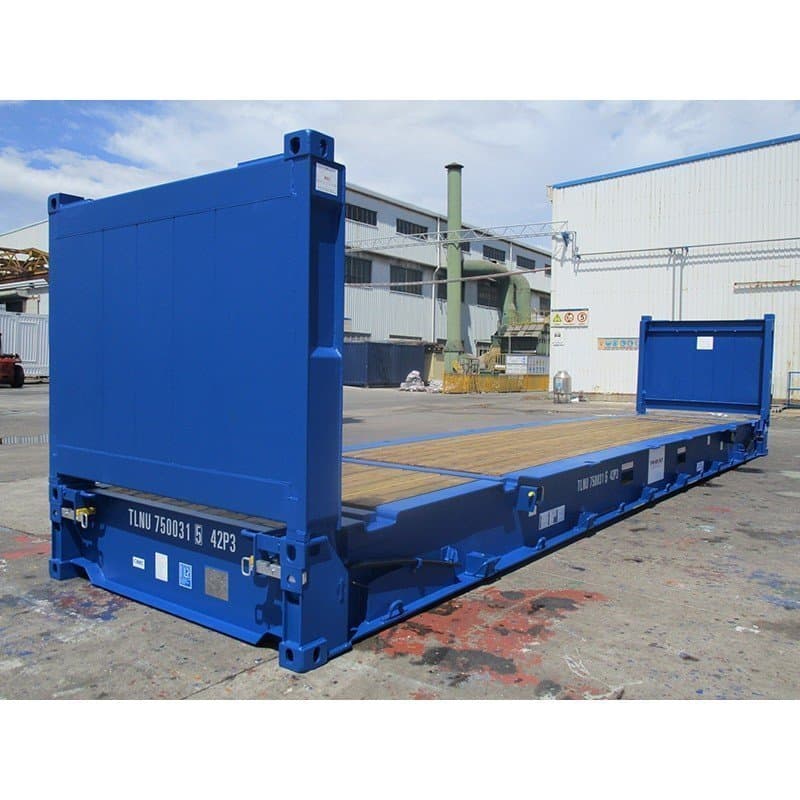
The new 40ft flat rack container is a maritime platform without side walls or roof, specifically designed for transporting goods that exceed the standard dimensions of a dry container. Its open structure allows loading wide, tall, or long equipment while retaining ISO corner fittings compatible with ships, railcars, and container trucks. This type of container is commonly used for heavy industrial loads such as agricultural machinery, construction equipment, generators, cable reels, steel coils, tanks, or vehicles. Unlike a standard container, it offers full access from the sides and top, facilitating loading and unloading by crane or forklift.
Technically, this 40ft flat rack complies with nominal dimensions defined by ISO 668 and ISO 1496-1 standards. Its external dimensions are 12,192 mm length, 2,438 mm width, and 2,591 mm height. Internal usable dimensions are 11,650 mm length, 2,350 mm width, and 1,960 mm height. Maximum payload is 44,650 kg, allowing transport of very heavy loads. Tare weight typically ranges from 5,000 to 6,000 kg depending on configuration, but refer to the container's CSC plate for the exact value. The structure is entirely made of Corten steel, a low-alloy steel that resists atmospheric corrosion through the formation of a protective oxide layer. The floor consists of either reinforced steel plate or treated hardwood, depending on the model. End walls can be fixed or collapsible (folding), allowing stacking of multiple empty containers to reduce space during storage or repositioning. Collapsible containers are particularly valued in container yards where space is limited.
The 40ft flat rack comes in several variants. The simple platform model, without walls, has forklift pockets for handling. The fixed-wall model has two rigid end walls with ISO corners. Finally, the collapsible model has two removable and retractable walls, reducing volume when folded. The container we offer is new, guaranteeing no corrosion, deformation, or prior repairs. It is delivered with a valid CSC date, attesting to its compliance with the International Convention for Safe Containers (CSC) and its suitability for international maritime transport. This certification is essential for sea shipping and port passage.
Using a new 40ft flat rack offers several advantages. First, it allows transporting loads that cannot fit in a standard dry container due to width, height, or length. Second, it is suitable for multimodality: it can be loaded onto a ship, train, truck, or river barge, simplifying international logistics chains. Moreover, its open design facilitates lifting and securing operations, reducing handling time. Finally, its robustness and weather resistance make it a durable solution for temporary storage or transport of sensitive materials.
When purchasing a new flat rack container, several points require attention. Verify that the CSC plate is present and the validity date is sufficient for your shipping duration. Check the condition of end walls, hinges, and locking systems. Ensure the floor shows no deformation and ISO fittings are in good condition. For intensive use, verify actual load capacity based on tare weight and maximum allowed load. Finally, if you plan to transport oversized goods, consider road gauge restrictions in France: maximum allowed width for an exceptional convoy is generally 2.55 meters, but can be extended under conditions. Maximum height is 4.00 meters for exceptional transport, and length can reach 16.50 meters for semi-trailers. A loaded 40ft flat rack may exceed these dimensions, requiring special traffic permits.
Maintaining a new flat rack container is relatively simple. Regular cleaning with fresh water and mild detergent removes salt deposits and pollutants. Retouch any paint scratches with anti-rust product to preserve Corten steel. Moving parts, such as hinges of folding walls, must be lubricated periodically. For prolonged storage, place on blocks to avoid direct ground contact and cover if necessary. A visual check before each use detects any deformation or emerging corrosion.
This container is also an interesting solution for land uses: storage of bulky equipment, mobile workshop, work platform, support for technical installation. Its open design allows natural ventilation and easy access. However, it does not offer weather protection like a dry container; therefore, it is recommended to tarp moisture-sensitive goods or package them appropriately.
In summary, the new 40ft flat rack container is versatile, robust, and compliant with international standards, suitable for out-of-gauge loads and projects requiring loading flexibility. It represents a durable investment for professionals in transport, logistics, construction, or industry. For any technical questions or to check availability, do not hesitate to contact our team.
To go further, it is useful to compare the 40ft flat rack with other container types to choose the best solution for each need. The standard 40ft dry container offers an internal volume of about 67 m³ and a payload of about 28,000 to 30,000 kg, but it is closed on all six sides and can only accommodate goods entering through rear doors. The 40ft high cube container offers additional internal height of about 30 cm but remains limited by its walls. The 40ft open top container has an open roof (tarpaulin or removable board) and rear doors, allowing top loading of tall goods, but retains fixed side walls. The 20ft flat rack, shorter, is suitable for heavy and compact loads, with a payload often exceeding 30,000 kg, but cannot transport objects longer than 6 meters. The 40ft flat rack, with its 12 meters length, is therefore the preferred choice for long and heavy loads. The 40ft platform container, without any walls, is even more basic and suits very wide loads, but offers fewer securing points than the flat rack. Finally, the 40ft reefer container is intended for perishable goods and cannot be used for out-of-gauge loads.
The choice between a new and used flat rack depends on intended use. A new container guarantees maximum strength, perfect sealing (though without walls, welds and structure are intact), and longer lifespan. It is recommended for regular shipments, very heavy loads, or corrosive environments. A used container can be an economical alternative for occasional use or static storage, but carefully check the structure, floor, and moving parts. In all cases, the CSC plate must be valid for maritime transport.
Sector-specific use cases for the 40ft flat rack are numerous. In agriculture, it transports tractors, plows, trailers, or irrigation systems. In construction, it is used for excavators, mobile cranes, compactors, or scaffolding. In industry, it carries machine tools, presses, molds, heat exchangers, or turbines. In the energy sector, transformers, generators, pylon sections, or drill pipes are loaded. In the marine field, it can hold marine engines, propellers, or deck equipment. Finally, for events, it transports mobile stages, grandstand structures, or sound equipment. This versatility explains why the 40ft flat rack is common equipment in container yards of port and industrial areas.
Transport regulations in France impose certain rules for containers and out-of-gauge loads. The Highway Code sets dimension limits for vehicles traveling without special authorization: width 2.55 m, height 4.00 m, length 16.50 m for semi-trailers. An empty 40ft flat rack has a width of 2.438 m, which is compliant. Once loaded, if width exceeds 2.55 m, an adapted driving license and exceptional transport authorization are required. Moreover, the authorized gross train weight (GTW) must not exceed 44 tonnes for a standard road combination, unless exempted. Maritime transport is governed by the CSC convention, requiring a valid safety plate. Containers must also comply with IMO (International Maritime Organization) rules for securing and verified gross mass (VGM). In France, Decree No. 2001-1366 on the transport of dangerous goods applies if the contents are classified as dangerous. Finally, for import-export, an EORI number is required for customs declarations.
Securing loads on a flat rack is a critical operation. It is essential to use straps, chains, or cables suited to the weight and nature of the goods. Container anchor points (rings, eyelets) must be in good condition. For very heavy loads, a stowage and securing plan must be established by a professional. Failure to comply with securing rules can cause damage, accidents, or fines. Additionally, during maritime transport, cargo must be protected from spray and weather; a resistant tarpaulin is often necessary.
Finally, purchasing a new 40ft flat rack involves considering total cost of ownership. Beyond purchase price, delivery, handling, storage, and maintenance costs must be anticipated. A new container can be delivered directly to your site by container truck, but delivery may require a crane if the site is not accessible. It is also possible to rent for occasional use, which can be more economical than buying. D.S. Globe Conteneur offers purchase and rental solutions adapted to each project. For personalized support, contact our team who will help define the best option based on your technical and budgetary constraints.
Let us now address some complementary aspects rarely detailed but decisive in the success of a project involving a 40ft flat rack. The lifting question deserves particular attention. A loaded flat rack can be handled by spreader, slings, or high-capacity forklift. Each method imposes constraints: the spreader requires ISO corners in perfect condition and even load distribution; slings must be positioned on designated anchor points and never on walls, to avoid deforming them; the forklift requires clear access and load-bearing ground. On a construction site or in a logistics yard, combining several machines is common, and a prior lifting study avoids unpleasant surprises. Training teams in these practices is a profitable investment, as poorly designed securing or unsuitable lifting can damage goods, the container, or injure personnel.
Storage of the flat rack itself, when empty, deserves a strategy. Collapsible models fold onto themselves and stack, significantly reducing ground footprint. Fixed-wall models, however, occupy volume comparable to a dry container and must be stacked with care, respecting stacking limits indicated on the CSC plate. In a container yard, parallel rows with traffic lanes for reach stackers are often preferred. In port areas, storage is on stabilized hardstands, with blocks to avoid direct ground contact and limit corrosion from below. A flat rack stored too long without inspection may see hinges seize and welds crack under thermal cycling; semiannual inspection is therefore recommended.
Traceability and identification of the container are also practical topics. Each flat rack has an identification number of four letters and seven digits, followed by a check digit, painted on end walls and sometimes on the chassis. This number allows tracking container movements, managing inventories, and retrieving maintenance history. For companies operating multiple flat racks, setting up a digital register, with supporting photos, facilitates management and possible resale. The CSC plate, affixed to the end wall, indicates manufacturing date, approval country, maximum allowed weight, and next periodic inspection date. This information must be verified before any international shipment, as a container with an expired CSC plate may be refused at port.
Maritime transport of heavy loads on flat racks also involves ship stability considerations. Shipping lines impose strict rules on weight distribution, center of gravity, and securing. A poorly secured flat rack can cause cargo shifting, damage other containers, or compromise ship safety. This is why carriers often require a detailed securing plan signed by an expert. For exceptional loads, prior carrier authorization is required, and additional fees may apply. It is therefore advisable to plan ahead and provide precise technical data sheets (weight, dimensions, center of gravity, lifting points) when booking freight.
Environmentally, the Corten steel flat rack aligns with circular economy logic. Steel is infinitely recyclable, and a well-maintained container can be used for decades, then reconditioned or transformed. Some modular architecture projects reuse flat racks as base structures for footbridges, technical platforms, or shading supports. This second life extends service life and reduces the carbon footprint associated with manufacturing new steel. For companies concerned about their environmental balance, choosing a durable new container over disposable solutions is a coherent choice.
The 40ft flat rack can also be integrated into rental solutions. Rental is relevant for activity peaks, temporary sites, or occasional import-export projects. It avoids capital tie-up and storage costs between uses. However, rental involves return constraints, deposits, and sometimes refurbishment fees. The choice between purchase and rental depends on frequency of use, project duration, and the company's ability to manage maintenance. D.S. Globe Conteneur can support this reflection based on each client's specific needs.
Finally, it is useful to recall some best practices when receiving a new flat rack. Inspect paint, welds, floor, and end walls. Verify consistency between the identification number, CSC plate, and delivery documents. Check hinge and lock operation. Ensure ISO corners show no abnormal play or deformation. Take dated photos of the initial condition; they will serve as reference in case of dispute or for future maintenance. Finally, file documentation (CSC certificate, invoice, technical data sheet) in an accessible folder. These few minutes of attention at reception avoid many inconveniences later.