Description
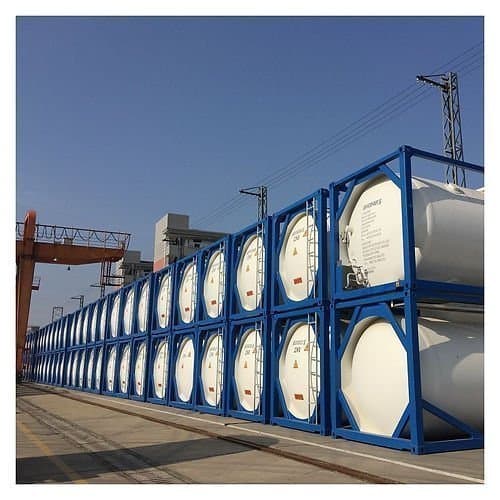
The Isotank container, also called tank container or ISO tank, is a transport equipment designed to carry liquid or gaseous products in bulk. It differs from conventional dry containers by its tank integrated into a metal frame with ISO dimensions, which allows it to be handled, stacked and transported exactly like a standard sea container. This design makes it a multimodal solution: the same tank can move from a truck to a train, a river barge or a container ship without transferring the goods, which reduces handling, contamination risks and logistics costs.
An Isotank consists of three main elements. The tank itself, usually made of stainless steel, is fixed inside a steel frame that incorporates standardized ISO corners. This frame provides structural strength, allows stacking and lifting by the four corners, and protects the tank during handling. The tank is equipped with filling and discharge openings, valves, pressure relief systems and, depending on the model, heating, insulation or refrigeration devices. The whole is designed to withstand the internal pressures related to liquid transport and the mechanical stresses of sea and land transport.
Available capacities range from 14 to 26 m³ depending on the tank type and the product transported. Lengths range from 6,058 mm for a 20-foot Isotank to 12,192 mm for a 40-foot model. The maximum permissible load varies from 34,000 to 49,100 kg, the tare weight from 2,900 to 5,100 kg and the gross weight from 42,000 to 55,000 kg. These ranges correspond to the main formats offered on the market; for a specific need, we recommend consulting us to validate the compatibility between the product, the usable volume and the transport constraints.
Isotank uses are varied. In the chemical sector, they transport solvents, acids, bases, resins and various intermediate products. In the oil and energy sector, they carry hydrocarbons such as diesel, unleaded petrol, Jet A1 or AVGAS. In the food industry, they are suitable for food liquids such as beer, wine, spirits, oils and juices, provided the tank and seals are suitable for food contact. They can also transport powdery or viscous products when the tank is equipped accordingly. This versatility explains their adoption by industry, fuel distributors, distilleries and international logistics operators.
The design of an Isotank meets precise regulatory requirements. ISO tanks are built according to ISO standards applicable to containers, including ISO 668 for dimensions and masses, and ISO 1496 for testing and performance. For the transport of dangerous goods, they must comply with ADR for road, RID for rail and IMDG for sea. These regulatory frameworks require periodic inspections, hydraulic tests and inspections of valves and safety equipment. A compliant Isotank bears a manufacturer's plate and a test plate indicating service pressures and inspection dates. Before any purchase, it is essential to verify that the tank is authorized for the product you wish to transport and that the certificates are up to date.
Tank materials vary depending on applications. Stainless steel is the most common, as it resists corrosion and facilitates cleaning. Some models use coated steel or specific internal linings for aggressive products. Seals and valves must be compatible with the product transported: an unsuitable seal can degrade, cause a leak or contaminate the cargo. Similarly, the choice of valve type and pressure relief system depends on the vapor pressure of the liquid and the transport conditions.
Insulation and temperature control are an important option. An insulated tank maintains the product at a given temperature during transport, whether to keep a liquid hot, prevent crystallization of a cold-sensitive product or limit thermal variations. Some Isotanks have a heating system, others a refrigeration unit, sometimes called a tank reefer, to maintain the liquid or gaseous state of the product. Temperature control can be done via a control unit integrated into the tank. The choice between simple insulation, heating or refrigeration depends on the product, the journey duration and the climatic conditions encountered.
Isotank maintenance is a central point of its operation. After each unloading, the tank must be cleaned according to a protocol adapted to the previous and next product, to avoid any cross-contamination. Cleaning can be carried out in specialized stations equipped for tanks, with effluent recovery. Valves, seals, piping and safety systems must be inspected regularly. Periodic regulatory inspections, including hydraulic tests, must be planned and documented. A poorly maintained Isotank presents risks of leakage, internal corrosion and non-compliance, which can lead to cargo rejection by the customer or authorities.
When purchasing a new Isotank, several points deserve attention. First, precisely define the product to be transported and its characteristics: density, viscosity, vapor pressure, corrosiveness, temperature sensitivity and any food requirements. These elements determine the tank material, coating type, seals, valves and temperature options. Then verify the regulatory compliance of the proposed model, including ADR, IMDG and RID approvals if dangerous goods transport is planned. The usable capacity must be calculated taking into account the product density and the load limits of the transport mode used. Finally, it is prudent to ensure that the supplier can document certificates, test plates and user manuals.
The transport of an Isotank in France and Europe is governed by regulations on the transport of dangerous goods. ADR applies to road transport and imposes obligations for classification, packaging, labeling, documentation and training of personnel. The driver must have written instructions and, depending on the case, appropriate training. The vehicle must be equipped and marked in accordance with requirements. For sea transport, the IMDG code applies, with its own classification and declaration rules. For rail, RID sets comparable requirements. Compliance with these frameworks is essential to avoid fines, immobilizations and refusal of loading.
In terms of operation, the Isotank offers several concrete advantages. It allows transporting large volumes of liquid in a single unit, reducing the number of units to handle compared to drums, cans or flexitanks. It limits leakage and contamination risks, as the product remains confined in a closed and controlled tank. It integrates into international logistics chains without breaking bulk, simplifying import-export operations. Finally, it can be temporarily stored on an industrial or port site, offering flexibility in flow management.
The price of a new Isotank depends on several factors: tank volume, material, coating type, insulation or temperature options, certifications and safety equipment. A basic stainless steel model for non-dangerous products does not cost the same as a refrigerated or heated tank for classified chemicals. It is therefore recommended to define precise specifications before comparing offers. The price displayed for this product corresponds to a new Isotank; for a specific model, consult us.
The lifespan of an Isotank depends on its use, the nature of the products transported and the quality of its maintenance. A properly maintained stainless steel tank can be operated for many years, with periodic regulatory inspections. Wear parts, such as seals and certain valves, are replaced over time. Rigorous tracking of the history of transported products and cleanings facilitates traceability and equipment valuation.
For food use, specific precautions are required. The tank must be designed or treated for food contact, and cleaning must follow validated protocols. Previously transported products must be compatible with food requirements. It is advisable to keep cleaning and compliance certificates, as some customers or authorities may request them.
For chemical or petroleum use, vigilance focuses on chemical compatibility, service pressure, pressure relief devices and product classification. A product classified as dangerous goods requires specific equipment and documents. The choice of tank type, coating and valves must be validated based on the product's safety data sheet.
To further explore Isotank use, it is useful to examine several concrete sector cases. In the beverage industry, a brewery exporting beer in kegs can opt for a food-grade Isotank to ship a volume equivalent to several dozen kegs in a single unit, with filling and pumping out. The gain is in handling, traceability and hygiene, provided a validated cleaning protocol between two products is available. In specialty chemicals, a manufacturer delivering solvents to distant industrial sites uses the Isotank to avoid multiple transfers and limit emissions. In refining and petroleum distribution, the Isotank is used to deliver fuels to areas not served by pipeline or conventional tanker truck. In the cosmetics and detergents sector, it allows transporting surfactant bases, alcohols and oils while avoiding disposable packaging. Finally, in agribusiness, it can be suitable for transporting vegetable oils, concentrated juices or syrups, subject to validated food compatibility.
Comparing the Isotank to other solutions helps choose the right equipment. Compared to metal or plastic drums, the Isotank offers much higher unit capacity, less handling and better sealing, but requires suitable filling and emptying infrastructure. Compared to the tanker truck, it provides multimodality and the possibility of long-distance sea or rail transport without breaking bulk; in return, the return of the empty container or its repositioning must be organized. Compared to the flexitank, which is a flexible bag installed in a dry container, the Isotank is more robust, reusable and better suited to dangerous products or controlled temperatures, but its acquisition cost and return logistics are higher. Compared to the conventional dry container, the Isotank is specifically designed for liquids and gases, while the dry is intended for dry and palletized goods.
The choice of size deserves particular attention. A 20-foot Isotank corresponds to the most common format for sea trade; it fits into container ships and terminals without adaptation. A 40-foot Isotank offers greater volume, but it is less common and may require gauge and weight checks on certain routes. The length from 6,058 mm to 12,192 mm reflects this difference. The higher tare weight of a large model reduces the payload at equal volume; therefore, a trade-off between available volume and transportable mass is necessary. For dense products, such as certain acids or hydrocarbons, the load limit may be reached before the volume limit, making density calculation essential.
The choice of tank type matters as much as size. A non-insulated tank is suitable for products whose temperature is not critical and for short journeys. An insulated tank limits thermal exchanges and protects against freezing or heat. A heated tank maintains a viscous product at a temperature allowing pumping. A refrigerated tank, or tank reefer, is reserved for products that must remain within a precise temperature range. These options affect price, tare weight and maintenance. They must be defined at the time of order, as they are integrated into the tank design.
Preparing an Isotank transport follows several steps. First, validate product-tank compatibility, then organize cleaning and, if necessary, degassing. Filling must respect the maximum authorized filling rate, which takes into account the thermal expansion of the liquid. Transport documents, the dangerous goods declaration if applicable, written instructions and certificates must be prepared. The container is then presented at the terminal or loaded onto the vehicle. On arrival, unloading is done by gravity or pump, depending on available equipment. Each step must be traced to meet regulatory requirements and customer expectations.
Safety is an essential component. Isotanks are equipped with pressure relief devices to prevent overpressure, protected bottom valves and, often, closed valve boxes. Operators must be trained in chemical risks, use of personal protective equipment and emergency procedures. In case of leakage, a containment and recovery procedure must be planned. The transport of dangerous goods also imposes rules on parking, marking and speed on certain routes. These precautions are not just for comfort: they condition the compliance of the operation.
Temporary storage of a full or empty Isotank must follow a few principles. The container must be placed on stable and suitable ground, with ISO corners accessible for handling. Valves must be protected and, if the product is dangerous, storage must comply with separation and retention rules. An empty Isotank must be kept closed to prevent the introduction of water or foreign bodies. Monitoring the condition of the tank, seals and valves during storage avoids discovering a problem at loading time.
Finally, purchasing a new Isotank is a long-term decision. Unlike buying disposable packaging, investing in an ISO tank pays off through reuse and reduced unit transport costs. However, operating costs must be included: cleaning, periodic inspections, replacement of wear parts, repositioning and possibly rental of cleaning stations. A comparative analysis between purchase, rental and use of disposable packaging helps determine the most suitable solution for the volume and frequency of shipments.
In summary, the Isotank is a specialized equipment that combines the flexibility of the sea container and the capacity of a tank. It is intended for industrialists, logisticians, fuel distributors, beverage producers and all operators who need to move bulk liquids over long distances. Its choice must be guided by the product, applicable regulations and transport constraints. Technical support helps avoid specification errors and optimize equipment operation.