Description
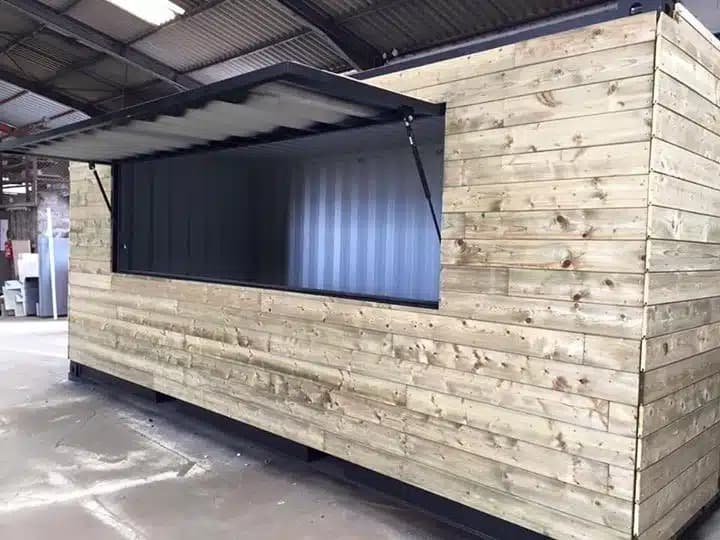
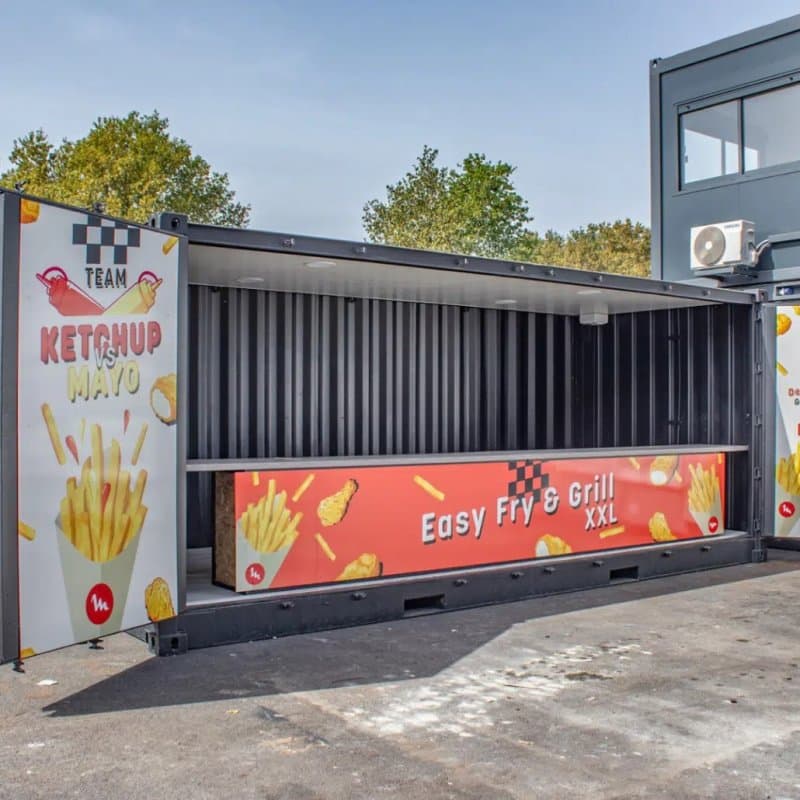
The container kiosk we offer is a turnkey solution for quickly launching a fast-food, takeaway or seasonal retail business. Built from a standard Corten steel shipping container, it is fitted out to become a functional, sturdy and mobile point of sale. Unlike a classic stand, it offers a larger surface area, better weather resistance and enhanced security. This model is particularly suited to pizzerias, snack bars, fixed food trucks, seasonal bars or beach kiosks. Below we detail its technical features, practical uses, points to watch when buying and the regulatory aspects to know.
Technical features and standard equipment
The container kiosk is based on a standard ISO dry shipping container (20 feet or 40 feet depending on the model). The structure is made of Corten steel, a self-weathering steel that resists corrosion thanks to the formation of a protective surface layer. The walls, roof and floor are kept in their original configuration, but openings are made to integrate the sales equipment. The original 28 mm marine plywood floor is covered with a non-slip chequered aluminium floor, with a drain to make cleaning easier. This covering is suitable for food preparation areas as it resists moisture and cleaning products.
On the front, a 4 m wide roller shutter provides maximum opening to the outside. A second 2 m side shutter allows additional access or natural ventilation. Access inside is via a standard access door and a double rear door fitted with container locks, ensuring the security of equipment and goods. A counter with disabled access (person with reduced mobility) is integrated, allowing customers to be served without obstruction. This counter can be fitted with a refrigerated display case or a display stand depending on your needs.
The ceiling is insulated to limit heat loss and prevent condensation. Six LED spots are recessed into the ceiling, providing even, energy-efficient lighting. The complete electrical pack includes an external connection socket, a consumer unit with circuit breakers and four 220 V sockets. This pack powers cooking, refrigeration and lighting equipment. It is important to note that the electrical installation must comply with the standards in force for premises receiving the public (NF C 15-100). We recommend having the installation checked by a qualified professional before any use.
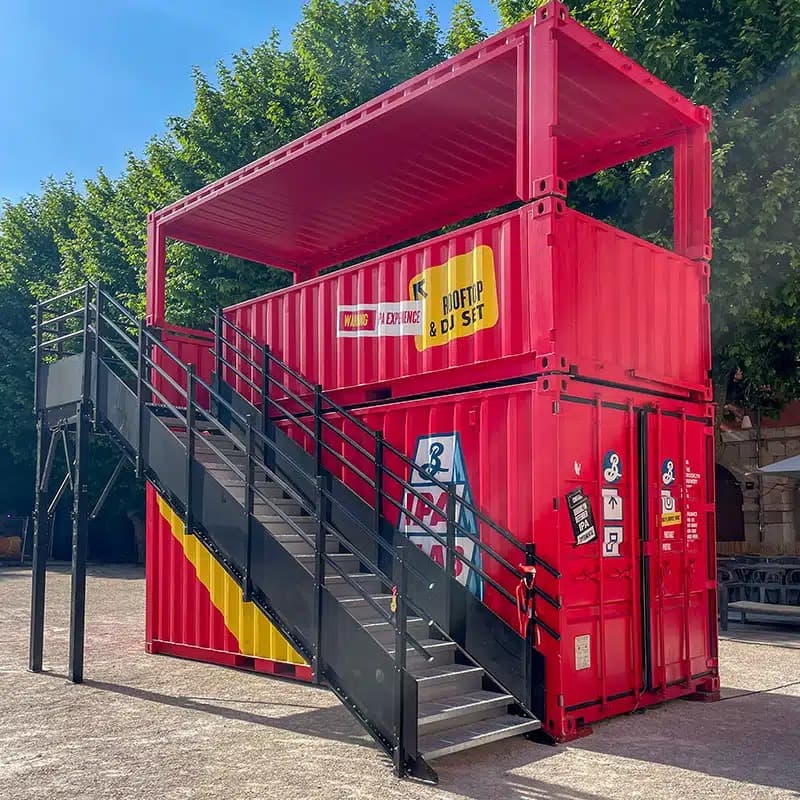
The container kiosk is supplied new, but we also offer second-hand models at the end of the season. In this case, the general condition and equipment are checked and refurbished if necessary. The bungalow model, with an extension or a mezzanine, is also available for those who want more storage or catering space.
Practical uses and possible configurations
The container kiosk can be used for many activities:
- Pizzeria: installation of a pizza oven, a worktop and a cold room. The 4 m shutter allows direct outdoor service.
- Snack / fast-food: fryer, grill, hot display case, service counter. The double rear door makes it easier to bring in goods.
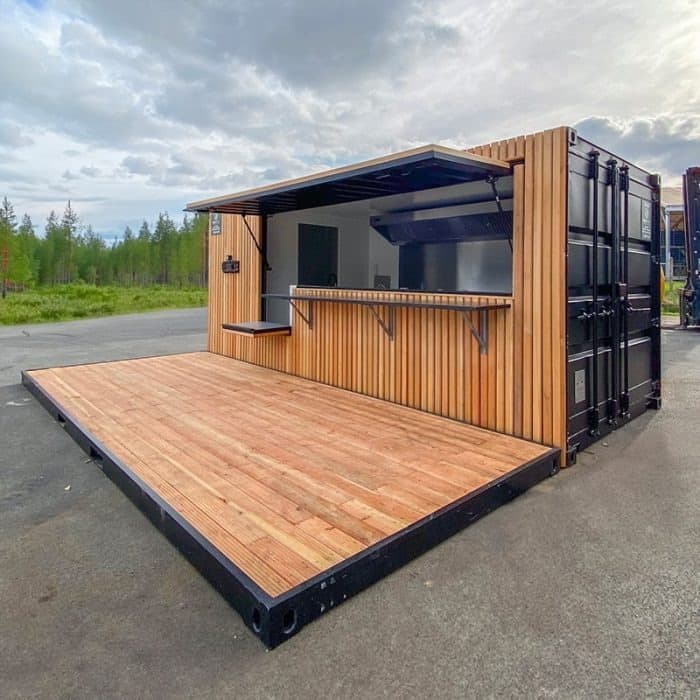
- Seasonal bar / guinguette: bar counter, beer tap, refrigerators. The side shutter can serve as an additional service area.
- Crêperie / ice cream parlour: crêpe maker, refrigerated display case, display stand. The chequered aluminium floor with drain simplifies floor cleaning.
- Kiosk selling non-food products: souvenirs, newspapers, flowers. The container can be fitted with shelves and display stands.
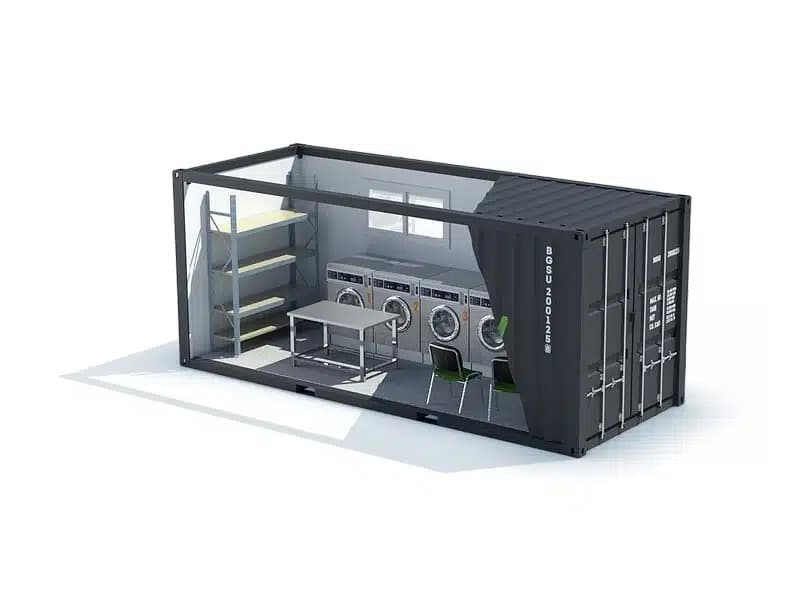
- Site office or technical room: fitted out with desk, changing area, sanitary facilities. The container is sturdy and secure.
Interior layout can be customised to your trade: we can install cooking, refrigeration, plumbing (water supply, drainage), air conditioning or heating equipment. We work with professional equipment suppliers to offer solutions suited to your budget. The container can also be fitted with an awning, a wooden terrace or an illuminated sign.
Points to watch when buying
Before buying a container kiosk, several points must be checked:
1. Condition of the structure: although new, a second-hand container may show traces of rust, impacts or deformation. Inspect the welds, corners and bottom rails. Anti-corrosion treatment may be necessary.
2. Insulation: for kitchen use, thermal insulation is important to prevent condensation and maintain a comfortable temperature. Check that the ceiling and walls are properly insulated (rock wool, polyurethane).
3. Electricity: the basic electrical pack (4 x 220 V sockets) may be insufficient for professional equipment. Plan for suitable power (single-phase or three-phase) and call on a qualified electrician to bring it up to standard.
4. Plumbing: if you need running water, a water supply and drainage must be provided. The floor with drain is an asset, but it must be connected to a network or a tank.
5. Ventilation: for cooking, an extractor hood and air extraction are often mandatory. Check whether a technical duct can be installed.
6. Local regulations: installing a kiosk on public land or in a campsite requires planning permission (building permit or prior declaration) and a commercial operating authorisation. Check with your local council.
7. Transport and handling: the container must be transported by a crane truck or a container truck. Plan for suitable access and stabilised ground. The weight of a fitted 20-foot container can reach 3 to 4 tonnes.
Transport regulations in France
Transporting a container kiosk is subject to abnormal load regulations if its dimensions or weight exceed the permitted limits. A standard 20-foot container measures 6.06 m long, 2.44 m wide and 2.59 m high. The empty weight is around 2.2 tonnes, and once fitted out it can exceed 3.5 tonnes. For road transport, the vehicle's gross vehicle weight (GVW) and traffic restrictions (height, width) must be checked. An abnormal load convoy may be necessary if the width exceeds 2.55 m or if the weight exceeds 44 tonnes for a road train. In this case, prior authorisation is required from the DREAL. We can assist you with these procedures.
Care and maintenance
A container kiosk requires regular maintenance to ensure its durability. Here are some recommendations:
- Cleaning: regularly wash the chequered aluminium surfaces with a mild detergent. Avoid abrasive products that scratch the surface.
- Checking watertightness: inspect the seals, welds and openings. Redo the seals if necessary.
- Anti-corrosion treatment: if traces of rust appear, sand and apply anti-rust paint. Corten steel forms a protective patina, but worn areas must be treated.
- Roller shutters: lubricate the mechanisms and check that the locks work properly.
- Electricity: have the consumer unit and sockets checked periodically by a professional.
- Plumbing: check for leaks and the drain outlet.
- Roof: clean leaves and debris to prevent water accumulation.
Container kiosk rental
In addition to sales, we offer container kiosks for rent for seasonal events, festivals or construction sites. Rental can be short term (a few days) or long term (several months). The container is delivered equipped according to your needs. This solution is ideal for testing a business before investing or for meeting a temporary need. Rental conditions (deposit, insurance, transport) are defined on a case-by-case basis.
Why choose a container kiosk rather than a classic stand?
A shipping container offers greater sturdiness than a wooden or canvas stand. It is secure, fire-resistant and weather-resistant. It can easily be moved from one site to another, which is an asset for seasonal activities. In addition, its acquisition cost is often lower than that of traditional construction. Finally, it is modular: you can add extensions, awnings or additional equipment over time.
Conclusion
The container kiosk is a practical and economical solution for launching a catering or retail business. With its standard equipment (roller shutters, disabled-access counter, aluminium floor, LED lighting, electrical pack), it is ready to be customised to your project. We advise you to carefully check the regulatory and technical aspects before buying. Our team is available to assist you with the configuration, transport and installation of your container kiosk.
In-depth maintenance and durability
Beyond routine maintenance, the durability of a container kiosk depends on several factors related to its environment and use. The Corten steel used for the structure naturally develops a protective patina layer when exposed to the open air. This patina is stable and prevents corrosion from progressing in depth. However, in a marine environment (near the sea, sea spray), this protection can be altered by chlorides. It is therefore recommended, for a seaside installation, to plan regular washing with fresh water to remove salt, and possibly to apply a protective paint to the most exposed areas (lower walls, bottom rails). For an installation in an urban or industrial area, atmospheric pollutants can also accelerate soiling; periodic cleaning is generally sufficient.
The 28 mm marine plywood floor is treated to resist moisture, but it remains sensitive to prolonged water infiltration. It is advisable to regularly check the condition of the seals around the openings and the drain. In case of localised detachment or swelling, a spot repair with epoxy resin can be considered. The chequered aluminium floor, for its part, is not affected by water but can be scratched. To limit scratches, avoid dragging heavy metal objects and use pads under the equipment.
The roller shutters are mechanical elements subject to wear. Their rails must be kept clean and lubricated with a suitable grease (without silicone to avoid attracting dust). Locks and latches must be checked and greased at least once a year. If they jam, do not force them: call a professional.
The electrical installation must be checked periodically, especially if the container is used outdoors and subject to temperature variations. Sockets and cables can wear out; an annual check by a qualified electrician is recommended. Likewise, the consumer unit must be protected against moisture (suitable IP rating).
Finally, the container roof must be inspected regularly. Dead leaves, moss or debris can block water drainage and cause stagnation. Cleaning at least twice a year is advisable, along with checking the watertightness of the roof seals. If the container is fitted with an extractor hood, check that the roof cap is properly fixed and watertight.
Applicable regulations and standards
Installing a container kiosk as a commercial or catering premises involves complying with several regulations. First, the container must comply with ISO 668 (dimensions) and ISO 1496 (technical specifications) if used as a transport unit, but once converted into premises it falls under the rules applicable to lightweight constructions. In France, installing a container on private land may require a prior declaration of works or a building permit depending on its surface area and how long it will be in place. Above 20 m², a building permit is often required. For a temporary installation (less than three months), a prior declaration may suffice, but it is essential to check with the town planning department of the municipality.
If the container is intended to receive the public, it must comply with fire safety rules (in particular the amended decree of 25 June 1980, for establishments receiving the public - ERP). This may involve requirements for smoke extraction, emergency resources, width of escape routes and fire resistance of materials. A bare metal container may require the addition of insulation and coverings to meet these requirements. In addition, disabled accessibility must be ensured for people with reduced mobility, which is provided for by the counter with disabled access, but the whole site must be laid out accordingly (ramps, passage width).
For food activities, the hygiene rules of Regulation (EC) No 852/2004 and the French decrees relating to sanitary rules applicable to retail and catering must also be respected. This concerns the design of the premises (washable surfaces, separation of clean and dirty areas, ventilation, sufficient lighting), waste management and supply of drinking water. A container kiosk can comply with these requirements if correctly fitted out, but validation by the veterinary services (DDPP) is often necessary before opening.
Finally, if the container is installed on public land (public road, market square), a temporary occupation authorisation (AOT) must be obtained from the town hall. This authorisation is generally issued for a limited period and may be subject to conditions (location, hours, fee).
Sector-specific use cases: beyond fast food
The container kiosk is not limited to selling food. Its modularity and sturdiness make it a solution suited to many sectors. In the events sector, it can serve as a ticket office, information point or mobile bar. Festivals, open-air trade fairs and Christmas markets appreciate its quick installation and secure appearance. For local authorities, it can become a temporary post office, a parcel distribution point or a local administrative office in rural areas or in the event of a natural disaster. In the health sector, a container kiosk can be fitted out as a mobile testing centre, first-aid post or rural pharmacy. NGOs sometimes use it as a mobile clinic or food distribution point.
In the industrial and construction sector, the container kiosk can serve as an improved site facility: canteen, changing room, meeting room or site office. It is more comfortable than a simple site hut and can be fitted with air conditioning, heating and sanitary facilities. For farmers, it can become a direct farm sales outlet, a processing unit (cheese dairy, cannery) or a refrigerated storage space. Finally, in retail, it can be used as a pop-up store, craft products stand or online order collection point. Its mobility allows it to follow fairs and markets.
Comparison with other container sizes and types
The container kiosk is generally based on a 20-foot container (about 15 m² of interior space) or 40-foot (about 30 m²). The choice between these two sizes depends on the activity and the space available. A 20-foot is easier to transport and install on a cramped site. It is suitable for a snack bar, a small bar or a single point of sale. A 40-foot offers more generous space, allowing a complete kitchen, a storage area and a larger service area to be included. It can also be divided into two rooms (for example, kitchen and counter).
There are also high cube (HC) containers, whose interior height is about 30 cm greater than that of a standard container. This can be an advantage for installing an extractor hood or creating a storage mezzanine. Open top (open roof) and flat rack (without side walls) containers are less suitable for a kiosk fit-out because they are not enclosed. Reefer (refrigerated) containers are equipped with a refrigeration unit and reinforced insulation; they can be used for a kiosk selling frozen or fresh products, but their cost and energy consumption are higher. A standard dry container remains the most economical and most common base for a kiosk.
In terms of comparison with other solutions, a container kiosk is often more advantageous than a traditional food truck: it offers more surface area, better insulation and increased security. It is also cheaper than a permanent construction and can be moved. Compared with a dismantlable market stand, it is heavier and requires specific transport, but it is much more resistant and can stay in place all season. Finally, compared with a caravan or a fitted-out mobile home, the container is sturdier and less sensitive to bad weather, but it is less easy to move without lifting equipment.
Conclusion
The container kiosk is a practical and economical solution for launching a catering or retail business. With its standard equipment (roller shutters, disabled-access counter, aluminium floor, LED lighting, electrical pack), it is ready to be customised to your project. We advise you to carefully check the regulatory and technical aspects before buying. Our team is available to assist you with the configuration, transport and installation of your container kiosk.