Description
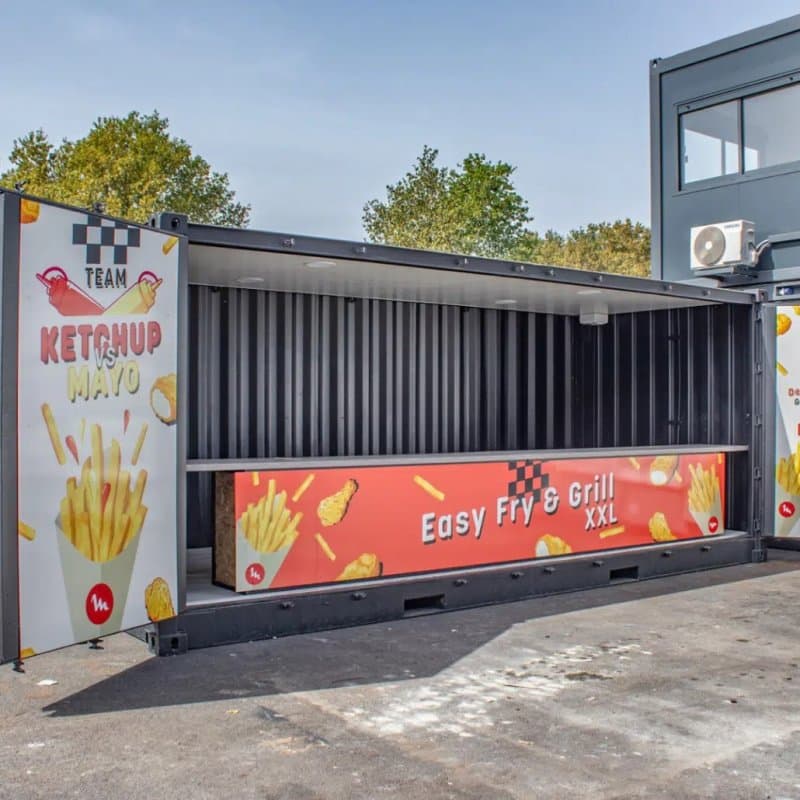
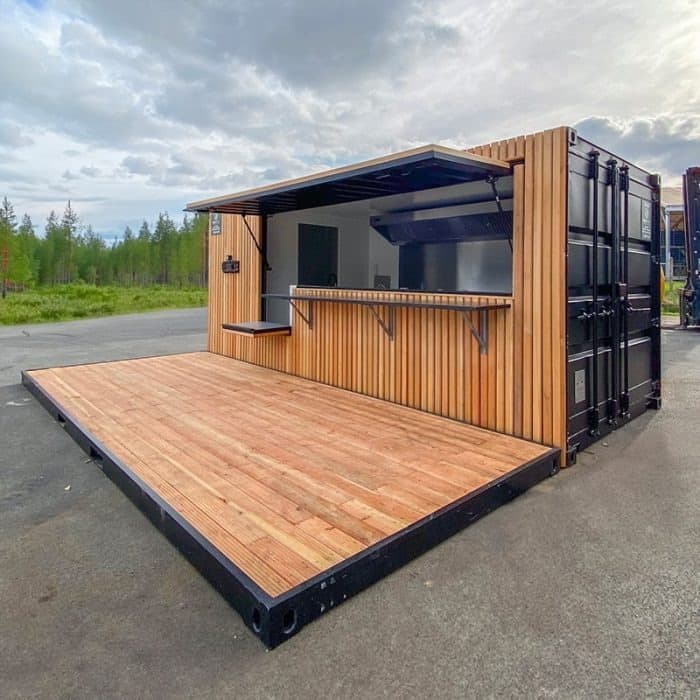
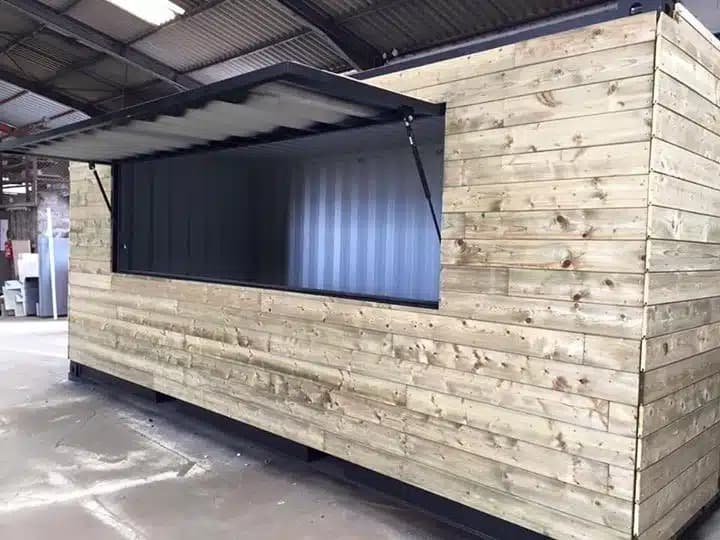
The street food container is a mobile catering solution designed to be operational quickly. It is a fitted shipping container, intended for food businesses that want to set up on a fixed or seasonal site without building a traditional premises. This model is offered for purchase or rental, with equipment that can be adapted to your activity: street food, food truck, pizzeria, rotisserie, pizza kiosk or grill stand. Its structure is based on a standard Corten steel shipping container, a material known for its corrosion resistance and durability outdoors. The original 28 mm marine plywood floor is replaced here by a checkered aluminium floor with a floor drain, better suited to the demands of a professional kitchen: moisture resistance, easy cleaning and liquid drainage. The ceiling is insulated and fitted with six LED spots, ensuring even work lighting across the whole preparation area. The electrical pack includes a connection plug, a distribution board and four 220V sockets, enough to power the usual street kitchen equipment: fryer, plancha, oven, refrigerated display, cash register or signage lighting. The interior fit-out includes a 5.50 metre bar counter, an access door and a double rear door with container locks. This configuration separates the customer-facing service area from the logistics or storage area at the rear. The container is new and compliant with the ISO standard, guaranteeing standardised dimensions and lifting points, compatible with usual handling equipment (forklifts, reach stackers, trucks with lifting arms).
To understand what this product can offer, it helps to return to what a shipping container is and what it is not. A standard dry container is a closed, stackable metal box designed for intermodal transport. Its most common sizes are 20 feet (about 6.06 m long, 2.44 m wide, 2.59 m high) and 40 feet (about 12.19 m long, 2.44 m wide, 2.59 m high), with high cube variants (2.89 m high) and special versions such as open top, flat rack or reefer. The street food container builds on this base, generally a 20-foot unit, to offer a compact but sufficient work surface for a fast food business. The 5.50 metre bar counter length matches the order of magnitude of the useful interior space of a 20-foot container, showing that the fit-out makes full use of the container length. The interior volume of a standard 20-foot container is around 33 m³, with a floor area of about 14 m². That is little for a classic restaurant, but it suits a simple production kitchen with a generous service run. The tare weight of a standard 20-foot container is generally between 2.2 and 2.4 tonnes, and the maximum payload around 28 tonnes. These values are indicative because they vary by manufacturer and any reinforcements. For a fitted container, the tare weight increases with the added equipment: counter, insulation, electrical installations, cladding. It is therefore important to know the total weight before planning transport and lifting.
Corten steel, also called weathering steel, is a low-alloy steel that develops a protective surface rust layer when exposed to the weather. This layer limits the progression of corrosion and explains the longevity of shipping containers, which can remain in service for decades with minimal maintenance. This does not mean a container never rusts: water-retention areas, impacts, deep scratches and poorly protected welds can become starting points for corrosion. Periodic maintenance involves inspecting the structure, cleaning dirt and debris, checking door seals and treating emerging rust spots with suitable paint. For catering use, hygiene is an additional issue: the checkered aluminium floor with drain makes washing and water drainage easier, but the drain must be kept clear and food-contact areas must be cleaned according to the usual professional kitchen protocols. The insulated ceiling contributes to thermal comfort and limits condensation, an important point when cooking in a metal volume subject to temperature variations.
The use of a street food container is part of a broader trend: nomadic catering and modular kitchens. A classic food truck is a fitted vehicle, with an engine, registration document, motor insurance and parking constraints. A fitted container, by contrast, is a fixed or lift-movable space. It can be placed on private land, in a business zone, at a market, at a festival, on an urban wasteland or at an event venue, subject to local authorisations. It can also be used as a production kitchen for an existing restaurant that wants to increase capacity without extending its premises, or as a seasonal stand for a pizzeria, rotisserie or ice cream shop. The double rear door makes loading goods and access to storage easier, while the main access door and bar counter structure customer service. This two-flow organisation, service at the front, logistics at the back, is a classic principle of professional kitchens. It avoids crossings between customers and deliveries, improving efficiency and hygiene.
Before buying or renting a street food container, several points deserve attention. First, the compliance of the base container: a shipping container must meet ISO 668 for dimensions and ISO 1496 for technical specifications. CSC certification (Convention for Safe Containers) is also important for containers intended for international sea transport, as it attests to structural safety. For fixed use in France, these certifications are not always mandatory, but they remain an indicator of quality and traceability. Next, the interior fit-out: the nature of the materials used for walls, cladding, insulation and electrical equipment must be checked. An electrical pack must be suited to the power of the cooking appliances and comply with current safety rules. In France, the electrical installation of professional premises must comply with standard NF C 15-100 and, in some cases, be checked by an approved body. For a fitted container, it is recommended to have the installation validated by a qualified professional and to plan a suitable connection: single-phase 230 V or three-phase 400 V depending on needs. The distribution board, sockets and residual current protection must be sized accordingly. Running water and wastewater disposal must also be planned: the container can be connected to the public network or operate with tanks and pumps, depending on the location. The checkered aluminium floor with drain requires drainage to a collection point or sewer system, to be checked with the town hall or site manager.
The applicable regulations depend on the use and installation site. A fitted container used as catering premises may be subject to planning rules: prior declaration of works, building permit in some cases, temporary occupation authorisation of public land for installation on the road or at a market. Food hygiene rules also apply: mandatory food hygiene training for operators, compliance with the cold chain, traceability, hygiene control plan. A container is not a vehicle: it has no registration document and does not travel on the road under its own power. It is moved by container truck or by lifting, with suitable machinery. Transporting a container in France is governed by the Highway Code and abnormal load rules when dimensions or weight exceed regulatory thresholds. A standard 20-foot container remains within usual dimensions, but a convoy may require authorisation depending on the route, total height and weight of the assembly. It is therefore advisable to prepare transport with a professional familiar with these constraints.
Maintaining a street food container is similar to maintaining professional premises, with some specific features linked to the metal structure. The roof, gutters and seals should be inspected regularly to prevent infiltration. Door hinges and locks must be greased and checked, as they ensure sealing and security. Interior walls should be cleaned with products compatible with the cladding, avoiding abrasives that would scratch the aluminium or paint. LED spots and the distribution board must be checked periodically. For seasonal installation, it is prudent to plan frost protection for pipes and protection against humidity during inactive periods. Finally, if the container is moved regularly, the lifting points and the condition of the corner castings must be checked, those standardised corner blocks used for handling and stacking.
The choice between purchase and rental depends on the duration of use and the project. Purchase suits a long-term activity, a fixed installation or regular use over several seasons. Rental can be relevant to test a location, cover an event, a tourist season or a temporary need. In both cases, it is important to clarify what is included: fit-out, cooking equipment, connections, transport, installation, maintenance. The street food container offered here is described as ready to use, with a basic fit-out comprising the bar counter, doors, aluminium floor, insulated ceiling with spots and the electrical pack. It can be adapted to your trade, meaning specific equipment can be added or modified: worktop, fryer, oven, display, hood, etc. It is recommended to request a detailed fit-out plan and a precise list of equipment before confirming the order.
To extend the reflection, it is useful to compare this street food container with other container formats and other catering solutions. Compared with an unfitted standard dry container, the difference lies in use: a bare dry container is used for storage, transport or building premises to fit out yourself, while the street food one is delivered with a fit-out designed for cooking. Compared with a high cube container, the extra height (about 30 cm) provides a more comfortable interior volume, which can make it easier to install a hood, a light mezzanine or a technical false ceiling. A high cube can therefore be a relevant choice if the activity requires more ceiling height, but the total height must be checked during transport, as it may exceed certain road dimensions and require authorisation. Compared with a reefer container, which is a refrigerated container with a cooling unit, the logic is different: the reefer is designed for transporting perishable goods and has reinforced insulation and a cooling system, but it is heavier, more expensive and more complex to maintain. For a street food stand, a reefer can be interesting if the activity relies on a significant cold chain, but it consumes energy and requires specific maintenance of the refrigeration unit. Compared with an open top container, whose roof opens, the interest is in loading tall volumes, which is not the main need of a kitchen. Compared with a flat rack, which has no side walls, protection from the weather and hygiene are not ensured, making it unsuitable for catering. Finally, compared with a 40-foot container, the surface doubles, but the footprint and weight increase, and transport and lifting costs follow. A 40-foot container can suit a central kitchen, a mobile restaurant with seating or a multi-activity project, but it is less manoeuvrable on a constrained urban site. The 20-foot remains the most common format for a fixed food truck or kiosk, as it offers a good compromise between useful surface, mobility and cost.
Sector use cases are varied. A pizzeria can use the container as a sales point with a pizza oven, a worktop for stretching dough and a hot display. A rotisserie can install a grill, a rotisserie and a carving area, with suitable extraction. An ice cream shop can place refrigerated displays and a service counter there. A caterer can use it as an off-site production kitchen to prepare dishes at events. A juice bar or coffee shop can use the 5.50 m bar counter for service and storing consumables. An existing restaurant can use it as a seasonal extension on a terrace or car park. In all these cases, the central question is the match between the installed equipment, available electrical power, water drainage and extraction of odours and fumes. A hood with filtration or mechanical extraction is often necessary for fatty cooking, and its installation must be anticipated in the fit-out design. Natural or mechanical ventilation must also be sufficient for working comfort, especially in summer, as a metal container can heat up quickly without efficient insulation and suitable ventilation. Adding air conditioning, an extractor or extra insulation can be considered depending on climate and exposure.
In summary, the street food container is a modular, robust and scalable solution for food businesses. It combines the strength of a Corten steel shipping container with a fit-out designed for fast food. It can serve as a pizzeria, rotisserie, fixed food truck, kiosk or production kitchen. Its main advantage lies in its speed of implementation, its mobility by lifting and its capacity to be customised. Its limits lie in the available surface, the need to plan connections and authorisations, and the importance of regular maintenance. An informed buyer or tenant will check the container's compliance, the quality of the fit-out, electrical safety and the regulatory constraints linked to its location. Under these conditions, this type of container becomes a reliable and durable working tool for a street food business.