Description
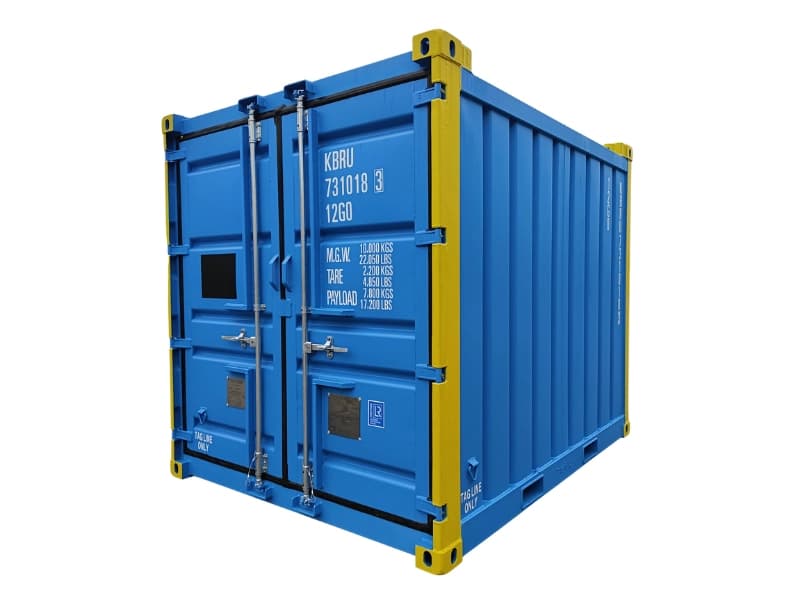
The 10ft offshore shipping container is a transport and storage unit designed to meet the specific requirements of marine and industrial environments. Unlike standard ISO shipping containers, this model holds DNV 2.7-1 / DNV-ST-E271 certification, an international standard issued by Det Norske Veritas. This certification confirms that the container has passed a series of regulatory tests covering lifting, structural strength and load capacity. It authorises its use in offshore operations, particularly for transferring equipment between land and offshore installations such as oil and gas platforms, vessels and coastal logistics bases. The presence of a DNV nameplate and an inspection plate enables periodic regulatory monitoring and ensures full traceability of the manufacturer and certificate number.
This container also stands out for its Corten steel construction, a low-alloy steel whose chemical composition gives it significantly higher resistance to atmospheric corrosion than conventional carbon steel. This property is essential for equipment permanently exposed to sea spray, saline humidity and climatic variations. The metal floor reinforces the overall robustness and makes it suitable for supporting heavy loads or specific equipment, where a wooden floor might wear more quickly or be unsuitable for certain uses. This container is a first trip, meaning it has not yet been used for commercial transport, which guarantees its excellent overall condition and conformity to original specifications.
Dimensionally, the 10ft offshore container has an overall length of 2.991 m, a width of 2.438 m and a height of 2.591 m. These external dimensions are slightly larger than those of a standard ISO 10ft container, particularly in height, due to the presence of structural reinforcements and specific lifting points required for offshore certification. The internal dimensions offer a useful volume of 14.7 m³, with a length of 2.804 m, a width of 2.270 m and a height of 2.243 m. The door opening, with a width of 2.258 m and a height of 2.218 m, allows the passage of bulky equipment. The tare weight is 2.4 tonnes, with a maximum authorised weight of 10 tonnes, giving a maximum payload of 7.6 tonnes. These characteristics make it a compact container yet capable of transporting or storing significant loads.
The main use of this DNV-certified offshore container is the secure transport of equipment between land and offshore installations. It is commonly used on oil and gas platforms, supply vessels, offshore logistics bases and marine construction sites. Its design allows lifting by slings or spreader, with reinforced lifting points that guarantee stability and safety during transfer operations. Outside the offshore sector, this container can also be used for storing sensitive equipment on industrial sites exposed to sea air, such as ports, shipyards or coastal areas. Its corrosion resistance and reinforced structure enable it to withstand demanding operating conditions.
When purchasing an offshore container, several points require attention. It is essential to verify the validity of the DNV 2.7-1 certification, which must be accompanied by an up-to-date nameplate and inspection plate. The certification must comply with the DNV-ST-E271 standard, which defines the requirements for the design, construction and testing of offshore containers. It is also advisable to ensure that the container has undergone the regulatory tests (lifting, load, structural strength) and that the test reports are available. The manufacturer's traceability and the certificate number must be clearly identified. Finally, the general condition of the container, including the presence of rust, deformation or non-compliant repairs, must be carefully examined. An offshore container must maintain its structural integrity to ensure the safety of lifting operations.
Maintaining a Corten steel offshore container requires regular monitoring to preserve its performance and longevity. It is recommended to periodically inspect the structure for signs of corrosion, particularly at welds, lifting points and assembly areas. Dirt, salt deposits and debris should be regularly cleaned with fresh water to limit corrosion. If surface rust appears, brushing and applying a rust-proof paint suitable for the marine environment may be sufficient. For highly exposed areas, a specific anti-corrosion treatment may be considered. It is also advisable to regularly check the condition of the door seals and replace them if necessary to maintain water and air tightness. Finally, the inspection plate must be kept up to date and certificates must be retained to prove compliance during regulatory inspections.
The regulations applicable to offshore containers in France and internationally require compliance with strict standards. DNV 2.7-1 certification is required for containers intended to be lifted and used on offshore installations. It is supplemented by the DNV-ST-E271 standard, which specifies the technical requirements. Other frameworks may apply, such as IMO (International Maritime Organization) rules for maritime transport, or EN 12079 standards for offshore containers. In France, the use of offshore containers is governed by maritime authorities and certification bodies. It is important to note that these containers are not subject to the same rules as standard ISO containers, particularly regarding testing and markings. CSC (Convention for Safe Containers) marking may not be applicable, but DNV certification remains the reference for offshore operations. During road or rail transport, the container must be loaded on a suitable chassis and comply with current weight and dimension limits.
Compared to a standard shipping container, the 10ft offshore container stands out for its certification, reinforced structure and specific lifting points. It is generally heavier when empty than an equivalent ISO container, due to additional reinforcements. Its acquisition cost is also higher, justified by testing and certification. However, for industries requiring frequent lifting operations and increased corrosion resistance, this investment is justified by the safety and durability it provides. This container can be used as an on-site storage unit, a mobile workshop, a technical room or a site office, provided that interior fittings comply with safety and ergonomic rules. It can also be integrated into modular housing projects, although its offshore certification is not required in that context.
To further discuss maintenance, a distinction should be made between preventive and corrective operations. Preventive maintenance includes regular visual inspection (at least once a year, and more frequently in saline environments), cleaning, checking fasteners and seals, and inspecting lifting points. Corrective maintenance takes place after anomalies are detected: replacement of parts, weld repair, localised anti-corrosion treatment. It is recommended to keep a maintenance log recording inspection dates, work carried out and observations. This log, together with certificates, facilitates inspections and potential resale. For containers intended for food or pharmaceutical use, more thorough cleaning may be necessary, but this falls outside the standard scope of this offshore model.
Regarding transport regulations, the 10ft offshore container can be transported by sea, road or rail. By sea, it is handled as conventional cargo or on specialised vessels, with precautions related to its weight and dimensions. By road, it must be loaded on a suitable container chassis, and the total weight (container + load) must not exceed the limits authorised by the highway code (generally 44 tonnes for a road train, but local restrictions may apply). By rail, it can be transported on flat wagons, subject to gauge compliance. In all cases, lashing must be carried out according to good practice to prevent any movement. It is also advisable to check customs requirements when crossing borders, particularly temporary admission status if the container is intended for re-export.
Sector-specific use cases for this container are varied. In the oil and gas sector, it is used to transport tools, spare parts, drilling equipment or samples. In the marine renewable energy sector (offshore wind, tidal), it enables components to be delivered and equipment to be stored on installation sites. In shipbuilding, it is used as a mobile workshop or on-board store. In the port industry, it can serve as a storage room for sensitive goods or as a site office. Finally, in scientific research, it can be used to transport instruments and samples during oceanographic campaigns. Its DNV certification and robustness make it a relevant choice for all these contexts.
Compared to other sizes and types of containers, the 10ft offshore offers advantages and disadvantages. Compared to a standard 20ft container, it is more compact, lighter when empty (2.4 T versus about 2.2 T for a 20ft dry, but with lower payload), and more manoeuvrable. It can be lifted by lower-capacity cranes, which is an asset on isolated sites. However, its internal volume of 14.7 m³ is much less than the 33 m³ of a 20ft, which limits the amount of goods transported. Compared to a 40ft container, the difference is even greater. The choice therefore depends on the volume to be transported and lifting constraints. The 10ft offshore container is also more expensive than a standard 10ft container, due to its certification and reinforcements. Finally, it should not be confused with a 10ft high cube container, which is taller but not offshore certified. DNV certification is the main distinguishing criterion.
For interior fitting, this container can be equipped with shelves, racks, fastening systems, lighting, electrical sockets, etc. However, any structural modification must be carried out by a professional and must not compromise the container's integrity or its certification. It is advisable to consult the manufacturer or a certification body before any transformation. Adding thermal insulation can be considered for use in cold or hot climates, but this reduces the useful volume. For use as an office or technical room, suitable ventilation and lighting are necessary. Finally, if the container is intended to accommodate people, it must comply with current safety and hygiene rules.
In addition, it is useful to specify the lifting and lashing procedures specific to this type of container. The lifting points are designed to withstand the dynamic stresses of offshore operations. They are generally marked and must be used with slings or shackles suitable for the maximum load. A spreader can also be used for balanced lifting. Before each lift, it is imperative to check the condition of the anchor points and ensure that no element is loose or corroded. Lashing on a vessel or platform must follow good practice, with crossed straps or chains and compliant attachment points. For multimodal transport, it is recommended to use twist-locks to secure the container on a chassis or wagon. These precautions ensure the safety of people and property.
Finally, the question of traceability and documentation should be addressed. A DNV-certified offshore container must be accompanied by a valid certificate, a nameplate and an inspection plate. The certificate mentions the serial number, manufacturer, test dates and technical characteristics. It is advisable to keep a copy of these documents, including test reports, and to have them available during inspections. The inspection plate must be updated after each periodic inspection. In the event of resale, these documents are essential to prove compliance and facilitate the transaction. For professional users, it is recommended to keep a register of movements and maintenance. This documentary rigour is a guarantee of safety and regulatory compliance.
In conclusion, the 10ft offshore shipping container certified DNV 2.7-1 is a specialised piece of equipment combining robustness, safety and compliance. Its Corten steel, metal floor and certification make it a reliable choice for demanding environments. Regular maintenance and compliance with regulations are essential to guarantee its durability and the safety of operations. Whether for transporting equipment, storage or fitting out, it meets the needs of marine and industrial professionals. For any questions about this product, please contact our teams.