Description
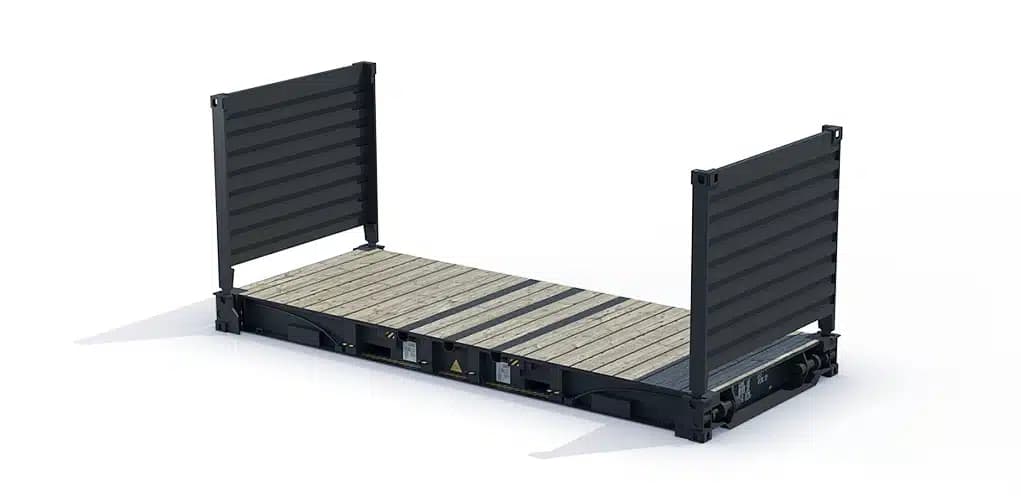
The 20-foot flat rack shipping container is a transport and storage unit designed to hold goods that cannot be loaded into a standard dry container because of their weight, dimensions or irregular shape. Unlike closed containers, it is a sturdy platform with collapsible end walls and fully open sides. This configuration allows loading from the top, the sides or the ends, greatly simplifying the handling of machinery, equipment, tubes, profiles, vehicles or out-of-gauge industrial parts.
This 20-foot model complies with standard ISO series 1 dimensions, with an overall length of 6.06 m and a width of 2.44 m. These characteristics allow it to be handled, secured and transported on the same ships, railcars and trucks as standard containers, while offering greater loading flexibility. The height of the end walls, collapsible or fixed depending on the version, contributes to the rigidity of the assembly and can be folded down to facilitate stacking or empty storage. The floor is made of 28 mm marine plywood, a dense material treated to withstand moisture, impacts and concentrated loads. The structure is made of Corten steel, a low-alloy steel that develops a protective oxide layer on its surface, improving its corrosion resistance compared with ordinary steel, particularly in marine or industrial environments.
Technically, the 20-foot flat rack stands out for its high load capacity. Exact values vary by manufacturer and container condition, but a new or recent model generally supports a payload of around 20 to 25 tonnes, with a tare weight between 2.4 and 3 tonnes. The tare weight of 2,900 kg indicated for this product falls within that range. The maximum gross weight (container plus cargo) is governed by ISO 668 and appears on the CSC plate affixed to the container. It is essential to consult this plate before any loading, as it determines transport safety and regulatory compliance.
Flat racks have many applications. In construction, they carry beams, scaffolding, prefabricated elements or construction machinery. In industry, they are used to transport machine tools, generators, pumps, motors or long metal parts. The energy sector uses them for pipes, valves, drilling components or heavy equipment. Transport and logistics professionals use them for out-of-gauge packages that cannot be conventionally containerised. Finally, when stationary, a flat rack can serve as a storage platform on a worksite, a support for a temporary workshop or a base for a specific fit-out, even though its primary purpose remains transport.
One of the major advantages of this type of container is its modularity. Collapsible end walls reduce its footprint when empty, lowering repositioning and storage costs. Open sides remove height and lateral width constraints, within the limits of the gauges permitted by the transport modes used. Loading can be carried out by crane, forklift or any other suitable means, without having to introduce the goods through a door. This accessibility also facilitates slinging and securing, which are critical points for safety at sea and on the road.
Securing is indeed a central concern. Unlike a closed container where the cargo is contained by the walls, a flat rack requires careful securing using straps, chains, tensioners and dedicated anchor points. The rings and securing rails built into the floor and structure must be inspected before each use. Insufficient securing can lead to load shifts, damage to the container or serious accidents. It is recommended to entrust securing to trained professionals or to follow the manufacturer's recommendations and best practices for load securing.
Maintaining a flat rack is relatively simple but must be regular. The paintwork should be checked and scratches touched up with suitable paint to limit corrosion. The marine plywood floor must be inspected: worn, delaminated or rotten areas must be repaired or replaced to guarantee the hold of fasteners and load safety. Moving parts, hinges and locks of the collapsible walls must be lubricated and kept in good working order. Regular cleaning, especially after transporting dirty or corrosive products, extends the container's service life. Finally, the CSC plate must remain legible and up to date; its renewal is handled by an approved body.
When buying, several criteria should be examined. The general condition of the metal structure, the presence of perforating rust, deformation of profiles, the condition of the floor and the proper operation of the collapsible walls are essential checkpoints. ISO compliance and the validity of the CSC plate determine acceptance of the container by shipping lines and port authorities. The tare weight and payload must be compatible with the available lifting and transport equipment. Finally, the price of a new or used flat rack varies with condition, year of manufacture, manufacturer and market availability; the price indicated for this product corresponds to a new container offered by D.S. Globe Conteneur.
Regarding transport regulations in France and Europe, a loaded flat rack is subject to abnormal load rules when it exceeds the regulatory limits for weight, width, length or height. In that case, a movement permit may be required, along with an escort depending on the category. Maritime transport is governed by the SOLAS convention and IMO rules, particularly regarding the Verified Gross Mass (VGM) declaration and cargo securing. Rail and road transport also require compliance with axle load limits and standard securing devices. It is the shipper's responsibility to ensure the compliance of the container-cargo assembly before any departure.
The 20-foot flat rack container offered here is a new model, in Corten steel, with a 28 mm marine plywood floor and ISO certification. It is suited to heavy, bulky or irregularly shaped loads, and is suitable both for repeated use in international transport and for static use at an industrial site or worksite. For professionals seeking a flexible and durable solution for handling oversized equipment, it is a relevant alternative to conventional transport or to hiring specialised equipment. D.S. Globe Conteneur, based in Marseille, offers this model for sale and can assist customers in choosing the configuration suited to their needs.
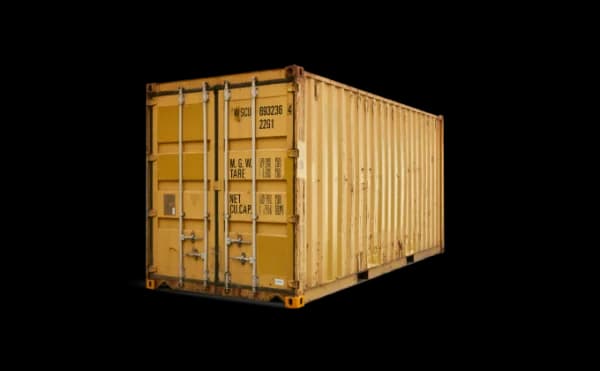
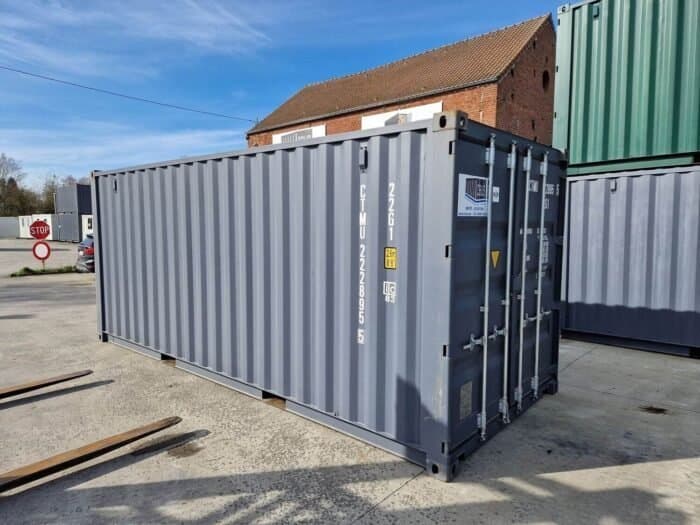
To choose well between a flat rack and other container types, it is useful to recall the structural differences. A standard 20-foot dry container has four rigid walls, a roof and doors at one end: it suits palletised goods, boxes, parcels and any unit load that fits through the door. An open top container keeps the side walls and floor but removes the roof, allowing vertical loading by crane while retaining side protection. A high cube container increases interior height by about 30 cm compared with a standard model, which is useful for light, bulky volumes. A reefer container is fitted with a refrigeration unit and insulated walls for perishable goods or temperature-sensitive products. A tank container, finally, is dedicated to liquids and gases. The flat rack is the opposite of the dry container in terms of opening: it does not protect cargo from the weather and does not contain it laterally, but it offers accessibility and out-of-gauge capacity that no other type allows.
The choice between a 20-foot and a 40-foot flat rack depends mainly on the length and weight of the load. The 40-foot model offers a usable length of about 12 m and suits long, relatively light loads such as tubes, profiles or structural elements. The 20-foot model, more compact, has a higher permissible load density and is better suited to heavy, concentrated loads, compact machinery or packages whose weight exceeds the limits of the 40-foot. The 20-foot is also easier to handle on urban sites or worksites with restricted access, and its empty transport cost is generally lower. The choice should therefore be based on the three factors of length, weight and access logistics.
In practice, several sector-specific use cases illustrate the value of the 20-foot flat rack. In construction, it allows mini-excavators, compactors, aerial platforms or hydraulic units to be shipped to remote worksites without using a specialised equipment carrier. In mechanical engineering, it transports drive shafts, gearboxes, heat exchangers or machine frames. In the oil and gas sector, it carries wellheads, valves, pipeline sections or drilling tools. In events, it is used to transport stage structures, grandstands, heavy sound equipment or forklifts. In agriculture, it can hold machine parts, irrigation pumps or greenhouse components. In the military and humanitarian fields, it is used for vehicles, generators and rapid deployment kits. This versatility explains why the flat rack is common equipment in carrier fleets and among professional rental companies.
Another practical aspect concerns stacking and storage. When empty, the collapsible walls allow several flat racks to be stacked on top of one another, optimising space in a depot or on a terminal. When loaded, stacking is only possible if the structure and cargo allow it, and it must comply with the CSC plate indications and the shipping line's rules. Lifting is carried out using the standard corner fittings, with a spreader or suitable slings. It is strongly advised not to lift a loaded flat rack from any point other than the intended corners, at the risk of deformation or rupture.
Road transport of a flat rack in France requires checking the convoy gauge. The maximum permitted width for a standard vehicle is 2.55 m, height 4 m and length 16.50 m for an articulated combination, with tolerances depending on the case. If the cargo exceeds these limits, transport falls under abnormal load regulations, with movement permits (AC) and, depending on the category, a pilot vehicle or escort. The authorised gross combination weight (PTRA) and axle load must also be respected. At sea, the shipper must provide a VGM (Verified Gross Mass) declaration in accordance with the SOLAS convention, failing which the container may be refused for loading. These obligations are the responsibility of the shipper, not the carrier.
Finally, buying a new flat rack from a professional such as D.S. Globe Conteneur provides a compliant, inspected and ready-to-use container, with traceability of origin and technical characteristics. A new model avoids surprises linked to hidden wear, previous repairs or an expired CSC plate. It is a durable investment for companies that regularly handle out-of-gauge loads and wish to control their logistics chain. For occasional use, rental can be an alternative, but it involves recurring costs and availability dependent on the renter's fleet. The choice between buying and renting therefore depends on frequency of use, the nature of the loads and the company's logistics strategy.