Description
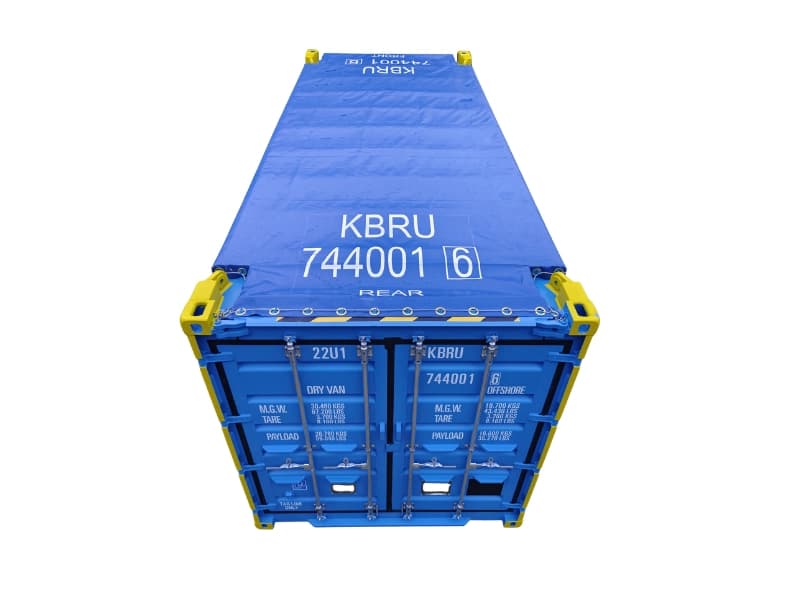
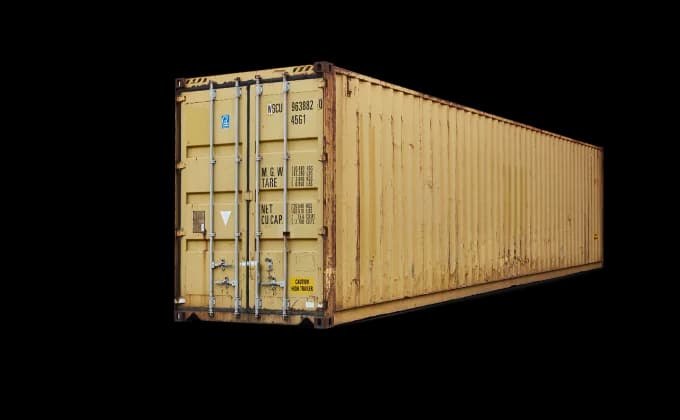
The 20ft Offshore Open Top shipping container is a specialised piece of equipment designed to meet the demands of the harshest maritime and industrial environments. Unlike standard ISO containers, it is DNV 2.7-1 certified, an international standard that guarantees its compliance for offshore lifting operations. This means it can be used safely to transport equipment between land and offshore installations such as oil rigs, vessels or offshore logistics bases. This certification confirms that the container has successfully passed lifting, load and structural strength tests, and that it has a nameplate and inspection plate allowing periodic regulatory monitoring.
This container is made of Corten steel, a low-alloy steel that offers superior resistance to atmospheric corrosion compared to ordinary steels. This characteristic is essential for use in a marine environment, where salt air and humidity accelerate oxidation. The floor is metallic, which reinforces the overall durability and allows heavy loads to be supported without risk of deformation. The structure is designed to withstand the mechanical stresses of lifting and maritime transport.
The 20ft Offshore Open Top container stands out for its open roof. This feature allows the loading of tall or out-of-gauge goods that could not pass through the standard doors. The roof can be removed or opened to facilitate loading by crane or from above. Once loaded, the roof is secured with a tarpaulin or rigid panel depending on the model, providing protection against the weather. This design is particularly valued for transporting bulky industrial equipment, machinery, pipes, metal parts or construction materials.
The external dimensions of this container are 6.058 m long, 2.438 m wide and 2.591 m high. These dimensions comply with ISO 668 standards for 20ft containers, which facilitates its integration into existing logistics chains. The internal dimensions are 5.836 m long, 2.218 m wide and 2.284 m high, offering an internal volume of 29.6 m³. The door opening measures 2.218 m wide by 2.149 m high, allowing large objects to pass through. The tare weight is 3.7 tonnes, and the maximum payload is 16 tonnes, with a payload capacity of up to 16.2 tonnes depending on configurations. These characteristics make it a robust and versatile container.
DNV 2.7-1 certification is a guarantee of quality and safety for offshore operations. It means the container is equipped with certified lifting points, generally slings or lifting rings, that allow it to be lifted safely. In addition, it has a DNV offshore nameplate that clearly identifies the container, its certificate number, its maximum load and other essential information. An inspection plate allows periodic mandatory checks to be tracked. This traceability is crucial for safety audits and compliance with international regulations.
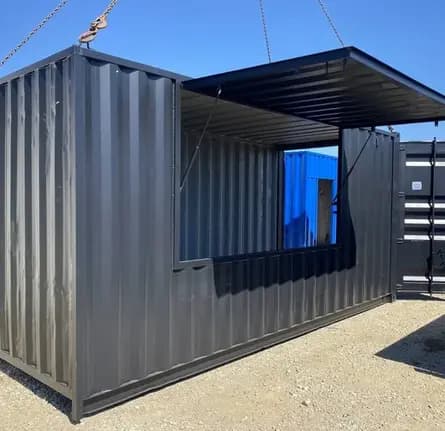
This container is also suitable for land use. It can serve as a secure storage unit for sensitive equipment, a mobile site office, a temporary workshop or even a base for modular fit-out (accommodation, meeting room, etc.). Its robustness and certification make it a relevant choice for the oil and gas industries, marine renewable energies, shipbuilding, ports and logistics bases. It is also used for transporting dangerous or high-value goods, thanks to its reinforced structure and its ability to be locked.
When purchasing an offshore container, several points of vigilance must be taken into account. Check that the DNV 2.7-1 certification is valid and that the inspection plates are up to date. Make sure the container has been regularly maintained and does not show excessive corrosion, cracks or structural deformation. Check the condition of the open roof, seals and fastening systems. Request test certificates and technical documentation. For offshore use, it is imperative that the container complies with the DNV-ST-E271 standard (formerly DNV 2.7-1) and has the required markings.
Regarding maintenance, a Corten steel container requires regular cleaning with fresh water to remove salt and debris. Periodically inspect welds, lifting points and hinges. Apply anti-rust paint to areas where protection is impaired. Grease the door locking mechanisms. If the container is used in a marine environment, rinsing with fresh water after each exposure is recommended to extend its service life. For long-term storage, place it on a flat, raised surface to avoid moisture accumulation on the ground.
Transporting this container in France is subject to abnormal load regulations if its dimensions or weight exceed authorised limits. A standard 20ft container generally complies with road gauges, but with a total loaded weight of up to 16 tonnes, it may require specific permits depending on the carrying vehicle and route. It is advisable to use a specialised carrier for lifting and moving. In addition, securing must comply with safety rules to avoid any accident.
This container is offered at a price of €2,500.00 excl. VAT. Prices and colours may vary depending on arrivals and availability, while stocks last. Photos are non-contractual. Transport and unloading are extra depending on the destination. For more information, contact D.S. Globe Conteneur in Marseille.
To go further into maintenance, a distinction should be made between preventive and corrective maintenance. Preventive maintenance consists of carrying out visual inspections before and after each use, paying particular attention to sensitive areas: lifting corners, upright welds, the bottom of side walls and roof rails. These areas concentrate mechanical stresses and are the first exposed to corrosion. Washing with fresh water at moderate pressure, without aggressive additives, removes salt deposits. After drying, a check of the door and open roof seals is essential. Rubber seals (EPDM or neoprene) must remain supple; treatment with talc or silicone grease protects them from ageing. Hinges and locking bars must be lubricated with a water-resistant marine grease. Corrective maintenance is carried out when deterioration is found: paint touch-ups on deep scratches, replacement of a seal, straightening of a deformed panel. It is recommended to keep a maintenance log, especially for offshore use where traceability is required. Inspection frequency depends on usage intensity: in a permanent marine environment, a monthly visual inspection and an annual in-depth check are common practices. For land use in an industrial-port area, a quarterly inspection may suffice. These frequencies are indicative and must be adapted to actual conditions and the operator's requirements.
Regarding transport regulations in France, several frameworks apply. Road transport of a loaded 20ft container may fall under abnormal load regulations if the total rolling weight exceeds the limits of the Highway Code or if the dimensions exceed the standard gauge. A 20ft container is 6.058 m long, which remains within the usual limits for an articulated vehicle, but the height of 2.591 m added to that of the chassis may approach clearance limits under structures. A route study is often necessary. Maritime transport is governed by the SOLAS convention, which requires verification of the gross mass (VGM) before loading on board. The CSC convention (Convention for Safe Containers) governs container safety and requires a CSC approval plate, with periodic inspections. For offshore containers, DNV 2.7-1 certification is added to these requirements. In terms of lifting, the use of certified slings and accessories is mandatory, and operations must be carried out by qualified personnel. The rules for securing and stowing goods inside the container fall under good practice and, for dangerous goods, the ADR (European Agreement concerning the International Carriage of Dangerous Goods by Road) or the IMDG (International Maritime Dangerous Goods Code). It is essential to comply with these texts and keep transport documents.
Sector-specific use cases for this container are varied. In the oil and gas sector, it transports drilling tools, spare parts, safety equipment and packaged chemicals. In marine renewable energies, it is used to transfer components for the assembly of offshore wind turbines or submarine cables. In shipbuilding, it allows hull sections, piping or machinery to be conveyed. Ports and logistics bases use it as a temporary storage unit for sensitive goods or as a mobile workshop. In the mining or construction industry, it can be used for transporting heavy and bulky equipment. Finally, for humanitarian or military projects, it offers a secure and rapidly movable storage solution. Its offshore certification makes it suitable for being helicoptered or transferred by crane between vessels and platforms, subject to complying with load limits and lifting procedures.
Compared to other container sizes and types, the 20ft Offshore Open Top has advantages and limitations. Compared to a standard 20ft dry, it offers the possibility of loading through the roof, which is decisive for tall or non-stackable loads. In return, its tare weight is higher (3.7 T versus about 2.2 to 2.4 T for a standard dry), which reduces the payload to 16.2 T versus about 28 T for a dry. Its internal volume of 29.6 m³ is slightly lower than that of a dry (about 33 m³) due to the thickness of the walls and the metal floor. Compared to a 40ft Open Top, the 20ft is more manoeuvrable, easier to lift and position in confined spaces, but it offers less volume (29.6 m³ versus about 65 m³ for a 40ft). The 40ft is often preferred for large volumes, but the 20ft remains favoured for heavy and dense loads, as it allows the load to be concentrated without exceeding weight limits. Compared to a flat rack, the Open Top offers superior protection against the weather once the roof is closed, but the flat rack is more suitable for very wide or irregularly shaped loads that cannot be contained within walls. Compared to a reefer container, the Open Top has no refrigeration unit and is not suitable for perishable goods, but it is more robust and less complex to maintain. Finally, compared to a high cube container, the internal height is lower (2.284 m versus about 2.655 m for a high cube), but the offshore certification and open roof provide specific features absent from the standard high cube.
To choose between these options, the nature of the load, its weight, its dimensions, the frequency of handling and the operating environment must be analysed. If the load must be lifted from above and the total weight remains under 16 tonnes, the 20ft offshore Open Top is suitable. If the load is light and bulky, a 40ft high cube will be more economical per cubic metre. If the load is very heavy and dense, a 20ft dry may suffice, but without roof access. If the load is out of gauge in width, a flat rack will be necessary. DNV 2.7-1 certification adds value for offshore operations, but it involves a higher acquisition and maintenance cost than a standard container. It is therefore advisable to define the need precisely before purchase.
In terms of safety, using an offshore container requires compliance with lifting procedures. Lifting points must be inspected before each operation. Slings must be suited to the load and lifting angle. The container must never be lifted with a poorly distributed or unsecured load. Doors must be closed and locked during lifting. The open roof must be properly secured. In the case of maritime transport, the container must be secured on the vessel according to IMDG code rules and the captain's instructions. For road transport, the chassis must be suitable and the container locked on the twist-locks. These precautions are essential to avoid accidents and damage.
Finally, purchasing a new or used offshore container must be accompanied by a documentary check. The DNV 2.7-1 certificate must be valid and correspond to the container's serial number. Recent inspection reports must be provided. The maintenance history can be requested. A used container may show normal wear, but it must not have major undocumented structural repairs. An in-depth visual examination, or even an assessment by a third-party body, is recommended for major purchases. The price of €2,500.00 excl. VAT for this 20ft Offshore Open Top container is indicative and may vary depending on condition, availability and options. Colours and stocks change. It is advisable to contact D.S. Globe Conteneur directly to find out current availability and delivery terms.