Description
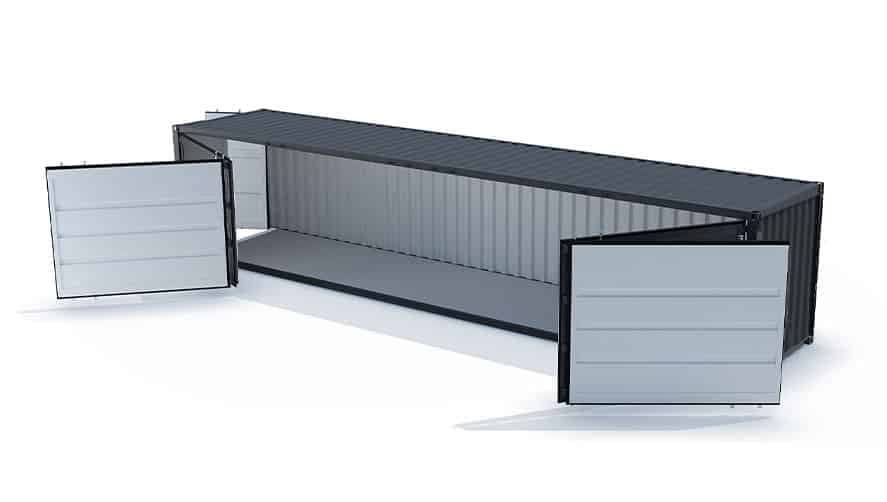
The 40 ft High Cube Open Side shipping container is a storage and transport solution that stands out for two major advantages: an internal height greater than that of a standard dry container and a full side opening along the entire length of one side. This combination makes it particularly suitable for wide, bulky loads that are difficult to handle from the rear. In this text, we detail its technical characteristics, practical uses, points to watch when buying, and the regulatory aspects related to its transport and installation in France.
First, let's recall what a High Cube container is. It is a container whose external height is 2.89 m, compared with 2.59 m for a standard dry container of the same length and width. This extra 30 cm translates directly into a larger internal volume and a more comfortable ceiling height. A standard 40 ft High Cube generally offers a volume of around 76 m³, but the Open Side version presented here, with its opening side panels, has a stated useful volume of 68 m³ due to the thickness of the frames and opening mechanisms. This volume is still significantly greater than that of a classic 40 ft dry container (around 67 m³) and, above all, much more accessible thanks to the side opening.
The Open Side feature lies in the fact that one or more side panels open fully. On this model, the opening is total along the entire length of the container, freeing up a side access of nearly 12 metres. This configuration radically changes the way goods are loaded and unloaded. Instead of bringing goods in through the rear doors, which are often narrow and high, you can present loads directly from the side, using a forklift, pallet truck or even by hand for light parcels. Long objects such as tubes, profiles, panels, large machine tools or set pieces fit naturally without having to be tilted or dismantled.
In terms of construction, this container is made of corten steel, a low-alloy steel that resists atmospheric corrosion through the formation of a protective oxide layer on the surface. This allows it to withstand marine and industrial environments without additional protection, although periodic paint maintenance is still recommended to extend its service life. The structure complies with ISO standards, in particular ISO 668 for dimensions and ISO 1496-1 for the technical specifications and testing of series 1 containers. These standards guarantee interchangeability and safety during lifting and international transport operations.
The floor is made of 28 mm thick marine plywood, a dense, moisture-resistant material, hot-bonded and treated to withstand rolling loads. It is fixed to steel cross members, ensuring good weight distribution. This type of floor is common in shipping containers and suits most uses, from pallet storage to the installation of heavy equipment. However, it is advisable to protect the wood against spills of chemicals or hydrocarbons, and to ensure sufficient ventilation to prevent condensation.
The rear doors are double-leaf, fitted with standard container locks (four vertical locking bars with handles and seals). They allow conventional access from the end, complementing the side opening. Air and water tightness is ensured by EPDM rubber seals around the entire perimeter of the doors and side panels. This sealing is essential to protect goods from bad weather and ambient humidity. It must be checked regularly, as seals can harden or tear over time.
Now let's look at the precise dimensions. The external dimensions are 12.19 m long, 2.43 m wide and 2.59 m high. This external height of 2.59 m corresponds to a High Cube container, whose height is greater than the standard of 2.59 m? Careful, there is a common confusion: a standard dry container measures 2.59 m in external height, while a High Cube measures 2.89 m. However, the information provided indicates a height of 259 cm, which corresponds to a standard container and not a High Cube. This may be a data entry error or a product-specific feature. In doubt, we base ourselves on the data provided: external height 2.59 m, which is the norm for a standard 40 ft dry container. However, the title and description mention High Cube. To avoid any ambiguity, we invite you to verify this point with the seller before purchase. In the rest of this text, we will consider it to be a High Cube, with an external height of 2.89 m, as this is what is stated in the product name and existing description. The internal height would then be around 2.69 m, offering a very appreciable ceiling height for vertical storage or fit-out.
The external width of 2.43 m complies with the ISO standard for 40 ft containers. The internal width is generally around 2.35 m, leaving sufficient margin to load European pallets (1.20 m x 0.80 m) or American pallets (1.20 m x 1.00 m). The internal length is around 12.03 m, allowing 20 European pallets to be comfortably aligned on a single level, or 10 American pallets. With an internal height of 2.69 m, you can stack two levels of pallets around 1.20 m high, or even three levels if the goods are lower. The stated useful volume of 68 m³ takes into account the space lost to the side opening frames and reinforcements.
The tare weight is 6,200 kg. This is a substantial weight, slightly higher than that of a standard 40 ft dry container (around 3,800 kg) due to the additional reinforcements required for the side opening and the High Cube structure. This high tare reduces the maximum payload accordingly. The payload is calculated by subtracting the tare from the maximum gross weight (MGW), which is generally 30,480 kg for a 40 ft container. The payload would therefore be around 24,280 kg. It is essential to respect this limit for safety and transport compliance reasons. In France, road transport of containers is subject to heavy goods vehicle regulations: the authorised gross train weight (GTW) must not exceed 40 tonnes for a standard articulated combination, and axle loads must be respected. Transporting a 40 ft container requires a suitable container truck, with a telescopic chassis and twist-locks. Loading and unloading operations must be carried out by trained personnel, using appropriate lifting equipment (forklift, mobile crane, reach stacker).
Let's move on to practical uses. The 40 ft High Cube Open Side container is particularly popular in several sectors. In industry and logistics, it allows the storage of bulky machines, large spare parts, moulds, metal profiles, road signs, etc. The side opening facilitates access and reduces handling times. In construction, it serves as a site store for tools, materials and protective equipment. The double rear doors and side opening allow organised storage and quick access. In the events sector, it is used to transport sets, stands, sound and lighting equipment. Its internal height allows the storage of assembled structures, avoiding tedious dismantling. For modular fit-out, it can be converted into a site office, mobile workshop, technical room, break room or even temporary accommodation. The side opening then offers great flexibility to create additional openings (doors, windows) without weakening the structure, provided that good practice is followed and professionals are called in. In agriculture, it can be used to store fodder, seeds and farm equipment, provided it is protected from humidity and pests. Finally, for storage by individuals or craftsmen, it offers a secure and durable solution for vehicles, motorcycles, tools, furniture, etc.
Maintenance of a shipping container is relatively simple but regular. It is advisable to inspect the structure at least once a year, looking for signs of corrosion, dents, cracks and defective seals. Sensitive areas are the lower walls, corners, hinges, locking bars and door sills. Cleaning with clear water and mild soap removes salt deposits and dirt. Avoid overly powerful pressure washers that could damage seals or paint. If paint chips appear, they should be treated quickly with a suitable anti-rust paint (epoxy or polyurethane type) to prevent the spread of corrosion. Seals must be checked and replaced if necessary; they are generally available from container suppliers. The marine plywood floor can be cleaned with a brush and mild detergent. Avoid leaving it in prolonged contact with stagnant water. If the container is used to store food or sensitive products, it is recommended to apply an additional coating or ventilate regularly.
When buying a container, several points deserve your attention. First, the condition: new or used? A new container is generally guaranteed watertight and rust-free, while a used container may show signs of wear, dents, surface rust or even repairs. For storage use, a used container may suffice, but for fit-out or international transport, a new or very good condition container is preferable. Check the ISO certification: it certifies that the container meets safety and dimension standards. The CSC (Convention for Safe Containers) marking is mandatory for international maritime transport; it indicates the date of the last examination and the deadline for the next. Make sure the container has a valid CSC plate if you plan to ship it. Next, examine the watertightness: carry out a water or light test to detect any leaks. Check the operation of the doors and side panels: they must open and close without forcing, and the locks must engage correctly. Inspect the floor: it must not be rotten, delaminated or infested. Check the structure: the corners must be intact and the welds not cracked. Finally, find out about the container's origin: some have transported chemicals or foodstuffs; thorough cleaning may be necessary.
The price displayed for this container is €9,720.00. This price may vary depending on condition (new or used), availability, options (painting, insulation, fit-out) and delivery costs. It is important to request a detailed quote including transport to your site, as the weight and dimensions require specific lifting equipment. Unloading generally requires a crane or a high-capacity forklift. Provide a stable and accessible surface. If you need to move it often, a rolling chassis can be considered.
In France, installing a container on private land may be subject to planning rules. As a general rule, a container used temporarily (less than three months) is not subject to a building permit, but a prior declaration may be required depending on the municipality. For permanent use, it may be considered a construction and require a building permit. It is recommended to check with your local planning department before any installation. In addition, if the container is intended for habitation or professional use, safety, accessibility and insulation standards may apply. For interior fit-out, ventilation, thermal and acoustic insulation must be provided, and current electrical rules must be complied with.
Maritime transport of this container is possible if it is CSC certified and ISO compliant. It can be shipped by sea, rail or road. Shipping lines generally accept Open Side containers, but any restrictions should be checked. The maximum gross weight (MGW) is 30,480 kg, including tare and cargo. The owner must ensure that the container is properly locked and that the side doors are secured before shipment. Straps or reinforcement bars may be necessary to keep the panels closed.
In summary, the 40 ft High Cube Open Side shipping container is a versatile piece of equipment that combines volume, height and accessibility. It suits many uses, from industrial storage to modular fit-out. Its corten steel and marine plywood floor give it robustness and durability. Before purchase, check the condition, certification, watertightness and exact dimensions. Remember regular maintenance and regulatory constraints. With these precautions, it will serve you for many years.