Description
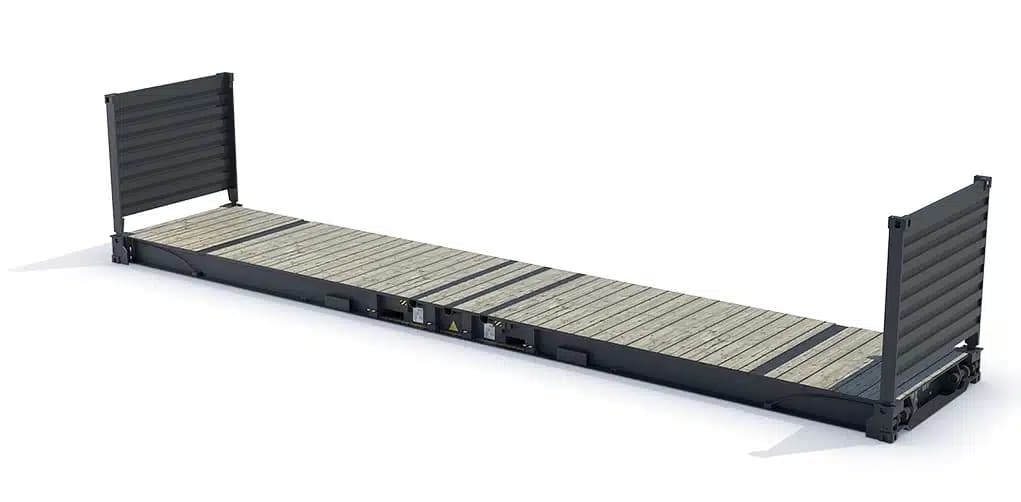
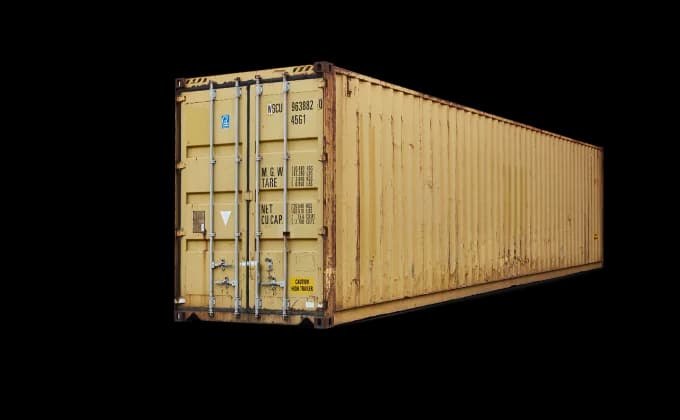
The 40-foot flat rack shipping container is an open-sided transport platform designed for goods that cannot be loaded into a standard dry container due to their length, width, height, or weight. Unlike closed containers, it has no side walls or roof: only two end panels, fixed or collapsible, frame a reinforced floor. This configuration allows loading and unloading from the top, sides, or ends, facilitating the use of cranes, forklifts, and lifting equipment. The model shown here is a 40-foot, the longest standard length in the ISO range, with an external length of about 12.19 meters and an external width of about 2.44 meters. Its external height, around 2.59 meters, corresponds to a high cube configuration that offers more usable volume than a standard 40-foot flat rack, while remaining compatible with ships, ports, and trucks equipped for this type of unit. The stated tare weight, 4,795 kg, is consistent with the reinforced structure of this type of container: flat racks are mechanically heavier than a dry container of the same dimensions, because their floor and cross members must withstand significant forces without side walls to stiffen them. This tare weight must be considered when calculating payload and planning lifting operations. The construction uses corten steel, a low-alloy steel whose resistance to atmospheric corrosion is superior to that of ordinary carbon steel. Under the effect of moisture and oxygen, it develops a stable surface oxide layer that slows the progress of corrosion. This property is particularly useful for a container exposed to sea spray, rain, industrial environments, or prolonged outdoor storage. The floor is made of 28 mm marine plywood, a thick and dense panel bonded with moisture-resistant resins, which supports concentrated loads and repeated passage of equipment. The ends are equipped with posts and cross members that form the load-bearing frame; depending on the model, the end walls may be fixed or collapsible, reducing bulk during storage or empty repositioning. The container complies with ISO standards applicable to series 1 maritime containers, particularly regarding dimensions, corner fittings, and securing devices. The ISO corners, located at the eight angles, allow spreader lifting, securing on ships, locking onto road chassis, and stacking in yards. The ISO mention does not mean that each unit has a valid CSC plate: for international maritime use, the presence and validity of the CSC (Convention for Safe Containers) approval plate must be verified, certifying the unit's safety compliance. This point is essential when purchasing, because a flat rack without a valid CSC cannot be loaded onto a ship without additional formalities. The stated volume, 29.0 m³, corresponds to a theoretical usable geometric volume; in practice, the actual load depends on distribution, stowage, and the type of goods. Flat racks are often used for loads that exceed the gauge: their purpose is not to contain a closed volume, but to support and secure bulky objects. Therefore, the determining characteristics are the maximum allowable load, floor strength, position of securing points, and the possibility of covering the goods with a tarp. Tarpaulin covering is a point not to be overlooked: a loaded flat rack without a tarp exposes the goods to weather, sea spray, and dust. A suitable tarp, fixed on arches or eyelets, partially protects the cargo without turning the container into a watertight unit. It is therefore necessary to distinguish a flat rack from an open top: the open top has side walls and a flexible roof, while the flat rack is completely open on the sides. This choice depends on the nature of the goods and the desired level of protection. The concrete uses of this container are numerous. In industry and mechanics, it allows the transport of machine tools, presses, generators, engines, or large parts that do not pass through the doors of a closed container. In the construction sector, it is used to transport beams, metal profiles, tubes, welded structures, frame elements, or long materials. In agriculture and forestry, it can hold wood, logs, posts, or towed equipment. For vehicles and machinery, a 40-foot flat rack can accommodate cars, quads, small construction equipment, or trailers, subject to proper securing and compliance with load limits. Finally, it is frequently used for oversized industrial packages, heavy crates, molds, foundry parts, or energy equipment. In all cases, securing is the shipper's responsibility: straps, chains, tensioners, chocks, and anti-slip mats must be adapted to the weight, dimensions, and foreseeable accelerations during maritime transport. Maritime transport imposes specific constraints. Ship movements generate longitudinal, transverse, and vertical dynamic forces; a poorly secured load can shift, damage the container, or present a danger to the crew and other cargo. It is therefore recommended to have the securing plan validated by a professional and to comply with the rules of the SOLAS convention and the IMDG code when the goods are dangerous. The container must also be weighed and declared with its verified gross mass (VGM) before loading, in accordance with international regulations. In France, road transport of containers is governed by the Highway Code and regulations on weights and dimensions. A 40-foot container mounted on a chassis generally complies with European road gauge, but a loaded flat rack may exceed the authorized width, height, or length. In this case, exceptional transport may be necessary, with prior authorization, imposed route, signage, and sometimes escort. Axles, bridges, roundabouts, and site entrances must be checked before any movement. The authorized gross vehicle weight, axle distribution, and compliance with axle load limits are critical points. For rail use, the flat rack can be loaded onto container wagons, subject to compatibility with rail gauge and operator rules. For river use, the same precautions for securing and stability apply. When purchasing, several points of vigilance must be checked. First, the structural condition: floor, cross members, end posts, ISO corners, welds, and paint. A used flat rack may have deformations, perforating corrosion, delaminated floors, or ovalized corners. Second, compliance: CSC plate, ISO marking, identification number, tare weight, and maximum load. The seller must be able to provide this information. The type of ends must also be checked: fixed or collapsible. Collapsible ends facilitate storage and empty transport, but add mechanisms that can wear or jam. Fixed-end models are simpler and often more rigid. The floor must be examined: 28 mm marine plywood is thick, but it can be sanded, cracked, or rotten in places. Repairs must be compliant and not create weak points. Paint is not just aesthetic: it protects the corten steel and limits corrosion. Flaking paint, rust runs, or untreated areas should alert. Finally, compatibility with the intended lifting method must be verified: ISO corners must be in good condition, and slings or spreaders must be adapted to the weight and dimensions. Maintaining a flat rack is relatively simple but regular. The floor should be cleaned, stagnant water removed, paint scratches touched up, locking mechanisms of collapsible ends greased, and welds and corners periodically checked. Storage on stable ground, with chocking, prevents deformation and moisture accumulation. In coastal areas, rinsing with fresh water limits salt deposits. These actions extend the unit's service life and preserve its resale value. The displayed price, EUR 2,900.00, corresponds to a new or equivalent-condition 40-foot flat rack container depending on available stock. This pricing should be compared with additional costs: transport to the site, lifting, possible leveling, tarpaulin, securing, and formalities. For a storage or fit-out project, the flat rack is not the most suitable solution: without walls or roof, it offers neither security nor protection. However, it is unbeatable for oversized loads and crane loading operations. If the goal is to create a technical room, a site office, or a closed storage space, a dry or high cube container will be more appropriate. If the goal is to transport a heavy and long machine, the flat rack is often the only option compatible with standard maritime containers. In summary, the 40-foot flat rack shipping container is a specialized, robust, and compliant logistics tool, intended for loads that closed containers cannot accommodate. Its value depends on its structural condition, CSC compliance, floor quality, and ability to be safely secured. An informed purchase, with verification of characteristics and documents, allows long-term use of this type of unit in industrial, port, agricultural, or construction environments. To go further, it is useful to compare the 40-foot flat rack with other available formats. The 20-foot flat rack, shorter, is suitable for compact but heavy loads: it offers a usable length of about 6 meters and is easier to handle on cramped sites. The 40-foot, on the other hand, accepts lengths up to about 12 meters, which is decisive for beams, tubes, profiles, and elongated machines. The choice between the two therefore depends first on the length of the goods, then on weight and lifting method. Another point of comparison concerns the floor: some flat racks are equipped with a wood floor, others with a steel floor or a mixed structure. The wood floor is more flexible, more repairable, and often preferred for loads that must be chocked or nailed; the steel floor resists impacts and abrasive products better, but it is more slippery and heavier. The model described here, with its 28 mm marine plywood, falls into the category of thick wood floors, suitable for concentrated loads. From a regulatory standpoint, a flat rack used in international transport must comply with the CSC Convention, which requires periodic inspections and legible marking. In France, using a container as a room or storage structure may fall under urban planning rules: depending on the municipality, authorization may be required, especially if the unit is fixed to the ground, connected to utilities, or visible from public space. For temporary use on a construction site, constraints are generally relaxed, but it is prudent to check with the local planning department. From a customs standpoint, a flat rack leaving or returning to the territory must be declared according to its status: empty container in circulation, transported goods, or equipment under temporary admission. Transport documents, the bill of lading, and the packing list must mention the dimensions, weight, and nature of the cargo, especially when it exceeds the container's gauge. Sector-specific use cases are varied. In energy and telecommunications, transformers, technical cabinets, masts, cable reels, or generators are loaded. In construction, the flat rack transports metal formwork, walkways, prefabricated stairs, or crane elements. In food processing, it can hold tanks, cisterns, or process equipment that does not pass through a door. In the events sector, it is used to transport stage structures, platforms, screens, or booth modules. In military and humanitarian fields, it is used for vehicles, technical containers, or large equipment lots. Each sector imposes its own constraints for securing, protection, and traceability. Preventive maintenance deserves to be planned. A visual check before each shipment detects deformation, a missing bolt, a worn strap, or an active rust area. A more complete check, once or twice a year, can include tightening bolts, examining welds, checking floor thickness, and testing collapsible mechanisms. When a flat rack is stored empty, it is recommended to place it on beams or blocks to avoid direct contact with damp ground, and to leave collapsible ends in the lowered position if the model allows, to limit wind exposure. Finally, traceability is an asset: noting identification numbers, inspection dates, and performed interventions facilitates resale and compliance. Compared to an open top container, the flat rack offers wider access but less protection; compared to a 20-foot flat rack, it offers more length but weighs more and generally costs more. Compared to a truck flatbed, it is designed to be stacked, lifted, and secured according to international standards, which simplifies port operations. These differences explain why the flat rack remains a reference for oversized loads, despite a higher operating cost than a dry container. In conclusion, the 40-foot flat rack shipping container is a specialized piece of equipment that combines robustness, modularity, and international compatibility. Its purchase should be guided by a rigorous technical examination, documentary verification, and consideration of securing and protecting the goods. Well chosen and well maintained, it is a durable investment for professionals who must move loads that closed containers cannot accommodate.