Description
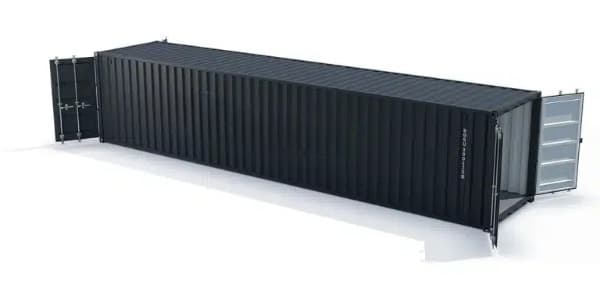
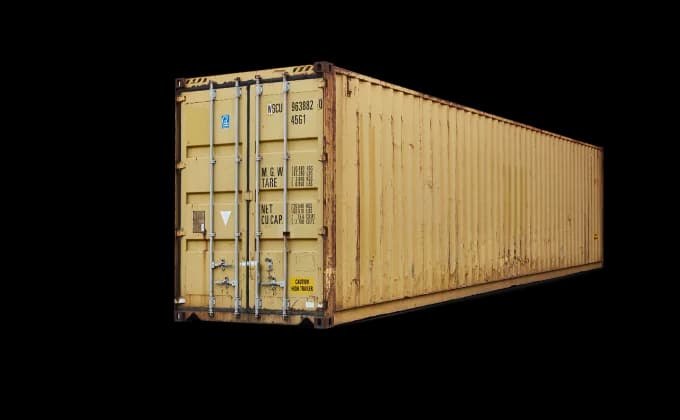
The 40ft High Cube double door shipping container is designed to provide full access to cargo from both ends. This dual door configuration, one at the front and one at the rear, fundamentally changes how storage and handling are organized. Instead of loading and unloading only from the rear, you have two opposite entry points, which simplifies the flow of goods, reduces unnecessary handling and allows the interior space to be compartmentalized as needed. Whether you store pallets, tubes, profiles, furniture or bulky equipment, this double opening provides valuable day-to-day flexibility.
With an overall length of 12.19 metres, a width of 2.44 metres and an external height of 2.89 metres, this 40ft High Cube container stands out from the standard model by its greater height. Where a classic dry container has an external height of around 2.59 metres, the High Cube gains almost 30 centimetres, bringing the internal height to around 2.69 metres. This extra volume translates into a usable capacity of around 77 m³, an asset for multi-level palletized loads, tall equipment or fit-outs that require a higher ceiling. The generous interior volume also makes it possible to install a light mezzanine, tall shelving or partitions without feeling cramped.
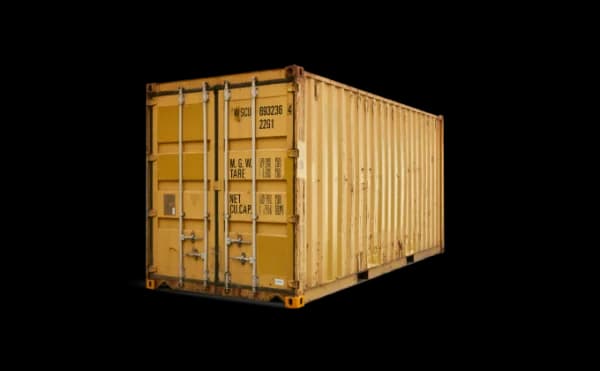
The structure is based on a corten steel frame, also known as weathering steel. This alloy contains copper, chromium and nickel, which allow it to develop a stable protective oxide layer on the surface, slowing corrosion. It has been the reference material in shipping container construction for decades. The side walls are made of corrugated sheets that provide rigidity and resistance to deformation, while the corner posts and cross members form a frame capable of withstanding significant stresses, particularly during stacking. The floor is generally made of 28 mm marine plywood, a dense, treated panel that resists moisture and heavy loads. This floor rests on metal cross members welded to the structure, ensuring even weight distribution.
Air and water tightness is ensured by rubber seals around the doors, complemented by a locking system with bars. Both front and rear doors are fitted with these devices, keeping the interior dry even when exposed to bad weather. However, the condition of the seals should be checked regularly, as a crushed, hardened or torn seal can let water in and eventually cause damp or rust marks on the floor and walls. Simple maintenance, consisting of cleaning the seals and treating them with a suitable product, extends their service life.
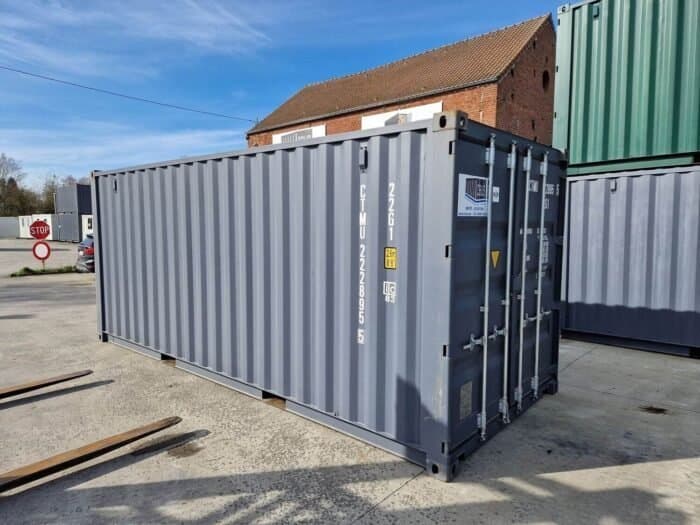
ISO compliance is an essential point. Shipping containers meet international standards, including ISO 668, which defines dimensions and maximum masses, and ISO 1496, which covers structural testing and performance. This compliance guarantees that the container can be handled, stacked and transported on global networks, with standardized corner fittings allowing securing on ships, trains and trucks. It also facilitates resale and integration into existing logistics chains. For land-only use or as a storage unit, this compliance remains a guarantee of manufacturing quality and standardization.
The 40ft High Cube double door container fits into many contexts. In logistics, it allows loading from one end and unloading from the other, speeding up turnarounds and limiting cross-flows. On a construction site, it serves as a tool store, material storage unit or site office after fit-out. In industry, it can hold long parts, pipes, metal profiles or bulky equipment. For agriculture, it provides dry shelter for grain, fodder or equipment. Finally, in modular fit-outs, it is a solid base for creating a workshop, technical room, retail space, studio or habitable extension, subject to local planning rules.
One of the major advantages of the double door is the possibility of creating through-traffic. On a site where space is limited, being able to enter from one side and exit from the other avoids tedious manoeuvres and U-turns. It also allows the container to be divided into two distinct zones, for example a storage area and a workshop area, each with independent access. Some users install a light partition in the centre, creating two separate spaces without losing the ability to open both ends. This internal modularity is particularly sought after by craftsmen, SMEs and individuals who need a versatile unit.
Before buying a double door container, several points deserve your attention. First, condition: a new container offers optimal tightness and finish, while a used container may show rust, dents or worn seals. The price generally reflects this condition. Next, check that both door sets are present and working properly. Locks should operate without forcing, bars should be straight and seals should be supple and complete. Inspect the floor: soft spots, splinters or damp marks may indicate a problem. Also check the lifting corners and welds, which are sensitive points. Finally, make sure the container has a valid CSC plate if you plan to transport it on public roads or by sea.
Transporting a 40ft container in France is subject to a few rules. A 40ft container measures around 12.19 metres long, which exceeds the maximum length allowed for a single vehicle. It must therefore be loaded onto a container carrier or a suitable truck, often with an extendable trailer. The total laden weight must not exceed regulatory limits, and an exceptional convoy may be necessary depending on dimensions and configuration. It is advisable to use a specialist carrier equipped with crane trucks or telehandlers for handling. Delivery to the destination must be prepared: stable ground, clear access, sufficient space for manoeuvres. An empty container weighs around 3,800 kg, giving an idea of the load to be moved before any goods are placed inside.
Maintaining a corten steel container is relatively simple. Regular cleaning with clean water or a mild detergent removes salt, dust and pollution deposits. Areas where paint has flaked can be sanded and repainted with an anti-rust paint suitable for metal surfaces. Hinges and locking mechanisms benefit from being lubricated once or twice a year to remain functional. If the container is used for long-term storage, it is advisable to ventilate regularly by opening the doors in dry weather to limit condensation. Adding a moisture absorber can be useful in humid environments. Finally, avoid storing corrosive or damp products directly against the walls, and raise loads on pallets or dunnage to let air circulate under the floor.
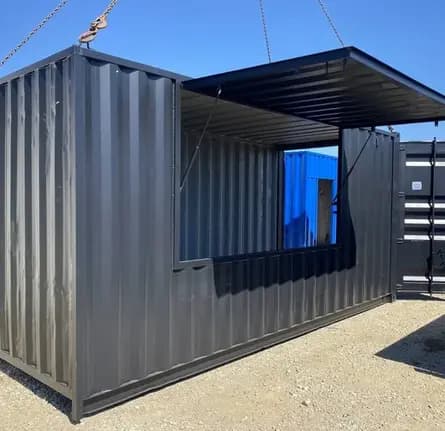
Internal fit-out of a double door container requires prior planning. If you want to insulate it, you can add a light timber or metal frame, mineral wool or rigid insulation board, then an interior lining. Electricity can be installed surface-mounted or concealed, with suitable conduits. Ventilation is a key point: without air circulation, condensation can become a problem, especially if the container is heated in winter. High and low ventilation grilles, protected against rain and insects, create natural airflow. For habitable or office use, it is essential to comply with safety and planning rules and, where applicable, to obtain the necessary permits from the local authority.
Choosing a High Cube container rather than a standard one is justified as soon as you need height. The 30-centimetre gain may seem modest, but it allows pallets to be stored on two levels more comfortably, taller shelving to be installed or a higher ceiling to be created for a workspace. For long loads, the double door makes insertion and extraction easier without having to manoeuvre around obstacles. This model therefore combines two advantages: height and accessibility. It is particularly suited to professionals handling bulky goods or needing a through-access unit.
In summary, the 40ft High Cube double door shipping container is a versatile, robust and standardized tool. Its corten steel structure, marine plywood floor and ISO compliance make it a reliable solution for transport, storage and fit-out. The double door provides flexibility that can save time and improve organization. Before buying, take the time to inspect the condition, check the doors and seals, and find out about transport and installation conditions. With minimal maintenance, this container can serve for many years, whether on a construction site, in an industrial area, on a farm or as the basis for a modular fit-out project.
To go further, it is useful to compare this model with other container formats and types to make an informed choice. The 20ft standard container, for example, measures around 6.06 metres long with a width and height similar to the 40ft standard. It offers a volume of around 33 m³ and an empty weight of around 2,200 to 2,400 kg. It is more manoeuvrable, easier to move on a cramped site and often less costly to buy and transport. However, it offers half the volume and cannot store very long loads without breaking them down. The 40ft standard offers around 67 m³ and an internal height of around 2.39 metres. The High Cube therefore adds around thirty centimetres of height and around 10 m³ of usable volume compared with the 40ft standard, which can make a difference for tall pallets or interior fit-outs.
The 45ft High Cube container is another option. It measures around 13.56 metres long and offers a volume of around 86 m³. It is less common, which can complicate transport and resale, but it maximizes capacity for a footprint barely larger than a 40ft. The 40ft High Cube double door therefore sits in an interesting compromise zone: a standard length widely accepted by carriers, a generous height and dual access that does not exist on classic dry models. Note that the double door slightly reduces usable interior space compared with a single door model, as the locking mechanisms and posts take up some space at both ends. This loss remains marginal and is offset by the convenience of access.
Other container types exist for specific needs. The reefer container is insulated and equipped with a refrigeration unit for transporting perishable goods; it is generally not intended for classic dry storage. The open top container has an opening or removable roof, practical for loading tall objects from above, but it is less watertight than a dry container. The flat rack container, without side walls or roof, is designed for out-of-gauge loads, machinery or equipment. The tank container, finally, is used for transporting liquids. The 40ft High Cube double door remains a versatile dry container, i.e. closed, dry and standardized, making it suitable for the vast majority of storage and fit-out uses.
The choice between a new and a used container also deserves detail. A new container, often called one-trip or single-trip, has been used once for sea transport. It has a sound structure, paint in good condition and supple seals. Its price is higher, but it offers better longevity and a neater appearance, which matters for a visible fit-out. A used container has already made several rotations. It may be in good general condition, with some superficial rust, or show repairs. For rough storage use, a well-maintained used container may suffice. For habitable fit-out or a customer-facing unit, a new or reconditioned model is often preferable. In all cases, a rigorous visual inspection remains essential.
The industry influences the choice of model. In construction, the double door container serves as a welfare unit, store or workshop. The double opening allows tool storage and workspace to be separated while facilitating access from two areas of the site. In events, it can become a stand, ticket office or technical room, with separate entry and exit to manage flows. In retail, it can serve as a seasonal shop, adjoining storage unit or mobile point of sale. In agriculture and livestock farming, it shelters equipment, seeds or fodder from moisture. In industry, it stores spare parts, consumables or sensitive tooling. Finally, for individuals, it offers an outdoor storage solution, a DIY workshop or a base for a tiny house or garden office project, subject to planning permissions.
French regulations govern the installation of a container on a plot of land. A container placed on the ground and used as a unit may be considered a construction and require a prior declaration of works, or even a building permit depending on its surface area, height and duration of installation. Rules vary by municipality and zone (urban, agricultural, coastal, protected). It is therefore advisable to check with the local planning department before any installation. If the container is intended for habitation, additional requirements may apply regarding safety, insulation, sanitation and connection to utilities. For temporary use on a construction site, specific rules may apply. Finally, if the container is transported on public roads, it must comply with the highway code and size rules, with the necessary permits for exceptional convoys.
The question of foundation and stability is also important. A loaded container can weigh several tonnes. It must rest on a flat, stable surface, such as concrete blocks, hardwood beams or a slab. Soft or sloping ground can cause deformation or stress in the structure. It is recommended to raise the container slightly to avoid direct contact with the ground, limit moisture and facilitate ventilation under the floor. The lifting corners must remain accessible to allow subsequent handling by truck or forklift. If the container is stacked, stacking limits must be respected and suitable corner fittings used. For use in windy areas, securing to the ground may be necessary.
The double door also has a few specific points to watch. As there are two door sets, there are twice as many seals, locks and hinges to maintain. A poorly closed front door can compromise the tightness of the whole. It is therefore advisable to regularly check that both sides close properly and to grease the mechanisms. In addition, the presence of a front door can reduce the surface available for fixing shelves or partitions on that wall. This must be taken into account when designing the interior fit-out. Finally, the double door can be an additional entry point for intruders; a reinforced locking system or a quality padlock is recommended if the container is used for sensitive storage.
In terms of handling, the 40ft High Cube double door container moves like a standard container, thanks to its standardized corner fittings. A truck with an auxiliary crane, a forklift equipped with a spreader or a reach stacker can handle it. The empty weight of around 3,800 kg must be taken into account when choosing lifting equipment. Once loaded, the total weight can reach several tens of tonnes, depending on the permitted payload. It is essential to respect the load limits indicated on the CSC plate and to distribute loads evenly to avoid deformation. Heavy loads should be placed in the centre and spread over the entire length, avoiding point concentrations.
Ventilation and moisture management are major issues for any container used for storage. Corten steel and marine plywood resist well, but condensation can appear when the outside temperature varies and the inside air is humid. To limit this, ventilation grilles can be installed, dehumidifiers or moisture absorbers used, and goods raised off the floor. Regular checks inside allow any damp to be detected quickly and action taken before damage appears. In coastal or very humid regions, these precautions are particularly recommended.
Finally, the 40ft High Cube double door container is part of a circular economy approach. Reusing a shipping container for land use extends its life and avoids the production of new structures. Many fit-out, office, temporary housing or cultural space projects use containers as a modular base. This model, with its double door and extra height, offers interesting flexibility for such projects. It allows through-spaces to be created, smooth circulation to be organized and technical equipment to be integrated without being limited by height. Whether for professional or personal use, it is a durable, robust and scalable solution, provided its acquisition, installation and maintenance are well prepared.