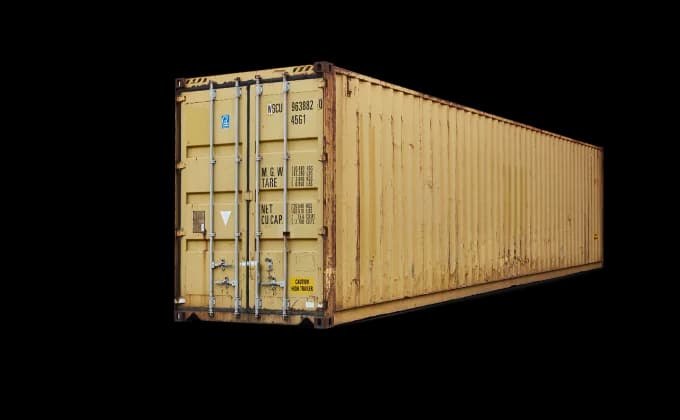
Description
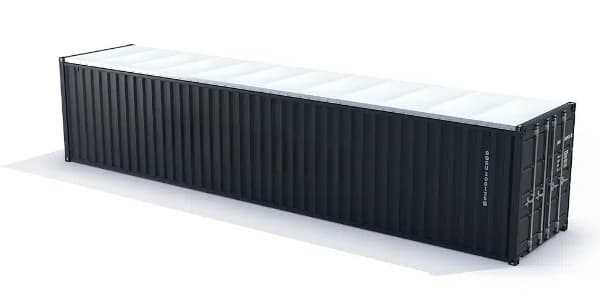
The 40 ft open top shipping container addresses a simple constraint: some goods cannot be loaded through the rear doors, either because they are too tall, or because they are too wide or too rigid to be handled along the container's axis. The removable roof of this model opens vertical access along the entire usable length, allowing the load to be lowered by crane or forklift and then secured inside. This is the standard solution for out-of-gauge cargo in maritime transport, and it remains relevant for on-site storage and fit-out. This model is offered new by D.S. Globe Conteneur, in Marseille.
Let's start with the dimensions, as they directly determine what you can load. A 40 ft container complies with ISO 668: overall length 12.192 m, overall width 2.438 m, overall height 2.591 m. The dimensions shown in the product sheet (1219 x 244 x 259 cm) correspond to these standardised values. Inside, there is typically a usable length of around 12.03 m, a usable width of around 2.35 m and an internal height of around 2.39 m for a standard open top. These internal dimensions may vary slightly depending on the manufacturer and roof type, but they provide a reliable order of magnitude for preparing a loading plan. The stated internal volume is 67 m³, which corresponds to the typical volume of a 40 ft dry; on an open top, the presence of the roof frame and tarpaulin system marginally reduces the usable height, without changing the order of magnitude.
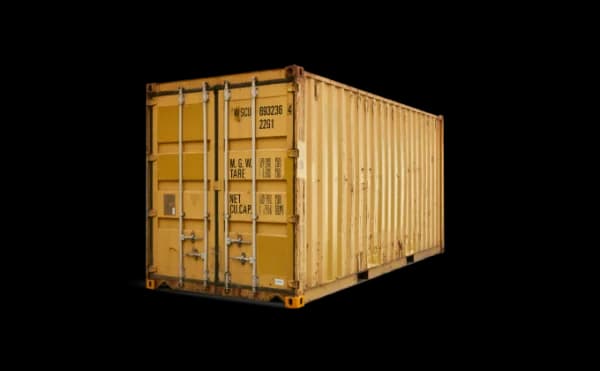
The tare weight is given as 4,050 kg. This is consistent with a 40 ft open top, generally heavier than a standard dry due to the roof reinforcement, fixing rails and cover system. The payload then depends on the maximum gross weight (MGW), which appears on each container's CSC plate. For a 40 ft, the MGW is most often around 30,480 kg, leaving a payload of around 26,000 to 28,000 kg depending on the model. It is essential to check this value on the plate before any heavy loading, as it determines the legality of road and sea transport.
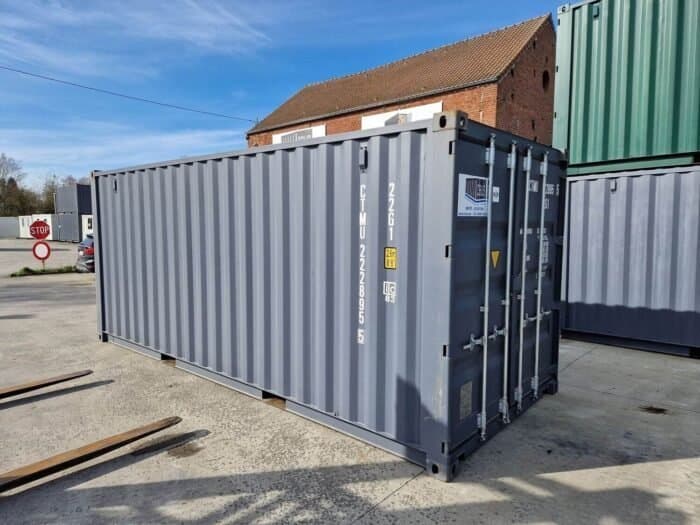
The structure is made of corten steel, a low-alloy steel that develops a protective oxide layer on the surface and resists corrosion better than ordinary steel. The side walls are corrugated, the frame is reinforced at the corners by standard ISO corner fittings, and the floor is 28 mm marine plywood, a common thickness on containers intended for concentrated loads. This floor rests on steel cross members; it supports moderate rolling loads, but remains vulnerable to puncturing and stagnant moisture. The rear doors are double-leaf, equipped with standard container locks (locking bars, handles, seals). The open roof is closed either by a flexible tarpaulin or by a rigid steel cap, depending on the configuration. The tarpaulin is lighter and quicker to handle; the steel cap offers better protection against intrusion and bad weather, but makes the assembly heavier and complicates lifting operations.
The principle of vertical loading deserves detail, as this is where the difference from a dry container lies. First the tarpaulin or cap is removed, revealing the top opening along the entire length, then the goods are lowered using a crane, gantry or forklift equipped with a suitable jib. Once the load is positioned, it is secured to the floor or walls using straps, chocks and anchor points. The roof is then replaced and locked. This sequence demands rigour: a poorly secured load can shift during sea transport, and dynamic forces at sea are significant. It is recommended to prepare a validated securing plan, especially for heavy machinery or cargo with a high centre of gravity.
Typical uses of this type of container are well identified. In industry, machine tools, generators, pumps, motors and large welded assemblies are loaded. In construction, metal profiles, beams, long tubes, structural components and formwork are transported. In the energy sector, cable reels, pipes and drilling equipment are placed. Long timber, large panels and composite materials also go through open top. Finally, on construction sites or in logistics areas, an open top can serve as a covered storage area for bulky items, with the advantage of being able to load and unload by crane without dismantling.
One point of vigilance concerns loading height. A standard 40 ft open top has an internal height of around 2.39 m, but the top opening allows this height to be exceeded if the load is accepted by the carrier and the roof can be closed. In practice, loads exceeding the top frame require specific approval, reinforced securing and sometimes exceptional convoy transport. Regulatory constraints must therefore be anticipated from the project preparation stage.
Transport regulations in France should also be recalled. On the road, a 40 ft container mounted on a container chassis generally complies with the Highway Code limits, but the total convoy height (chassis + container) can approach or exceed 4 m, requiring checks on routes, bridge heights and traffic rules. The gross vehicle weight must remain within the limits of the vehicle and the driver's licence category. For exceptional transport, prior authorisation is required, with route and time constraints. At sea, the container must be stackable according to the vessel's rules; the CSC plate certifies its compliance and must be up to date. Finally, for import, the usual customs formalities apply, with declaration and any duties and taxes.
Maintenance of an open top differs slightly from that of a dry. The tarpaulin must be inspected regularly: seams, eyelets, tension straps, signs of rubbing. A worn tarpaulin lets water through, which can damage the goods and the floor. The steel cap requires checking of seals, hinges and locking points. The corten steel structure must be monitored where water stagnates: bottom of walls, corners, around the floor. Deep scratches reaching bare metal must be treated quickly by brushing and applying a suitable anti-rust paint. The marine plywood floor must be kept dry; regular cleaning and proper ventilation limit the risk of mould. Door seals and locking bars should be greased periodically to remain functional.
When purchasing, several points must be checked. First, the CSC plate and ISO marking: they indicate the date of manufacture, MGW, tare and tests undergone. Then the actual condition of the roof: a torn tarpaulin or warped cap is easy to spot, but the rails and tensioning systems must also be checked. The floor must be probed at several points to detect rotten or delaminated areas. The walls and frame must be examined for impacts, deformation or cracked welds. Finally, the doors must open and close without forcing, with flexible seals and locks that engage correctly. A new container obviously presents fewer risks, but an inspection remains essential, particularly to verify ISO compliance and the absence of transport-related damage.
Compared to a dry container, the open top offers vertical access that radically changes loading logistics. Compared to a flat rack, it retains side walls and a roof, thus better protection against bad weather and better safety for goods that must not be exposed. Compared to a high cube, it does not gain internal height but gains accessibility. The choice therefore depends on the nature of the load: if it is tall or wide, the open top is essential; if it is standard, a dry is sufficient and generally costs less.
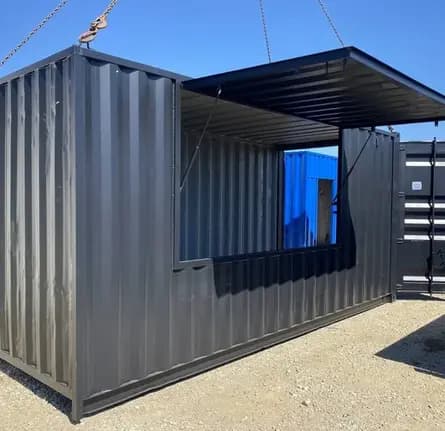
At D.S. Globe Conteneur, in Marseille, this 40 ft open top container is offered new, at the price of EUR 3,100.00. Marseille being a major Mediterranean port, supply and shipping from this area are common, but the exact terms of delivery, availability and transport must be confirmed directly with the company. It is also possible to consider fit-outs: partitioning, insulation, lighting, ventilation, or conversion into a technical room, mobile workshop or specialised storage space. These modifications must be carried out in compliance with safety rules and without compromising the container's structure.
To go further on sector-specific uses, let's take a few concrete examples. In events and entertainment, a 40 ft open top allows the transport of stage structures, platforms, scaffolding, large set pieces, or pre-assembled technical control desks. In agriculture and agri-food, it can hold tanks, small silos, conveyors, parts of harvesting machines. In the maritime and port sector, anchors, chains, propellers, propeller shafts and lifting equipment are stored. In construction, mobile concrete plants, pumping units and pre-equipped site cabins frequently go through this type of container. Finally, in defence or humanitarian logistics, the open top is used to load light vehicles, generators, tents and bulky equipment that cannot pass through the doors.
Sizes should also be compared. A 20 ft open top is shorter (about 6.06 m overall) and lighter, making manoeuvres easier and reducing transport costs when the load does not need 12 m of length. A 40 ft open top, like the one presented here, offers double the usable volume and suits long loads or large batches. There are also 40 ft high cube open tops, which gain about 30 cm of internal height compared to a standard open top, an advantage for tall loads that remain within gauge. The choice between 20, 40 standard and 40 high cube therefore depends on the length, volume and height of the goods, but also on road transport constraints and the lifting capacities available at the loading and unloading sites.
Another practical point concerns handling. A 40 ft open top container is handled by the upper and lower corner fittings, with a suitable spreader. Lifting by the roof is prohibited, as the top frame is not designed to take the full forces alone. During vertical loading, it is recommended to use compliant slings and hooks, and to check that the load does not rub against the walls or frame. Positioning must be gradual, with guides if necessary, to avoid impacts that could deform the corrugations or damage the paint. Once the load is in place, the roof must be properly replaced, with sufficient tension of the tarpaulin and effective locking of all attachment points.
In terms of safety, an open top presents specific risks: falling objects from the open roof, pinching when closing the cap, exposure to bad weather during operations. It is therefore prudent to define a loading procedure, mark out the area, wear appropriate personal protective equipment and train operators. Load stability must be checked before each movement, and the container must not be stacked in a non-compliant manner. Finally, the transport of dangerous goods imposes additional rules (classification, packaging, marking, documentation), which apply regardless of the container type.
In terms of durability, a shipping container is a product designed to last several decades if maintained. Corten steel, marine plywood floor and cast steel corner fittings are repairable: a floor section can be replaced, a weld repaired, a locking bar changed, a tarpaulin repaired or replaced. This repairability is an asset compared to less robust storage solutions. It also allows a second life to be considered: after several years of transport, an open top can be converted into a storage room, workshop, sales space or technical module, subject to checking the structural condition and adapting the fit-out.
Finally, to succeed in a purchase project, it is useful to prepare a simple specification: dimensions and weight of the load, intended loading method, desired roof type, transport constraints, fit-out needs, budget and deadline. These elements make it possible to confirm that the 40 ft open top is suitable, or to direct towards another size or type of container. D.S. Globe Conteneur, in Marseille, can support this reflection and specify the terms of sale, delivery and availability.
In summary, the 40 ft open top container is a versatile logistics tool, designed for loads that standard containers cannot receive. Its corten steel structure, 28 mm marine plywood floor, lockable rear doors and removable roof make it a robust solution for sea, rail and road transport, as well as for on-site storage. Before purchase, the exact dimensions, payload, roof condition and ISO compliance should be validated. D.S. Globe Conteneur can assist with this verification and specify the terms of sale and delivery.