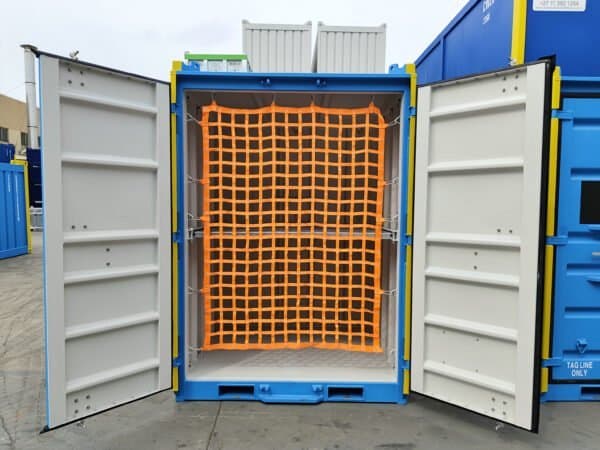
Description
The 5-foot offshore maritime container is a specialized piece of equipment designed to meet the demands of the most severe maritime and industrial environments. Unlike standard ISO containers, it is certified to the DNV 2.7-1 standard (and DNV-ST-E271), which governs offshore containers intended for lifting and transporting equipment between land and offshore installations. This certification guarantees that the container has successfully passed regulatory tests for lifting, load, and structural strength. It is therefore approved for handling by crane or helicopter under controlled conditions, which distinguishes it from a standard maritime container not certified for such operations.
This 5-foot model is particularly suited to confined spaces and dense loads. Its external dimensions are 1.692 m long, 1.964 m wide, and 2.770 m high. These compact proportions allow it to be installed on platforms, ships, or logistics bases where space is limited, while offering a useful internal volume of 6.22 m³. The internal dimensions are 1.482 m long, 1.740 m wide, and 2.413 m high. The door opening measures 1.740 m wide by 2.348 m high, which facilitates loading and unloading bulky equipment.
The construction uses Corten steel, a low-alloy steel with atmospheric corrosion resistance significantly superior to that of ordinary steel. Under the effect of weathering, a protective layer of oxides forms on the surface and slows the progression of corrosion. This property is essential for maritime or coastal use, where salt air and humidity attack metals. The floor is metal, which ensures good mechanical strength and facilitates cleaning, while avoiding the humidity problems that wooden floors can experience. This container is advertised as being on its first trip, meaning it has not yet been used for commercial transport.
The tare weight is 1.7 tonnes and the maximum load is 4 tonnes, for a maximum gross weight of 5.7 tonnes. These values are consistent with offshore certification, which imposes high safety factors for lifting. The maximum load of 4 tonnes allows transport of a wide range of equipment: tools, spare parts, drilling equipment, electrical equipment, consumables, etc. The internal volume of 6.22 m³ provides optimized storage space for dense loads.
DNV 2.7-1 certification is issued by DNV (Det Norske Veritas), an international organization recognized in the maritime and offshore field. It comes with an offshore nameplate that identifies the container (serial number, certificate, characteristics) and an inspection plate allowing periodic verifications to be tracked. Complete traceability of the manufacturer and certificate number is provided. This documentation is essential for offshore operations, as it guarantees that the container has been tested and is maintained in compliance over time.
The uses of this container are multiple. It is primarily intended for transporting equipment between land and offshore installations: oil or gas platforms, research vessels, offshore wind farms, port logistics bases. It can also serve as a storage container on an industrial site, a secure site chest, or a technical module for sensitive equipment. Its offshore certification makes it a relevant choice for companies that must comply with strict safety and traceability requirements.
Maintaining a DNV-certified offshore container requires particular attention. The condition of the structure, lifting points, and fastenings should be checked regularly, in accordance with periodic inspection procedures. Slings and lifting accessories must be inspected before each use. Corrosion must be monitored, especially on welds and wear areas. Regular cleaning and paint touch-ups if necessary extend service life. Inspections must be recorded and certificates updated according to current regulations.
When purchasing, several points of vigilance should be considered. Verify that the container has its DNV nameplate and a valid certificate. Ensure that lifting and load tests have been carried out and documented. Check the general condition: absence of major deformations, perforating corrosion, cracks. Verify the operation of doors, seals, and locking devices. For offshore use, compliance with the DNV 2.7-1 standard is essential; a non-certified container must not be used for offshore lifting operations. Finally, consider transport constraints: this 5-foot container can be transported by truck, but its height of 2.77 m may require a special permit depending on the countries and roads used.
Transporting an offshore container in France is subject to exceptional transport regulations if its dimensions or weight exceed authorized limits. For a 5-foot container, the width of 1.964 m and height of 2.77 m may exceed standard road gauges (2.55 m width and 4 m total height with the vehicle). It is therefore advisable to inquire with the competent authorities and plan the necessary permits. In addition, lifting must be carried out by qualified personnel, with suitable machinery and certified accessories.
In summary, this 5-foot offshore maritime container is specialized equipment, DNV 2.7-1 certified, designed to withstand demanding maritime and industrial environments. Its Corten steel construction, metal floor, and offshore certification make it a reliable solution for transporting and storing equipment at sea or on isolated sites. It stands out from standard ISO containers by its approval for offshore lifting and its complete traceability. For any project requiring a certified container, it is essential to verify compliance and the condition of the equipment before purchase.
To go further, it is useful to place this container within the family of offshore equipment and compare its characteristics with other commonly used solutions. DNV-certified offshore containers exist in several standardized sizes, including 6-foot, 8-foot, 10-foot, and 20-foot. The 5-foot format is one of the most compact; it is often chosen when the space available on the platform or vessel is very limited, or when the load to be transported is dense but of moderate volume. A 10-foot offshore container offers a larger internal volume, generally around 15 to 16 m³, but it is bulkier and heavier when empty. The 20-foot offshore container, meanwhile, can exceed 30 m³ of internal volume, but it requires more powerful lifting means and is not suitable for cramped areas. The choice therefore depends on the trade-off between available volume, mass to be transported, lifting capacity, and bulk.
Another point of comparison concerns standard ISO containers. A classic 20-foot dry container has an external length of 6.058 m, a width of 2.438 m, and a height of 2.591 m (or 2.896 m in high cube version). Its tare weight is generally between 2.2 and 2.4 tonnes, for a payload of around 28 tonnes. It is not certified for offshore lifting and must not be used for offshore transfer operations. The 5-foot offshore container, with its DNV certification, reinforced structure, and specific lifting points, meets constraints that the ISO container cannot satisfy. It is therefore not a simple storage container, but a certified handling equipment.
Sector-specific use cases are numerous. In the oil and gas sector, this container can transport maintenance tools, spare parts for pumps or valves, geological samples, or safety equipment. In offshore wind, it is used to deliver electronic components, sensors, measuring instruments, or repair kits to turbines. In oceanographic research, it allows sensitive scientific equipment to be stored and protected during sea campaigns. Port logistics bases use it as a secure storage chest for costly tooling. Finally, in shipyards or industrial sites, it can serve as a mobile technical room for control or measurement equipment.
Routine maintenance should be complemented by planned preventive maintenance. It is recommended to keep an inspection log, including the date, nature of checks, and any repairs. Lifting points (ears, slings, shackles) must be visually examined before each operation and subject to an in-depth inspection at a frequency defined by the operator, in accordance with best practices and certification requirements. Welds must be inspected to detect any cracks or incipient corrosion. Doors and their seals must be greased and checked to ensure sealing. If the container is exposed to a highly corrosive environment, washing with fresh water after each prolonged exposure to salt can be beneficial. Any paint touch-up must use products compatible with Corten steel and comply with the manufacturer's recommendations.
The regulations applicable to transporting this container in France deserve clarification. Road transport is governed by the Highway Code and decrees relating to exceptional transports. The general limits are 2.55 m width, 4 m total height (vehicle included), and 16.50 m length for a road train. A 5-foot offshore container, with a width of 1.964 m and a height of 2.77 m, can be transported on a container truck without exceeding the maximum width, but the total height depends on the chassis height. If the total height exceeds 4 m, an exceptional transport permit is required, possibly with an imposed route and escort. For maritime transport, the container must be secured in accordance with IMO rules and the vessel's prescriptions. For lifting, operations must be carried out by qualified personnel, with lifting accessories periodically inspected.
It is also important to emphasize that DNV 2.7-1 certification imposes periodic verifications. The DNV-ST-E271 standard defines requirements for offshore containers, including initial tests and in-service inspections. The operator must ensure that the container is maintained in compliance, which may involve annual inspections or at intervals defined by the certification body. Failure to comply with these requirements can result in suspension of certification and prohibit use of the container for offshore operations. It is therefore essential to keep all documentation and plan deadlines.
Finally, choosing a 5-foot offshore container must take overall logistics into account. Its tare weight of 1.7 tonnes and maximum load of 4 tonnes mean the total gross weight is 5.7 tonnes. Lifting equipment must have sufficient capacity, taking into account the safety factor and sling configuration. The internal volume of 6.22 m³ may seem modest, but it is optimized by an internal height of 2.413 m, which allows tall objects to be stored or crates to be stacked. The presence of a metal floor facilitates sliding heavy loads and resists wear. All these elements make this container a robust and specialized tool, suited to missions where reliability and compliance are paramount.
To complete this presentation, aspects related to safety and personnel training should be addressed. Using a DNV-certified offshore container implies complying with strict procedures. Before any lifting operation, a lifting plan must be established, specifying the load mass, type of slings, attachment points, and trajectory. Operators must be trained in lifting techniques and know the associated risks (swinging, sling failure, collision). The container must be equipped with clearly identified lifting points in good condition. Operations in strong wind or rough seas should be avoided or carried out with additional precautions. Finally, the container must be inspected after each lifting operation to detect any damage.
Another important aspect concerns traceability and document management. The container's maintenance log must be kept up to date, with certificates, inspection reports, and any repairs. In case of inspection by an organization or client, these documents prove compliance. The DNV nameplate must remain legible and securely attached. Any modification to the structure or lifting points must be validated by the certification body, otherwise certification will be lost. It is therefore recommended to keep a digital copy of all documents and archive them throughout the container's service life.
Finally, for companies considering purchasing this container, it is useful to remember that the price of 1000 euros excluding tax is indicative and may vary depending on options, availability, and delivery costs. As this container is on its first trip, it has the advantage of being new and benefiting from optimal service life. It can be used immediately after receipt, provided the lifting accessories are checked for compliance. For intensive use, it is advisable to plan a stock of wear parts (door seals, paint) and schedule inspections. With proper maintenance, this container can serve for many years under difficult conditions.