Description
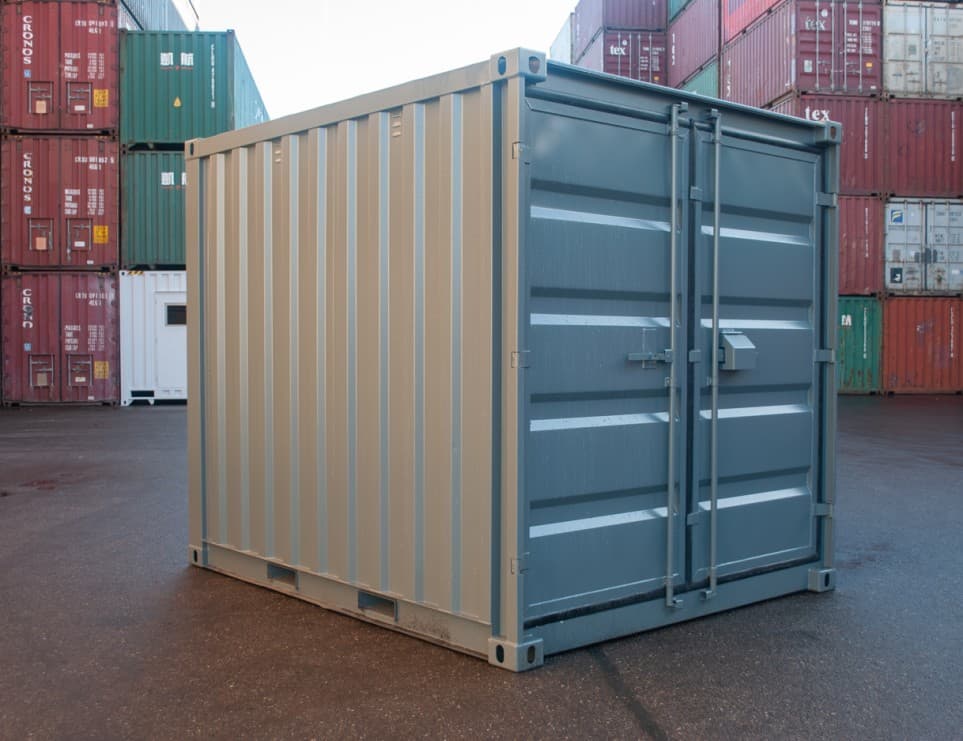
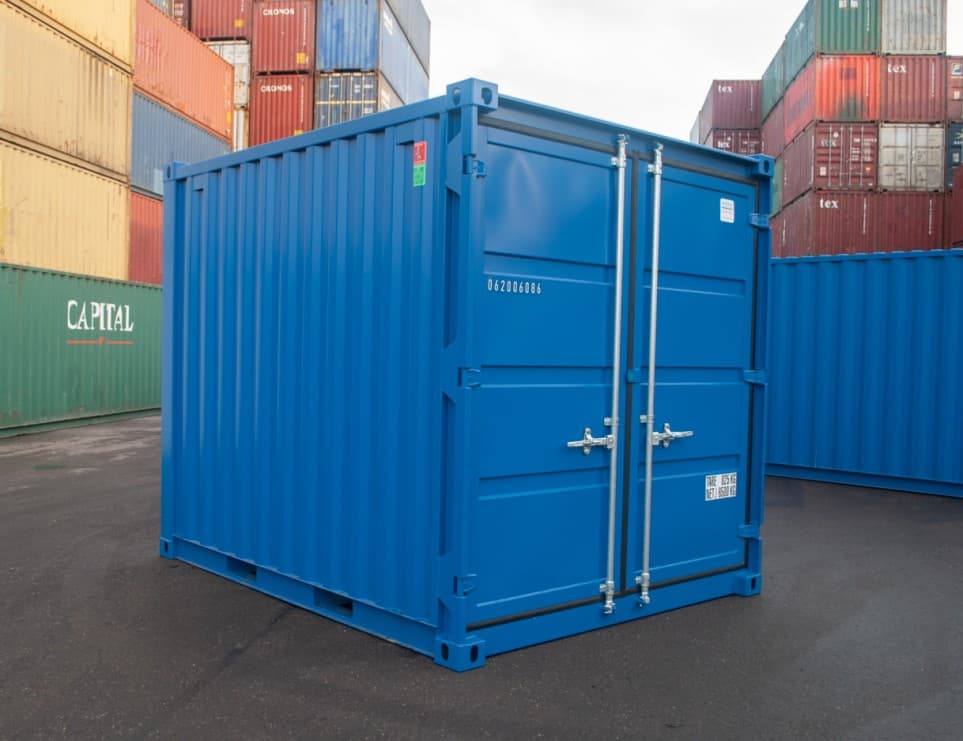
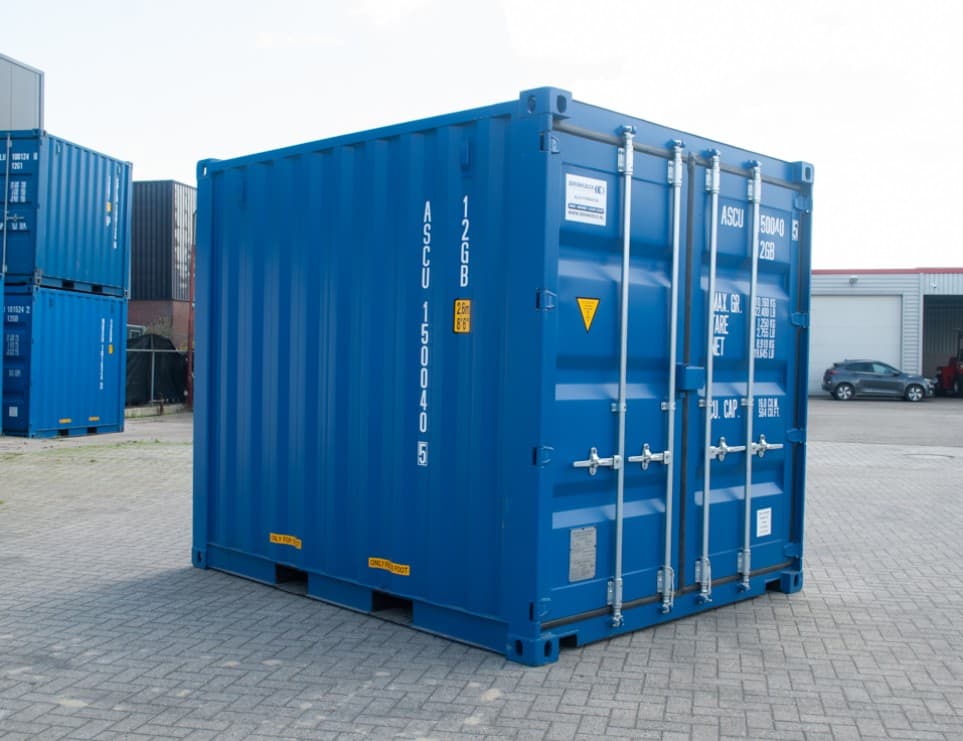
The new 10ft container, also known as a 3-metre container, is a storage and transport module made of Corten steel, built to ISO standards for shipping containers. It is a compact format, shorter than the standard 20ft, that fits where space is limited or when the volume to be stored is moderate. This model is supplied new, meaning it has not yet been used in commercial rotation: its structure, walls and floor have not suffered the wear caused by repeated port handling. It therefore retains all its original features, including its factory-installed Lockbox and its 28mm marine plywood floor.
Technically, a 10ft container follows the construction principles of shipping containers: a Corten steel frame, welded assembly, corrugated walls and double rear doors fitted with container locking bars. Corten steel, or weathering steel, is an alloy that develops a protective oxide layer on its surface when exposed to the weather. This gives it good resistance to atmospheric corrosion, without the need for regular painting, although it is still advisable to monitor wear areas and any deep scratches. The 28mm marine plywood floor is an industry standard: it supports rolling loads and heavy storage while providing a flat, stable surface. This type of floor is treated to resist moisture, but it should be protected from water ingress and cleaned regularly to prevent the build-up of abrasive dust.
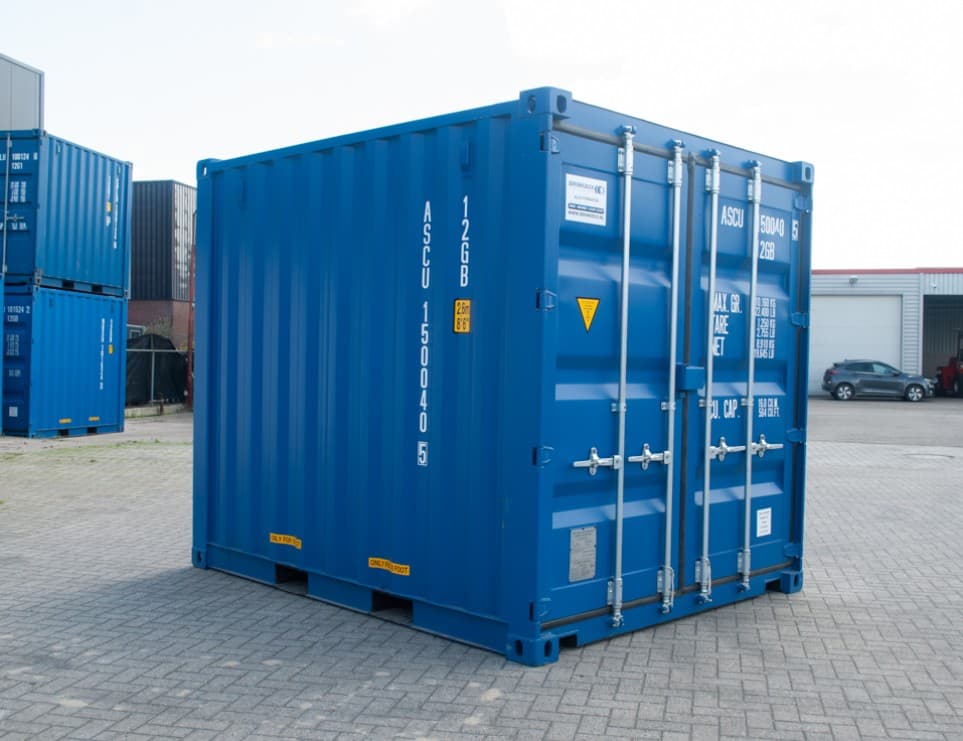
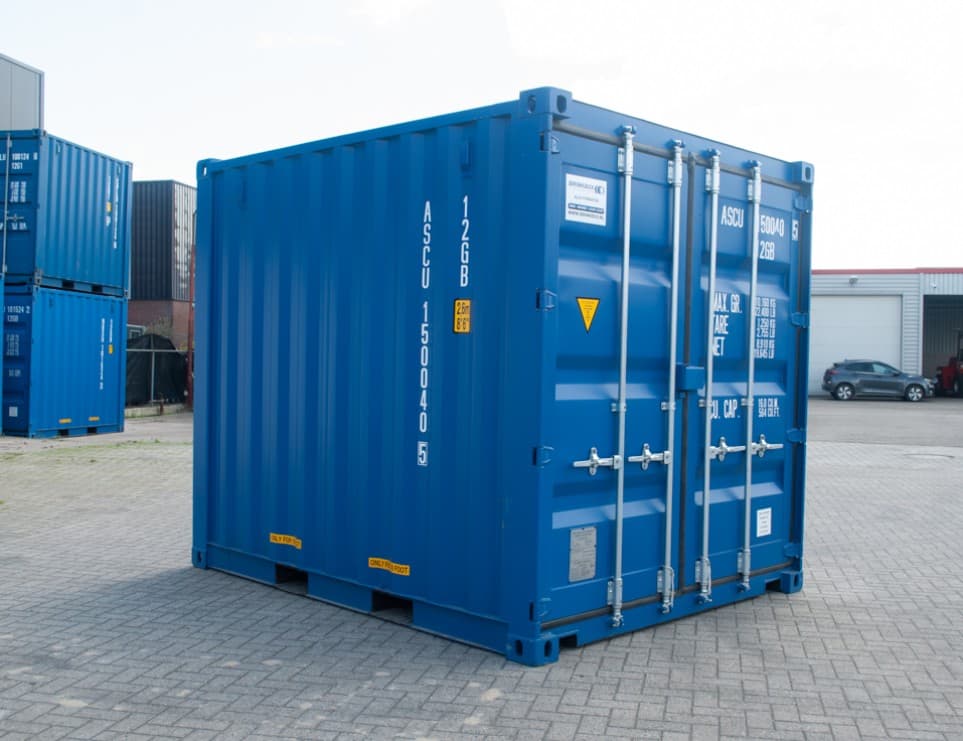
The external dimensions of a 10ft container are generally around 2,991 mm long, 2,438 mm wide and 2,591 mm high for a standard (non-high cube) model. Internal dimensions are approximately 2,830 mm long, 2,352 mm wide and 2,393 mm high, giving a usable volume of around 15.9 m³. Tare weight is around 1,300 kg, and the maximum payload is approximately 10,000 kg, depending on manufacturing tolerances and the certificates specific to each unit. These values are indicative and may vary slightly from one manufacturer to another. The maximum gross weight (MGW) is often around 10,480 kg for this type of container, but it is essential to refer to the CSC (Convention for Safe Containers) plate on the door to know the exact limits of the unit delivered.
The double rear doors are the only access to the container. They are fitted with container locking bars, the vertical and horizontal bars that hold the doors closed and provide a degree of air and water tightness. A factory Lockbox is fitted to this model: this is a welded metal box that protects the padlock or security lock, preventing any attempt at cutting or easy break-in. The Lockbox is a popular feature for storing valuable equipment on construction sites or in gardens. Note that the Lockbox does not replace a certified locking system; it complements protection by shielding the padlock attachment point.
The uses of a new 10ft container are varied. On construction sites, it serves as a storage room for tools, sensitive materials or electronic equipment. Its small size allows it to be placed in narrow yards, alleys or urban areas where a 20ft would not fit. For private individuals, it becomes a secure garden shed, a utility room, a workshop or even a base for modular fit-out (site office, changing room, sanitary facilities). For a fit-out, it is possible to insulate the walls, install a partition, an additional door or openings, subject to local building and planning rules. A new container provides a sound base for this type of conversion, as it has no perforating rust or structural deformation.
Transporting a 10ft container is relatively simple. It can be handled by a crane truck, a forklift with suitable forks or a side-loader. Its small dimensions allow it to be loaded onto a standard flatbed without excessive overhang, and it can be placed on the ground on blocks or sleepers to avoid direct contact with moisture. In France, exceptional transport is not required for a 10ft container, as its dimensions remain within standard road limits (width 2.44 m, height 2.59 m). However, the total weight (container plus load) must comply with the limits of the carrying vehicle and heavy goods vehicle regulations. It is advisable to check local parking and handling permits, especially in towns.
Maintaining a new container is limited to a few simple steps. Regular visual checks of the walls, roof and floor allow any deep scratch or early corrosion to be detected quickly. Dirt and debris should be removed from the roof to prevent water pooling. Door seals (rubber gaskets) should be checked and possibly lubricated with a suitable product (silicone) to keep them supple and watertight. Locks and hinges can be greased once or twice a year. If the container is used to store moisture-sensitive products, adding a dehumidifier or desiccant bags is recommended, as condensation can form inside when temperatures vary.
Buying a new container involves a few points to watch. First, make sure the container is genuinely new, i.e. recently manufactured and not used for sea transport. A new container may have been used for a single delivery trip from the factory, but it should not show significant signs of wear. Second, the ISO certification and CSC plate must be present and up to date. The CSC plate certifies that the container complies with the international convention for safe containers. Finally, it is advisable to check the flatness of the floor, the condition of the seals, the presence of the Lockbox and the proper operation of the locking bars. A test opening and closing of the doors ensures they do not rub and that the seals compress correctly.
French regulations govern the installation of a container on private land. In general, a container used as an ancillary storage unit does not require a building permit if it is not fixed to the ground and does not alter the external appearance of the main building. However, local planning rules (PLU) may impose restrictions, particularly in protected areas. For permanent residential or office use, planning permission is almost always required. It is therefore advisable to check with the local planning department before any installation. In addition, if the container is intended to receive the public, it must meet current fire safety and accessibility standards.
This new 10ft container is offered by D.S. Globe Conteneur, a company based in Marseille. It is sold with its original features: Corten steel, 28mm marine plywood floor, double rear doors with container locking bars, factory Lockbox and ISO certification. To find out about availability, delivery options and purchasing terms, contact the company directly. This compact and robust model meets the needs of secure storage and transport for professionals and private individuals alike, with the advantage of a small footprint and simple implementation.
To continue on preventive maintenance, it is useful to distinguish two levels of intervention. The first is routine checking, which the user can carry out themselves: visual inspection of interior and exterior walls, examination of the roof for leaves or debris that retain moisture, checking the condition of door seals and an opening test. The second level concerns heavier work, which may require professional advice: repairing a deep scratch that has exposed the metal, replacing a worn door seal, straightening a door that rubs, or treating a spot of surface rust locally. On a new container, these interventions remain exceptional in the first few years, but they determine the longevity of the whole. It is also prudent not to store moisture-sensitive products directly on the floor: using pallets, duckboards or raised shelving limits moisture rising through the floor, especially if the container is placed on poorly drained ground.
The question of ventilation deserves particular attention. A closed container exposed to the sun can experience significant temperature variations between day and night. This range encourages condensation on the metal walls, especially when the internal air is humid. To limit this, several solutions exist: installing low and high ventilation grilles, adding a moisture absorber, or insulating the walls and ceiling if the container is intended for regular use. These modifications are not mandatory, but they significantly improve storage comfort and the preservation of goods. Note that drilling the structure to install ventilation must be done carefully, treating the edges of the openings against corrosion, so as not to create weak points in the envelope.
In terms of transport and handling, a 10ft container has standardised lifting corners, called corner castings, located at the eight angles. These solid steel pieces are designed to receive the twist-locks of crane spreaders or truck slings. Their presence allows safe, standardised handling without risk of deforming the structure. When a container is set on the ground, it is recommended to place it on rigid, stable supports, such as hardwood sleepers or concrete blocks, to avoid any direct contact with soil or grass. This simple step limits corrosion of the underframe and makes subsequent lifting easier. It is also important to ensure the ground is sufficiently load-bearing: a loaded container can exert significant pressure on the ground, and soft soil can cause uneven subsidence.
Choosing a 10ft rather than a 20ft deserves comparison. The standard 20ft, more widespread, offers a volume of around 33 m³, double that of the 10ft, for a length of 6.06 m. It is often more economical per cubic metre, but it requires more space and wider access for delivery. The 10ft, with its 3 m length, fits into configurations impossible for a 20ft: town garden, inner courtyard, alley, or densely occupied site area. It also has the advantage of a lower tare weight, which simplifies lifting and reduces constraints on the transport vehicle. In return, its cost per cubic metre is generally higher, and its storage capacity remains limited. The choice therefore depends on a trade-off between accessibility, required volume and budget.
Compared with other types of container, the 10ft dry stands out for its simplicity. A reefer (refrigerated) container incorporates a refrigeration unit and reinforced insulation: it is intended for transporting perishable foodstuffs or temperature-sensitive products, and its cost, maintenance and energy consumption are much higher. An open top has a removable roof, useful for loading tall or bulky objects from above. A flat rack, without walls or roof, is used for transporting out-of-gauge loads. A high cube, finally, offers an internal height around 30 cm greater, practical for fit-outs or vertical storage. The new 10ft dry presented here corresponds to the most common use: dry storage, transport of general goods, base for light fit-out. It has no refrigeration unit or removable roof, and its height is that of a standard container.
For professionals, several sector-specific use cases stand out. In construction and public works, the 10ft container serves as a tool room, site store or mobile changing room. Its compactness allows it to be moved as the site progresses, and its strength allows intensive use. In events, it can serve as a technical control room, a storage room for sound and lighting equipment, or a temporary sales point after fit-out. In agriculture and market gardening, it becomes a storage room for seeds, tools or harvests, provided humidity is controlled. In trade and crafts, it can house a small workshop, a preparation room or a seasonal sales space. Finally, for private individuals, it meets needs for garden storage, motorbikes, DIY equipment or leisure gear, with greater security than a conventional garden shed.
A few safety principles should be recalled. A container should never be used as living space without suitable fit-out: insulation, ventilation, electricity and emergency exits must be designed by professionals. Likewise, the storage of chemicals, flammable or pressurised products must comply with specific rules and should not be done in a standard container without precautions. The load must be distributed evenly over the floor, avoiding excessive concentration on a small area. The doors should be kept closed and locked when the container is not in use, not only for the security of goods, but also to prevent the wind from slamming them and damaging the seals.
Finally, buying a new container is part of a sustainability approach. A shipping container is designed to last several decades if properly maintained. Choosing a new model avoids surprises linked to hidden wear and provides a sound base for later fit-out. It also provides a structure that has not been repainted, with a known history. For a long-term storage project, it is an investment justified by the robustness of Corten steel and the quality of the marine floor. For a temporary need, rental can be an alternative, but it involves return and duration constraints. The new 10ft container offered by D.S. Globe Conteneur is therefore aimed at those seeking a compact, secure and durable module, suitable for professional or private use, with the assurance of a product compliant with ISO standards and equipped as standard.