Description
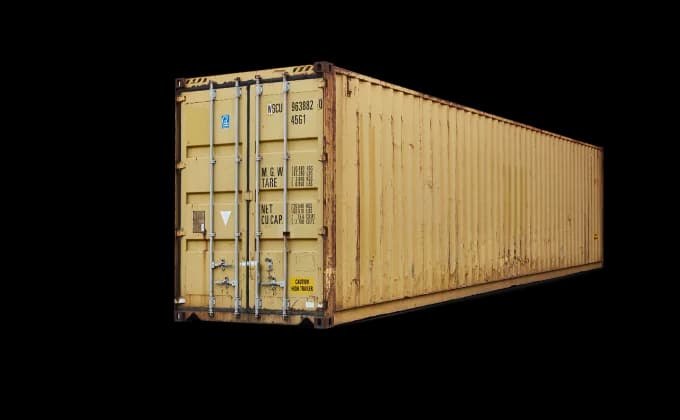
The used 10ft container is a compact, sturdy and economical storage solution, suitable for both professionals and individuals. With its reduced dimensions of around 3 metres in length, it provides secure storage space where a standard 20ft or 40ft container would be too bulky. This format is particularly popular on urban construction sites, in company yards or on residential plots where available space is limited.
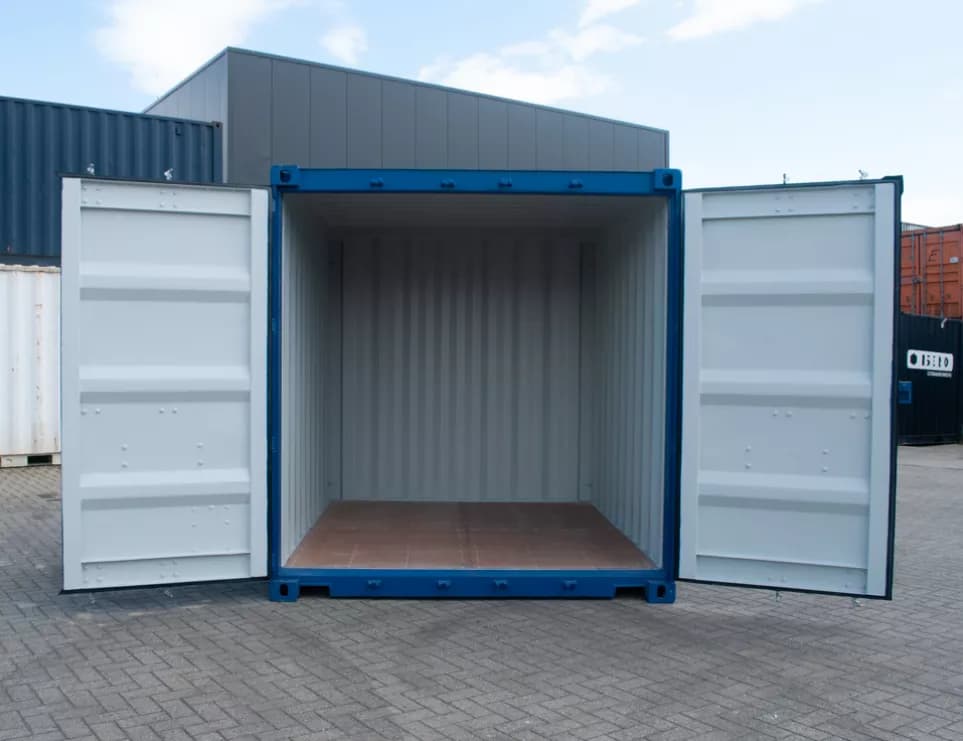
This shipping container is made of Corten steel, a low-alloy steel containing copper, chromium and nickel, recognised for its resistance to atmospheric corrosion. This feature is essential for outdoor use, as it extends the lifespan of the structure even when exposed to the weather. The floor is made of 28 mm thick marine plywood, a dense material treated to withstand moisture and heavy loads. Together, these ensure watertightness and effective protection against dust and pests, provided the seals and doors are in good condition.
This 10ft container is a used model, meaning it has already been used for sea transport or storage. Each unit is inspected before sale to check its watertightness, structural strength and proper operation. It may show superficial signs of wear (scratches, minor dents) without this affecting its use. This type of container is often sought after for its excellent value for money: it offers the robustness of a shipping container for a cost well below that of a new one.
In terms of dimensions, this 10ft container measures approximately 299 cm long, 243 cm wide and 259 cm high. These measurements correspond to the external dimensions standardised by ISO 668 for series 1, 10ft category containers. The useful internal volume is around 14.5 m³, allowing you to store, for example, construction equipment, tools, archives, palletised goods or personal belongings. The internal height is generally around 2.39 m, and the internal width around 2.35 m, so European pallets (120 x 80 cm) fit through without difficulty. The tare weight is approximately 1,300 kg, making it a relatively light container that can be handled by a forklift with suitable forks or a mobile crane.
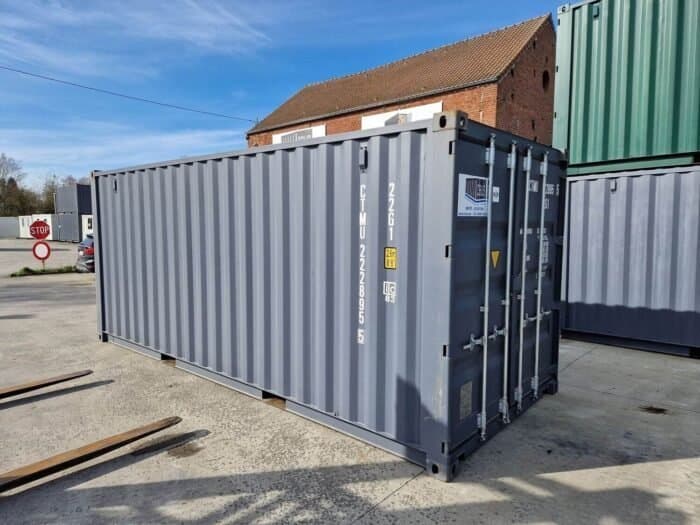
The container structure is based on a welded steel frame, with corrugated steel side walls and roof. The corner posts are drilled with corner castings compliant with ISO 1161, allowing the container to be lifted with twist-locks, secured to a chassis or stacked on another container. Stacking is possible up to several levels, but it is advisable to respect load and stability limits, especially for a used container. The double rear doors are fitted with container locking bars and rubber seals. These seals must be checked regularly: if they are cracked or missing, watertightness is no longer guaranteed.
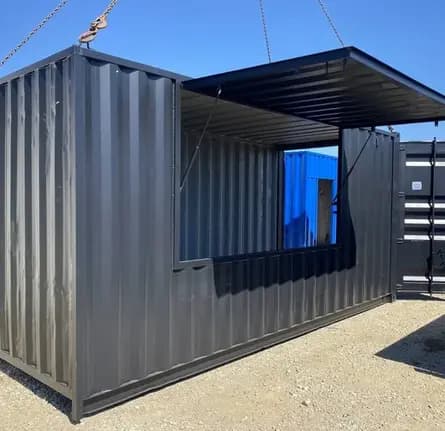
The uses of a used 10ft container are many. On construction sites, it serves as a secure store for tools, materials and sensitive equipment. Industrial or craft businesses use it as buffer storage for spare parts, consumables or finished products. Local authorities can store maintenance equipment, seasonal decorations or archives. Individuals see it as a storage solution for gardening, DIY, bicycles, furniture or keepsakes. Finally, with some fitting out, it can be converted into a technical room, site office, workshop or even a small modular dwelling, subject to local planning rules.
Before buying a used container, several points should be checked. It is advisable to visually inspect the container or request detailed photos: check for no perforating rust on the walls, roof and floor; ensure the doors open and close properly, the locks work and the seals are supple; check the condition of the plywood floor (no soft spots, delamination or holes); examine the corner posts and welds for cracks. A watertightness test can be carried out by spraying water on the roof and doors, or by using a light test (looking for daylight). Finally, it is important to ask whether the container has been treated against rust or repainted, and whether any repairs have been carried out.
Maintenance of a used shipping container is simple but regular. It is recommended to clean the surface with clean water and mild soap once or twice a year, remove plant debris and soil accumulated on the roof, and touch up any scratches with an anti-rust paint suitable for steel. Door seals can be maintained with a silicone-based product to prevent them drying out. If the container is stored on soft ground, it is best to place it on wooden beams or concrete blocks to prevent it sinking and moisture rising through the floor. Internal ventilation can be added if the container is used to store materials sensitive to condensation.
Transporting a 10ft container in France is subject to a few rules. Due to its dimensions (around 3 m long), it can be loaded onto a container truck or a flatbed truck. The total weight (container + load) must not exceed the vehicle's legal gross vehicle weight (GVW) limits, i.e. 3.5 tonnes for a light commercial vehicle, 19 tonnes for a two-axle truck, etc. Exceptional transport is generally not necessary for an empty 10ft container, as its dimensions remain within standard gauges. However, if the container is loaded, the payload must be checked and the masses distributed correctly. For lifting, a forklift of sufficient capacity (at least 2.5 tonnes) or a mobile crane is required. It is also possible to hire a truck with a lifting arm (crane truck) for delivery and unloading.
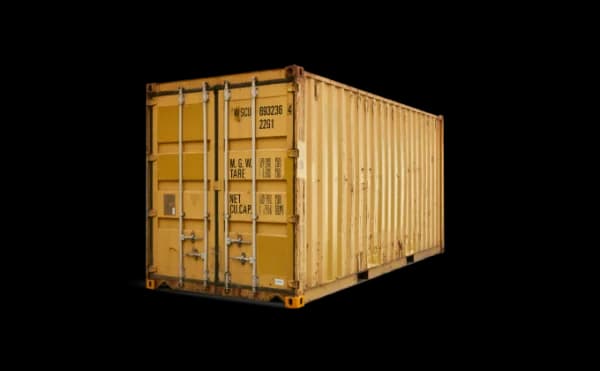
Buying a used container involves checking compliance with ISO 668 for dimensions and ISO 1496-1 for technical specifications and testing. CSC (Convention for Safe Containers) marking is mandatory for containers used in international sea transport; however, for static storage use, this marking is not required, but it attests to the container's initial conformity. The CSC plate indicates the maximum gross weight (MGW), tare and payload. This information is useful for knowing load limits. In France, installing a container on private land may require planning permission if it is considered a construction (depending on surface area, height and duration). It is advisable to check with the local town hall before any permanent installation.
This used 10ft container is offered at the price of €1,890.00. This price positions it as an economical alternative to new containers, while offering verified quality. For more information or to order, you can contact D.S. Globe Conteneur in Marseille. The team can advise you on the model suited to your needs, delivery options and available accessories (padlocks, ventilation grilles, lighting, etc.).
To go further, it is useful to compare the 10ft container with other formats commonly available on the used market. The 20ft container (around 6.06 m long, 2.44 m wide, 2.59 m high) offers a volume of around 33 m³, more than double. It is more widespread, so often easier to resell, but it requires more ground space and larger lifting equipment. The 40ft container (around 12.19 m long) offers around 67 m³, but it is difficult to manoeuvre in a confined space and its transport costs more. The 40ft High Cube container (2.89 m high) adds around 9 m³ of volume, useful for bulky but light loads. The 10ft container stands out for its compactness: it can be placed in a yard, garden, alley or small car park, and it can be moved with a standard forklift. It is also easier to integrate into a built environment without special permission, as its ground area (around 7.3 m²) remains modest.
Compared to 8ft (around 2.44 m long) or 6ft containers, the 10ft offers a better compromise between footprint and useful volume. Models under 10ft are often specialised containers (for example for air transport or military uses) and are less available on the used market. The 10ft is a standard series 1 ISO format, which guarantees compatibility with handling equipment and spare parts (seals, locks, handles).
In terms of container types, the model offered is a "dry" (or "standard") container, i.e. a dry container, not refrigerated, with no side opening or opening roof. Other types exist: the "reefer" container (refrigerated) is fitted with a refrigeration unit and insulated walls, used for transporting perishable goods; it is heavier, more expensive and requires a power supply. The "open top" container has a removable or tarpaulin roof, allowing tall objects to be loaded from above. The "flat rack" container has no side walls or roof, only a platform and folding end walls, for out-of-gauge loads. The "high cube" container is simply around 30 cm taller. For general storage use, the dry 10ft remains the most versatile and economical.
It is also important to distinguish the shipping container from the so-called "new" or "one-trip" storage container. A one-trip container has made a single voyage and is often offered at a price close to new. A used container like this one has already been in service for several years, but it has been inspected. The choice depends on use: for long-term storage exposed to the weather, a well-maintained used container is more than sufficient; for conversion into an office or dwelling, a one-trip or new container may be preferred for aesthetic reasons and maximum watertightness.
Sector-specific use cases are numerous. In construction, the 10ft container serves as a tool store, site changing room or materials depot. In agriculture, it can store seeds, fertilisers or small equipment. In retail, it becomes a storage reserve for unsold stock or decorations. In events, it can be used as a technical room for sound and lighting. In the maritime and port sector, it can serve as a ship's store or maintenance room. For individuals, it advantageously replaces a wooden or resin garden shed, with a much longer lifespan and increased security against theft.
Another important point concerns security. A shipping container is difficult to break into: the steel walls and multi-lock doors act as a deterrent. However, it is recommended to add a high-security padlock (disc padlock or armoured padlock) and, if necessary, an alarm or video surveillance system. For professional use, it is possible to install internal lighting, a power socket or ventilation. These fittings must be carried out in compliance with electrical safety rules (NF C 15-100 for low-voltage installations).
Thermal insulation is another aspect to consider. An uninsulated steel container undergoes significant temperature variations: it can be very hot in summer and cold in winter. For storing sensitive materials, internal insulation can be added (mineral wool panels, polyurethane foam) and a finishing lining. This reduces condensation and protects goods. For occasional use, simple ventilation through air grilles may be enough to limit humidity.
Condensation is indeed one of the main enemies of a metal container. It forms when warm, humid air inside cools on contact with cold walls. To limit it, you can use dehumidifiers (sachets or electric), avoid storing damp objects, and ventilate regularly. A well watertight container can paradoxically retain humidity; a balance must therefore be found between watertightness and ventilation.
Finally, it is useful to recall the obligations related to renting or selling containers in France. The sale of a used container between professionals and individuals is subject to the general rules of the consumer code (pre-contractual information, legal guarantee of conformity for hidden defects, etc.). For a used container, the legal guarantee of conformity applies for 2 years from delivery for hidden defects, but it does not cover normal wear. It is therefore advisable to request a detailed invoice and, if possible, an inspection certificate. D.S. Globe Conteneur, based in Marseille, can provide these documents and assist the buyer with the formalities.
This used 10ft container therefore represents a balanced solution for anyone looking for secure, mobile and durable storage space, without investing in a permanent structure. Its affordable price, compatibility with standard handling equipment and ease of maintenance make it a relevant choice for many professional and personal uses.