Description
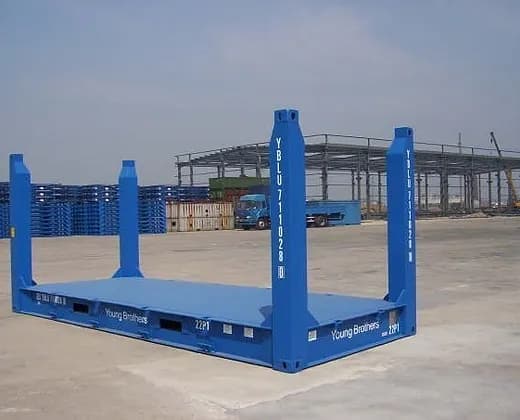
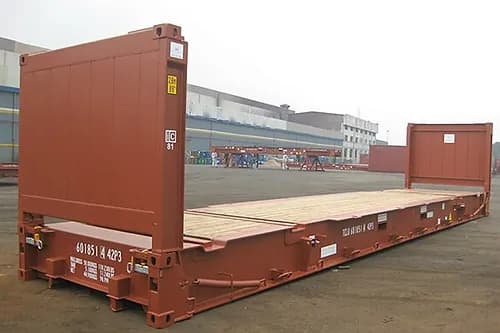
The new 20ft Flat Rack container is a transport and storage solution designed for cargo that exceeds the internal dimensions of a standard dry container. Unlike a closed container, the Flat Rack has no side walls or roof: it is a reinforced platform equipped with collapsible end walls. This configuration allows loading of wide, tall or irregularly shaped goods that could not be inserted into a conventional container. This model is particularly suited to sea, rail and road transport, as well as temporary storage on industrial sites.
To understand the purpose of this type of container, we must look at its structure. The 20ft Flat Rack complies with the standard external dimensions of a 20ft ISO container, approximately 6.06 m long and 2.44 m wide. Its height varies with the wall configuration: collapsed, it is reduced (around 0.65 m), which facilitates stacking and empty transport; deployed, it reaches about 2.23 m, providing vertical retention at the ends. This modularity allows the container to be adapted to the nature of the cargo. The floor, made of reinforced hardwood or anti-slip steel depending on the model, is designed to withstand concentrated loads and the passage of handling equipment. The structure is made of Corten steel, a low-alloy steel that resists atmospheric corrosion and impacts, extending the container's service life in marine or industrial environments.
The collapsible end walls are a key element. They can be lowered to facilitate loading from above or from the sides, then raised to hold the goods in place. Integrated lashing rings are distributed on the platform and on the walls, allowing the use of straps, chains or tensioners to secure the load. These anchor points are essential to comply with stowage and lashing rules in sea transport, where ship movements can be significant. The container is also stackable, optimizing space in container yards or on ships, provided load limits and manufacturer's instructions are respected.
Compliance with international standards is a guarantee of safety and interoperability. The 20ft Flat Rack meets ISO 668, which sets the dimensions and tolerances of series 1 containers, ensuring compatibility with global handling and securing systems. The ISO 1161 corners, located at the four angles, allow handling by crane, reachstacker, forklift or spreader, as well as locking onto wagons, trailers and ships. CSC certification (Convention for Safe Containers) attests that the container has been tested and approved for international transport. Finally, ISO 6346 marking ensures unique identification and traceability throughout the logistics chain.
What are the concrete uses of this container? The 20ft Flat Rack is commonly used to transport machine tools, generators, transformers, metal coils, large-diameter piping, structural components, light vehicles or moderate-sized construction equipment. In the oil and gas industry, it is used to move heavy equipment to offshore platforms or remote sites. In construction, it allows moving prefabricated elements, scaffolding or formwork. For storage, it provides a platform accessible from all sides, convenient for loading and unloading bulky pallets or long parts. Finally, it can be used as a base for modular fit-out (workshop, outdoor workstation), although this use is less common than for a dry container.
Before buying a new Flat Rack container, several points should be checked. First, verify the maximum payload and the allowable floor load, as these values vary by model and manufacturer. Payload can reach around 34,000 kg for some models, but depends on the container's tare weight (about 2,500 to 3,000 kg) and structural limits. It is also important to check the condition of the collapsible walls, hinges and locking systems: a seized or damaged mechanism can compromise safety. Lashing rings must be solid and free of corrosion. Floor flatness is another criterion: a bowed or sagging floor can make loading unstable. Finally, the presence of CSC plates and ISO markings must be confirmed, as they determine acceptance of the container by carriers and port authorities.
Maintenance of a new Flat Rack aims to preserve its performance over time. Regular cleaning with fresh water and mild detergent removes salt deposits, especially near the sea. Friction areas (hinges, locks, corners) can be lubricated with suitable grease to prevent seizing. Any deep scratch on the Corten steel should be treated with anti-rust paint to prevent corrosion spread. The wooden floor should be inspected for splinters, mould or sagging; plank replacement may be necessary. Lashing rings must be checked before each use to ensure they have no cracks or deformation. Annual maintenance by a professional is recommended for containers subject to intensive use.
From a regulatory standpoint, transporting a Flat Rack container in France and internationally is governed by rules. CSC certification is mandatory for any container used in international sea transport; it must be renewed periodically according to International Maritime Organization (IMO) rules. ISO 6346 marking must be legible and up to date. For road transport, the container must be properly secured on a container chassis, with twist-locks in good condition. The authorized gross vehicle weight and axle load must be respected, which may require a special permit for abnormal loads if the cargo exceeds regulatory limits. Finally, transporting dangerous goods (flammable, corrosive materials, etc.) imposes additional rules for stowage, labelling and documentation.
Compared to a dry container, the Flat Rack offers greater loading flexibility but less protection against weather and theft. It is therefore often used for loads that can be exposed or that are packed to withstand outdoor conditions. For very tall loads, an Open Top container, which has side walls and an opening roof, can also be considered. The choice between Flat Rack, Open Top and dry depends on the nature of the goods, their height, width and handling constraints.
To deepen the comparison, let's examine the differences with other container types and sizes. A 20ft dry container offers an internal volume of about 33 m³ and a door opening 2.34 m wide by 2.28 m high. It fully protects the goods but can only accommodate objects whose dimensions remain below these openings. The Flat Rack has no width or height limit above the floor, apart from stability and road gauge constraints. A 20ft Open Top container keeps the side walls and one fixed end, but its roof is removable or openable, allowing vertical loading by crane. It is suitable for tall loads but less wide than the Flat Rack. The 40ft Flat Rack, meanwhile, offers double length (about 12.19 m) for very long loads, such as long tubes or beams. The 20ft remains more manoeuvrable and less costly to transport empty, as it occupies a smaller ship slot. The choice between 20 and 40 feet therefore depends on the length of the load and transport constraints.
There are also Flat Rack variants: some models have fixed rather than collapsible end walls, offering greater rigidity but less loading flexibility. Others are equipped with steel floors, more resistant to heavy loads and impacts, but more slippery and prone to corrosion if not maintained. The new model we offer is generally configured with collapsible walls and a hardwood floor, which suits most industrial uses. However, additional accessories can be found: protective tarps, ratchet straps, wooden chocks, anti-slip mats. These accessories are not included by default and must be ordered separately according to needs.
Now let's look at more detailed sector-specific use cases. In the energy sector, the 20ft Flat Rack is used to transport transformers, electrical panels, generators and turbine parts. These items are often heavy and bulky, and require rigorous lashing to prevent any movement during transport. In manufacturing, it carries machine tools, presses, moulds and large parts. Construction companies use it to move steel beams, structural elements, prefabricated stairs and façade modules. The agricultural sector uses it to transport tractors, trailers or agricultural machinery parts. Finally, in storage, it serves as a support platform for pallets of heavy materials, drums or flexible containers (big bags) that must remain accessible.
Another important aspect is handling. The 20ft Flat Rack can be lifted from above using a spreader or from below with a forklift, provided the forks are correctly engaged in the designated pockets. It can also be moved by a reachstacker, which grips it by the ISO corners. During loading, it is recommended to use ramps or levelling platforms to roll or slide the goods onto the floor. Once the load is in place, lashing must be done with crossed straps or chains, taking care not to exceed the capacity of the rings. Chocks can be placed under rolling loads to prevent movement. In sea transport, it is common to use lashings (ropes or cables) to secure the load to the container, and sometimes dunnage (stowage materials) to fill gaps.
Routine maintenance is not limited to cleaning. The condition of welds must also be checked periodically, especially at the corners and floor supports. A cracked weld can compromise structural integrity and must be repaired by a qualified welder. Collapsible walls must be operated with care: forcing a seized mechanism can bend the hinges. Regular greasing of pins and locks is therefore advisable. The wooden floor can be treated with a fungicide and insecticide to prevent mould and insect attack, especially in humid climates. If the container is stored outdoors, it is best to place it on chocks to avoid direct contact with the ground and moisture accumulation under the floor. A tarp can be used to protect the load, but it must be properly tensioned to avoid water pockets.
Under French regulations, in addition to CSC, road safety rules must be considered. Transporting a container on a container chassis is considered goods transport; the driver must hold an appropriate licence and the vehicle must comply with weight and dimension limits. For abnormal loads, a movement permit is required, issued by the prefecture. Abnormal convoys may be subject to traffic restrictions (hours, routes). In addition, transporting certain goods (dangerous materials, waste) is subject to specific regulations (ADR for road transport, IMDG for sea). It is therefore essential to check with the competent authorities before any transport.
Finally, environmental aspects should be mentioned. Corten steel is 100% recyclable at end of life, making it a relatively sustainable material. The floor wood, if treated, must be disposed of through appropriate channels. A well-maintained container can last several decades, limiting replacement and therefore carbon footprint. For companies concerned about their environmental impact, buying a new container may be preferable to buying a used one, as it offers better energy efficiency during transport (less dead weight, better aerodynamics) and avoids frequent repairs.
In summary, the new 20ft Flat Rack container is a versatile tool for professionals who need to transport or store out-of-gauge loads. Its robust design, compliance with international standards and modularity make it a reliable solution, provided safety and maintenance rules are followed. Before purchase, it is advisable to precisely define the type of load, maximum dimensions, weight and transport conditions, then verify that the chosen model meets these requirements. A specialised supplier can assist the buyer in choosing accessories (straps, tarps, chocks) and in certification procedures.