Description
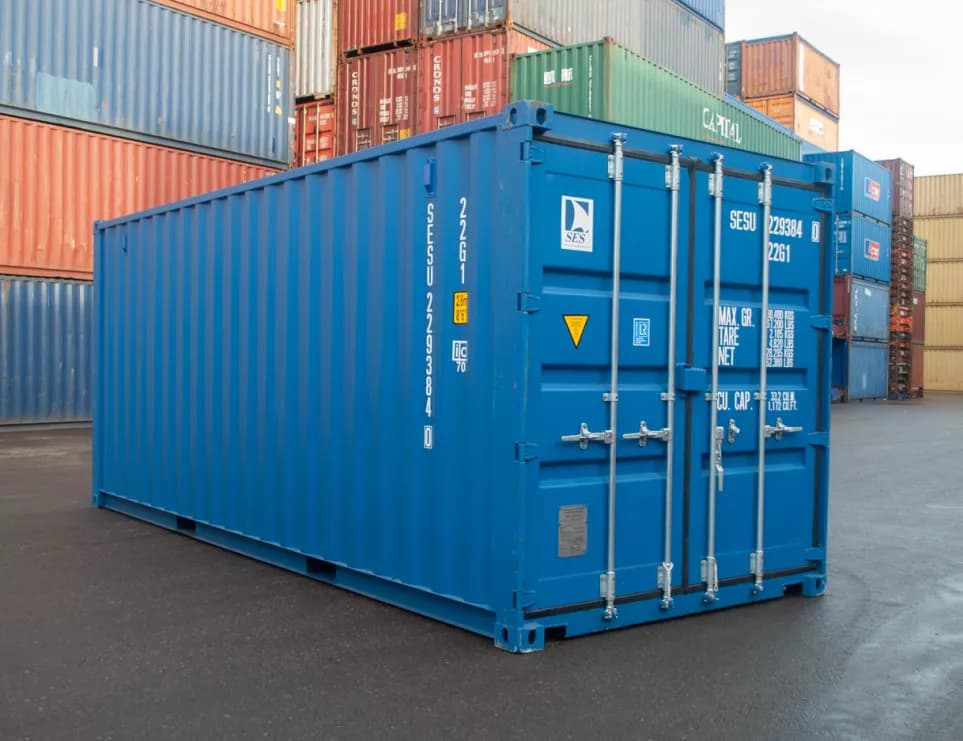
The used 20ft shipping container is a smart choice for businesses, tradespeople and individuals looking for a reliable storage or transport solution without the cost of a new container. Also known as an EVP (Equivalent Vingt Pieds) or TEU (Twenty-foot Equivalent Unit), this type of container is the standard unit of global maritime transport. Its standardised design means it can be handled, stacked and transported with the standard equipment used by ports and carriers.
Technically, a standard 20ft container complies with the dimensions set out in ISO 668 and ISO 1496. Its external dimensions are approximately 6.05 m long, 2.43 m wide and 2.59 m high. These measurements may vary slightly depending on the manufacturer and year of production, but they remain within the accepted tolerances to guarantee interchangeability. The empty weight, known as tare, is generally around 2,000 kg for a standard steel container. The maximum payload is often between 28,000 and 30,000 kg, but it depends on the exact tare weight and the limitations of each individual unit. It is essential to refer to the CSC (Convention for Safe Containers) plate on the door to find the precise tare, payload and maximum gross mass values.
The structure of a 20ft container is designed to withstand significant stresses. The side walls and corner posts are made of Corten steel, a low-alloy steel that offers better corrosion resistance than ordinary steel. This material, sometimes called weathering steel, develops a protective oxide layer on its surface when exposed to the weather, which slows the progress of rust. The floor is generally made of 28 mm thick marine plywood, treated to resist moisture and heavy loads. The double rear doors are fitted with container locking bars and rubber seals that protect against water and dust ingress. These doors open across the full internal width and height, making it easier to load and unload bulky goods.
The interior of a 20ft container offers a volume of around 33 m³. Typical internal dimensions are approximately 5.90 m long, 2.35 m wide and 2.39 m high. These values may vary by a few centimetres depending on the model. This volume allows you to store a large quantity of goods, equipment or materials. As a guide, a 20ft container can hold around 10 Euro pallets (800 x 1200 mm) on a single level, or 11 pallets if loaded widthways. It can also accommodate 9 or 10 US pallets (1000 x 1200 mm) depending on how they are arranged. This capacity makes it a versatile storage space suitable for many uses.
A used container has already been used for maritime transport or storage. Its condition can vary considerably from one unit to another. There are generally several categories: so-called "one-trip" or "nearly new" containers, which have made only one voyage and are in excellent condition; "good" or "standard" containers, which show normal signs of wear (scratches, small dents, surface rust) but remain perfectly functional and weatherproof; and "for repair" or "out of spec" containers, which may have more significant structural damage. The used 20ft container offered here is described as being in good condition, inspected and ready to use. It has been cleaned and checked to ensure it is watertight and solid. It retains its ISO certification, confirming its compliance with international standards. It is important to note that even a used container in good condition may show cosmetic signs of wear, such as scratches, small dents or areas of surface rust. These defects do not affect its functionality or structural strength in any way.
Buying a used container has several advantages. The first is economic: the price of a used container is generally lower than that of a new one, allowing substantial savings, especially for non-intensive or temporary use. The second is immediate availability: used containers are often in stock and can be delivered quickly, unlike new containers which may require a manufacturing or import lead time. The third is robustness: even second-hand, a shipping container remains a product designed to withstand extreme conditions. It offers excellent protection against bad weather, rodents and theft, provided it is properly locked.
The uses of a used 20ft container are varied. For storage, it can hold goods, building materials, tools, equipment, archives, etc. It can be placed on private land, a car park, an industrial estate or a building site. For businesses, it provides a buffer or seasonal storage solution. For individuals, it offers a secure space for furniture, vehicles (motorcycles, quad bikes, small equipment) or bulky items. For transport, it can be used to ship goods by sea, rail or road, provided loading and securing rules are followed. It can also serve as a base for conversions: site office, technical room, workshop, changing room, break room, etc. These conversions often require insulation, electrical and ventilation work, but they are common and achievable. The container can also be integrated into modular housing or sustainable construction projects, although this requires specific preparation.
Before buying a used container, several points should be checked. It is advisable to check the general condition: presence of perforating rust, holes, cracks in the structure, major deformation of the corner posts or cross members. Watertightness should be checked: door seals should be supple and free of tears, the floor should not have rotten or sagging areas, and the walls should not let light through. The CSC plate should be legible and valid; it confirms that the container has been inspected and deemed fit for circulation. The container identification number (owner code, serial number, check digit) should be verified and match the documents provided. Finally, it is advisable to ask for recent photos and, if possible, to visit the container before purchase. A reputable professional will provide all the necessary information and can advise on the actual condition of the unit.
Maintaining a used container is simple but should be regular. It is advisable to periodically clean the walls and roof to remove debris, leaves and dust, to prevent moisture build-up. Door seals should be checked and possibly treated with a rubber care product. Areas of surface rust can be brushed and repainted with an anti-rust paint suitable for metal surfaces. The marine plywood floor can be cleaned with water and mild soap; abrasive or overly wet products are not recommended. If the container is used to store moisture-sensitive products, it is advisable to install a dehumidifier or moisture absorbers, as condensation can form inside due to temperature variations. Adequate ventilation can also be added.
Transporting a 20ft container in France is subject to certain rules. A standard 20ft container is 6.05 m long, 2.43 m wide and 2.59 m high. These dimensions exceed the limits allowed for road transport without special authorisation, particularly regarding width (2.55 m maximum for refrigerated vehicles, 2.50 m for others) and height (4 m maximum). Transporting a container therefore requires a container truck fitted with a suitable chassis, and may require an abnormal load permit if the dimensions or weight exceed the regulatory thresholds. The maximum authorised gross train weight (PTRA) and the truck's payload must be taken into account. It is advisable to use a specialist carrier, who understands these constraints and has the right equipment (crane, forklift, etc.) for delivery and positioning. Delivery can be arranged by appointment, and the container can be placed on the ground or on blocks to avoid direct contact with the ground and limit corrosion.
The used 20ft container can be delivered to mainland France, as well as to some neighbouring countries such as Belgium, Germany, Spain or Luxembourg, depending on the information provided. It is advisable to check delivery conditions, lead times and any costs with the seller. A personalised quote can be requested to find out the exact price based on the delivery address and the options chosen.
In summary, the used 20ft container is an economical, robust and versatile solution for storage, transport or conversion. It retains the technical characteristics of standard shipping containers while offering a reduced purchase cost. Its purchase should be accompanied by a careful check of its condition and regular maintenance to extend its lifespan. With appropriate use, it can provide many years of service.
To go further, it is useful to compare the 20ft container with other commonly available formats. The standard 40ft container offers an internal volume of around 67 m³, double that of the 20ft, with an external length of around 12.19 m. It is better suited to large volumes and house moves, but it is heavier (tare of around 3,750 kg) and requires a longer truck, with greater manoeuvring constraints. The 40ft High Cube (HC) container adds around 30 cm of internal height, which is useful for storing bulky goods or for converting into an office or technical room. The 10ft container, being more compact, is practical for small spaces, but it is less common and often more expensive per cubic metre. The 20ft High Cube container also exists; it offers an internal height of around 2.69 m, useful for certain conversions, but it is less common than the 40ft HC. Finally, there are specialised containers: open top, flat rack, reefer (refrigerated), tank. These models meet specific needs and are generally more expensive. For everyday dry storage or transport, the standard 20ft remains the best compromise between capacity, footprint and price.
In logistics, the 20ft container is often used to transport palletised goods, machinery, building materials, packaged chemicals, etc. It can be stacked up to nine high on a container ship, and up to five or six high in a terminal, which optimises space. On the ground, it can be stacked two or three high if safety conditions allow, but this requires precautions (checking ground strength, using slings and twist-locks). For static use, stacking is not recommended without a suitable structure.
Many industries frequently use used 20ft containers. Construction uses them as welfare units, site stores, workshops, changing rooms or toilets. Farmers store seeds, fertiliser, fodder or small equipment in them. Retailers and tradespeople store stock, tools and spare parts. Logistics companies use them for temporary storage or cross-docking. Local authorities may use them to store municipal equipment, road salt or compost. Associations find them a low-cost storage space. Finally, individuals use them for self-storage, DIY, gardening or protecting vehicles. In all these cases, the used 20ft container offers a long-lasting and secure solution.
A few safety rules should be remembered. A container must not be overloaded: respect the payload shown on the CSC plate. The load must be distributed evenly over the floor, without exceeding the floor strength (around 4.5 t/m² for a 28 mm marine plywood floor). Heavy, concentrated loads should be placed on bearers or spreader plates. Doors must be properly locked before any transport. When lifting, use the four corner castings provided for this purpose, with suitable slings. Never lift a container by its walls or roof. For use in windy areas, it is advisable to anchor the container to the ground, especially if it is empty, as it can be overturned by violent gusts. These precautions are simple and ensure safe use.
Finally, buying a used container can be an opportunity to get good value for money. It is advisable to compare several offers, check the container's origin, year of manufacture and usage history. A container that has served on intensive shipping routes may be more worn than one used for land storage. "One-trip" containers are often offered at prices close to new, but they offer almost flawless quality. For a tight budget, a container in good used condition remains an excellent choice. In all cases, choose a specialist seller who can provide accurate information and a reliable delivery service. The used 20ft container is a durable investment that can serve for many years, provided it is chosen carefully and maintained regularly.