Description
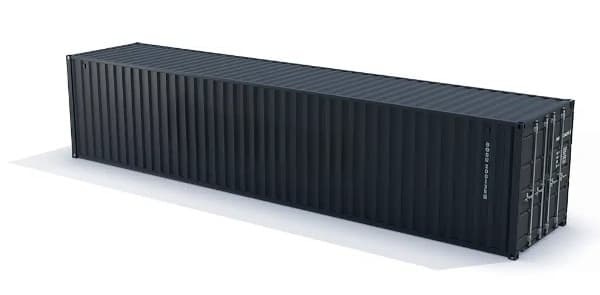
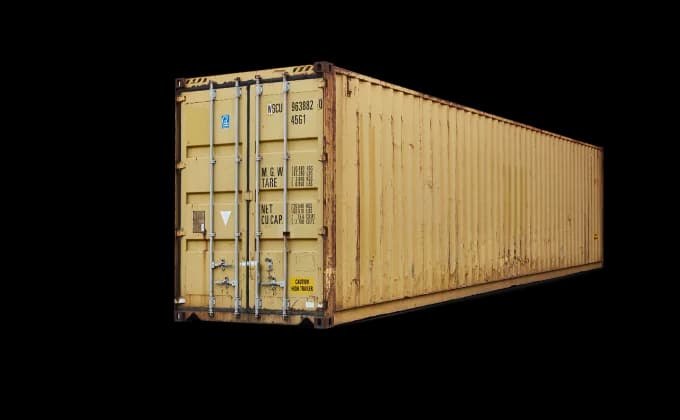
The 40ft dry shipping container is a standard transport and storage container, designed to protect dry goods over long distances and in varied conditions. Its fully enclosed design, Corten steel structure and marine plywood floor make it a robust solution for storage, logistics and many professional uses. This model is offered for sale by D.S. Globe Conteneur in Marseille.
Dimensions and usable volume. A 40ft dry container complies with the standard external dimensions of ISO series 1: approximately 12.19 m long, 2.44 m wide and 2.59 m high. These are the dimensions provided for this product and correspond to the standard 40ft format. Inside, the loading volume is around 67 m³, allowing you to organise the storage of pallets, boxes, equipment or various goods. The internal usable width is generally close to 2.35 m and the internal height around 2.39 m for a standard dry container, leaving comfortable room for handling and stacking. The 28 mm marine plywood floor supports rolling or point loads common in logistics use, provided the unit's load limits are respected.
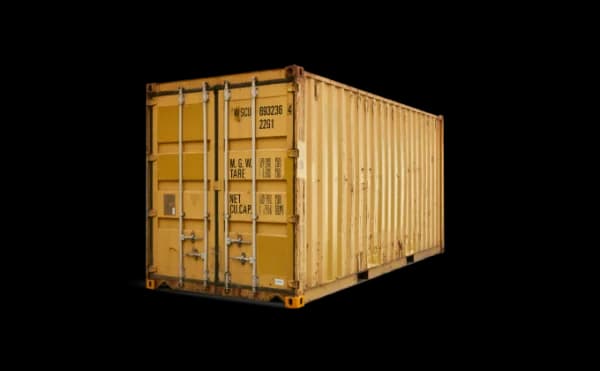
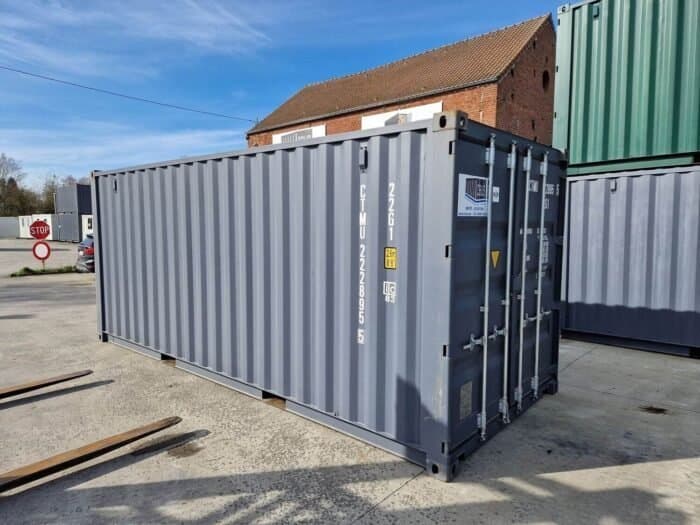
Materials and construction. The structure is made of Corten steel, a low-alloy steel that resists atmospheric corrosion better than ordinary steel. The side walls and roof are made of corrugated sheets, which provide rigidity and contribute to watertightness. The corner posts and cross members are reinforced to allow stacking and handling by the corners. The marine plywood floor is fixed to metal cross members and treated to withstand residual moisture and mechanical stress. The double rear doors are fitted with container locks, with vertical locking bars and handles, and open across the full width to facilitate loading. Peripheral seals limit water and dust ingress.
Compliance and standardisation. This container is stated to comply with the ISO standards applicable to series 1 shipping containers, in particular ISO 668 for dimensions and masses, and ISO 1496-1 for the technical specifications and testing of dry freight containers. These standards govern dimensions, corner fittings, stacking resistance, watertightness tests and permissible loads. The ISO mention means the unit is designed to be handled with standard equipment (spreader, forklifts, lifting clamps) and to be stacked under the same conditions as other containers in the fleet. For professional use, it is recommended to check the CSC (Convention for Safe Containers) plate and the date of the last periodic inspection, which certify compliance with international safety regulations.
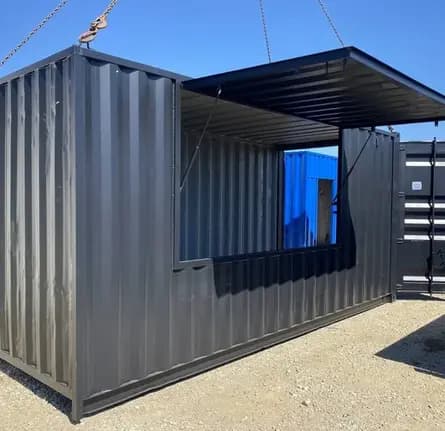
Common uses. The 40ft dry container is used in many contexts. In logistics and transport, it is used for sea, rail and road freight for dry, non-refrigerated goods: pallets, boxes, spare parts, materials, equipment. For storage, it provides an enclosed reserve for companies, craftsmen, farmers or individuals who need a large volume and protection from rain, wind and dust. For conversion, it can be transformed into a site office, technical room, changing room, workshop, sales space or housing module, subject to the applicable planning and construction rules. Its 40ft length offers a generous floor area for these projects, with an internal width of around 2.35 m allowing partitions, services and furniture to be installed.
Transport and handling. The 40ft dry container is handled by its four lifting corners, using a spreader or suitable clamps. It can be loaded onto a container truck, a railcar or a ship. In France, road transport of a 40ft container must comply with the highway code and rules on dimensions and weight. The overall length of a tractor + container semi-trailer combination may require particular attention to routes, traffic permits and local restrictions. The tare weight of a 40ft dry container is generally around 3.5 to 3.8 tonnes depending on the manufacturer; the value stated for this product is 3,470 kg. The payload then depends on the gross mass limit and the applicable transport rules. For sea transport, the maximum gross mass is often around 30,480 kg, but reference should be made to the container plate and the carrier's requirements.
Points to check when buying. Before buying a 40ft dry container, it is useful to check several points. First the general condition: presence of perforating rust, impacts on the walls, deformation of corner posts, signs of moisture inside. Then watertightness: examine the door seals, locking bars, hinges and floor. A simple test is to close the container and observe whether any light remains visible at the seals. Also check the flatness of the floor, the absence of rot or delamination of the plywood, and the strength of the fixings. The CSC plate and markings must be legible. For a new container, these points are normally checked at the factory, but an inspection on delivery is still recommended.
Maintenance and durability. A Corten steel container requires little maintenance. It is advisable to clean the walls and roof regularly to remove salt deposits, especially near the sea, and to touch up scratches with suitable paint to limit corrosion. Door seals can be cleaned and, if necessary, replaced when they harden or crack. The floor must be kept dry; in case of persistent humidity, ventilation or a moisture absorber may be useful. For outdoor use, check that the container rests on stable, drained ground and that the corners are properly supported to avoid deformation. Periodic checking of the locks and hinges helps keep the doors working properly.
Conversion and modification. The 40ft dry is a frequent base for conversion: fitting windows and doors, insulation, electricity, plumbing, interior finishes. This work must be carried out in compliance with construction, fire safety and planning rules. In some cases, planning permission is required before any conversion. It is also important not to compromise the load-bearing structure: cut-outs must be reinforced and loads properly transferred. For professional use, calling on a container conversion specialist helps ensure compliance and durability of the installation.
Regulations and usage framework in France. Buying and owning a shipping container is not subject to specific authorisation as such, but its installation and use may depend on the planning code, local regulations and safety rules. For temporary storage on private land, local rules should be checked. For use as a workplace or dwelling, additional requirements may apply. Road transport must comply with weight and dimension limits, as well as any traffic restrictions. Finally, for export or import, the usual customs formalities apply.
Choosing between 20ft, 40ft and 40ft high cube. The 40ft dry is the most common format for large volumes. The 20ft offers a smaller footprint and simpler handling, but half the volume. The 40ft high cube adds around 30 cm of internal height, which can be useful for bulky loads or conversion, but it is less common and sometimes more expensive. The choice depends on the volume to be stored, site access constraints, budget and handling options. A 40ft requires sufficient manoeuvring space for a container truck and lifting equipment.
Why choose a 40ft dry container. This format offers a good balance between available volume, robustness and standardisation. It is suitable for companies that need to store or transport large quantities of dry goods, and for those wishing to create a modular space. Its ISO compliance facilitates integration into existing logistics chains and multimodal transport. At D.S. Globe Conteneur in Marseille, this model is offered for sale, with the possibility of advising you on the choice, delivery and use of your container. For any questions about availability, condition or options, contact us directly.
Preventive maintenance and humidity management. In a dry container, the main enemy is not only rain, but also condensation. When the outside temperature varies, moisture in the air can condense on the metal walls and roof, then fall back onto the contents. To limit this, it is useful to ventilate the container when conditions allow, avoid storing damp materials and place sensitive goods on pallets rather than directly on the floor. Moisture absorbers or dehumidifiers can be used for long-term storage. Regular visual checks of the ceiling, walls and corners help quickly detect infiltration or early corrosion. The most exposed areas are the lower walls, lower corners and around the doors. Cleaning with clear water, without a high-pressure jet directed at the seals, is generally sufficient. Near the sea, more frequent rinsing helps remove salt, which accelerates corrosion.
Transport regulations in France and Europe. Transporting a 40ft container by road is governed by the highway code and European regulations on vehicle weights and dimensions. A container road train can reach a significant length and high gross vehicle weight; it must comply with authorised limits and, where applicable, be subject to specific permits. The driver must ensure the container is correctly secured to the chassis using twist-locks. Rail and inland waterway transport have their own rules, but the ISO container is designed to be compatible with these modes. For sea transport, the SOLAS convention and IMO rules govern the declaration of verified gross mass (VGM): the shipper must provide this mass before loading. In terms of safety, the CSC convention requires periodic inspections and valid safety markings. These elements are important if the container is used for international transport. For static storage use, these constraints are less direct, but the CSC plate remains a useful indicator of structural condition.
Sector-specific use cases. In construction and public works, the 40ft dry serves as a site store, tool room, changing room or temporary office. Its size allows a meeting area and a storage area to be installed. In agriculture, it houses seeds, fertilisers, small equipment or dry harvests, protected from rodents and humidity, provided ventilation is monitored. In trade and distribution, it provides an off-site reserve or order preparation space. In industry, it allows storage of parts, consumables or sensitive equipment. In the events sector, it can serve as a technical room, control room or equipment storage. For individuals, it offers a storage solution for furniture, light vehicles, leisure equipment or archives, where space allows. In all these cases, the questions of access, ground and security must be addressed beforehand.
Comparison with other container types. The dry is the most widespread and most economical type. The reefer (refrigerated) container has a refrigeration unit and insulated walls: it is intended for perishable goods and controlled temperatures, but it costs more and requires a power supply. The open top has a sliding or removable roof, useful for loading tall or heavy objects from above, but it is less watertight and less common. The flat rack has no side walls or roof: it is used for out-of-gauge loads, machinery or bulky packages, but it does not offer the protection of a dry. The high cube is a dry container about 30 cm taller, practical for bulky loads or conversion. The 20ft dry container is half the length of the 40ft, with a volume of around 33 m³; it is easier to manoeuvre and transport, but it often costs more per cubic metre. The choice therefore depends on the type of goods, frequency of use, site constraints and budget.
Site preparation and placement. Before delivering a 40ft container, a stable and accessible location must be prepared. The ground must be level, drained and able to support the weight of the unit and its contents. A compacted gravel bed, a concrete slab or blocks may be suitable depending on the case. It is important to provide manoeuvring space for the truck and lifting equipment, as well as clear access to the doors. Orientation can influence the internal temperature: facing due south, the container heats up more in summer. A slight slope or a drainage system around the location limits water stagnation. If the container is to be stacked, check the ground strength and use suitable corner pieces. Finally, think about security: a closed container can be fitted with padlocks or reinforced locks to protect its contents.
Security and protection of contents. The double rear doors with container locks are the main opening. To enhance security, it is possible to add a quality padlock, a lock protector or an additional locking system. Interior lighting, ventilation and intrusion detection can be installed as needed. It is also recommended not to store dangerous or regulated products without complying with applicable rules. Protection against rodents involves keeping the area clean, avoiding accessible foodstuffs and, if necessary, sealing gaps. A well-maintained and correctly placed container remains a safe space for many applications.
Conclusion. The 40ft dry container is a versatile, robust and standardised tool. It is suitable for transporting dry goods, storing large volumes and many conversion projects. Its ISO compliance, Corten steel structure and marine plywood floor make it a reliable base, provided it is maintained and used in compliance with the rules. D.S. Globe Conteneur in Marseille supports you in choosing and acquiring this model. Contact us for availability and terms.