Description
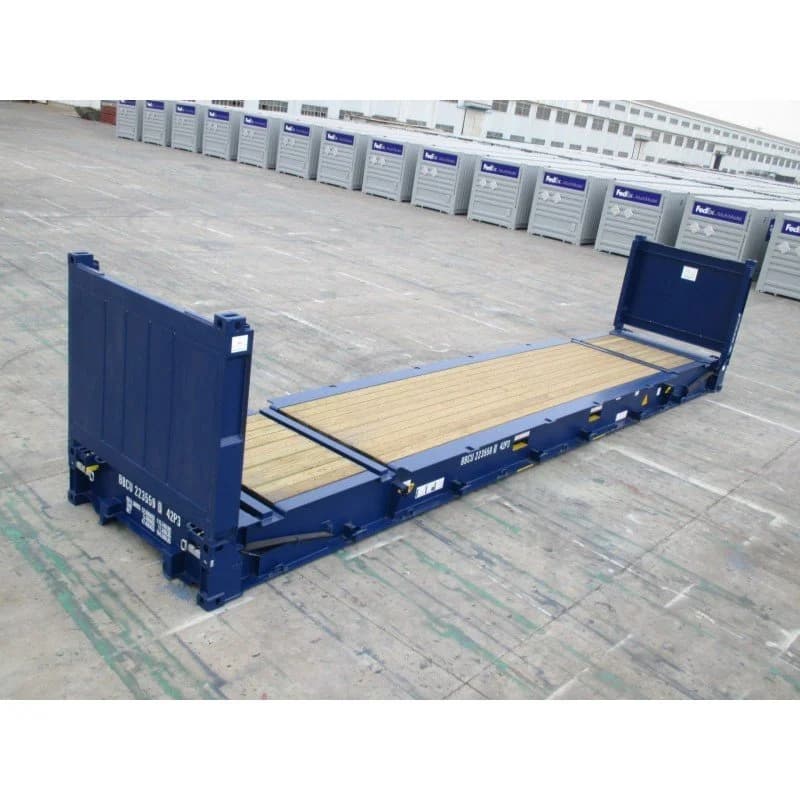
The 40ft Flat Rack container is specialized transport equipment designed for cargo that cannot be loaded into a standard dry container due to out-of-gauge dimensions. Unlike closed containers, the Flat Rack has no roof or fixed side walls: it is a robust platform, usually fitted with collapsible or removable end walls, allowing long, wide or irregularly shaped objects to be loaded. This type of container is commonly used in industry, construction, energy and machine transport. It is also popular for outdoor storage of bulky materials, as its open design facilitates loading by crane or forklift. In this article, we detail the technical specifications, practical uses, points to watch when buying, maintenance and regulatory aspects related to transport in France.
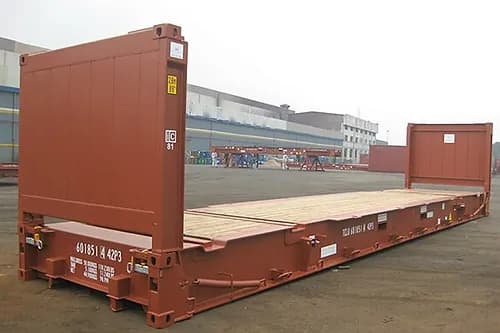
The new 40ft Flat Rack container we offer is made of Corten steel, a low-alloy steel that offers excellent resistance to atmospheric corrosion. This steel grade, also used for standard shipping containers, ensures a long service life even outdoors. The structure includes longitudinal and transverse beams that provide rigidity. The floor can be reinforced exotic wood (often apitong or keruing) or steel plate, depending on the chosen configuration. This floor is designed to support heavy and concentrated loads, which is essential for transporting machinery or metal parts. The end walls, also called side rails, are collapsible or removable. They can be fixed vertically to retain cargo, or folded down to facilitate loading and empty stacking. Lashing rings are integrated around the platform, allowing straps, chains or tensioners to secure the goods.
The external dimensions of the 40ft Flat Rack comply with ISO 668: length 12.19 m, width 2.44 m, height 2.59 m. These dimensions are identical to those of a standard 40ft container, ensuring full compatibility with ships, trains and trucks. The usable platform area is about 29 m², and it can hold up to 24 standard pallets (1.20 x 0.80 m) if loaded in a single layer. The internal length is 11.88 m, internal width 2.08 m and internal height 2.27 m when the walls are in place. These internal dimensions are indicative and may vary slightly by manufacturer. The tare weight of a 40ft Flat Rack is generally between 5,000 and 6,000 kg. The maximum payload is often around 40,000 kg, but it depends on manufacturer specifications and transport rules. It is essential to consult the CSC plate (Convention for Safe Containers) on the container for exact tare and payload values.
ISO 668 defines the dimensions and tolerances of series 1 containers, ensuring their worldwide interchangeability. The corner fittings comply with ISO 1161, allowing handling by crane spreaders, forklifts or twist-locks on trailers. The container is CSC certified, attesting to its compliance with safety requirements for international maritime transport. It also bears ISO 6346 marking, which includes an owner code, serial number, country code and check digit. These elements are essential for traceability and identification during transport operations.
The 40ft Flat Rack is particularly suited to transporting out-of-gauge goods. Examples include: industrial machinery (presses, generators, gensets), construction elements (beams, tubes, profiles), vehicles (cars, motorcycles, quads, small boats), long materials (pipes, bars, scaffolding), energy equipment (wind turbine blades, transformers), or bulky and heavy objects (stone blocks, sculptures). For storage, the Flat Rack can serve as a raised platform for materials that must be protected from ground moisture, or as a base for modular fitting (workshop, site office) after adding a light structure. However, note that the Flat Rack offers no weather protection; for outdoor storage, a tarpaulin or shelter is recommended.
When buying a new 40ft Flat Rack container, several points deserve attention. First, check compliance: the container must be CSC certified and bear a valid compliance plate. Next, examine the quality of the Corten steel: it must be free of deep rust or deformation. Welds must be regular and crack-free. The floor, whether wood or steel, must be in good condition, without broken boards or dented plates. The collapsible walls must work properly, with solid hinges and effective locking systems. Lashing rings must be securely fixed and not worn. Finally, check the presence and legibility of regulatory markings (identification number, tare, payload, date of manufacture, etc.).
A new container is generally delivered with a primer coat and finish, but may have minor scratches from transport. For intensive use, apply touch-up paint to exposed areas. Routine maintenance consists of regularly cleaning the platform, removing debris and checking paint condition. For surface corrosion, brushing and anti-rust paint are sufficient. Moving parts (hinges, latches) must be lubricated periodically. It is also advisable to check the floor and replace defective elements if necessary.
Transporting a 40ft Flat Rack container in France is subject to regulations on vehicle weights and dimensions. A 40ft container is 12.19 m long, which exceeds the maximum length allowed for a standard road train (16.50 m for a semi-trailer). However, ISO container transport is generally carried out on specialized semi-trailers whose length is adapted. The width of 2.44 m complies with the maximum authorized width (2.55 m) for refrigerated vehicles or exceptional transports. The total convoy height must not exceed 4 meters. The authorized gross combination weight (GCW) is 40 tonnes for a standard road train, but special permits may be required for exceptional convoys. It is important to consult a specialized carrier for exact conditions.
The 40ft Flat Rack can be used as a base for modular fitting. For example, it is possible to install an additional floor, partitions, a light roof, to create a covered storage space or workshop. However, these modifications must comply with safety rules and not compromise the container structure. It is also possible to use the Flat Rack as a support for a solar panel or small wind turbine, but this requires a technical study.
In summary, the new 40ft Flat Rack container is a versatile solution for transporting and storing out-of-gauge cargo. Its robust design, international standards and compatibility with existing infrastructure make it a relevant choice for professionals. Before purchase, check exact specifications with the manufacturer or seller, including payload, floor type and available options. Regular maintenance will extend its service life and ensure the safety of transported goods.
To complete this presentation, let us examine sector-specific use cases in more detail. In construction, the 40ft Flat Rack is often used to transport precast concrete elements, steel beams, roof trusses or facade modules. Its clear platform allows these parts to be placed without the constraints of a roof or side walls. Public works companies load large-diameter tubes, trench shields or road plates. In the energy industry, transformers, alternators, wind turbine mast sections or heat exchangers are transported. The automotive and marine sectors use the Flat Rack for transporting classic cars, pleasure boats (up to 12 meters) or chassis. Equipment rental companies place aerial work platforms, mini-excavators or compactors. Finally, the art and events sector can transport monumental sculptures, stage sets or scenography structures.
Now let us compare the 40ft Flat Rack with other container types and sizes. The standard 40ft dry container offers an internal volume of about 67 m³ and a payload of 28 to 30 tonnes. It is fully closed and protects goods from weather, but cannot accommodate loads exceeding its internal dimensions (about 12.03 m long, 2.35 m wide, 2.39 m high). The 40ft Flat Rack has no height or width limit (within transport gauge), making it complementary. The 40ft open top container has an opening or removable roof, allowing top loading, but retains fixed side walls. It is suitable for heavy and tall loads, but not for objects wider than 2.35 m. The 20ft flat rack container is shorter (6.06 m) and offers about 14 m²; it is more maneuverable for small out-of-gauge loads and can be transported on standard trucks without significant overhang. The 40ft high cube container has greater internal height (2.69 m instead of 2.39 m), useful for bulky but light loads. Finally, the 40ft reefer container is intended for perishable goods and has a refrigeration unit; it is not suitable for out-of-gauge loads.
The choice between a 20 and 40ft Flat Rack depends on the volume and weight of the goods. The 40ft is more economical per linear meter for long loads, but requires adapted logistics (semi-trailer truck, crane). The 20ft is more flexible for urban deliveries or sites with difficult access. There are also 40ft high cube Flat Racks, with taller walls, but they remain less common.
Let us now address specific Flat Rack maintenance. In addition to general checks, regularly inspect the condition of hinges and wall locking systems. These mechanical parts are subject to wear and corrosion. Annual greasing with a suitable grease (marine type) is recommended. Lashing rings must be inspected for deformation or cracks; a bent or worn ring must be replaced by a professional. Wooden floors can be treated with protective oil to prevent rot or warping. Steel floors must be cleared of rust and repainted. The metal structure must be cleaned with fresh water, especially after maritime transport, to remove salt. For prolonged storage, it is advisable to raise the container on blocks to avoid direct contact with the ground and to cover it with a tarpaulin.
French regulations also govern the use of containers as premises. If you convert a Flat Rack into a workspace (office, workshop), you must comply with the Labor Code for safety (emergency exits, ventilation, lighting) and possibly obtain a building permit if the installation is permanent and exceeds certain thresholds. For temporary use on a construction site, a prior declaration may be required. It is prudent to inquire at the town hall.
In maritime transport, the Flat Rack is often used for international shipments. It can be loaded on deck or under deck. Under deck, it is protected from spray but limited in height. On deck, it is exposed to weather but can accommodate taller loads. Freight rates are generally higher than for a dry container, as the Flat Rack occupies valuable space and requires specific lashing. Shipping lines sometimes charge a surcharge for out-of-gauge cargo.
For purchase, there are two options: new and used. A new Flat Rack guarantees a corrosion-free structure, intact paint and optimal service life. It is recommended for companies seeking reliable and durable equipment. A used Flat Rack can be interesting for occasional use, but carefully check the condition of the structure, walls and floor. The price of a new one is higher, but justified by quality and longevity.
In conclusion, the new 40ft Flat Rack container is an essential tool for many industries. Its open design, robustness and compliance with international standards make it a reliable solution for transporting and storing out-of-gauge cargo. Whether for a construction site, a maritime shipment or modular fitting, it offers flexibility that few other containers can match. Do not hesitate to contact us for a personalized quote and advice on the model suited to your needs.