Description
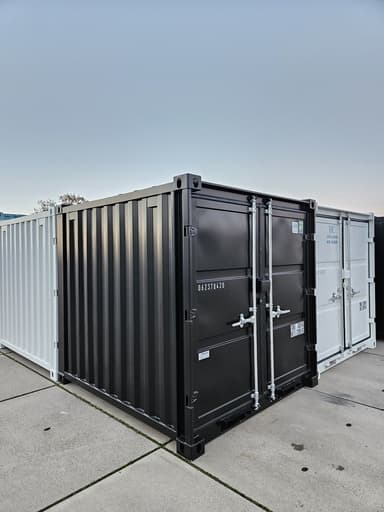
The used 8ft container we offer at D.S. Globe Conteneur is a compact, robust and economical storage solution. With a length of approximately 2.43 metres, a width of 2.20 metres and a height of 2.26 metres, it fits into small spaces while offering a useful internal volume of around 9.6 m³. This particular format, shorter than a standard 10ft container, is often used for storing tools, construction equipment, various goods or furniture. Its corten steel design and marine plywood floor make it a durable solution for both outdoor and indoor use.
Before going into technical details, it is worth recalling what a shipping container is and why this type of product remains relevant even when used. A shipping container is a standardised metal box, designed for the intermodal transport of goods. The main dimensions and characteristics are defined by international standards, notably ISO 668 and ISO 1496, which guarantee interchangeability between different modes of transport (sea, rail, road). Containers are generally made of corten steel, a low-alloy steel that resists atmospheric corrosion thanks to the formation of a protective oxide layer on the surface. This feature explains their longevity, even when exposed to the weather.
The used 8ft container we sell is a dry model, meaning without a refrigeration or mechanical ventilation system. It is intended for storing dry goods and must not be used for products requiring controlled temperature. Its structure includes corrugated steel side and front walls, a steel roof, and a 28 mm thick marine plywood floor. This floor is treated to resist moisture and repeated loads. The rear doors are double-leaf, equipped with standard container locks (vertical locking bars and handles). These doors ensure secure closure and good air and water tightness, within the normal wear limits of a used container.
The external dimensions of this container are approximately 2.43 m long, 2.20 m wide and 2.26 m high. These measurements may vary slightly from one model to another depending on the manufacturer and year of production. The internal volume is approximately 9.6 m³, which corresponds to a substantial storage space for a small footprint. The maximum payload is stated as 950 kg. This value is given as an indication and may vary depending on the actual condition of the container and load distribution. It is important not to exceed this limit for safety and structural durability reasons.
When buying a used container, several points of vigilance must be taken into account. First, the general condition of the structure: the presence of perforating rust, significant deformations or cracks on the walls or roof can compromise water tightness and solidity. A used container in good condition may show traces of surface rust, which is normal and does not affect its functionality. However, holes or areas of deep rust require repair or repainting. Second, the condition of the floor: marine plywood may be worn, stained or slightly sagging in places. A sound floor should not have soft areas or delamination. Finally, the door seals: rubber seals must be flexible and not cracked to ensure good water tightness. They can be replaced if necessary.
At D.S. Globe Conteneur, each used container is inspected before sale. We check in particular for the absence of holes in the structure, the proper functioning of the locks and the presence of seals in good condition. That said, as it is a used product, aesthetic signs of wear (scratches, small dents, surface rust) are possible and do not affect use. The container is delivered ready to use, without requiring major work. It can be used immediately for storage.
The uses of an 8ft container are varied. For building tradespeople, it constitutes a mobile and secure site unit for storing tools, materials or sensitive equipment. For farmers, it can serve as a shed for small equipment, seeds or plant protection products (subject to compliance with regulations on the storage of hazardous products). For local authorities, it can be used as a technical unit or temporary storage space. For individuals, it offers an outdoor storage solution, a reinforced garden shed or a storage space for furniture, bicycles, gardening tools. Finally, it can be fitted out as a site office, temporary sales unit or small dwelling unit, although for the latter use, insulation, electrical and plumbing work is necessary, and planning permission may be required depending on local regulations.
Maintenance of a used container is simple but regular. It is advisable to clean the walls and roof once or twice a year with clean water, possibly with a mild detergent, to remove dirt and bird droppings that can accelerate corrosion. Surface rust can be treated with a wire brush and a suitable anti-rust paint. Door seals should be checked regularly and replaced if damaged. The floor can be cleaned with a broom or vacuum cleaner, and it is recommended not to let water stagnate on it. If the container is placed on soft ground, it is preferable to raise it on blocks (concrete blocks, beams) to avoid direct contact with the ground and limit humidity. This also facilitates levelling and ventilation under the floor.
Regarding regulations, the purchase and use of a shipping container in France are subject to certain rules. If the container is used as a temporary storage unit on a construction site, it may be subject to safety obligations (stability, access, fire). If it is permanently installed on a plot of land, it may be considered a construction and require a building permit or prior declaration, depending on the surface area and duration of installation. It is recommended to check with the town hall before any permanent installation. Furthermore, transporting a container on public roads must be carried out by a professional with the necessary authorisations, as the dimensions and weight may exceed the limits of light commercial vehicles. An 8ft container, although compact, weighs several hundred kilos empty, and its transport requires a crane truck or a suitable container carrier.
The price of a used 8ft container is generally more affordable than that of a new container. At D.S. Globe Conteneur, this model is offered at €1,470.00 incl. VAT. This price may vary depending on availability, the exact condition of the container and delivery options. We invite you to contact us for delivery arrangements in your region. We are based in Marseille and can organise delivery throughout France, subject to feasibility and transport cost.
Compared to a new container, a used container has the advantage of being more economical while offering equivalent functionality for dry storage. It may show aesthetic signs of wear, but its structure remains solid if properly maintained. For intensive use or conversion into housing, a new or one-trip container (used only once) may be preferable, as it offers better water tightness and a better finish. However, for standard storage use, a used container in good condition like this one is a relevant and durable choice.
To go further in preventive maintenance, it is useful to distinguish occasional interventions from seasonal operations. In spring, a complete visual inspection helps identify areas where paint is flaking, a sign that the steel is beginning to oxidise. Local brushing followed by a coat of anti-rust paint is usually enough to stop the process. In autumn, before prolonged rains, it is wise to check water drainage on the roof: containers are designed with a slight slope and ribs that guide flow, but accumulation of leaves or debris can create stagnant puddles conducive to corrosion. Cleaning the roof with a soft brush and a moderate water jet is sufficient. Avoid overly powerful pressure washers, which could damage seals or strip paint. Regarding the floor, regular sweeping and removal of organic waste limit the risk of mould. If the container is used to store absorbent or powdery products, a protective tarpaulin on the floor extends the life of the plywood.
The regulations concerning container transport in France deserve clarification. A shipping container is considered goods and not a vehicle. Its road transport is governed by the Highway Code and rules on vehicle weights and dimensions. A loaded 8ft container can reach a total weight which, added to that of the truck, may exceed 3.5 tonnes, the threshold above which the vehicle must have a transport licence and the driver suitable training (FIMO/FCO). In addition, transporting containers often requires a truck equipped with a lifting arm or a hook container carrier, as the container cannot be loaded by hand. Using a specialised carrier is therefore recommended, or even mandatory for home deliveries. Furthermore, if the container is intended to be placed on public roads (for example for a construction site), a temporary occupation permit for the public domain must be requested from the town hall. Finally, sea or rail transport of containers is subject to IMO (International Maritime Organization) rules and international conventions, but these aspects mainly concern transport professionals.
As for sector-specific use cases, the used 8ft container finds its place in many contexts. In the construction sector, it serves as a secure tool store on urban sites where space is limited. Its reduced size allows it to be positioned in yards, dead ends or parking areas without excessively encroaching on the roadway. Landscaping companies use it to store small equipment, plants or treatment products. In events, it can serve as a technical unit for generators, sound or lighting, or as a temporary changing room. Associations and sports clubs store equipment, balls, jerseys or maintenance materials there. Farmers store seeds, fertilisers (in compliance with chemical storage rules) or small tools there. Individuals use it as a garden shed, DIY workshop or storage space for bicycles and garden machinery. Finally, local authorities can use it as an urban cleanliness unit, to store cleaning products or small equipment.
Comparing the 8ft container to other sizes and types helps to better understand its value. A standard 10ft container measures approximately 3.05 m long, 2.44 m wide and 2.59 m high, with a volume of around 15.9 m³. It therefore offers more internal space, but it is bulkier and generally more expensive, even used. A 20ft container (6.06 m long) offers around 33 m³, which is ideal for intensive professional use, but it requires significant floor space and suitable lifting equipment. The 8ft container stands out for its compactness: it can be handled with a forklift or small crane truck, and it fits into spaces where a 20ft would not. However, its internal volume is more limited, which restricts the amount of goods that can be stored. It is therefore important to assess needs precisely before choosing.
As for container types, dry (or standard) is the most common and versatile for dry storage. High cube (HC) is distinguished by an internal height approximately 30 cm greater, offering more volume without increasing the footprint. Reefer (refrigerated) is equipped with a cooling unit and allows the transport of perishable goods, but it is more expensive and requires a power supply. Open top has a removable roof to load tall objects, and flat rack has no side walls or roof, allowing oversized loads. For standard storage use, dry remains the most economical and simplest choice. The used 8ft container we offer is of this type.
Finally, it should be emphasised that buying a used container is part of an economic and ecological approach. Reusing an existing container avoids the production of a new container, the manufacture of which is energy-intensive. Moreover, at end of life, corten steel is recyclable. For companies concerned about their environmental footprint, this solution can be relevant. However, the importance of buying from a professional who guarantees the actual condition of the product and provides transparent information on its characteristics should not be overlooked.
In summary, the used 8ft container is a compact, robust and economical storage solution. Its reduced dimensions allow it to fit into restricted spaces, while its corten steel construction and marine plywood floor guarantee good resistance to weather and loads. Before purchase, it is advisable to check the condition of the structure, floor and seals, or to call on a professional for an inspection. D.S. Globe Conteneur supports you in your project and offers inspected containers, ready to use. Do not hesitate to contact us for more information or to place an order.