Description
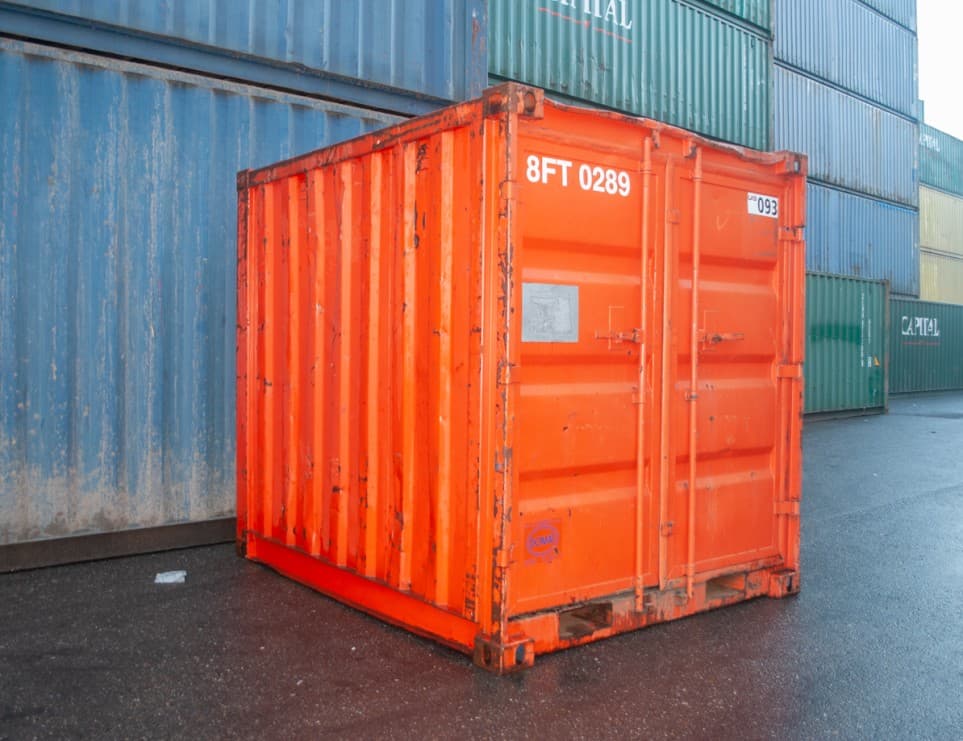
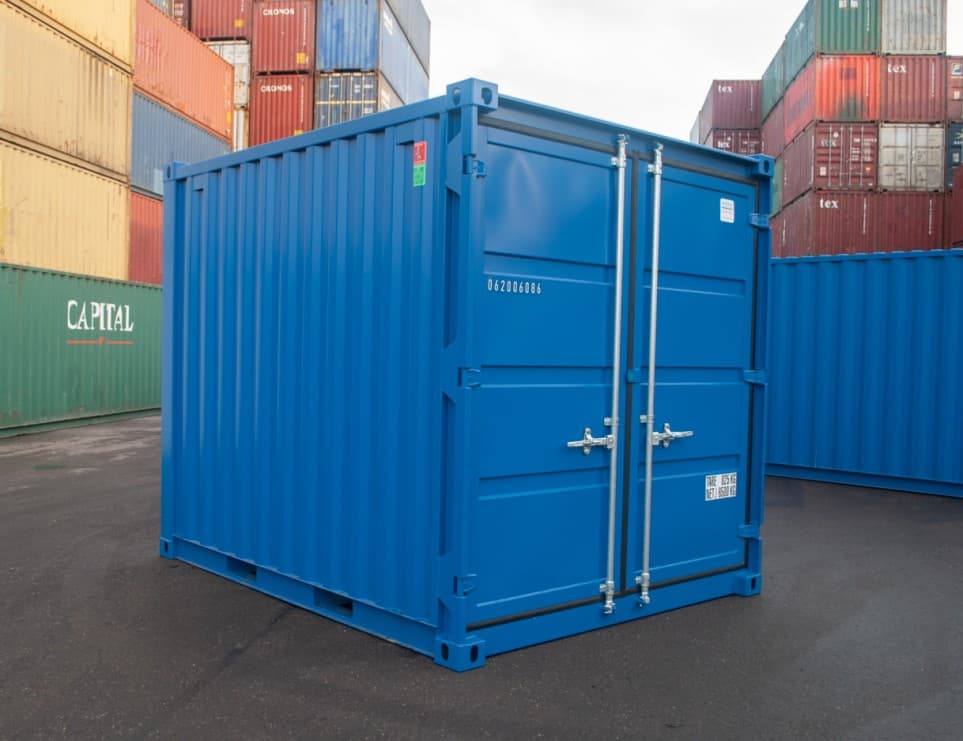
The used 8ft container we offer is a compact and sturdy storage module, originally designed for maritime transport and now commonly reused as a fixed storage space. Its Corten steel construction, a low-alloy steel that resists atmospheric corrosion, gives it considerable longevity outdoors. This type of container is recognizable by its self-supporting structure: the side walls, roof and floor contribute to the rigidity of the whole, allowing it to be placed directly on the ground without heavy foundations. The 8ft model belongs to the family of so-called "special" or "mini-containers", in that it is not one of the standard lengths of international maritime transport (20 and 40 feet). It is generally produced for specific uses: on-site storage, mobile workshops, guard booths, or as a base for small fit-outs. This means that its exact dimensions may vary slightly from one manufacturer to another, even if they remain close to the usual specifications for this format. We invite you to consult us to obtain the precise measurements of the container in stock if you need placement to the nearest centimetre.
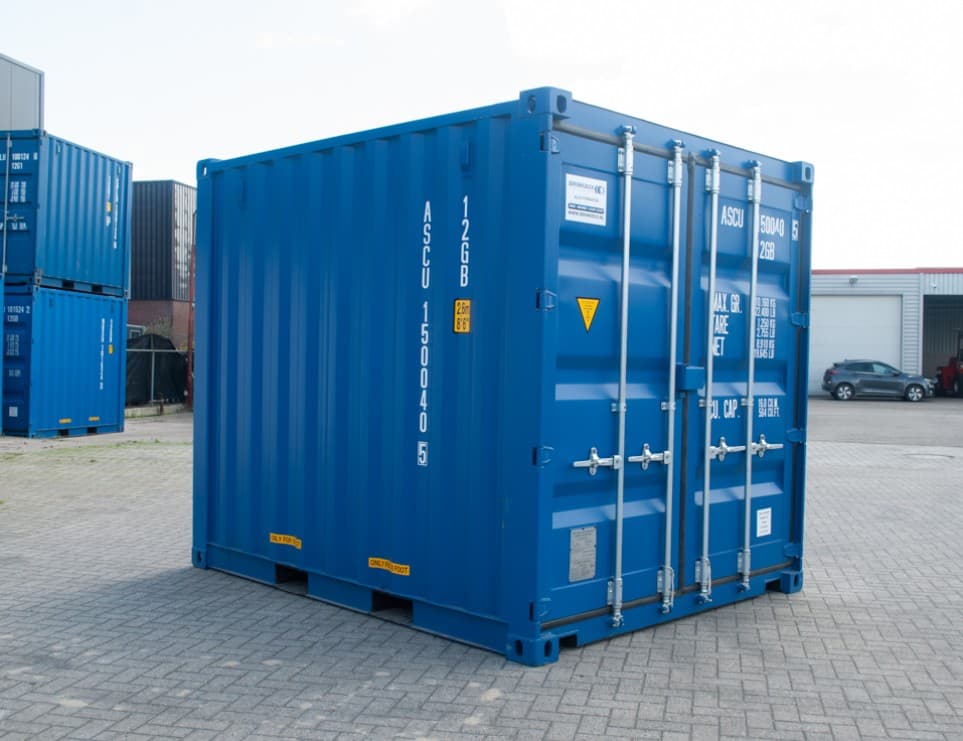
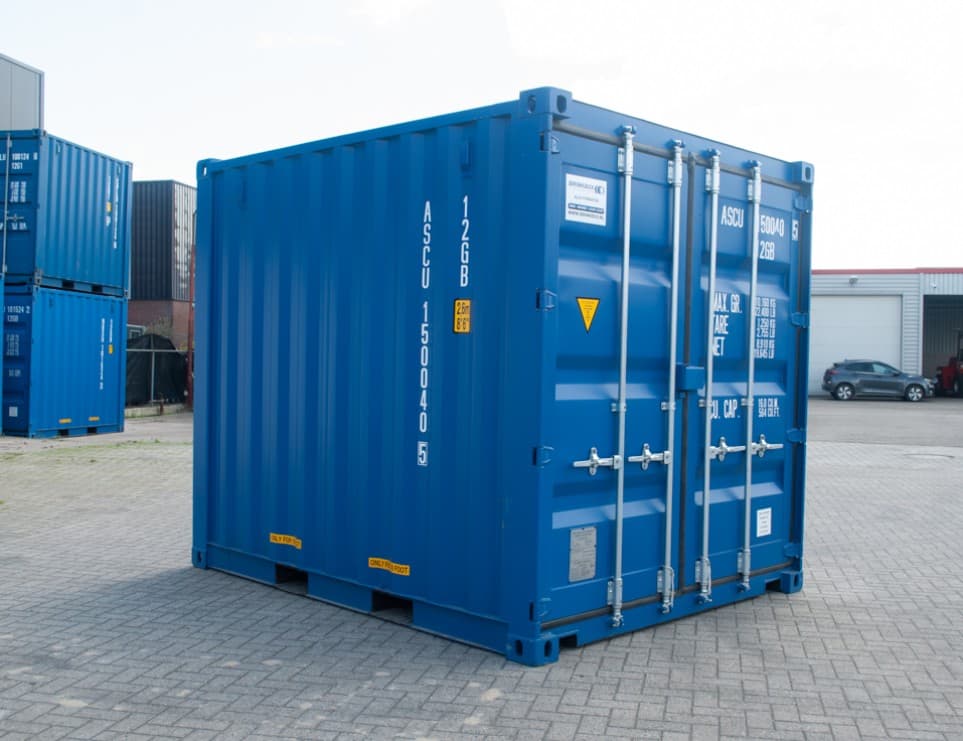
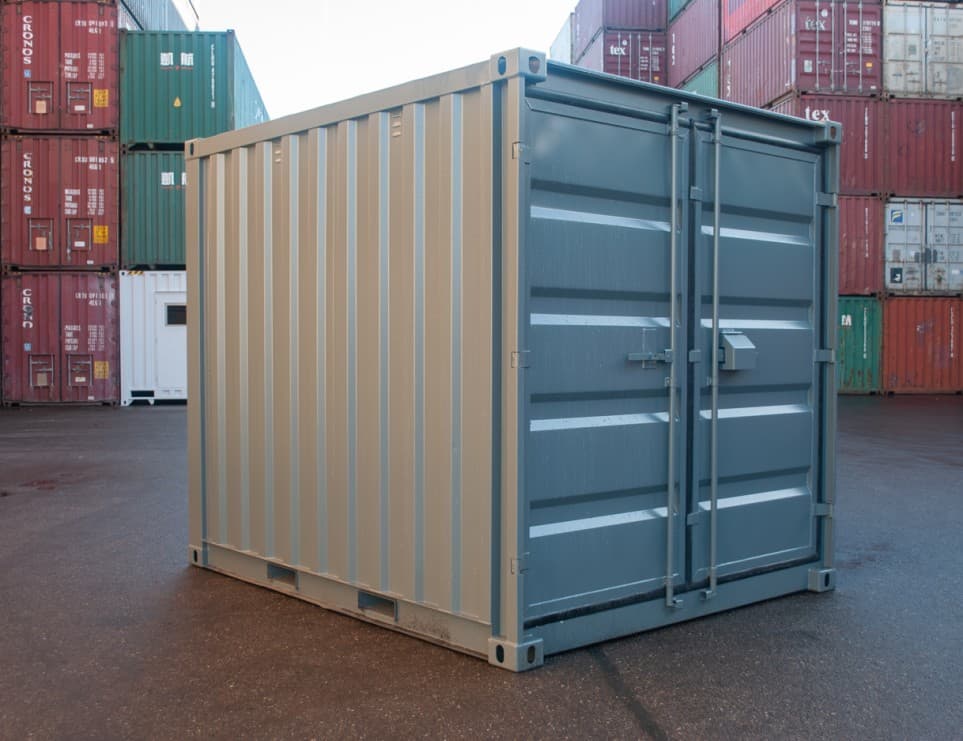
Technically, an 8ft container has an external length of about 2.44 metres, an external width of 2.44 metres as well, and an external height of 2.59 metres for the standard version, or 2.79 metres for a high cube version. These dimensions comply with the widths and heights standardized by ISO 668, ensuring compatibility with common handling equipment (forklifts, reach stackers) fitted with the appropriate attachments. The internal floor area is around 5.5 square metres, and the internal volume is around 13 to 15 cubic metres depending on height. The tare weight of such a container is generally between 600 and 900 kilograms, and its maximum payload can reach several tonnes, although for static storage use this limit is rarely restrictive. The floor is made of 28 mm marine plywood, a dense material treated to resist moisture and rolling loads. It is fixed on metal crossbars welded to the structure. The side walls and roof are made of corrugated Corten steel sheet, with a typical thickness of 1.6 to 2 mm. The rear doors are double swing doors equipped with container locks (vertical locking bars with handles and latches), ensuring secure closure and a certain air- and water-tightness. Rubber or foam seals are present around the door perimeter. The container is also fitted with corner castings at the eight corners, drilled with standardized oval holes, which allow lifting, slinging and securing. These parts are essential for handling and transport, and their integrity must be checked when buying a used container.
The primary use of a used 8ft container is storage. Its compact size makes it particularly suitable for confined spaces: house yard, small plot, craft area, urban construction site, etc. It allows you to store tools, gardening equipment, bicycles, motorcycles, spare parts, archives, or various goods sheltered from bad weather and opportunistic theft. Thanks to its watertight design and robust lock (completed if necessary by a padlock or additional lock), it offers security far superior to that of a wooden or resin garden shed. On construction sites, it often serves as a site office for storing power tools, consumables, or as a makeshift changing room. Event professionals use it to store sound and lighting equipment. Local authorities may see it as a temporary storage solution for municipal equipment. Finally, some individuals transform it into a DIY workshop, a technical room, or even a small living space after fitting out (insulation, electricity, ventilation), subject to compliance with local planning rules.
Indeed, let's talk about regulations and points of attention. Buying a used container involves checking a number of points. First, the general condition of the structure: look for perforating rust, especially on the roof (often neglected) and on the lower walls. Superficial surface rust is not alarming and can be treated, but holes or weakened areas compromise watertightness and strength. Next, inspect the floor: marine plywood may be stained or slightly worn, but it must not be rotten, delaminated or soft. Check that the doors open and close without forcing, that the seals are in good condition and that the locks work properly. The corner castings must be sound, without major deformation or cracks. A container that has been repaired (welded patches, sheet replacement) can be perfectly usable, but the repairs must be clean and not hide structural weaknesses. Our container is described as "watertight and refurbished, ready for immediate use", which means we have checked these essential points and carried out the necessary refurbishment. That said, a used container retains signs of use (scratches, small impacts, traces of surface rust) that are part of its history and do not affect its function.
Regarding installation, an 8ft container can be placed on flat, stabilized ground: concrete slab, compacted gravel, or even bare earth if the ground is well drained. It is recommended to raise it slightly (for example on concrete blocks or wooden beams) to avoid direct contact with ground moisture and promote air circulation under the floor. This precaution limits the risk of corrosion from below and extends the container's lifespan. If you plan to use it as a workspace or living space, ventilation is essential: a closed container can become very hot in summer and cold in winter, and the indoor air can become humid. Adding ventilation grilles, an extractor or air conditioning is then necessary. For simple storage use, minimal ventilation may suffice, but it is advisable to open the doors regularly in dry weather to renew the air.
Maintaining a Corten steel container is relatively simple. An annual cleaning with clean water and mild soap removes dirt and salt deposits (particularly by the sea). If paint chips appear, it is prudent to treat them with a suitable anti-rust paint to prevent corrosion from spreading. Door seals can be cleaned and possibly lubricated with a silicone-based product to prevent them from sticking or cracking. Locks and hinges can be greased once or twice a year. A well-maintained container can remain functional for several decades.
Transporting an 8ft container is an operation that requires a crane truck or a container carrier equipped with a lifting arm. In France, exceptional transport may be subject to authorization if the dimensions or weight exceed regulatory limits, but an 8ft container remains within standard dimensions and generally does not require any special exemption. However, you must ensure that the truck can access the delivery location (street width, bridge height, presence of overhead cables). We can organize delivery from Marseille to many destinations, studying feasibility and cost on a case-by-case basis. Do not hesitate to consult us for a transport quote.
Finally, buying a used container offers an obvious economic advantage over a new container, while providing equivalent strength for static use. The price of €1450.00 excluding VAT for this refurbished 8ft model reflects its condition and availability. We invite you to come and see it on site or request detailed photos before purchase. Our team is available to answer your technical questions and support you in your project.
Let us now delve into certain practical aspects not yet covered, to help you make an informed choice. Let's start with a comparison of container sizes and types, to place the 8ft in the overall offering. Standard maritime containers are mainly the 20ft (about 6.06 m long) and the 40ft (about 12.19 m long), both available in dry (standard) or high cube (raised) versions. There are also 10ft (about 2.99 m) and 8ft containers, which are rarer, often manufactured for specific needs. The 8ft is therefore the smallest common format, giving it an advantage for cramped sites and a disadvantage in terms of storage volume. Compared to a 20ft, it offers about three times less floor area, but it is also lighter and more manoeuvrable. Compared to a metal garden shed, it is significantly more robust and secure, but also heavier and more expensive to purchase. The 8ft can be an interesting alternative when space is limited or when the volume to be stored is moderate.
Among other container types, there are reefers (refrigerated), open tops (open roof), flat racks (platform without walls), tank containers, etc. The 8ft we offer is a dry container, i.e. a dry, non-refrigerated container with solid walls. It has no refrigeration unit or reinforced thermal insulation. For storing temperature-sensitive products, additional insulation will be required or a different type of container should be chosen. Similarly, if you need to load objects from above (bulky machines, for example), an open top would be more suitable. The dry container remains, however, the most versatile and economical type.
Let's move on to more detailed sector-specific use cases. In the building and public works sector, the 8ft container is often used as a site office to secure tools and expensive materials. Its small size makes it easy to move from one site to another using a crane truck. It can also serve as a basic site office, with the addition of a table, chair and power socket. In agriculture, it can store seeds, fertilizers, small tools, or serve as a room for plant protection products (subject to compliance with the storage standards for these products). Winegrowers can store their cellar equipment there. In the events sector, it is useful for storing sound, lighting and decoration equipment, or as a changing room for artists. Local authorities use it to store road maintenance equipment, Christmas decorations, or as a technical room for municipal gardeners. Sports associations can store balls, cones, bibs. Finally, individuals see it as a secure storage solution for garden tools, bicycles, motorcycles, quads, or to create a DIY workshop or a storage space for creative hobbies.
If you are considering a more extensive fit-out, it is possible to transform an 8ft container into a small living space, but this requires work. First, the walls, roof and floor must be insulated, as steel is an excellent thermal conductor. Rock wool or polyurethane foam is generally used, covered with a facing. Then, mechanical ventilation (VMC) or at least ventilation grilles must be provided to prevent condensation. Electricity must be installed by a professional, with earthing and residual current protection. Water supply and drainage are more complex: the structure must be drilled and the passages sealed. Finally, planning rules must be respected: a container placed on the ground may be considered a construction and require a building permit or prior declaration, depending on its surface area and the duration of its installation. Check with your town hall before undertaking any work.
Another important point concerns security and protection against theft. A standard container is equipped with door locks that can be forced with cutting equipment. To enhance security, there are accessories: high-security padlocks (hardened steel, with anti-drill protection), blocking bars, or recessed locks. Some add an alarm or video surveillance system. It is also possible to weld bars on the top rails if the container has them. The best protection remains to place the container in a visible and well-lit location, and not to store very high-value goods there without additional measures.
Regarding transport regulations in France, a distinction must be made between transporting the container itself (delivery) and transporting goods inside the container. For delivery, an 8ft container is generally transported on a container truck or crane truck. If the convoy exceeds 2.55 m in width, 4 m in height or 16.50 m in length, or if the total rolling weight exceeds 44 tonnes, it may be subject to exceptional transport authorization. An 8ft container does not exceed these limits, so no special authorization is required in most cases. However, the truck must comply with the highway code and local restrictions (pedestrian zones, height limits, etc.). For the transport of goods inside the container, if you ship goods by sea, rail or road, you must comply with the regulations on the transport of dangerous goods (ADR) if applicable, as well as customs declaration rules for export. An 8ft container is not designed for international maritime transport because its size is not standardized for modern container ships. It is therefore mainly used as a fixed storage unit or for local land transport.
Let's now talk about preventive maintenance in more detail. A Corten steel container is designed to resist corrosion, but this does not mean it is eternal. The layer of surface rust that forms naturally protects the steel to some extent, but if exposed to a marine environment (sea spray, salt), corrosion can accelerate. It is therefore recommended to wash the container with fresh water at least once a year, and more often by the sea. Avoid too powerful a pressure washer that could damage the seals and paint. For stubborn stains, use a mild detergent and a soft brush. After washing, rinse thoroughly. Regularly check the condition of the door seals: if they are cracked or missing, replace them. Lubricate the hinges and locks with silicone grease or white grease. Inspect the floor: if plywood boards lift, it is possible to glue them back or replace them. If you notice areas of perforating rust, treat them immediately: brush, apply a rust converter, then an anti-rust paint and a finishing paint. Regular maintenance will save you costly repairs and extend the life of your container.
Finally, do not forget to check the container's compliance with current standards. ISO 668 defines the dimensions and masses of series 1 containers, but 8ft containers are not part of this series. They are often manufactured according to proprietary specifications. The ISO certification mentioned in our specifications indicates that the container was built according to ISO standards, but it may be a manufacturer's quality certification. Ask us for the available documents if you need proof for insurance or a particular installation. We remain at your disposal for any further information.