Description
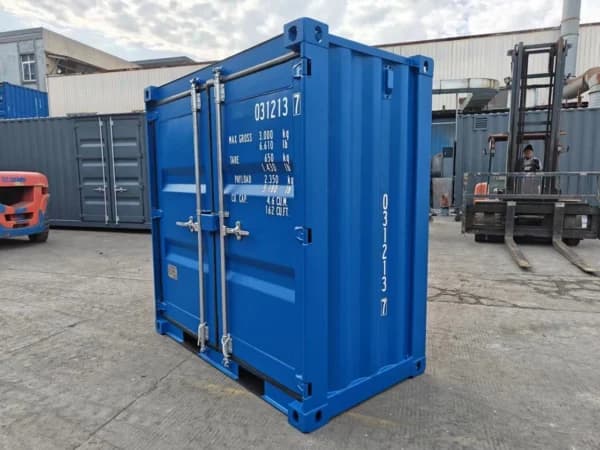
The 4ft storage container is a compact and robust solution for secure storage of equipment, tools, or various goods. Its Corten steel construction, a self-weathering steel that resists corrosion, gives it great durability even when exposed to the elements. This type of container, although small, follows the construction principles of standard shipping containers: welded steel structure, corner reinforcements, and assured watertightness. It is equipped with a 28mm thick marine plywood floor, a dense material treated to resist moisture and loads. A lock box is integrated, providing a secure anchor point for a padlock or lock, reducing the risk of theft or break-in.
This container measures externally 1.20m long, 2.20m wide, and 2.26m high. Internally, dimensions are 1.05m long, 2.11m wide, and 2.06m high, offering a floor area of 2.21m² and a useful volume of 4.6m³. These compact dimensions allow installation in restricted spaces while providing significant storage volume. The door opening, located at one end, measures 2.106m wide and 1.962m high, facilitating the passage of bulky items. Forklift pockets are provided, with a center distance of 95cm, allowing easy movement with a forklift or pallet truck. The tare weight is 650kg, and the maximum payload is 2.35 tonnes, allowing storage of heavy equipment.
This container is described as "nearly new" or "first trip". It is a shipping container that has made a single commercial voyage, generally loaded with goods, before being put up for sale in Europe. It therefore has an excellent general condition, with verified structural integrity and watertightness. Unlike a new container, it may show slight superficial wear marks, but without impact on functionality. This type of container is valued for its value for money, as it is cheaper than new while being in very good condition.
The uses of this 4ft storage container are varied. It can serve as a secure storage unit on a construction site for tools, materials, or sensitive equipment. Businesses can use it as a mini-warehouse for spare parts, archives, or supplies. Individuals will find it a solution for storing garden furniture, bicycles, gardening tools, or any other bulky items, protected from weather and theft. Thanks to its small size, it can be placed in a garden, courtyard, parking lot, or industrial area, without requiring special planning permission in most cases (subject to local rules).
Maintenance of this container is minimal. Regular cleaning with clear water and mild soap preserves its appearance. It is advisable to periodically check the paint condition and touch up any scratches with anti-rust paint to maintain corrosion protection. The marine plywood floor can be cleaned with a brush and mild detergent; it is recommended to let it dry to avoid moisture accumulation. Door seals should be inspected and replaced if necessary to ensure water and air tightness.
Before buying a 4ft storage container, several points of vigilance should be considered. Check the structural condition: absence of major deformations, holes, or perforating rust. Check watertightness by inspecting seals and testing with a water jet (if possible). Ensure the floor is in good condition, without rot or sagging. Check the functioning of doors and the presence of the lock box. Finally, consider transport and unloading conditions: this container can be delivered by truck crane or forklift, depending on site access. Transport and unloading are generally extra and depend on the destination.
In France, installing a storage container on private property is subject to planning regulations. As a general rule, if the container is considered a light construction and is not permanently fixed to the ground, it may be exempt from building permits, but it is prudent to check with the town hall. For professional use, specific rules may apply. Additionally, transporting a container on public roads must comply with the highway code, particularly regarding dimensions and weight, and may require an exceptional transport permit if thresholds are exceeded.
This container is available in several colors, depending on arrivals. The most common color is RAL 5010 (gentian blue). Other colors may be offered on quote, with possible extra cost or waiting time for uncommon shades.
In summary, the 4ft storage container is a practical, durable, and secure solution for storing various goods. Its Corten steel design, marine plywood floor, and lock box make it a reliable choice for many uses. Whether for a construction site, a business, or an individual, it offers an economical alternative to traditional garden sheds or storage rentals, with the advantage of mobility and robustness.
To delve deeper into maintenance, several levels of intervention should be distinguished. Routine maintenance first consists of clearing the roof of leaves and debris that could retain moisture and promote corrosion. Regular sweeping and rinsing with clear water are sufficient. Then, annual preventive maintenance may include applying a protective wax to exposed steel parts, although the original paint already plays this role. If deep scratches appear, it is important to treat them quickly: clean the area, apply a coat of anti-rust primer, then a finish paint of similar shade. For the floor, avoid abrasive products that could scratch the wood; a simple broom and damp cloth are sufficient. For stubborn stains, a mild wood cleaner can be used. Also check door hinges and latches: a spray lubricant (such as WD-40) applied once or twice a year ensures smooth operation and prevents squeaking. Door seals, made of rubber or foam, can harden over time; inspect them and replace if cracked or compressed.
Transport regulations in France deserve special attention. The 4ft storage container, although compact, remains a bulky and heavy object (650kg empty). Its transport on public roads is subject to highway code rules. For truck transport, check that the vehicle's gross combined weight rating (GCWR) is respected. If the convoy exceeds regulatory dimensions (width of 2.55m, length of 16.50m for an articulated set, height of 4m), an exceptional transport permit is required. Here, the container dimensions (1.20m x 2.20m x 2.26m) remain within standard limits, but the weight may require a suitable vehicle. Transport can be done by flatbed truck, truck crane, or trailer. Unloading on site must be prepared: provide a stable and level ground, and lifting equipment (forklift, auxiliary crane) if the truck is not equipped. It is also recommended to check local traffic restrictions (weight, height) in urban or residential areas.
For sector-specific uses, this container is particularly suitable for several fields. In construction, it can serve as a secure tool room on a site, preventing frequent thefts. Landscaping or green space companies store their small equipment (mowers, brush cutters, fuel). Craftsmen (plumbers, electricians, painters) can store their tools and consumables, protected from the weather. In events, it can serve as temporary storage for sound and lighting equipment, or as a mobile changing room. Local authorities can use it to store municipal equipment (signage, small street furniture). Farmers will find shelter for seeds, fertilizers, or small tools. Finally, individuals can store bulky items, bicycles, motorcycles, or even set up a small DIY workshop.
Let's now compare this 4ft container with other sizes and types. The 4ft container is the smallest standard format, often used for storage. The 6ft container (or 1.8m) offers slightly more volume but remains compact. The 8ft container (2.4m) is more common and offers about 5.5m². The 10ft container (3m) is a standard for storage, with a volume of about 15m³. The 20ft container (6m) is the most widespread, with a volume of 33m³. The 40ft container (12m) offers 67m³. The choice depends on available space and volume to store. In terms of type, the dry (standard) container is most suitable for dry storage. The reefer (refrigerated) container is used for transporting perishable goods and is not necessary for simple storage. The open top container allows loading from above, useful for bulky items. The flat rack container is used for heavy or out-of-gauge loads. The high cube container offers additional internal height of about 30cm, useful for storing tall items. For classic storage, the standard dry is the most economical and widespread.
In conclusion, the 4ft storage container is a wise investment for those seeking a robust, secure, and mobile storage solution. Its compact size allows installation in small spaces while offering a volume of 4.6m³ and a payload of 2.35 tonnes. Its nearly new condition guarantees a long lifespan. With minimal maintenance, it can serve for many years. Whether you are a building professional, craftsman, farmer, or individual, this container will meet your storage needs. Do not hesitate to contact us for availability, delivery options, and available colors.
Let's now address the question of location and ground preparation. A storage container, even small, must rest on a stable and level surface to avoid deformation of the structure and ensure proper door operation. A concrete floor, prefabricated concrete slabs, or a compacted gravel bed are recommended. If the container is placed on soft ground, it is advisable to provide blocks or wooden beams to distribute the load and prevent sinking. Using jacks or shims is also possible to adjust flatness. It is important to leave free space around the container to allow doors to open 180 degrees and facilitate access. A clearance of at least one meter in front of the door is desirable. Also consider orientation: placing the door sheltered from prevailing winds and weather reduces the risk of water penetration when opening.
Ventilation is another aspect to consider. Although this container is watertight, natural ventilation can be useful to avoid condensation, especially if you store moisture-sensitive materials. Some models are equipped with vents, but this is not systematic. You can add ventilation grilles on the walls, ensuring not to compromise watertightness. Another solution is to use dehumidifiers or moisture absorbers (silica gel packets) inside. For long-term storage, it is recommended to raise items off the floor using pallets or shelves, to allow air circulation and avoid contact with residual moisture.
In terms of security, the 4ft storage container offers basic protection against intrusions. The lock box is an asset, but it is advisable to use a high-security padlock, anti-theft type, resistant to cutting and picking. To enhance security, you can add an additional lock, a security bar, or an alarm system. If the container is placed in an isolated location, exterior lighting with motion detector can deter intrusions. It is also possible to anchor the container to the ground using suitable fixings, making its removal more difficult.
The interior layout of the container can be customized to your needs. You can install shelves, racks, hooks, or storage bins to optimize space. Ceiling rails allow hanging tools or bicycles. Interior lighting, powered by a battery or electrical extension, improves comfort of use. If you wish to transform this container into a small workshop, you can add a workbench, a vise, and wall storage. For use as a site office, a layout with a table, chair, and electrical outlet is possible, but requires insulation and auxiliary heating in winter.
Let's compare usage costs. Buying a 4ft storage container represents an initial investment, but it is quickly amortized compared to renting a storage unit. A 5m² unit typically rents for between 50 and 100 euros per month in France, or 600 to 1200 euros per year. The container, however, is a durable asset that generates no further costs after purchase (aside from minor maintenance). Moreover, it is mobile: you can move it if you relocate or change sites. It requires no rental contract or deposit. For professionals, it can be depreciated over several years.
Finally, note that this container can be stacked, subject to verifying the structure's strength and using appropriate fixings. Shipping containers are designed to be stacked, but a 4ft container may not have the same corner characteristics as standards. It is therefore essential to consult the manufacturer or seller before any stacking. Similarly, lifting must be done by the four corners or forklift pockets, never by the walls, to avoid deformation.
With this additional information, you have all the elements to make an informed decision. The 4ft storage container is a versatile, durable, and economical product that meets many storage needs. For any technical questions or to place an order, our team is at your disposal.