Description
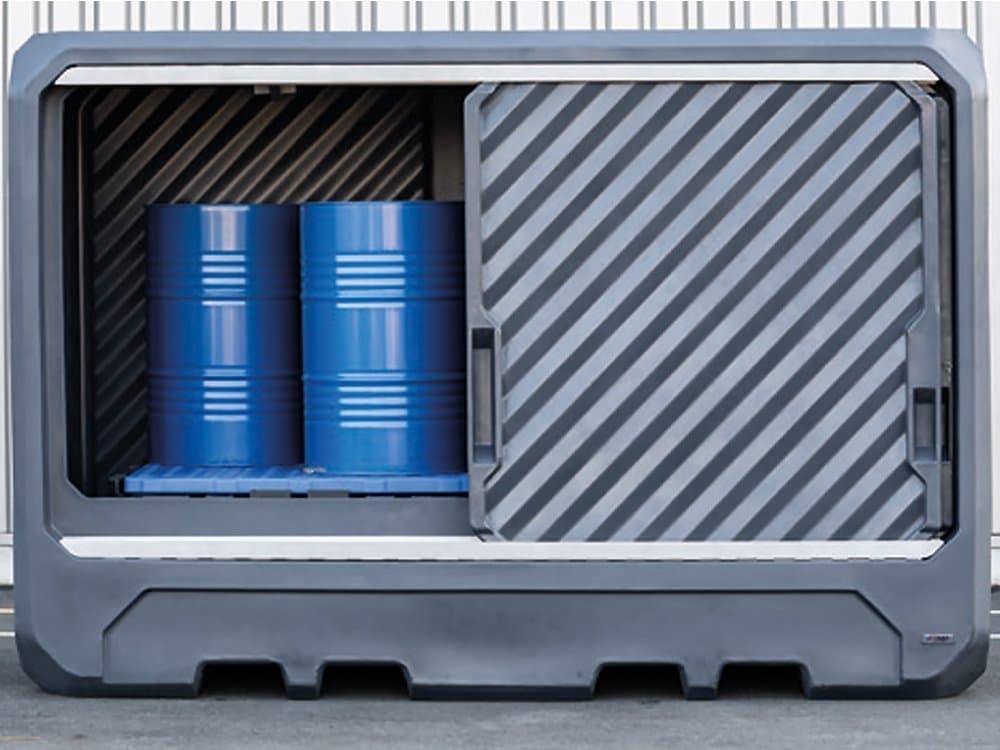
The 3-metre insulated storage container with retention is a solution dedicated to the outdoor storage of potentially polluting liquid products, such as oils, solvents, lubricants or chemicals packaged in cans and drums. It combines an insulated sandwich panel enclosure with a built-in 1000-litre retention sump, fitted with a galvanised steel grating. This configuration allows containers to be stored raised above the sump, while containing any accidental spillage inside the enclosure. The container is factory-assembled and delivered ready to be installed on stabilised ground, with feet suitable for forklift handling and four lifting rings for crane movement.
In terms of dimensions, the container has external dimensions of 3160 mm length, 1498 mm width and 1948 mm height. The usable internal dimensions are 2920 mm length, 1330 mm width and 1363 mm height. These dimensions provide an internal volume of approximately 5.3 m³, sufficient to accommodate several standard 200-litre drums or a set of cans in common formats. The 1000-litre retention corresponds to a containment capacity allowing the entire contents of several drums to be collected, depending on storage configurations. The galvanised steel grating provides a raised working surface, corrosion-resistant and compatible with rolling or palletised loads.
The container structure is based on a load-bearing welded steel base, which guarantees the rigidity of the assembly and load distribution. The walls consist of insulating sandwich panels, with a pre-coated electro-galvanised sheet finish. The roof is made of galvanised steel. The thermal insulation provided by the sandwich panels limits temperature variations inside the container, which can be useful for protecting certain products sensitive to frost or heat, without however constituting active temperature regulation. The doors are sliding type, two in number, which facilitates access from outside and optimises the manoeuvring space around the installation. The two-tone finish combines RAL 9010 white on the doors and RAL 5017 blue on the sides.
The container is classified M1 - European class B s3 d0, a classification relating to the fire reaction of construction materials. This classification indicates that the materials used have fire behaviour characteristics suitable for outdoor use, without however replacing local regulatory obligations applicable to the storage of dangerous products. The specific requirements related to the nature of the stored products should be verified with the competent authorities or a inspection body, particularly regarding safety distances, ventilation and signage.
The main use of this container is the outdoor storage of polluting liquids. It can be installed on an industrial site, a logistics platform, a construction site, a farm or a municipal technical centre. The built-in retention sump provides protection against accidental leaks and limits the risk of soil and water pollution. The galvanised grating raises the drums and cans, which facilitates visual inspection and intervention in the event of a spill. Access via sliding doors allows containers to be loaded and unloaded without additional ground footprint, an advantage on sites where space is limited.
In terms of safety, the container must be used in accordance with the storage rules for the products concerned. It is recommended not to mix incompatible products in the same volume, to respect the maximum admissible quantities and to provide suitable ventilation if the products emit vapours. The retention sump must be kept clean and free of any accumulated liquid, in order to preserve its containment capacity. Regular visual inspection of the condition of the grating, walls and roof allows any traces of corrosion or deformation to be detected. Galvanised elements can be cleaned with clean water and products compatible with zinc; chlorinated or strong acid products should be avoided.
Installing the container requires a flat and stable surface, capable of supporting the weight of the assembly once loaded. The forklift feet and lifting rings facilitate handling, but positioning must be carried out by equipped professionals. It is advisable to provide clearance space around the sliding doors and to check that the ground does not have a slope likely to unbalance the structure. If the container is intended to remain in place permanently, shimming or anchoring to the ground may be necessary depending on local conditions.
Regarding transport regulations in France, the storage container is not intended to be transported as a standard maritime container on ships. Its out-of-gauge dimensions may require special permits for road transport, particularly if the width or height exceed regulatory limits. Transport must be entrusted to an authorised carrier, with compliant securing. For lifting, the four rings must be used with suitable slings and strict respect for lifting angles. Handling operations must be carried out by trained personnel.
In terms of maintenance, the galvanised steel and pre-coated sheet structure requires little routine maintenance. Periodic cleaning helps preserve the appearance and durability. The insulating sandwich panels do not require special maintenance, but the sealing of joints and doors should be checked. The sliding doors must be kept in working order, with checking of rails and rollers. If corrosive products are stored, more frequent inspection is recommended. The retention sump must be emptied and cleaned in accordance with procedures applicable to hazardous waste.
This container differs from standard maritime containers by its specific retention and insulation function. A classic dry container, made of Corten steel, is designed for the transport and storage of dry goods, without a liquid containment device. A reefer container is equipped with a refrigeration unit for the transport of perishable goods. An open top or flat rack container is intended for out-of-gauge loads. The insulated storage container with retention meets a different need: it combines a closed, insulated and secure enclosure with an environmental protection device. It is not an ISO 668/1496 container intended for maritime stacking, but a storage unit dedicated to a fixed or semi-fixed installation.
Insulation with sandwich panels offers several advantages. It limits temperature variations, reduces condensation on the walls and improves working comfort inside. It can also attenuate noise nuisance from surrounding equipment. However, it is not intended to maintain a constant temperature; for controlled temperature storage, an active heating or cooling solution would be necessary. The container must not be considered a cold room or a drying oven.
Typical applications include the storage of used oil drums, solvents, paints, plant protection products, lubricants or detergents. In a workshop or factory, it allows dangerous liquids to be centralised away from production areas. On a construction site, it offers a temporary storage solution compliant with good environmental practices. On a farm, it can accommodate crop treatment products. In a local authority, it can be used for storing cleaning products or liquid waste. In all cases, the user must ensure the compatibility of the products with the materials of the container and the sump.
The 1000-litre retention capacity is a key element. It allows a large volume to be contained in the event of a drum or can rupture. The galvanised grating raises the containers by a sufficient height so that any spillage flows into the sump without stagnating in contact with the drums. This design also facilitates cleaning and suction of liquids. The sump must be checked periodically to verify the absence of cracks or deformations. In the event of a spill, the liquid must be pumped out and disposed of in accordance with hazardous waste regulations.
French manufacturing is highlighted for this product. It implies local production, quality monitoring and proximity for after-sales service. The materials used, galvanised steel and pre-coated electro-galvanised sheet, are common in the construction of containers and industrial equipment. They offer corrosion resistance suitable for outdoor use, subject to normal maintenance. The pre-coated finish provides additional protection and a neat appearance.
When purchasing, several points of vigilance deserve attention. It is necessary to check that the container dimensions correspond to the available space and storage needs. The retention capacity must be adapted to the total volume of stored products, taking into account applicable rules. The nature of the products must be compatible with the materials of the container and the sump. Installation conditions, particularly ground flatness and access for handling, must be anticipated. Finally, it is recommended to find out about local obligations regarding the storage of dangerous products and any necessary permits.
The container is delivered factory-assembled, which reduces on-site operations. It can be moved later thanks to its feet and lifting rings. Its insulated and closed nature protects products from bad weather, wind and dust. The sliding doors offer wide and secure access. The assembly constitutes a durable storage solution for industrial, logistics or agricultural sites concerned with environmental protection.
To further detail maintenance, it is useful to distinguish routine operations from periodic interventions. Daily or at each use, a visual check of the inside of the sump verifies that no liquid is stagnating and that the grating is not obstructed. The sliding doors must open and close without effort; cleaning the rails with a brush and removing plant debris or gravel prevents stiff points. Once a quarter, depending on exposure, it is advisable to inspect the seals, fasteners and hinges, and to check for corrosion on steel parts. Paint touch-ups on chipped or scratched areas limit the progression of rust. Once a year, a more complete check can include examination of the roof, rainwater drainage and the flatness of the base. If the container is installed in a marine or aggressive industrial environment, these frequencies may be increased. The retention sump, for its part, must be emptied after each spill and cleaned with products suited to the type of liquid concerned; washing water must be treated as hazardous waste if contaminated.
The regulations applicable to transport and installation deserve clarification. In France, road transport of indivisible or out-of-gauge loads is governed by the Highway Code and requires, depending on dimensions and weight, a circulation permit issued by the prefectural services. The container, with its 3160 mm length and 1948 mm height, remains within dimensions that can often be transported on a plant trailer or flatbed, but the final width and height depend on the vehicle used. The carrier must ensure the conformity of securing and signage. For lifting, the four rings must be used simultaneously with slings of suitable length; lifting by a single ring or by the feet is prohibited. On the installation site, the container must be placed on a stable surface, and if necessary secured to withstand wind, particularly in exposed areas. Finally, the storage of dangerous products is subject to the regulations on installations classified for environmental protection (ICPE) depending on the volumes and nature of the products; it is up to the operator to check whether their activity falls under a declaration, registration or authorisation regime, and to comply with the corresponding requirements regarding retention, ventilation, distances and emergency resources.
Sector-specific use cases are varied. In mechanical industry, the container can accommodate cutting oils, lubricants and cleaning solvents. In the automotive sector, it is suitable for storing engine oils, brake fluids and antifreezes. In chemicals and pharmaceuticals, it can be used for storing packaged liquid raw materials, subject to compatibility. In agriculture, it allows plant protection products and agricultural fuels to be grouped in a confined volume, away from living areas. In construction and public works, it offers a mobile solution for sites, where petroleum products and additives are often stored temporarily. In local authorities and waste centres, it can be used for hazardous liquid waste, as a complement to unloading areas. In the logistics sector, it can serve as a buffer zone for liquid goods awaiting shipment. Each use requires verifying the chemical compatibility of the products with galvanised steel, pre-coated sheet and the sump materials, and complying with site-specific safety instructions.
Compared to other sizes and types of containers, this 3-metre model positions itself as a compact unit. Standard maritime containers of 20 feet (about 6.06 m long) and 40 feet (about 12.19 m long) offer much larger volumes, but do not have built-in retention and are designed for stacking and maritime transport. A 10-foot container (about 3.05 m) is close in length, but its width and height differ and it generally has neither insulation nor retention sump. High cube containers, about 30 cm taller, increase usable volume without changing the ground footprint. Reefer containers incorporate a refrigeration unit and reinforced insulation, but their purpose is the transport of perishable goods, not the containment of polluting liquids. Open top and flat rack containers are open or without walls, making them unsuitable for retention. Finally, containers fitted out as offices or living spaces have insulation and comfort equipment, but no retention sump. The choice of a 3-metre insulated storage container with retention is therefore justified when the main need is the containment of liquids outdoors, with a reduced ground footprint and easy handling.
In summary, the 3-metre insulated storage container with retention is specialised equipment for the outdoor storage of polluting liquids. It combines an insulated structure, sliding doors, a 1000-litre retention sump and a galvanised grating. Its dimensions and design make it an alternative to standard maritime containers for secure storage and environmental protection needs. It is intended for professionals who must store liquid products in compliance with good pollution prevention practices.