Description
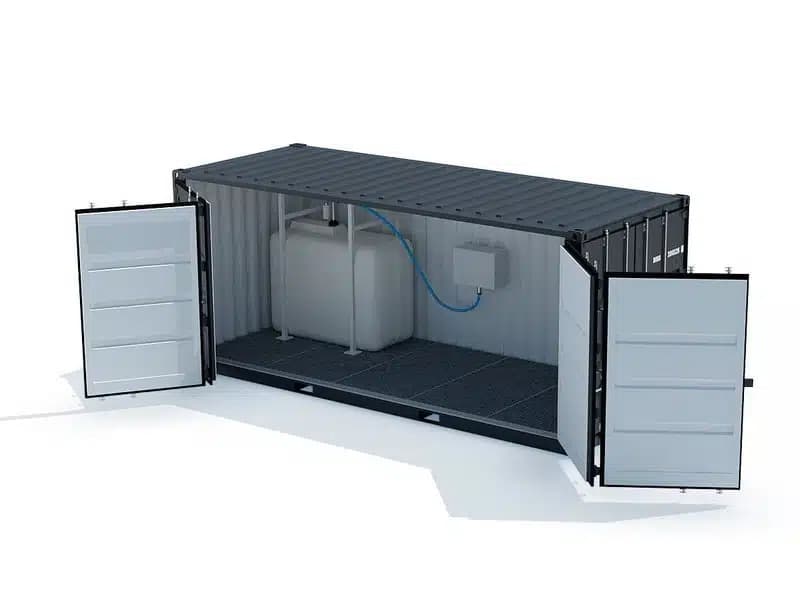
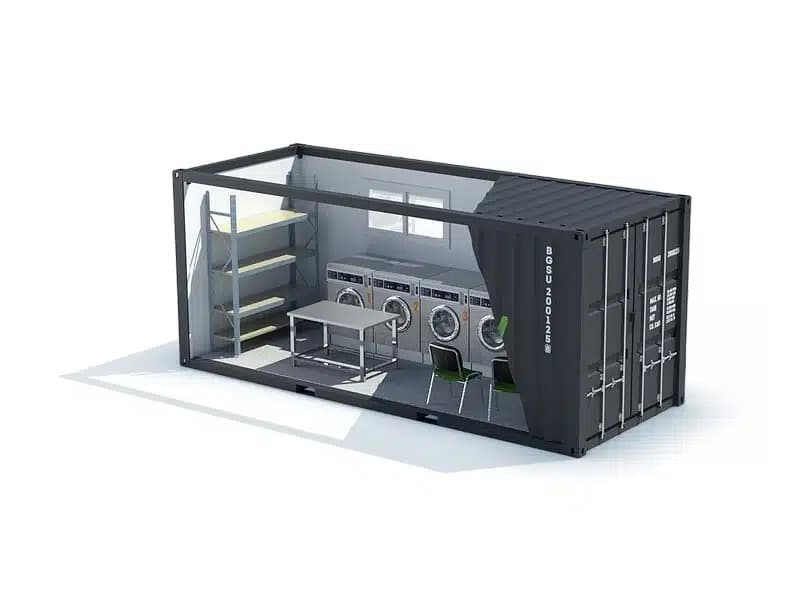
The modular plant protection laboratory container is a solution designed for the storage and handling of plant protection products under enhanced safety conditions. It is based on the proven structure of a shipping or storage container, converted into a technical room or field laboratory. Its central element is an integrated retention basin, placed under a galvanized grating floor. This system contains any accidental liquid spill, whether from a canister leak, a spill during decanting or a simple drip. The raised grating keeps packaging out of contact with the bottom of the basin, which facilitates cleaning and limits corrosion. The structure is made of Corten steel, a low-alloy steel that develops a stable protective oxide layer on its surface, suitable for outdoor environments and humid atmospheres. The walls and roof come from standard shipping containers, whose rigidity and watertightness are well known. The original 28 mm marine plywood floor can be kept or replaced depending on use, but in the case of a plant protection container, the technical grating floor takes priority. Ventilation is provided by a dedicated grille, allowing natural air renewal and limiting the accumulation of vapors. This point is essential for the storage of classified products, as a confined atmosphere can present risks of accumulation of volatile compounds. The grille can be equipped with a filter or a regulation system if the need is identified. The container is also equipped with double rear doors with container locks, offering wide access for loading and unloading, including with a pallet truck or small trolley. The closure is robust and can accommodate a padlock or an additional locking system. The whole unit is mobile: thanks to the ISO corner castings at the four corners, the container can be lifted, set down and transported by standard handling equipment (forklift, crane, container truck). This mobility allows the room to be moved on a site, evacuated at the end of a project or repositioned according to changing needs. Customization is a key point of this product. Depending on the configuration, it is possible to add an electrical supply (panel, sockets, lighting), thermal insulation (panels, mineral wool, foam), shelves or racking, air conditioning or heating, a roller shutter, an access ramp, a decontamination airlock, a water point or a sink. These options transform the container into a true field laboratory or preparation room. The intended use should be precisely defined before ordering: simple storage, preparation of spray mixtures, rapid analysis, storage of protective equipment, etc. The plant protection laboratory container is intended for farms, cooperatives, agricultural contracting companies, local authorities and research organizations. It allows plant protection products to be centralized in a single, dedicated and secure room, rather than dispersed across several buildings. This centralization facilitates stock management, expiry date control and traceability. It also limits the risks of mixing or cross-contamination. The retention basin is sized to collect a volume at least equal to the capacity of the largest stored container, in accordance with good retention practices. In the case of plant protection products, French and European regulations impose specific storage conditions: closed, ventilated room, away from water points, with a suitable retention system. The modular laboratory container meets these requirements by design, subject to correct installation and compliant use. It is important to note that regulations may change and that the operator must verify the texts in force (in particular the decrees relating to the storage of plant protection products). Container maintenance is simple but regular. The retention basin and grating should be inspected after each product handling, any splashes should be cleaned with appropriate absorbents, and ventilation should be checked. Corten steel walls can be cleaned with clean water; aggressive chemicals should be avoided. An annual check of seals, locks and lifting points is recommended. When storing classified products, it is prudent to keep a register of entries and exits, and to display safety instructions inside. The container can be equipped with fire extinguishers, spill kits and standardized pictograms. In terms of transport, a standard 20-foot shipping container measures approximately 6.06 m long, 2.44 m wide and 2.59 m high, with an empty weight of around 2.2 to 2.5 tonnes. A 40-foot container measures approximately 12.19 m long with similar width and height. High cube versions gain about 30 cm of internal height. These dimensions are standardized by ISO 668 and ISO 1496, which guarantees compatibility with handling equipment and transport vehicles. The gross weight of a 20-foot container is generally 30,480 kg, but it depends on the original specifications. The laboratory container can be based on a 20-foot container, more compact and easier to move, or on a 40-foot container for a larger internal volume. The choice depends on the quantity of products to be stored, the presence of a work station and site constraints. Thermal insulation is often recommended if the container is to hold products sensitive to heat or cold, or if an operator must work inside. Insulation with sandwich panels with a rigid foam core offers good thermal performance. Air conditioning can be added to maintain a stable temperature, particularly for certain products that must be kept frost-free. A heating system may be necessary in winter. Electricity must be installed in accordance with current standards (NF C 15-100 for low-voltage installations). It is advisable to use a qualified electrician for connection, grounding and differential protection. Waterproof LED lighting is suitable for humid environments. Power sockets can supply laboratory equipment, scales, agitators or computers. Ventilation can be natural or mechanical. Mechanical ventilation (VMC) can be considered to renew air continuously. In all cases, extracted air must be discharged outside, away from fresh air intakes and occupied areas. An activated carbon filter can be added if organic vapors are present. The roller shutter is a practical option to secure access when it is not necessary to open the double doors. It can be motorized or manual. The access ramp facilitates the entry of trolleys and pallet trucks; it must be adapted to the load and the floor height. An entrance airlock can be fitted to limit air ingress and create a transition zone. Finally, the interior layout can include metal shelves, safety cabinets, a workbench, a sink with water collection, or a storage space for personal protective equipment. The plant protection laboratory container is therefore a modular base that adapts to many uses. It can be delivered with various options, but it is essential to define precise specifications before manufacturing. Points to watch when purchasing concern the quality of the base structure (check for perforating corrosion, condition of seals, flatness of the floor), the compliance of the retention basin (volume, watertightness, material compatible with the stored products), ventilation (sizing, filtration), the electrical installation (standards, protection), and handling (ISO corner castings in good condition). It is recommended to request a layout plan and to verify that the container can be delivered and set down on site. Transport to the place of use may require a crane truck or a container carrier with a lifting arm. The price shown is a base rate for a fitted container; options and customization may vary the cost. It is advisable to request a detailed quote according to specific needs. In summary, this modular plant protection laboratory container combines the robustness of a shipping container, the safety of a retention basin and the flexibility of a custom layout. It offers a mobile, durable and functional solution for the storage and handling of plant protection products, while facilitating compliance with good pollution prevention practices.
To go further, let us look at sector-specific use cases that justify this type of container. On large-scale crop farms, the plant protection laboratory container often serves as the main storage room for treatment products, but also as a spray mixture preparation area. The presence of a water point and a sink allows spray equipment to be rinsed and rinse water to be collected in the retention basin or in a dedicated container. This practice avoids the discharge of residues into the natural environment, which is a regulatory obligation in many cases. The container can be positioned near the sprayer filling area, which reduces handling and spill risks. In agricultural cooperatives, the container can be used as a distribution or product collection room, with a counter and shelves. It allows products to be separated by hazard class and storage rules to be respected. In agricultural contracting companies, the mobile container follows the worksites: it can be dropped off on a plot or in a temporary depot, then moved. This mobility is an asset for teams working on several sites. In local authorities, green space services use this type of container to store plant protection products, but also protective equipment and small tools. Regulations govern the use of plant protection products in public spaces, and a dedicated room allows safety distances and ventilation conditions to be respected. In research organizations and experimental stations, the laboratory container can be fitted with a bench, a sink, a fume hood or an air filtration system. It then serves as a field laboratory for sample preparation or rapid analysis. In agricultural training, it can become a teaching aid to explain good storage and handling practices. Finally, in areas not connected to the electricity grid, the container can be equipped with solar panels and batteries, making it self-sufficient. This option is useful for isolated sites.
Now let us compare the different sizes and types of containers. The 20-foot dry container is the most common for this type of fit-out. Its internal length of about 5.90 m, width of about 2.35 m and height of about 2.39 m offer a useful volume of about 33 m³. It is easy to transport, as it can be loaded on a standard truck without an exceptional convoy. Its empty weight, generally between 2.2 and 2.5 tonnes, allows it to be installed on a stabilized platform without heavy foundations. The 40-foot dry container offers an internal volume of about 67 m³, double that. It is suitable for large storage needs or for fitting out several spaces (storage, preparation, office). However, its transport requires a suitable truck and its installation can be more complex. The 40-foot high cube container gains about 30 cm of internal height, which improves working comfort and allows taller shelves to be installed. The open top container, whose roof opens, is useful if high equipment must be loaded, but it is less watertight. The flat rack container, without side walls, is not suitable for a closed room. The reefer container, equipped with a refrigeration unit, is designed for transporting perishable goods; it can be converted into an air-conditioned room, but its cost and maintenance are higher. For the storage of plant protection products, the standard dry container remains the most relevant, as it is watertight, robust and easy to fit out. The storage container, often called a "site container", can also serve as a base. It is generally lighter and less tall, but it may be sufficient for simple use. Its strength and watertightness must be checked before fitting it out.
Let us now address transport regulations. In France, the transport of shipping containers is governed by the Highway Code and transport safety rules. A 20-foot container can be transported on a container truck or a suitable trailer. The total weight of the vehicle and its load must not exceed regulatory limits (40 tonnes for a standard road train, unless exempted). The driver must ensure that the container is properly secured, that the locks are engaged and that the center of gravity is respected. The transport of dangerous goods, if the container is used to transport classified plant protection products, is subject to ADR (European Agreement concerning the International Carriage of Dangerous Goods by Road). In this case, the container must comply with ADR requirements, with appropriate marking, and the driver must have specific training. It is important to distinguish between the transport of the empty (or fitted) container and the transport of dangerous goods inside it. The plant protection laboratory container is generally transported empty, then loaded on site. If dangerous goods must be transported, ADR regulations must be respected and a suitable container used. For on-site installation, it is recommended to provide a stabilized, level area accessible to lifting equipment. A concrete slab or compacted ground may be sufficient. The container should be placed on blocks or beams to avoid direct contact with the ground and allow air circulation. This precaution limits corrosion of the floor and walls. If the container is intended to remain in place, it can be anchored to the ground to withstand strong winds. In flood zones, it is advisable to raise the container. Finally, it is useful to check local planning rules before installation, as a container may be considered a construction and require authorization. In most cases, a container used as a temporary technical room is not subject to a building permit, but it is prudent to check with the town hall.
Routine maintenance deserves detail. The retention basin must be emptied and cleaned after any spill. Residues must be disposed of in accordance with hazardous waste regulations. The galvanized grating can be removed to access the basin. It is advisable to check the condition of the galvanizing and to touch up any corroded areas with a suitable paint. The ventilation grille must be kept clean; a filter, if present, must be replaced according to the frequency recommended by the manufacturer. Door seals must be checked and replaced if cracked, to preserve watertightness. Hinges and locks must be lubricated regularly. The roof must be inspected for any perforation or early corrosion. ISO corner castings must be checked before each lift. An annual maintenance plan can be established, with a complete visual check and intervention on sensitive points. When storing chemicals, it is recommended to clean interior walls with a damp cloth and a mild detergent, then rinse. Aggressive products must not be used without checking compatibility with Corten steel and galvanizing. Operator safety requires the wearing of personal protective equipment (gloves, goggles, mask) during handling. A first-aid kit and an eye wash can be installed nearby. Finally, it is useful to keep a maintenance log and report any anomaly.
In conclusion, the modular plant protection laboratory container is a complete solution that combines safety, mobility and customization. It meets the needs of professionals who must store and handle plant protection products in a regulated framework. Its design based on a shipping container guarantees a long service life and resistance to bad weather. The integrated retention basin and grating floor are key elements for pollution prevention. Fit-out options allow the container to be adapted to each use, from simple storage to field laboratory. Before purchase, it is essential to define needs precisely, verify regulatory compliance and plan transport and installation conditions. A detailed quote and a layout plan allow the feasibility of the project to be validated. With regular maintenance, this container offers a durable and scalable solution for years to come.