Description
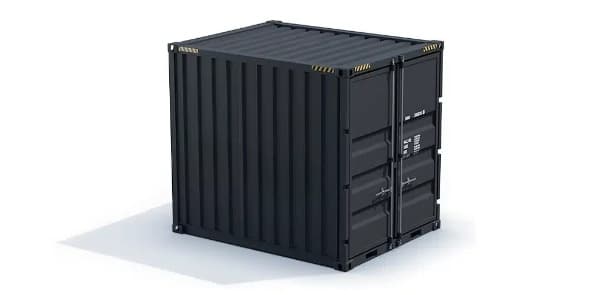
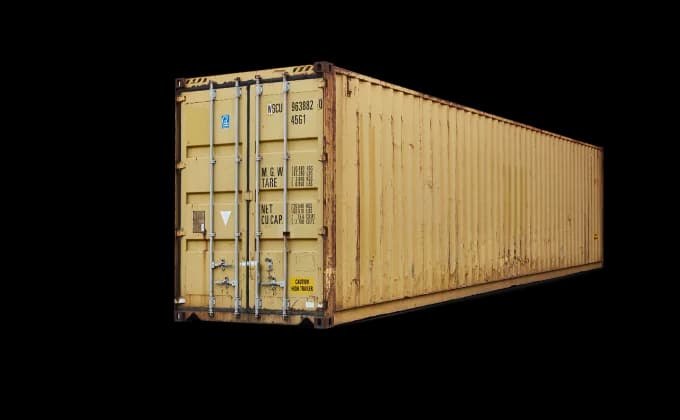
The 10ft High Cube shipping container is a short, often overlooked format that combines two rarely paired advantages: a limited footprint and an interior height greater than that of a standard dry container. Where a classic 10ft container tops out at around 2.39 m external height, the High Cube version at 2.89 m offers a significantly larger usable volume without requiring more floor space. It is precisely this compromise that appeals to professionals facing space constraints: a cluttered company yard, an urban construction site, a storage area at a property boundary, or simply the need for vertical volume for tall equipment.
Let's start with the construction, as it determines the lifespan of the unit. This container is made of Corten steel, also known as weathering steel. It is a low-alloy steel with copper, chromium and nickel, whose particularity is to form a stable oxide layer on the surface that slows the progression of corrosion. This property explains why this material has been used for decades in the construction of shipping containers intended to sail in saline environments. A Corten steel container remains a steel product: it is not indestructible, and periodic maintenance of friction or impact areas is still necessary, but it resists humid atmospheres and sea spray far better than ordinary steel.
The structure is based on the standardized principles of the shipping container: a frame made of profiled steel rails and uprights, corrugated side walls, a corrugated roof, and a 28 mm thick marine plywood floor. This floor deserves particular attention. Marine plywood is a multi-layer panel bonded with phenolic resin, designed to support rolling loads and resist moisture. It is laid on metal cross members welded to the base, which distributes the load and allows a trolley or pallet truck to pass under good conditions. However, avoid rolling highly concentrated loads directly on the wood without a load-spreading plate, as plywood, even marine grade, marks under excessive point pressure.
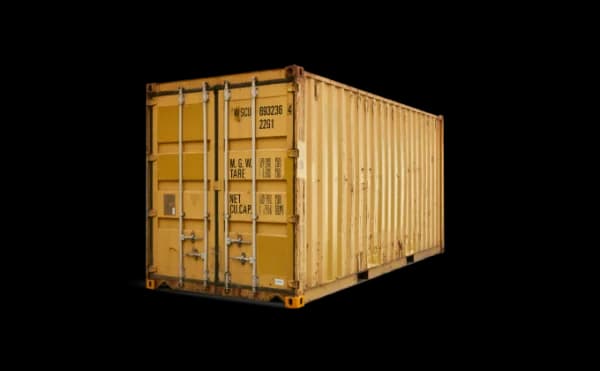
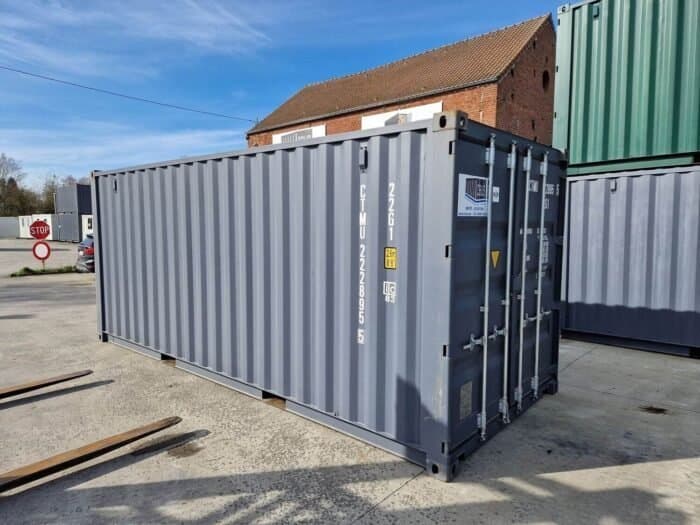
The rear doors are double-leaf, mounted on welded hinges and secured by vertical locking bars equipped with handles and locking cams. This system, standard on shipping containers, ensures firm compression of the seals and good resistance to opportunistic break-ins. Elastomer gaskets, set in the door leaf rebates, ensure watertightness once the doors are properly locked. It is recommended to check their condition at each extended opening and to treat them with talc or a suitable lubricant to prevent them from sticking or cracking over time. A worn gasket is easy to replace; it is one of the few consumables of this type of container.
Dimensionally, this model measures approximately 2.99 m in length, 2.43 m in width and 2.89 m in external height. These dimensions correspond to the 10ft container gauge, whose width and fittings comply with the tolerances of ISO 668, allowing it to be stacked on another container or placed on a compatible chassis. The High Cube height, however, exceeds the standard gauge: this is a point to factor in from the transport and installation phase. A High Cube container does not fit under a bridge or gantry sized for standard containers, and it cannot be loaded onto just any truck without checking the total height of the convoy. In France, the maximum authorized height for a road vehicle is 4 metres, unless an exemption or exceptional transport permit applies. A High Cube container on a low-bed chassis generally remains within this limit, but the assembly must be checked case by case with the carrier, taking into account the chassis, tractor and route.
The stated tare weight, approximately 1,375 kg, is consistent with a 10ft High Cube steel container. This weight affects several things. First, the choice of lifting equipment: a crane or forklift with suitable capacity is required, and the container must be lifted by its four corners, using slings or spreaders compatible with the standardized corner cavities. Then transport: the tare weight adds to the cargo weight to determine the total load, which must remain compatible with the chassis and vehicle. Finally, installation: a loaded container exerts significant pressure on the ground, and it is prudent to provide a flat, stabilized surface, such as concrete pads or a bed of compacted gravel, rather than soft ground that would cause subsidence and deformation of the base.
The usable interior volume, around 18 m³, places this format between the standard 10ft and the 20ft. This volume may seem modest, but the extra height concretely changes usage. You can store tall equipment upright, technical cabinets, props, tubes, panels, handling trolleys, or pallets on two levels if the load allows. Where a standard 10ft forces you to bend your back or tilt loads, the High Cube restores a sense of vertical space that improves working comfort and safety during handling.
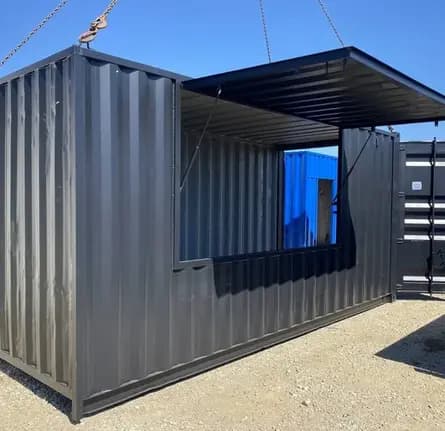
Let's talk about concrete uses. The first is construction site storage. A 10ft High Cube container can be placed in a yard, on land at a property boundary, or on a small platform. It serves as an equipment room, a depot for tools, consumables, PPE, spare parts. Its height allows vertical storage of items you don't want on the ground: ladders, props, profiles, light gantries. The second use is the site office or welfare unit. A 10ft is compact but sufficient to fit out a workstation, a changing room or a break room, provided insulation, electricity and ventilation are installed, which are not included as standard. The third use is industrial and logistics storage: raw materials, bulky parts, consumables, archives. The fourth, more recent use, is modular housing and fit-out: garden micro-office, technical room, workshop, site studio, improved site cabin. The 10ft High Cube format is particularly sought after in this context, as it offers a usable ceiling height for interior fit-out while remaining transportable without exceptional convoy in most configurations.
On fit-out, a few points of caution. A raw shipping container is not insulated: in summer, the sheet metal heats up and the interior temperature can rise sharply; in winter, it drops quickly. For regular use, insulation (rigid panels, sprayed foam, mineral wool with vapour barrier) and ventilation, or even air conditioning or heating depending on use, must be provided. The wooden floor can be covered with a suitable coating if you want a floor that is easier to clean or more comfortable. The corrugated interior walls make installing partitions difficult: prefer added frames fixed into the corrugations or rails, rather than through-fixings that would pierce the sheet metal and create corrosion points. Finally, any cut-out (window, door, duct passage) must be carefully treated: protected edges, suitable sealant, reinforcements if the cut-out affects a structural upright. A poorly executed cut-out is the leading cause of leaks and rust on a fitted-out container.
Now let's look at maintenance. A shipping container requires little, but it does require some. The roof must be inspected regularly, as it is the area where water stagnates most easily: leaves, moss and debris must be removed to prevent moisture from accumulating and eventually attacking the welds. Side walls are cleaned with water and neutral soap; avoid overly powerful pressure washers on seals and weld areas. Superficial rust spots should be treated early: brushing, application of a rust-inhibiting primer then a suitable topcoat. The earlier you intervene, the simpler and more durable the repair. Hinges, locking bars and cams should be lubricated once or twice a year, especially in humid or saline environments. Door seals should be visually checked and replaced if cracked or crushed. Finally, if the container remains unused for a long time, it is advisable to leave slight ventilation or a moisture absorber inside to prevent condensation and odours.
A word on regulations and transport in France, as this is often where projects get complicated. A shipping container is a potential oversized load depending on how it is transported. On a container chassis, it travels as a standard road combination if dimensions and weight remain within the limits of the highway code. The width of 2.43 m remains within the authorized width of 2.55 m for a refrigerated vehicle or a given combination, but the overall width of the convoy must be checked. The container length, around 3 m, fits easily on a suitable chassis. The height, as mentioned, is the critical point with High Cube: the 4 m limit must be respected, and any excess requires an exceptional transport permit, with a validated route and possible escort. For handling, using a mobile crane or a crane truck is common for home delivery, as the container must be placed, not just dropped on the ground. It is prudent to provide sufficient manoeuvring space and to check the load-bearing capacity of the ground at the placement point. Finally, if the container is intended to be placed on public land or used as a dwelling, you should contact the town hall: local planning rules may govern the location, duration and appearance of structures, even light and demountable ones.
Let's turn to points to watch when buying, as this is where long-term satisfaction is decided. A new container and a used container are not compared in the same way. On a new one, mainly conformity is checked: no impacts, seals in good condition, floor without splinters, uniform paint, legible markings. On a used one, inspection is more thorough: examine the roof for patches and perforating rust, test watertightness with light (close the doors and look for daylight points), check the floor (soft spots, delamination, moisture marks), check the operation of locking bars and door alignment. A container that has travelled may have undergone significant stresses: deformation of the base or uprights can compromise stacking and watertightness. It is therefore useful to request recent photos, or even a visit, and to ask specific questions about the history: previous use, year of manufacture, last inspection. For simple storage use, a used container in good condition may suffice; for fit-out or long-term installation, a new or very good condition one is preferable.
Another point: ISO certification. It certifies that the container complies with the dimensional, strength and marking standards defined by ISO, in particular ISO 668 for dimensions and ISO 1496 for tests and characteristics. This conformity is important for stacking, lifting and transport. However, it does not mean the container is suitable for all uses: a container certified for maritime transport is not automatically compliant with building regulations for housing, which fall under other frameworks. A distinction must therefore be made between maritime certification, which covers handling and transport, and the requirements specific to fit-out.
The 10ft High Cube format also has limits you should know. Its short length makes it less standard than the 20 or 40ft: it is less common, which can affect availability and choice on the used market. Its volume remains modest: 18 m³ is useful, but it is not a large storage space. For large volumes, a 20ft remains more economical per cubic metre. Finally, the High Cube height can be a drawback in low-ceiling sites, underground car parks, passages under structures or yards closed by a porch. Before buying, it is therefore essential to measure access: gate width, porch height, crane turning radius, drop-off space.
On durability, a well-maintained shipping container can serve for several decades in static storage use. Factors that reduce its lifespan are stagnant moisture, salt, repeated impacts and lack of maintenance. Conversely, a container placed on pads, ventilated, inspected once or twice a year and treated at the first signs of rust lasts a very long time. The wooden floor can be replaced if necessary, but the operation is heavier than simply replacing a seal.
In summary, the 10ft High Cube shipping container is aimed at those who need vertical volume in a constrained floor space. It is suitable for storing tall equipment, site offices, technical rooms, workshops or light fit-out. It is transported and placed with suitable means, provided the convoy height and ground load-bearing capacity are checked. It requires simple but real maintenance, and particular attention to seals, roof and rust spots. It is a robust, durable and functional product, whose value largely depends on the quality of the inspection at purchase and the care taken during installation.