Description
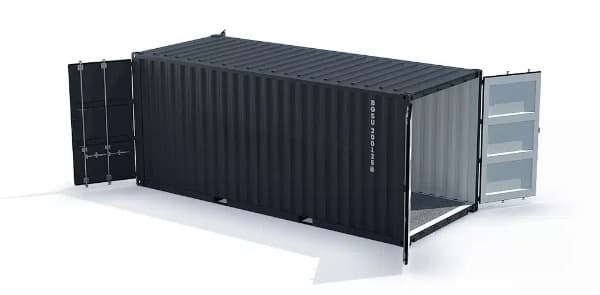
The 20 ft dry double door shipping container is a variant of the standard dry container that stands out for a simple but decisive feature: it has doors at both ends. This configuration concretely changes the organization of flows inside the container, since it allows entering from one side and exiting from the other, without having to move already stored goods to reach those at the back. For professionals handling large volumes or varied references, this time saving is repeated with every rotation.
Let's start with the structure. This container is made of Corten steel, a low-alloy steel whose chemical composition allows it to develop a protective oxide layer on the surface that slows corrosion. This has been the standard material for shipping container construction for decades, and it largely explains the longevity of these boxes when properly maintained. The walls, roof and posts are made of profiled sheet metal, which gives the whole a high rigidity while remaining compatible with transport weight constraints. The floor is 28 mm marine plywood, a dense and moisture-resistant panel, fixed on metal cross members. This floor easily supports rolling loads such as pallet trucks or forklifts, provided load limits are respected and heavy masses are distributed.
The external dimensions are those of a standard 20 ft container: approximately 6.05 m long, 2.43 m wide and 2.59 m high. These dimensions correspond to the specifications of ISO 668, which defines the dimensions and tolerances of series 1 containers. The width and attachment points (corner castings) comply with ISO 1496-1, which guarantees compatibility with gantry spreaders, road chassis twist-locks and container wagons. The stated tare weight is 2,180 kg, a consistent value for a 20 ft dry equipped with a second door, slightly higher than a single-opening model due to the additional structure and hardware. The useful internal volume is approximately 33 m³.
The double door is the element that deserves the most attention. Each end is equipped with two leaves, with the usual locks, handles and locking bars of shipping containers. These doors are hinged and open outward. The peripheral sealing gasket, generally made of EPDM, ensures watertightness and limits air and dust ingress when the doors are properly locked. However, it should be kept in mind that a shipping container is not a strictly airtight enclosure: it protects from rain and splashes, but it does not prevent condensation related to temperature variations, especially if the container is exposed to the sun or used to store moisture-sensitive materials. Adding a moisture absorber or suitable ventilation is often useful in this type of use.
Logistically, the double opening offers interesting possibilities. In a warehouse, it allows creating a through flow: pallets are loaded from one side with a forklift and retrieved from the other, which avoids back-and-forth movements and reduces downtime. On a construction site, it gives access to equipment and tools from both ends, which is practical when the container is positioned against a wall or in a space where rear access is partially obstructed. For industrial use, it facilitates modular storage and interior layout, for example installing through racking or a work station with separate entry and exit. In retail, it can serve as a storage reserve with two service points, or as a sales area fitted with an opening on the customer side and another on the replenishment side.
The double door dry container also lends itself to less conventional uses. In modular housing or as a site office, the second opening provides natural light and improves through ventilation, provided the necessary fittings are planned: insulation, electricity, joinery, wall treatment. It must then be taken into account that steel walls are conductive and that condensation can be a sensitive point if insulation is poorly designed. For a workshop, technical room or tool storage space, the double door simplifies organization and allows separating areas without partitioning.
When purchasing, several points must be checked. First, the general condition of the structure: presence of perforating rust on the roof, walls or floor, deformation of posts, condition of corner welds. Then the condition of the doors: alignment of leaves, operation of locks and locking bars, condition of gaskets, hinge play. A container whose doors close poorly quickly loses its watertightness and becomes difficult to secure. The floor must be inspected over its entire surface: looking for soft spots, delamination, traces of persistent moisture or mold. The corner castings must be intact, without cracks or deformation, because they bear the stresses during handling. Finally, the presence of a CSC (Convention for Safe Containers) plate and an identification plate is a good indicator of traceability, even if these plates may be missing or outdated on used containers.
French and European regulations govern container transport. On the road, a 20 ft container is transported on a suitable container chassis with twist-locks. The authorized gross vehicle weight depends on the vehicle and load; in France, the maximum authorized mass of a road train is generally 44 tonnes for combined transport, with specific rules depending on configurations. Maritime transport is governed by the SOLAS convention and IMO rules, particularly regarding verified gross mass (VGM) before loading. Rail transport uses container wagons compatible with the same attachment points. For private use, the container is considered movable property or a construction depending on its installation; ground anchoring and a declaration may be required depending on the municipality's local urban plan.
Maintaining a double door container is not fundamentally different from maintaining a standard container. It consists of regularly inspecting sensitive points: roof, door perimeter, lower walls, floor. Small paint touch-ups on scratched areas limit the progression of corrosion. Door gaskets are cleaned and replaced when they harden or tear. Locks and hinges are periodically lubricated to remain operable. If the container is stored on grassy or wet ground, it is prudent to place it on beams or blocks to prevent the bottom of the frame from remaining in permanent contact with water. Pressure washing and complete drying before closing prevent trapping moisture inside.
The price of this 20 ft dry double door container is indicated at 2,020 euros. This positioning corresponds to a new or very good condition model, the double door representing a specific manufacturing compared to the standard dry container. As a reference, a used single 20 ft dry often falls in a lower range, while a new single-door model approaches this range. The price may vary depending on condition, availability, delivery location and options. Delivery is offered in France, as well as in Belgium, Luxembourg, Germany and Spain. For a quote or additional information, the contact indicated is contact@vente-de-conteneur.com.
To go further on maintenance, it is useful to distinguish two situations: a container used statically, placed on the ground on a site, and a container that travels regularly. In the first case, exposure to weather and ground moisture is the main aging factor. The roof, in particular, accumulates leaves, dust and sometimes pockets of stagnant water if the surface is slightly sagging; annual cleaning and checking water drainage prevent corrosion from setting in. The lower walls, in contact with splashes, require similar attention. In the second case, handling impacts and wear of moving parts dominate: hinges, locks, gaskets. Regular greasing and checking clearances after each rotation significantly extend the life of the doors, which remain the most fragile component of a container.
From a regulatory standpoint, the CSC convention, which entered into force under the auspices of the International Maritime Organization, must also be mentioned. It requires that any container used in international transport bear an approval plate certifying that it has been inspected and found compliant with structural safety requirements. This plate includes the manufacturing date, identification number, maximum load and date of the next periodic examination. For purely land or private use, this obligation does not apply in the same way, but the presence of an up-to-date CSC plate remains a useful indicator of the container's condition and history. In France, using a container as premises or as a construction may fall under urban planning law depending on its nature, duration of installation and anchoring; it is recommended to inquire with the town hall before any permanent installation.
Another practical aspect concerns transport itself. A 20 ft double door container is handled with the same equipment as a standard container: forklift equipped with a spreader or suitable forks, mobile crane, gantry. The tare weight of 2,180 kg must be taken into account when calculating the vehicle's payload. On a truck, a 20 ft generally occupies the front position of a container chassis and is secured by four twist-locks. Rail and sea transport use the same attachment points. This interchangeability is one of the great advantages of ISO standardization: a container purchased for static use can, if needed, be shipped by sea or rail without special adaptation, provided it is in travel condition and its CSC plate is valid.
To choose between a single 20 ft and a double door 20 ft, the determining criterion is the nature of the flow. If goods enter and exit through the same point, a single-door container is sufficient and generally costs less. If flows are through, if the space around the container is constrained, or if one wants to physically separate a loading area and a picking area, the double door provides operational comfort that justifies the price difference and the slight extra weight. Compared to a 40 ft, the 20 ft remains more maneuverable, easier to move and to place on a small site; it is better suited to dense loads and urban sites. Compared to a high cube, it offers lower internal height, but remains compatible with most road gauges without the additional height constraints that an HC can pose on certain routes or under certain structures.
Finally, for sector-specific uses, a few concrete examples can be cited. In agri-food, a double door container can serve as a buffer storage area between receiving and shipping, with a one-way flow that limits crossings. In construction, it becomes a site base with tool access on one side and consumables access on the other. In events, it can be fitted out as a control room or technical room with two separate accesses. In crafts and small industries, it serves as a workshop or reserve with a materials entrance and a finished products exit. These examples illustrate the same logic: the double door is not a gadget, it is a response to a flow organization problem, and that is where it provides the most value.
In summary, the 20 ft dry double door shipping container is a versatile tool that combines the robustness and standardization of the shipping container with superior ergonomics thanks to its two openings. It suits professionals in logistics, construction, industry and retail, as well as individuals looking for a durable storage or fitting solution. Its use value rests on simple principles: a proven structure, standardized dimensions, multimodal compatibility and improved accessibility. Before purchase, a methodical inspection and reflection on actual use help avoid unpleasant surprises and make the most of this model.