Description
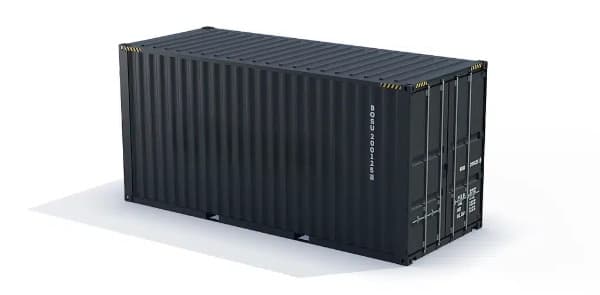
The 20ft High Cube shipping container is a variant of the standard dry container with an exterior height about 30 cm greater. This difference, which may seem modest, concretely changes the game when it comes to loading tall pallets, machinery, tubular elements or goods whose dimensions rule out the use of a classic 20ft. With an exterior height of 2.59 m and an overall length of 6.05 m for a width of 2.43 m, it keeps exactly the same footprint as a standard 20ft while offering an interior volume of about 37 m³. It is this combination — same footprint, more volume — that makes it a frequent choice in logistics, on construction sites and in fit-out projects.
To fully understand the appeal of this model, one must return to the ISO 668 standard, which defines the dimensions and masses of series 1 containers. A standard 20ft (often called 20' DC for Dry Container) has an exterior height of 8 feet 6 inches, i.e. 2.59 m. The High Cube, for its part, is a 20ft whose exterior height reaches 9 feet 6 inches, i.e. about 2.89 m. The length and width remain identical, which means that the handling points, lifting corners and floor securing grooves are positioned in the same way. A forklift, reach stacker or crane equipped for a 20ft will therefore handle a High Cube without any particular adaptation. This compatibility is a major operational advantage: no need for specific equipment, no additional training for teams, no modification of loading plans or storage areas.
The container structure is based on a Corten steel frame, a low-alloy steel that resists atmospheric corrosion thanks to the formation of a protective oxide layer on the surface. The side walls and roof panels are made of corrugated sheet metal, generally 1.6 to 2 mm thick depending on the areas. The floor is made of 28 mm marine plywood, a panel made of wood plies bonded with phenolic resin, designed to support rolling loads and resist moisture. The bottom cross members, which support this floor, are spaced so as to distribute point loads. The rear doors are double swing doors equipped with container locks (the famous locking bars with handles and locking cams), rubber seals and sealing devices. These doors are designed to open to about 270 degrees, which facilitates loading and unloading, including with a forklift.
Watertightness is a crucial point. A shipping container is designed to withstand ocean transport: spray, rain, temperature and humidity variations. Door seals, continuous welds and surface treatment (epoxy or polyurethane paint on Corten steel) provide protection against infiltration. This does not mean, however, that a container is airtight or impervious to residual moisture: when transporting sensitive goods, it is common to use desiccant bags or passive ventilation systems. For long-term storage use, minimal ventilation may be necessary to avoid condensation, especially if the container is exposed to large temperature variations.
The interior volume of about 37 m³ deserves comparison with that of a standard 20ft, which is around 33 m³. The gain of 4 m³ may seem marginal, but it represents, for example, the possibility of loading an additional row of tall pallets or housing equipment that does not fit under a 2.39 m ceiling. The interior height of the High Cube is around 2.69 m, compared with 2.39 m for a standard. This 30 cm difference is often decisive for transporting machine tools, street furniture, tubes, profiles or goods palletized on two levels.
In terms of transport, the 20ft High Cube is subject to the same rules as other series 1 containers. On the road, in France, transporting a 20ft container is generally done on a container chassis towed by a heavy goods vehicle. The total gross mass (container + goods) must not exceed the regulatory limits of the vehicle and the road train, i.e. 44 tonnes for a 5-axle combination in combined transport, or 40 tonnes for a standard combination. The container itself weighs about 2,100 kg empty, which leaves a comfortable payload capacity, often above 25 tonnes depending on the model. It is essential to check the container identification plate (CSC plate), which indicates the maximum gross mass, tare and authorized payload. This plate, affixed by the manufacturer, is mandatory for sea and land transport.
For lifting, the four upper and lower lifting corners comply with ISO 1161. They allow slinging with standard hooks or spreaders. Stacking is possible: a High Cube container can be stacked on another container, provided the load limits and stability rules are respected. In port environments, containers are often stacked on several levels, but for private use, it is prudent not to exceed two or three levels and to ensure that the ground or platform supports the load. A loaded 20ft High Cube container can weigh more than 30 tonnes; the ground must be sized accordingly.
Buying a new or used shipping container deserves particular attention. A new container, such as this one, is generally delivered with a manufacturing warranty and fresh paint. It is recommended to check for the absence of major impacts on the walls, the flatness of the floor, the condition of the door seals and the proper functioning of the locks. For storage use, a used container may suffice, but corrosion must then be examined, particularly at the bottom cross members and corners. Preventive anti-corrosion treatment can extend the service life. The new High Cube container is often prized for fit-out projects (site office, technical room, modular housing) because it offers a more comfortable ceiling height once insulated and fitted. Interior insulation reduces the available space, but the additional height helps maintain an acceptable sense of volume.
Routine maintenance consists of regularly cleaning the surface to avoid the accumulation of dirt that retains moisture, checking the door seals and greasing the locking mechanisms. In the event of a deep scratch, a paint touch-up is advisable to prevent corrosion. The marine plywood floor can be cleaned with soapy water; it should not be left soaked. If the container is used to store chemicals or waste, local regulations on storage areas and any containment requirements must be respected.
French regulations govern the installation of a container on private land. In general, a container is considered a construction if its floor area exceeds 5 m² and its height exceeds 1.80 m. It may therefore be subject to prior declaration of works, or even a building permit depending on the surface area and use. It is strongly recommended to inquire with the town planning department of the municipality before any installation. For temporary use on a construction site, derogations may exist. Furthermore, road transport of a container must comply with size rules: the total height of the combination (vehicle + container) must not exceed 4 metres to circulate without special authorization. A High Cube container on a low-bed chassis can reach this limit; routes and any level crossings or tunnels must therefore be checked.
The concrete uses of this container are numerous. In logistics, it allows goods palletized at a greater height to be transported, optimizing the number of pallets per shipment. In construction, it serves as a site store for tools, spare parts or sensitive materials. It can be fitted out as a site office with insulation, lighting and air conditioning. In industry, it becomes a technical room for compressors, generators or pumping systems. For events, it can be transformed into a stand, control room or temporary storage space. Finally, in alternative housing projects, the High Cube is often chosen to build tiny houses or modular extensions, because its height allows a mezzanine or insulated ceiling to be integrated without excessive loss of volume.
It is important to note that this container is sold individually, at a price of EUR 1,910.00. This price corresponds to a new container, in Corten steel, with a 28 mm marine plywood floor and lockable double rear doors. The technical characteristics provided indicate ISO certification, which guarantees its compliance with international standards for dimensions and strength. The stated volume of 37 m³ is consistent with the typical interior dimensions of a 20ft High Cube. The empty weight of 2,100 kg is within the standard range for this type of container, which generally varies between 2,000 and 2,400 kg depending on manufacturers and equipment.
When purchasing, it is advisable to request the CSC plate and the certificate of conformity, especially if the container is to be used for sea transport. For land use only, these documents may not be essential, but they remain a guarantee of quality. The presence of the four lower and upper lifting corners should also be checked, as well as the condition of the door seals. A new container must be free of rust, dents and repairs. If repairs are visible, this may indicate a reconditioned used container, which is not necessarily a problem but must be reflected in the price.
To complete this presentation, it is useful to address long-term maintenance and the specific points of vigilance for the High Cube. The additional height exposes the roof more to radiation and bad weather, which can accelerate the ageing of the paint on top. An annual visual inspection of the roof is recommended, particularly after episodes of hail or strong wind. The corrugations of the sheet metal can retain water if the container is placed on uneven ground; it is therefore necessary to ensure that the floor is level and that water does not stagnate on the roof. Door seals are wearing parts: they can harden over time and lose their elasticity. Replacing them is a simple and inexpensive operation that preserves watertightness. Door locks must be greased regularly, especially if the container is exposed to the seaside where salt air accelerates corrosion. In this case, rinsing with fresh water and wiping are beneficial.
Transport regulations deserve some additional clarification. In France, container transport is governed by the Highway Code and decrees relating to vehicle weights and dimensions. A road train consisting of a tractor and a container chassis must not exceed 16.50 m in length, 2.55 m in width and 4 m in height. The maximum authorized mass is 44 tonnes for a combination of 5 axles or more, in the context of combined rail-road transport, and 40 tonnes for a standard combination. These limits include the weight of the container and the goods. It is therefore imperative to know the gross mass of the loaded container and to verify that it remains within the limits. For exceptional convoys, special authorizations are required, with imposed routes and sometimes escorting by a pilot vehicle.
Sea transport, for its part, is governed by the SOLAS convention and the IMDG code for dangerous goods. A container must be stacked and secured according to IMO rules. The CSC plate certifies the container's compliance with safety standards. It must be checked before any loading onto a ship. For private use, these rules do not apply directly, but they constitute a good reference for assessing the quality and robustness of the container.
In sector-specific use cases, the 20ft High Cube finds its place in several fields. In the food industry, it can be used to store non-perishable goods, provided hygiene and ventilation rules are respected. In the pharmaceutical sector, it can be used as a temporary storage room, but requires insulation and temperature control. In retail, it becomes a mobile reserve for peak periods. In events, it is often transformed into a bar, ticket office or technical room. In construction, it is frequently used as a living base or workshop. Finally, in housing, it can be fitted out as a studio, office or spare bedroom, subject to obtaining the necessary planning permissions.
Let us now compare the 20ft High Cube with other container sizes and types. The standard 20ft (Dry) has an exterior height of 2.59 m and a volume of about 33 m³. The standard 40ft offers a volume of about 67 m³, but requires a longer chassis and more manoeuvring space. The 40ft High Cube goes up to about 76 m³, with an exterior height of 2.89 m. The 20ft High Cube therefore sits as a compromise: more volume than a standard 20, but less bulky than a 40ft. It is particularly suited to heavy and compact loads, because it allows high masses to be reached without exceeding the load limits of the chassis. The 20ft is often preferred for transporting dense goods (machinery, metals, chemicals) because its payload capacity is high relative to its volume. The 40ft, on the other hand, is more used for light and bulky goods.
There are also specialized containers: the reefer (refrigerated) for perishable goods, the open top for out-of-gauge loads requiring top loading, the flat rack for very wide or very tall loads without side walls, and the tank container for liquids. The 20ft High Cube dry, the subject of this sheet, does not have a refrigeration system or roof opening. It is therefore reserved for dry goods and uses requiring a closed and secure enclosure.
Finally, it should be emphasized that the choice of a container depends on the intended use. For storage on private land, a 20ft High Cube offers a good volume-to-footprint ratio. For conversion into an office or housing, the additional height is an asset. For sea transport, it is important to check the availability of ships accepting 20ft High Cubes, because not all ports handle this type of container in the same way. In general, 20ft High Cubes are accepted on most lines, but it is prudent to inquire with the carrier.
In summary, the 20ft High Cube shipping container is a versatile solution that combines the ground-level compactness of a 20ft with a larger interior volume. Its Corten steel construction, marine plywood floor and ISO compliance make it a robust product for transport, storage and fit-out. Whether for professional or personal use, the regulatory aspects, delivery conditions and condition of the container should be checked before purchase. This model is particularly suited to bulky loads and projects requiring a comfortable interior height. With regular maintenance and proper use, it can serve for many years.