Description
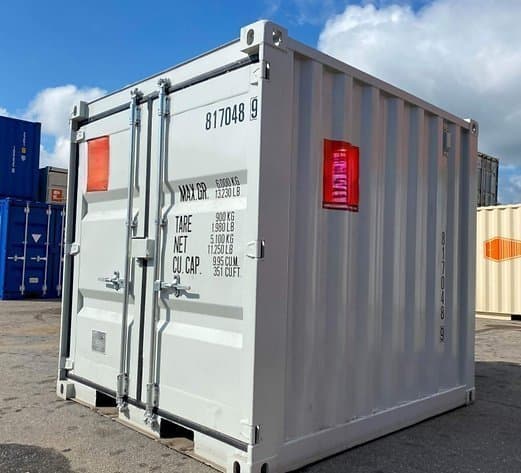
The brand new 8-foot shipping container is a compact and robust unit, designed to intermodal transport standards. Its small size makes it a practical solution for professionals and individuals alike who lack space or are looking for a movable storage unit. This container is of the Dry Cargo (DC) type, meaning it is intended for the transport and storage of dry goods, protected from moisture and bad weather. It has no refrigeration unit or specific ventilation system, which sets it apart from reefer containers. Its structure is made of Corten steel, a low-alloy steel that resists atmospheric corrosion well thanks to the formation of a protective surface layer. This feature allows it to withstand marine environments and outdoor conditions over long periods, provided minimal maintenance is carried out.
In terms of dimensions, this 8-foot container has external measurements of 2,438 mm in length, 2,134 mm in width and 2,200 mm in height. These dimensions are slightly larger than those of a standard ISO 1D container (which generally measures 2,438 mm x 2,438 mm x 2,438 mm for a 10-foot unit, but the 8-foot is a less common size, often produced for specific uses). Inside, the usable space is 2,300 mm long, 2,100 mm wide and 2,130 mm high, offering an internal volume of approximately 10.6 cubic metres (374 cubic feet). These dimensions allow you to store pallets, tools, equipment or various goods, while remaining compatible with transport by truck or trailer. The door opening, with a width of 2,100 mm and a height of 2,032 mm, makes it easier to pass bulky items, provided you check that their height does not exceed this limit.
The tare weight of this container is approximately 1,300 kg (2,866 lbs), which makes it manoeuvrable by standard lifting equipment, such as a forklift fitted with forks or a truck-mounted crane. The maximum gross weight (MGW) is approximately 10,000 kg (22,046 lbs), meaning you can store up to 8,700 kg of goods in it, while respecting the total loaded weight limit. This capacity is sufficient for most domestic or professional storage needs, but it remains lower than that of a 20-foot container, which can support a much greater payload. It is therefore important to match the choice of container to the volume and weight of the goods to be stored.
This new container is delivered without any specific interior fittings. Its internal walls are made of steel, generally coated with protective paint. The floor is made of hardwood, often marine plywood or treated pine boards, which provides a resistant and non-slip surface. This floor can support rolling loads, but it is advisable to distribute heavy weights to avoid marking the wood. The doors are fitted with rubber seals and cam locks, ensuring a hermetic closure. Like any shipping container, it is designed to be stackable and liftable by its corner castings to ISO standards. These corner castings are welded to the ends and allow securing on a ship, train or truck. Even if you do not plan to ship it by sea, these anchor points are useful for lifting and securing to the ground.
The most common use of this 8-foot container is on-site storage. Whether for a construction site, a business, a farm or private property, it offers a secure and durable solution for storing tools, materials, equipment or archives. Its compact size allows it to be installed in restricted spaces, where a 20-foot container would not fit. It can also serve as a mobile site office, after basic conversion (insulation, electricity, ventilation). Many construction professionals use this type of container as a site welfare unit or technical room. For residential use, it can become a garden shed, a workshop or a storage room, provided local planning rules are respected. In France, for example, installing a container on private land may be subject to authorisation depending on its surface area and how long it is to remain in place. It is recommended to check with the local town hall before any permanent installation.
Another possible use is the transport of goods. Although the 8-foot container is less standard than 20 or 40-foot units, it can be shipped by truck, train or boat, provided suitable handling equipment is available. Its internal volume of 10.6 m³ allows you to load around 5 to 6 Euro pallets (1200 x 800 mm) on the floor, depending on how they are arranged. For a house move or a group shipment, it is an interesting alternative to a full truck. However, you must check size and weight restrictions with the carrier, as this type of container may not be accepted on all regular shipping lines. For road transport in France, the total weight of the loaded container must not exceed the legal limits of the carrying vehicle (generally 44 tonnes for a road train). The container itself, once loaded, can be secured on a container trailer or a suitable chassis.
When buying a new container, several points deserve your attention. First, check that the container is indeed new and not reconditioned. A new container has uniform paint, no traces of rust, and supple door seals. Welds should be regular and non-porous. The floor should be clean, with no splinters or damp stains. Next, make sure the container complies with current ISO standards, in particular ISO 668 for dimensions and loads, and ISO 1496 for technical specifications. A new container must be accompanied by a certificate of conformity (CSC - Convention for Safe Containers) to be used in international transport. This certificate confirms that the container has successfully passed strength and safety tests. If you are buying for land use only, the CSC certificate is not mandatory, but it remains a mark of quality.
Another important point is the origin of the container. New containers are often manufactured in Asia and imported. Some models may be made in Europe, but this remains rarer for non-standard sizes. The quality of the steel and paint can vary depending on the manufacturer. A new container should be protected by epoxy or polyurethane paint, applied in several coats, to resist corrosion. Check that the paint is not flaking and that it covers the welds well. The roof should be slightly curved to drain rainwater. The doors should open and close without forcing, with a functional clearance allowing for thermal expansion.
In terms of maintenance, a Corten steel container requires little care. It is advisable to clean it once or twice a year with a hose and a mild detergent to remove salt, dust and pollution deposits. Avoid overly powerful pressure washers that could damage the seals. Regularly inspect the door seals and replace them if they are cracked or hardened. Check for rust spots, especially around welds and corners. A small touch-up with anti-rust paint may be enough to stop corrosion. If the container is exposed to a very humid or salty environment, additional treatment may be considered. For long-term storage use, it is recommended to raise the container on blocks or beams to avoid direct contact with the ground, which limits moisture and corrosion from below. Even simple internal ventilation helps prevent condensation, especially if you store materials sensitive to humidity. You can add moisture absorbers or a small dehumidifier if necessary.
Regarding French regulations, installing a container on private land may be considered a construction. Under the French planning code, a prior declaration of works is often required for a floor area between 5 and 20 m². Above 20 m², a building permit may be required. The floor area of an 8-foot container is approximately 5.1 m² (2.438 m x 2.134 m), which generally places it below the prior declaration threshold, but it is always prudent to check with your local town hall. If the container is intended for temporary use (less than 3 months), the rules may be different. Furthermore, if you install the container in a protected area (listed site, surroundings of a historic monument), specific authorisations may apply. Finally, if you use the container as a workplace, you must comply with health and safety rules (ventilation, lighting, emergency exits) under the French labour code.
For transport, if you buy this container from a supplier in Marseille, it can be delivered by truck with a lifting arm or a forklift. Delivery requires suitable access: a container truck needs manoeuvring space and stable ground. Allow sufficient unloading space and check that the weight of the loaded truck is compatible with the road. The container can be placed directly on the ground or on blocks. If you need to move it later, you can call on a specialist carrier equipped with a truck-mounted crane. The transport cost depends on the distance and the handling equipment required. It is advisable to obtain several quotes and check that the carrier is insured for this type of goods.
In summary, the brand new 8-foot shipping container is a versatile, robust and compact product. It is suitable for many uses: storage, office, workshop, technical room, transport. Its reduced dimensions allow it to fit into spaces where a standard container would not. Its Corten steel and new construction guarantee a long service life with limited maintenance. Before buying, check conformity, general condition and installation authorisations. For professional use, make sure the container meets the requirements of your activity. For personal use, assess your volume and weight needs to choose the right size. Do not hesitate to ask the seller for detailed photos and a certificate of conformity. A new container is a durable investment that can be amortised over several years, or even resold at a good price if you take care of it.
To complete this presentation, it is useful to examine sector-specific use cases in more detail. In the construction sector, this 8-foot container is useful as a storage room for power tools, small equipment, consumables (screws, plugs, paint) or spare parts. Its reduced size allows it to be positioned as close as possible to work areas, reducing travel for teams. It can also serve as a break room for workers, with the addition of a bench, a table and a power supply. In agriculture and market gardening, it becomes a shelter for seeds, fertilisers, plant protection products (provided the rules for storing chemicals are respected) or a room for gardening tools. Vineyard or orchard operators can store their small pruning and harvesting equipment there. In retail, it can act as a nearby storeroom for a shop, restaurant or convenience store, especially if indoor space is limited. Tradespeople (plumbers, electricians, carpenters) see it as a way to secure their tools on a site or in their yard. Finally, for individuals, it is a better alternative to a traditional garden shed, with a much longer lifespan and better resistance to intrusion, provided a good-quality padlock is added to the locks.
Let us now compare this 8-foot container with other sizes and types. A 10-foot container, also called a 1D container, is more common and slightly longer (about 3 metres), offering an internal volume of approximately 15 m³. It is often used for site storage or as a technical room. A 20-foot container (1C) is the most common standard: it measures about 6 metres long, offers a volume of approximately 33 m³ and can support a payload of 25 to 28 tonnes. It is ideal for sea transport and storage of large volumes. A 40-foot container (1A) doubles this length and offers around 67 m³. The 8-foot container is therefore at the bottom of the scale, but it retains the advantage of compactness and reduced weight, which makes it easier to handle and transport on small trailers. In terms of types, Dry Cargo is the simplest and most economical. The reefer container (refrigerated) is equipped with a refrigeration unit and allows the transport of perishable goods, but it costs much more and requires a power supply. The open top container has a removable roof for loading tall objects, while the flat rack has no side walls and is used for transporting heavy or bulky loads. The high cube (HC) container is a variant of Dry Cargo with an internal height about 30 cm greater, useful for gaining volume without increasing the footprint. For a simple storage need, the 8-foot Dry Cargo remains the most rational and most affordable choice.
Let us now address transport-specific regulations. In France, road transport of containers is governed by the Highway Code and the Transport Code. An 8-foot container can be transported on a container truck or a trailer fitted with a chassis. The authorised gross train weight (GTW) must not exceed 44 tonnes for a road train with more than 4 axles. The container itself, with its maximum load of 10 tonnes, can therefore be transported without problem by a standard heavy goods vehicle, provided the vehicle complies with axle load limits. For exceptional transports, a prefectural authorisation may be necessary if the dimensions exceed the regulatory limits (width 2.55 m, height 4 m). Here, the width of 2.134 m and the height of 2.20 m remain within the standards, so no special authorisation is required for the container alone. If you ship the container by sea, it must be accompanied by a valid CSC certificate and an identification plate (CSC plate) fixed to the door. This plate indicates the identification number, tare weight, payload and date of the last examination. For rail transport, the container must comply with the standards of the International Union of Railways (UIC). Finally, for export outside the European Union, customs formalities are required, including an export declaration and, where applicable, a certificate of origin.
A final practical aspect concerns interior conversion. If you wish to transform this container into an office, workshop or living space, several steps are required. First, thermal and acoustic insulation: you can use rock wool or extruded polystyrene panels, covered with plywood or panelling. Next, electricity: it is necessary to drill a sheathed cable entry and install an electrical panel to NF C 15-100 standards. For water, if you plan a water point, you need to provide a supply and drainage, which may require groundwork. Ventilation is essential to avoid condensation: a high ventilation grille and a low one allow natural air circulation. Finally, heating can be provided by an electric radiator or a wood stove, provided fire safety rules are respected. This work must be carried out by qualified professionals to guarantee compliance and safety. Before undertaking any work, check local planning rules and any co-ownership restrictions. A converted container can become a functional and comfortable space, but it requires careful preparation to avoid thermal bridges, damp and electrical problems.